
Summaries: A B C D E-I J-K L-M N O P Q-R S T-V W X-Z
Ababco – An eastern Algonquian tribe or sub-tribe, this group initially lived on the Choptank River in Maryland when first encountered by Europeans. Thomas Bacon first mentioned them in his Laws of Maryland, published in 1765, as connected with the Hutsawap and Tequassimoe as distinct tribes; however, later historians believed them to be a division of the Choptank. They were not mentioned in John Smith’s documents of his exploration of the Chesapeake Bay in the early 1600s. By 1837, the entire tribe had dwindled to a few individuals of mixed Indian and African blood.
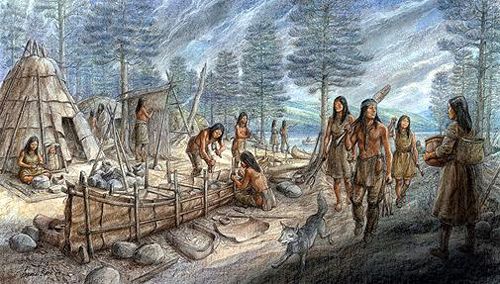
Abenaki Village.
Abenaki (or Abnaki) – Pronounced OBB-uh-nah-kee, the name means “people of the dawn.” The Abenaki were a linguistic and geographic grouping rather than a single tribe. Their homeland, which they called Ndakinna, meaning “our land,” extended across most of northern New England, southern Quebec, and the southern Canadian Maritimes.
Aberginian – A collective term used by the early settlers on Massachusetts Bay for the tribes to the north. They were described in 1654 as consisting of the Massachusett, Wippanap, and Tarratine tribes. The name may be a corruption of Abnaki or a misspelling for “aborigines.” The Wippanap were the Abenaki, while the Tarratine were the same Indians or a part of them.
Abihka – Abihka was one of the four mother towns of the Muscogee Creek Confederacy. Abihka is also used to refer to all Upper Creek (or Muscogee) people. The Abihka were the remnants of the 16th century “Chiefdom of Coosa,” a powerful Native American chiefdom in Georgia. Their principal residence was along the banks of the Coosa and Alabama Rivers in what is now Talladega County, Alabama. Most of the Natchez people settled with the Abihka after being dispersed by the French in the 18th century. After their removal to the Indian Territory, Abihka refugees established a ceremonial stomp dance ground near Henryetta, Oklahoma.
Abittibi – A little-known Algonquin band whose habitat has been the shores of Abittibi Lake in Ontario, Canada. The first recorded notice of them is in the Jesuit Relations for 1640. In the Jesuit Relations of 1660, the Iroquois warred upon them and two other tribes of the same area. The French explorer Daniel Greysolon Sieur du Lhut included them in a list of nations living north of Lake Superior in 1684. In 1736, they were estimated to have 140 warriors living with the Tětes de Boule. Their totems were the partridge and the eagle. The Canadian Indian Office reported them to number 450 in 1878, after which date they are not officially mentioned.
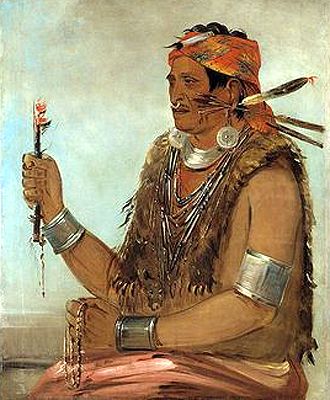
Absentee-Shawnee Indian.
Absentee Shawnee – The Absentee is a division of the Shawnee tribe that originally lived in the eastern United States, in Ohio, Indiana, Illinois, Kentucky, Tennessee, Pennsylvania, and other neighboring states. These Algonquian-speaking people traveled widely through lands from Canada to Florida and from the Mississippi River to the eastern continental coast. Today, they are one of three Shawnee tribes in Oklahoma.
Accohanoc – A tribe of the Powhatan Confederacy, they formerly lived on the river of the same name in Accomac and Northampton Counties of Virginia. In 1608, they were described as having 40 warriors. Later, they became mixed with African Americans, and what was left of them was driven off during the Nat Turner insurrection in about 1833.
Accominta/Agamenticus – The Accominta people, also known as Agamenticus, were a small tribe or band of the Pennacook Confederacy. They first occupied a village of the same name at or near the site of present-day York, Maine, to which the name “Boston” was given on some early maps.

Achumawi Indian Woman.
Achumawi – A division of the Shastan family, they formerly occupied the Pit River country of northeast California, except for the Burney, Dixie, and Hat Creek Valleys, which the Atsugewi inhabited. They had a principal village near Fallriver Mills in Shasta County. While unquestionably related, the Achumawi and the Atsugewi languages are strikingly different. The term Achumawi was also used by some historically by all the Pit River Indians.
Achiligonan – A tribe or band who, between 1640 and 1670, was living on the north shore of Lake Huron, about the mouth of French River and westward
Acolapissa – Of Choctaw lineage, this band formerly lived on Lake Ponchartrain, about the coastal lagoons, and on the Mississippi River in Louisiana. Early French writers derived the name from the Choctaw káklo pisa, meaning “those who listen and see.” The name appears to have been used by an early author, including several tribes, such as the Bayogoula, Mugniasha, and others. They were said to have had six or seven different villages but suffered severely from an epidemic in about 1700. They later settled north of New Orleans, and what was left of them was absorbed into the Houma tribe.
Acquintanacsnak – The Acquintanacsnak people were a tribe or sub-tribe that English explorer Captain John Smith encountered living on the west bank of Patuxent River in present-day St Mary’s County, Maryland.
Acuera – The Acuera tribe was part of the Timucuan linguistic division of the Muscogean Family. They lived on the headwaters of the Ocklawaha River in Florida.
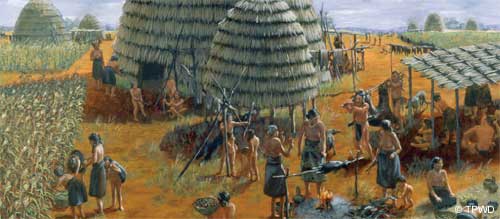
Caddo Village.
Adai – A tribe of the Caddo Confederacy, they were first encountered in 1529 by Cabeza de Vaca.
Adirondack – See Algonquin. The term “Adirondack” was a derogatory name that the Iroquois gave the Algonquin, which meant “they eat trees.”
Adena Culture – From about 1000 B.C. to about 1 A.D., the Adena people were a group of well-organized societies living in present-day Ohio, Indiana, Wisconsin, West Virginia, Kentucky, Pennsylvania, Maryland, and New York.
Adshusheer – A tribe associated with the Eno and Shakori in North Carolina in 1701. They were thought to have been located near present-day Durham, North Carolina. The Adshusheer were probably absorbed by one of the tribes with which they were associated.
Agawam (or Agawom) – A name of frequent occurrence in southern New England, Long Island, New York, and at least three villages or tribes in Massachusetts. The most important of these villages was located near present-day Ipswich, Massachusetts. However, the site was sold by the chief in 1638. This band was part of the Pennacook Confederacy and was almost extinct in 1658. However, as late as 1726, three families still lived near Wigwam Hill. The second tribe or band of that name had its chief town on Long Hill, near Springfield, Massachusetts. Springfield was sold in 1635, and the Indian town existed in 1675. This tribe was commonly classed with the Pacomtuc. The third was about Wareham, Massachusetts, the site of which was sold in 1655. It was probably subject to the Wampanoag but joined the plot against the English in 1621.
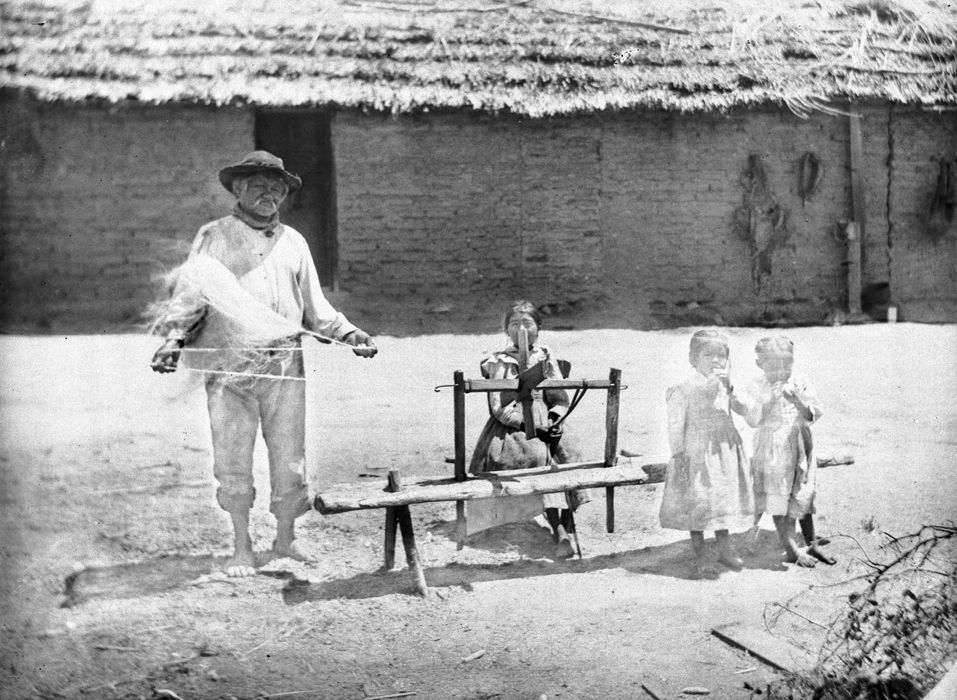
Agua Caliente Indians by George W. James, 1903.
Agua Caliente – The Agua Caliente people are a small Cahuilla division located at the San Luis Rey River headwaters in southern California.
Akonapi – A people mentioned in the ancient Walam Olum record of the Delaware, with whom they fought during their migrations. They have been identified with the Akowini of the same tradition, thinks it is probable that they lived immediately north of the Ohio River in Ohio or Indiana. He regards Akowini as a “correspondent” with Sinako and Towakon with Towako; the latter he identifies with the Ottawa, called by the Delaware Taway. If this identification is correct, the Akonapi were likely the Sinago branch of Ottawa.
Ais/Ays – A tribe who once inhabited the Atlantic Coast of Florida primarily lived in villages of what is now called the Indian River. Little is known of their language or origins. They were noted by Jonathan Dickinson, whose party had been shipwrecked in 1696. By this time, they had had considerable contact with Europeans and regarded the Spanish as friends but all others as enemies. They did not survive much longer as, after 1700, settlers in Carolina started raiding the Ais to capture slaves. By 1743, when the Spanish established a mission among them, the Ais numbers had declined dramatically because of slave raids and disease. They were gone from the area by 1760.
Alabama/Alibamu – A Muskogean tribe of the southern United States, the tribe lived primarily within the state that now bears their name. Along with other Muskogean-speaking tribes, the Creek, Hitchiti, and Coushatta formed the Creek Confederacy. The Alabama and their closely allied Coushatta migrated from Alabama and Mississippi to Texas in the late 18th century and early 19th century under pressure from white settlers. They essentially merged and shared reservation land. Although the tribe was terminated in the 1950s, it achieved federal recognition in 1987 as the Alabama-Coushatta Tribe of Texas. Today, Its 550 members have about 4,500 acres of reservation land.
Alchedoma – A former Yuman tribe found living in eight villages in 1604 by Juan de Onate, below the mouth of the Gila River on the Colorado River. Later, they lived along the Colorado River in Arizona and California, and were estimated to number about 2,500 people. They were allegedly enemies of the Mojave tribe and were absorbed by the Maricopa Indians, whom they joined before fleeing from the Mojave along the Colorado River.
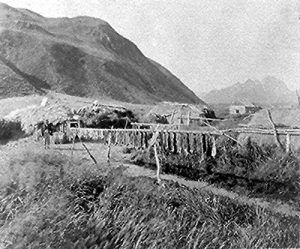
Aleut Village 1889.
Aleut – The indigenous people of the Aleutian Islands of Alaska and Kamchatka Krai, Russia. Though they called themselves Unangan, meaning “coastal people,” Russian fur traders called them Aleut in the mid-18th century. Before outside influence arrived, the Aleut were estimated to have numbered about 25,000. Violence and disease reduced them to only about 1,500 by 1910. In the 1970s, there were about 2,000 Aleuts who could claim at least 1/4 Aleut blood. Today, more than 1,000 people claim Aleut ancestry. While English and Russian are the dominant languages among Aleuts in the U.S. and Russia, respectively, several hundred people still speak Aleut.
Algonquian – One of the most populous and widespread Native American groups, these tribes consist of people who speak Algonquian languages.
Algonquin/Algonkin – The Algonquin people, sometimes spelled Algonkin, are Indigenous people of Eastern Canada. Before the French, Dutch, and English colonization, the Algonquin were organized in bands of patrilineal extended families. They lived in villages of small round buildings called wigwams.
Allakaweah – This tribe or band was first encountered by Lewis and Clark, who gave them the name Allakaweah, which meant “Paunch Indians.” Living along the Yellowstone and Bighorn Rivers in Montana, they were estimated to number about 2,300 people. As the Crow Indians occupied this area, they were considered a band of that tribe.
Alsea/Alsi – A Yaquina tribe formerly occupying a small territory at the mouth of the Alsea River in western Oregon. In 1910, there were only 29 Alseas in the census report. They are now part of the Confederated Siletz Indians of Oregon.
Amacano – A tribe or band perhaps connected with the Yamasee, which lived on the Apalachee Coast of Florida in 1674 with the Chine and Caparaz tribes. At that time, the three groups numbered about 300 people.
Amahami – According to tribal history, the Amahami had always lived along the upper Missouri River. Although they were culturally and linguistically similar to the Hidatsa, they were closer to the Mandan. Lewis and Clark recognized them as a distinct tribe in 1804 but practically lost their identity 30 years later. In Lewis and Clark’s time, their village was at the mouth of Knife River in North Dakota, and they were estimated to have about 50 warriors. Disease caused survivors to merge with the Hidatsa.
Amaseconti – A small division of the Abnaki tribe that formerly resided in Maine. They took part with the other Abnaki in the early Indian wars against the English and joined in the treaty made at Portsmouth, New Hampshire, in 1713. Some of them lingered in their old homes until about 1797, when the last family moved to St Francis, Lower Canada, where they retained their distinctive name until 1809.
Amikwa – An Algonquian tribe found by the French living on the north shore of Lake Huron, where they remained until about 1672. They were said to have been allies of the Nipissing tribe and once inhabited the shores of Lake Nipissing in Ontario, Canada. After disease and attacks by the Iroquois, the tribe was much reduced and moved to various locations, including Lakes Superior and Michigan.
Anadarko – A tribe of the Caddo Confederacy, they were encountered by the Moscoso Expedition in 1542, living in villages scattered along the Trinity and Brazos Rivers in Texas. A Spanish mission was established among the Anadarko early in the 18th century, but was soon abandoned. Disease and tribal wars forced them to the northeast, and in 1812, about 200 of them were reported living on the Sabine River. They are now incorporated with the Caddo, many living in western Oklahoma. The town of Anadarko perpetuates the tribal name.

Historic Ancient Puebloan dwellings, such as Cañon de Chelle, dot the southwest. Photo from 1873.
Ancient Puebloans – Often called Anasazi, a Navajo word meaning “The Ancient Ones,” their descendants, including the Hopi, Zuni, and the Puebloans, prefer the name Ancient Puebloans. These Indians lived from A.D. 1 to the 14th century in the Four Corners region of Colorado, New Mexico, Utah, and Arizona.
Anishinaabe – A large Algonquin nation inhabiting the Lake Superior region. The name means “Original Men” in their tongue. The Algonquian term for them, Ojibway, was later corrupted into the English “Chippewa.” They are closely related to Ottawa and Potawatomi, and collectively form the “Three Fires.” They lived in cone-shaped and domed wigwams covered with bark and rushes, and were considered especially adept at constructing and using birch-bark canoes. They were fierce enemies of the Santee Sioux.
Ani-Stohini/Unami – Part of the Algonquian language family, this tribe lived in the Blue Ridge Mountains of Virginia and North Carolina and was a major branch of the Delaware tribe. Living along ancient trade trails that met at Max Meadows, Virginia, many mastered several languages for trade. Their sacred hunting grounds were a strip of land with vast meadows stretching from Draper Valley westward to the Cumberland Gap. Historically, they were notable for their height. In the 18th century, George Washington called them “giants” when he saw them. Most of the tribe’s descendants still live in the Blue Ridge Mountains. For several decades, they have been trying to gain federal recognition, but they have been unsuccessful.
Aondironon – A branch of the Neutral tribe whose territory bordered that of the Huron in western Ontario, Canada. In 1648, owing to an alleged breach of neutrality, the chief town of this tribe was sacked by 300 Iroquois, mainly Seneca, who killed many of its inhabitants and carried many others in captivity.
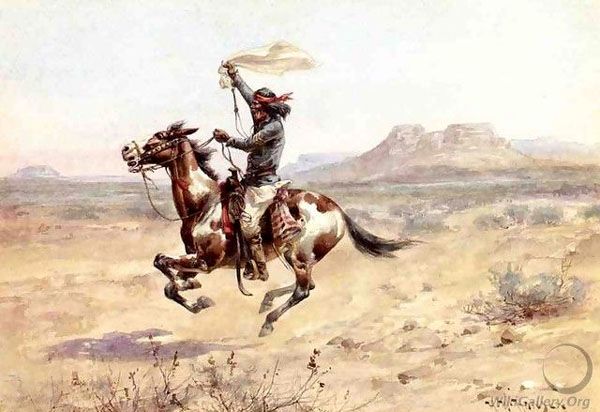
Apache Warrior by Herman Wendleborg Hansen.
Apache – Primarily found in the Southwest, “Apache” is most likely derived from ápachu, a Zuni name meaning “enemy.” The Apache were not so numerous in the 17th century. Still, they were a hostile tribe and increased their numbers by taking captives from other tribes, particularly the Pueblo, Pima, Papago, and other peaceful Indians, as well as from the settlements of northern Mexico. Made up of several tribal groups, including the Mescalero, Jicarilla, Faraone, Llanero, Chiricahua, and more, they were collectively known as Apache.
Apalachee – Considered by Spanish explorers to have been the most advanced indigenous nation in Florida, they inhabited the area in northwestern Florida between the Aucilla and Apalachicola Rivers above Apalachee Bay. Today, most of the Apalachee live in Louisiana. Its tribal office in Libuse, Louisiana, serves approximately 300 members.
Apalachicola – Also called Pallachacola, this tribe, which was related to the Creek Indians, spoke a Muskogean language related to Hitchiti. They lived along the Apalachicola River in present-day Florida. Around 1706, some people from the Apalachicola River area moved to the Savannah River, near the colony of South Carolina, where they were called the Naleathuckles. In the Yamasee War of 1715, they joined in the Native American attacks on South Carolina. Afterward, the survivors returned to the Apalachicola River, near the Chattahoochee River and Flint River juncture. Some later moved north to live along the Chattahoochee River in Alabama. After two Indian Removal Act treaties made in 1833 and 1834, the tribe was moved from 1836 to 1840 to present-day Oklahoma, where they merged with other Creek peoples.
Appomattoc – A tribe of the Powhatan Confederacy that spoke the Algonquian language; they formerly lived on the lower Appomattox River in Virginia. English explorers first encountered them in 1607, and the following year was described as having 60 warriors. The English burned their principal village, which bore the same name, in 1611. As the Appomattoc population dwindled, they became vulnerable to attacks from traditional Western enemies. In 1691, they petitioned to live among the English for protection. By 1705, they were described as having only about seven families; by 1722, they were extinct, having merged with other tribes.
Aquackanonk – A band of the Lenape Indians, they lived on the Passaic River in northern New Jersey when first encountered. Jacques Cortelyou acquired their lands in 1676, and a settlement of Dutch traders was established two years later. A township later took the name, but by then, the Indians were gone.
Aranama – A small agricultural tribe who formerly lived on and near the south coast of Texas. In 1822, however, they lived along the San Antonio River and were estimated to number about 125 people. As a tribe, the Aranama were extinct by 1843.
Arapaho – The Arapaho were originally farmers, but after horses were introduced to the Americas, they began to follow the buffalo herds, like the Cheyenne and Sioux. The Arapaho were probably the original residents of Minnesota and North Dakota. However, as expansion pushed the tribes westward, population pressures forced the Arapaho to resettle in what is now Colorado, Wyoming, and Kansas.
Arendahronon – One of the four chief tribes of the Huron Indians, their name means “rock people.” Being located farther east than the other Huron people, they claimed to be the first allies of the French, who founded among them the missions of St Jean Baptiste, St Joachim, and St Elisabeth. In 1649, following the political destruction and expulsion of the Huron tribes by the Iroquois, the inhabitants of St. Jean Baptiste submitted en masse to the Seneca, who adopted them.
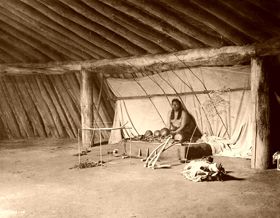
Arikara Indian at the altar, by Edward Curtis, 1908.
Arikara (also Arikaree, Ree) – This semi-nomadic group lived in tipis on the plains of South Dakota for several hundred years. Today, they are associated with the Hidatsa and Mandan, known collectively as the Three Affiliated Tribes. The Arikara live primarily on the Fort Berthold reservation in North Dakota.
Arivaipa – The Arivaipa people were an Apache band whose home was in the Aravaipa Canyon, a tributary of the San Pedro River in southern Arizona.
Arkokisa – A people formerly living in villages chiefly along the lower Trinity River in Texas. The Spanish Presidio of San Agustin de Ahumada was founded in 1756, and several Mexican families settled there, but it was abandoned in 1772. They were allied with the Aranama and the Attacapa and were also on friendly terms with the Bidai, but their linguistic affinity is unknown. They numbered about 80 men in 1760-70 and subsisted on shellfish and fruits. In 1805, their principal town was on the west side of the Colorado River of Texas, about 200 miles southwest of Nacogdoches. As more and more white settlers moved into their territory, their numbers were decimated by disease, and their tribal relations were broken up, causing them to scatter and disorganize.
Armouchiquois – Armouchiquois was the name given by the Abnaki Indians to the people who lived south of the Saco River on the coast of Maine. There is little known about this group.
Arosaguntacook – The Arosaguntacook people, also known as Androscoggin, Amoscoggin, and other variants, were a tribe of the Abnaki Confederacy. They are extinct today.
Ascahcutoner – A tribe belonging to his Sioux-Osage family, they were also said to have been associated with the Teton Sioux.
Assegun – A tribe that originally occupied the region around Mackinaw and Sault Ste Marie, Michigan, they were later driven southward by the Anishinaabe and Ottawa into Lower Michigan. They were once considered connected to the Mascouten but are now believed to have been a Siouan tribe. The name probably derives from the Anishinaabe word meaning “Black Bass.”
Assiniboine – The Assiniboine tribe shares characteristics with the Nakota Sioux. The dialect differences between the two suggest a period of separation sometime before 1640.
Assuti – A small Nez Percé band formerly living on Assuti Creek in Idaho. They joined Chief Joseph in the Nez Perce War of 1877.
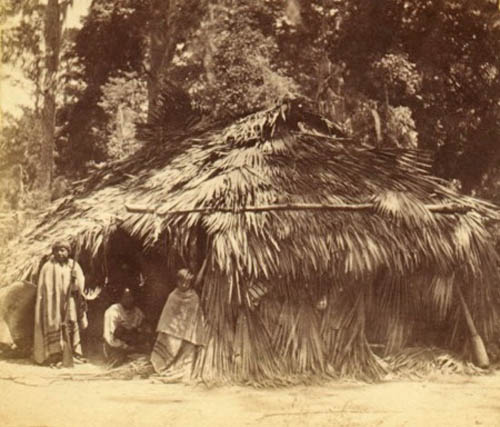
Atakapa People.
Atakapa – The Atakapa were a hunting-and-gathering tribe that lived along the Gulf of Mexico in Texas and Louisiana.
Atanumlema – A small Shahaptian tribe living on the Yakima Reservation in Washington. They once spoke a dialect closely related to the Yakima and Klickitat.
Atchatchakangouen – From their word meaning “crane,” these Indians were a principal division of the Miami. After hostilities with the Illinois Indians, they moved west of the Mississippi River, where they found more conflict when the Sioux attacked them. Moving again, they briefly settled near the Jesuit mission at Green Bay before making their way into Illinois and Indiana with the rest of the tribe.
Atfaiati – Also known as the Tualatin, they were a band of the Kalapuya tribe that formerly inhabited the Tualatin Valley in northwest Oregon. Although they were hunter-gatherers, they also lived in permanent villages during the winter. Little is known about their native customs. White settlers began to invade their territory in the early 19th century, and by 1842, their population had decreased significantly due to disease to only about 600. By 1848, it had shrunk to only about 60 people. In 1855, the government negotiated a treaty with the larger Kalapuya group, which included the Atfalati, that relocated the Atfalati to the Grand Ronde Indian Reservation in the foothills of the Oregon Coast Range, where they lived with a variety of other tribes. By the early 1900s, they had further dwindled to only about 20 people.
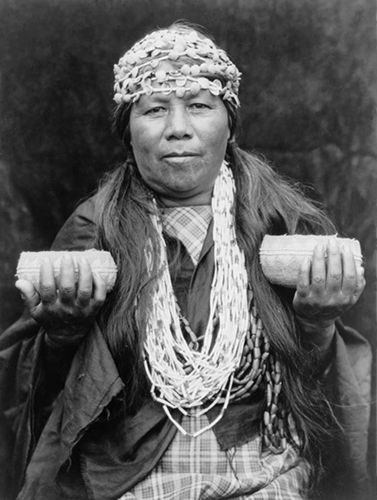
Athapascan Hupa Female Shaman, Edward Curtis, 1923.
Athapascan Family – The Athapascan Family was the most widely distributed of all the Indian linguistic families of North America, formerly extending over parts of the continent from the Arctic coast far into northern Mexico, from the Pacific Ocean to Hudson Bay at the north, and from the Colorado River to the mouth of the Rio Grande at the south.

Atikamekw Indians 1900
Atikamekw – The Atikamekw are a small, traditional tribe that still speak their native language and live on their ancestral land in Quebec, Canada. Closely related to the Cree and often discussed together, the Atikamekw consider themselves distinct people and have their own First Nation with a separate government from the Cree.
Atquanachuke – A tribe or band that resided in New Jersey early in the 17th century. They were said to have lived on the seacoast beyond the mountains northward from the Chesapeake Bay. They spoke a language different from that of the Powhatan, Conestoga, Tocwogh, and Cuscarawaoc.
Atsugewi – Of the Palaihnihan Family language family, the Atsugewi were a small semi-sedentary hunter-gatherer tribe who lived in northern California near Mount Shasta. They are closely related to the Achumawi and consist of two groups. Along with the Achumawi, they were estimated to number some 3,000 people in 1770. However, they were devastated by the settlers flocking to their territory during the California Gold Rush. By 1910, the combined tribes were estimated to be about 1,100 people. Today, some of their descendants are members of the Susanville Indian Rancheria in Lassen County, California.
Aucocisco – The name of the territory about Casco Bay and Presumpscot River, in the area now included in Cumberland County, Maine. It was also sometimes applied to the Abnaki Indians who occupied it. Since the section was settled early by whites, the name soon fell out of use when applied to the Indians, or rather it was changed to “Casco,” but this was a mere local designation, not a tribal distinction, as the Indians referred to were Abnaki. The proper form of the word is said to have been Uh-kos-is-co, meaning crane or heron. These birds still frequent the bay.
Avavare – A former tribe of Texas, possibly Caddoan, which lived “behind” the Quintole toward the interior and to which Cabeza de Vaca, in 1527-34, fled from the Mariames. Their language was different from the Mariames, although they understood them. They bartered bones, which the Mariames ground and used for food, and traded in bows. While staying with the Avavares, Cabeza de Vaca and his companion became known for their successful treatment of the sick. The people seem to have been kindly disposed and have different habits from those of the coast tribes.
Avoyel – The Avoyel people were a small Natchez-speaking tribe who called themselves Tamoucougoula. The word Avoyel is of French origin and means either “Flint People” or “the people of the rocks,” reflecting their active trade in flint for tools.
Awani/Awanichi – A division of the Miwok living in the Yosemite Valley in Mariposa County, California. The name applied by the natives of the valley was the principal village, which, by extension, was given to the whole valley and its inhabitants, who occupied it when snow permitted. The Awani had nine villages, each containing 450 people, when the white settlers first encountered them.
Awatovi – The Awatovi people were Puebloans who lived in a former Hopi pueblo on a mesa about nine miles southeast of Walpi in northeastern Arizona. The pueblo was destroyed after other Hopi people rejected the Spanish missionaries.
Summaries: A B C D E-I J-K L-M N O P Q-R S T-V W X-Z
©Kathy Alexander/Legends of America, updated February 2026.
Also See:
Native American Heroes & Leaders
Native American Photo Galleries
Native Americans – The First Owners of America
See Sources.