
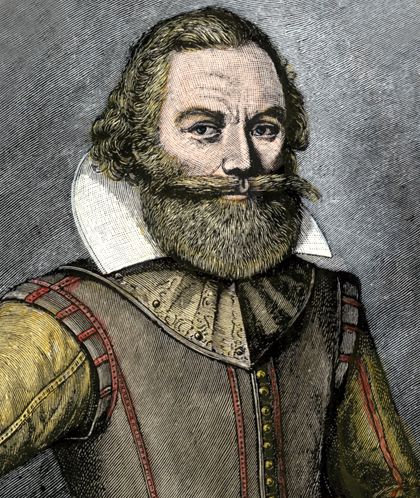
Captain John Smith.
Captain John Smith was an English soldier, explorer, admiral, and author. Smith established the first permanent English settlement in North America at Jamestown, Virginia, in 1607. He was a hero: he led the exploration of Virginia and the Chesapeake Bay, managed the settlement of Jamestown, fought and negotiated with Native Americans, and recorded several historical books and maps that encouraged further exploration of the New World. However, he was also a proud and boastful man, making it difficult to determine which parts of his life are fact and which are fiction.
He was born in January 1580 in Willoughby, England, and attended grammar school for just three years while also helping out on the family farm. However, John set off to sea after his father died when he was just 16. He served as a mercenary in the army of King Henry IV of France against the Spaniards and fought for Dutch independence from the Spanish King Phillip II. Two years later, he set off for the Mediterranean Sea, working on a merchant ship. In 1600, he joined the Austrian Forces to fight the Turks in the “Long War.”
A brave soldier, he was promoted to Captain while fighting in Hungary. Two years later, in 1602, he fought in Transylvania. There, he was wounded in battle, captured, and sold as a slave to a Turk. This Turk then sent Smith to Istanbul as a gift to his sweetheart. According to Smith, the girl fell in love with him and sent him to her brother for training in Turkish imperial service. Smith reportedly escaped by murdering his brother, and he returned to Transylvania by fleeing through Russia and Poland. After being released from service and receiving a large reward, he traveled throughout Europe and Northern Africa before returning to England in the Winter of 1604-05.
Restless in England, Smith became actively involved with the Virginia Company’s plans to colonize Virginia for profit in 1606. The expedition, made up of three ships, set sail on December 20, 1606, and reached Virginia in April 1607 after a long voyage of more than four months. Smith was a troublemaker on the voyage, and Captain Christopher Newport, who commanded the three ships, planned to execute him upon arrival in Virginia. However, before he did, Newport opened a sealed box listing the seven council members who would govern the colony, and Smith’s name was on the list. For the next few weeks, the expedition searched for a suitable site and, on May 13, 1607, landed at Jamestown, ready to begin surviving in a new environment.
The first year, the settlers faced several problems, including a lack of fresh water, disease, a very harsh Winter, and attacks by the native Powhatan Indians, nearly destroying them. The Indians, angered at the intrusion upon their territory and trying to drive the settlers away, raided their camps and stole their supplies.
In December 1607, while Smith was searching for food on the Chickahominy River, a Powhatan chief named Opechancanough captured him and took him back to the camp of the Powhatan Confederacy’s primary chief, Powhatan, to decide his fate. Chief Powhatan was greatly impressed by Smith’s self-confidence and fascinated by the mystical instruments Smith carried, such as an ivory and glass pocket compass. Smith was questioned about his colony and then made to participate in a ritual or trial; after that, in keeping with Indian custom, he was made a subordinate chief in the tribe.
Powhatan’s 11-year-old daughter, Pocahontas, took part in the ceremony. Smith was constantly unsure of his fate and was convinced afterward that Pocahontas had saved his life. After about four weeks of captivity, Smith was released as a friend and returned to Jamestown, guided by the Indians.
Meanwhile, dissent within the colony fermented due to laziness, lack of supplies, and periodic attempts at desertion by many colonists. Personal conflicts and disagreements over new policies being formulated in London developed between Smith and various leaders.
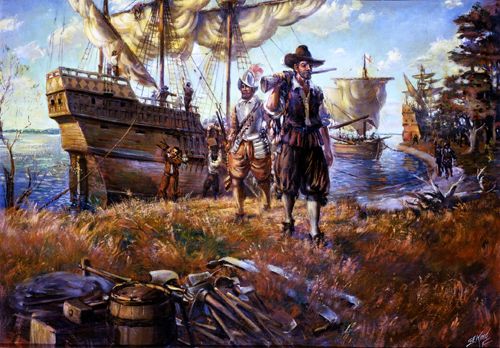
On May 13, 1607, the Jamestown colonists came ashore at the first permanent English settlement in North America. Painting by Sidney E. King, courtesy of Colonial National Historical Park.
As a result, Smith left Jamestown to explore and map the Chesapeake Bay region and search for badly needed food supplies. Because of poor governance and near chaos, Smith eventually became the local council president in September 1608. He instituted rigid discipline, strengthened defenses, and encouraged farming with this admonishment: “He who does not work will not eat.” Because of his strong leadership, the settlement survived and grew during the following year. Unfortunately, Smith was accidentally injured by a gunpowder burn and returned to England for treatment in October 1609. He never returned to Virginia.
In London, he actively promoted the further colonization of Virginia, encouraging more Englishmen and women to follow the trail he had blazed and colonize the New World. Later, he said, “Here every man may be master and owner of his own labor and land… If he has nothing but his hands, he may…by industries quickly grow rich.” However, because of his independence, the Virginia Company disliked him and did not ask him to return.
Though he would not go to Virginia again, in April 1614, he returned to the New World on a successful voyage to the Maine and Massachusetts Bay areas. With Prince Charles’s approval, he named the region New England. He made two more attempts to return to the same coast, but the first failed because a major storm dismasted his ship. In the second attempt in 1615, he was captured by French pirates off the Azores. Smith escaped after weeks of captivity and made his way back to England. He was denied further opportunities to return to America and spent the rest of his life writing books, dying in 1631 at age 51. He was buried in the church of St. Sepulchre-without-Newgate, the largest Parish Church in the City of London.
Though his message and writings would attract millions of people to the United States over the following centuries, many of his writings were questioned because his narratives changed over time. In later writings, including the scene where he credits Pocahontas with saving his life, these details were changed or left out of earlier accounts. These changes and his boastful manner have made much of his remembrances obscure and questionable.
Compiled and edited by Kathy Alexander/Legends of America, updated October 2026.
Also See:
Source: National Park Service