

Seneca Indians.
The Seneca are an Iroquoian-speaking tribe historically living South of Lake Ontario, one of the five Great Lakes of North America. The largest of the six Native American nations that made up the Iroquois Confederacy, they were the farthest west in New York before the American Revolution. They were called “The Keepers of the Western Door.” In the Seneca language, they are known as O-non-dowa-gah or “Great Hill People.” Their democratic government predates the United States Constitution.
They were divided into two separate entities: the Northeastern Seneca Indians from New York and the Seneca Indians from Ohio. The New York Seneca tribe became part of the Iroquois Nation, while the Ohio Seneca fought the Iroquois alongside the Algonquian Nation. The Ohio Seneca, also known as the Mingo Indians, are believed to have relocated to Ohio to avoid a takeover from the New York Seneca tribe.
The word Seneca is an Anglicized form of the Dutch pronunciation of the Mohegan word, initially referring to the Oneida, Onondaga, Cayuga, and Seneca.
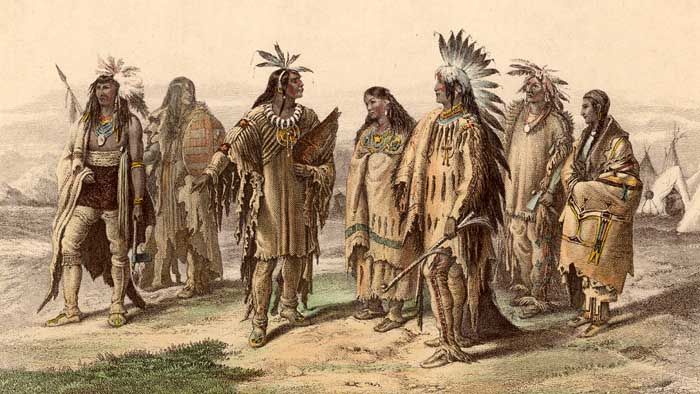
Iroquois People.
When the Iroquois Confederacy was formed, comprising the Seneca, Onondaga, Oneida, Cayuga, and Mohawk, the five nations occupied large land areas in the Northeast United States and Southeast Canada. An oral tradition mentioning a solar eclipse dates to 1142 AD, the year the Seneca joined the Iroquois. The Seneca were by far the most populous of the Iroquois Confederacy, numbering about 4,000 by the 17th Century.
The historical Seneca occupied territory throughout the Finger Lakes area in central New York and the Genesee Valley in Western New York. Recent archaeological evidence indicates their territory eventually extended to the Allegheny River in present-day northwestern Pennsylvania, particularly after the Iroquois destroyed both the Wenrohronon and Erie Nations, who were native to the area, in the 17th Century.
The Seneca lived in villages and towns fortified with wooden palisades. They traditionally lived in longhouses, large buildings up to 100 feet long and approximately 20 feet wide. Related families shared the houses, which could hold up to 60 people. Hearths sat in the central aisle, with two families sharing each hearth. These towns were relocated every ten to 20 years as soil, game, and other resources were depleted.
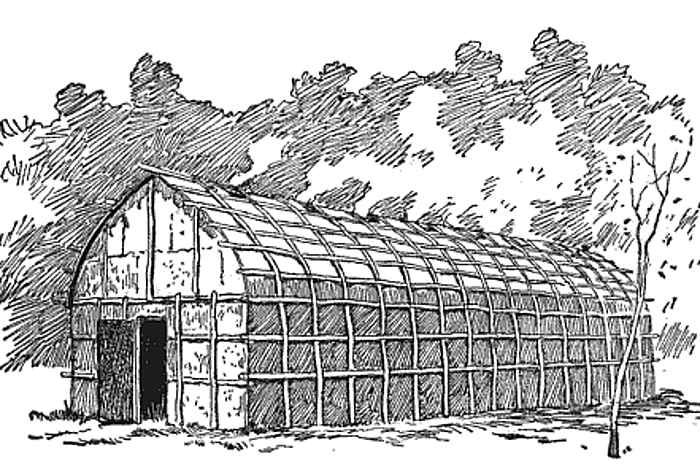
Iroquois Longhouse.
During the 19th Century, many Seneca adopted the customs of their immediate American neighbors by building log cabins, practicing Christianity, and participating in the local agricultural economy.
The Iroquois have a matrilineal kinship system, with inheritance and property descending through the maternal line. The main form of social organization was clans, descended from one woman. Children are born into their mother’s clan and inherit their social status from their mother’s family. Their mother’s eldest brother was traditionally more significant than their biological father, who did not belong to their clan. The presiding elder of a clan is called the “clan mother.”
Seneca women generally grew and harvested corn, beans, and squash, as well as gathering and processing medicinal plants, roots, berries, nuts, and fruit. They also domesticated animals such as dogs and turkeys.

Seneca Chef Corn Planter by Frederick Bartoli, 1796.
Seneca men found and developed town sites, including clearing forests to create fields. They also spent significant time hunting and fishing, often leaving towns or villages for these activities. Highly skilled in warfare, they were regarded as fierce adversaries. The Seneca men held the traditional title of war sachems, gathered the warriors, and led them into battle within the Iroquois Confederacy.
After Europeans arrived, the French called the Iroquois League during the colonial years, later the Iroquois Confederacy, and the English called them the Five Nations. After 1722, they accepted the Tuscarora people from the Southeast into their Confederacy and became known as the Six Nations.
The Seneca Nation has two branches: the western and the eastern. The western Seneca lived predominantly in and around the Genesee River, gradually moving West and Southwest along Lake Erie and the Niagara River, then South along the Allegheny River into Pennsylvania. The eastern Seneca lived predominantly South of Seneca Lake. They moved South and East into Pennsylvania and the western Catskill area.
The West and North were constantly attacked by powerful Iroquoian tribes: the Huron to the South, and the Iroquoian-speaking Susquehannock, which also threatened constant warfare. The Algonquian Mohican tribes blocked access to the Hudson River in the East and northeast. In the Southeast, the Algonquian Lenape threatened war from eastern Pennsylvania, New Jersey, and the Lower Hudson River.
The men of both branches of the Seneca wore the same headgear. Like the other Iroquois Confederacy, they wore hats with dried corn husks on top, with one feather sticking up straight.
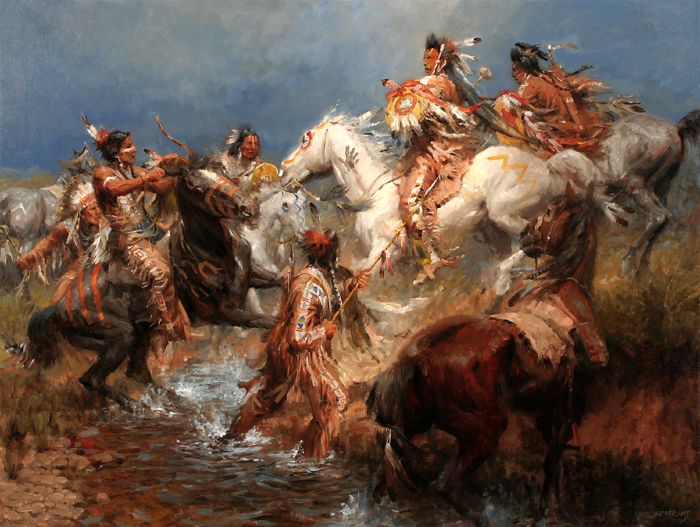
Iroquois in War.
In 1622, the Montagnais, the Algonquin, and the Huron sought to end the war with the Iroquois because “they were weary and fatigued with the wars which they had had for more than 50 years.” The truce ended in 1624 but was broken by the Algonquin warriors’ continued guerrilla warfare.
The Seneca made peace with them after defeating the Huron in the spring of 1634. The Huron, in the following year, sent an embassy to Sonontouan, the chief town of the Seneca, to ratify the peace, and while there, learned that the Onondaga, the Oneida, the Cayuga, and the Mohawk were desirous of becoming parties to the treaty.
The Huron renewed the war in May 1639 when they captured 12 Seneca prisoners. The war continued with varying success.
By 1643, the Seneca, including the Cayuga, the Oneida, and the Onondaga, equaled, if they did not exceed, in number and power, the Huron, who previously had had this advantage, and the Mohawk at this time had three villages with 700 or 800 men of arms who possessed 300 long guns that they had obtained from the Dutch and which they used with skill and boldness.
The Seneca warriors made up the largest part of the Iroquois warriors who, in 1648-49, assailed, destroyed, and dispersed the Huron tribes. In 1649, they sacked the chief towns of the Tionontati or Tobacco tribe and also played a leading role in the defeat and subjugation of the Neuter in 1651 and the Erie in 1656.

Seneca Warriors.
In 1652, the state of Maryland bought from the Susquehanna Indians all their land claims on both sides of Chesapeake Bay up to the mouth of the Susquehanna River.
That year, the Seneca Indians conspired with the Mohawk to destroy French settlements along the St. Lawrence River. Two years later, the Seneca sought peace with the French, likely due to their split with the Erie tribe. However, the Mohawk, unwilling to make peace as they planned an attack on the Huron, murdered two of the three Seneca ambassadors, with the third taken hostage by the French. This nearly ignited a war between the tribes, but ongoing foreign affairs prevented conflict.
On September 19, 1655, Fathers Chaumonot and Dablon left Quebec after receiving invitations to visit and view the Seneca Country, establish their French habitation, and teach the Seneca the articles of their faith.
In 1657, the Seneca tribe incorporated eleven different tribes into its political body by carrying out the League policy of adopting conquered tribes upon submission and the expression of a desire to live under the form of government established by the League.
In 1663, 800 Seneca and Cayuga warriors from the Confederation of the Five Nations were defeated by the Minqua, aided by the Marylanders. The Iroquois did not end their hostilities until famine reduced the Conestoga so much that, in 1675, when the Marylanders disagreed with them and withdrew their alliance, the Five Nations subdued the Conestoga and thereafter claimed a right to the Minqua lands to the head of Chesapeake Bay.
In 1677, the English allied with the Iroquois League in what they called the “Covenant Chain.”

Seneca Indians.
In 1686, 200 Seneca warriors attacked the Miami tribe. At the same time, the Illinois tribe had already been defeated by the Iroquois in a war that lasted about five years. In 1687, the Marquis Denonville brought together a large group of Native American allies from the upper lakes and the St. Lawrence River. This group included the Huron, Ottawa, Chippewa, Mississauga, Miami, Illinois, Montagnais, Amikwa, and others. He had 1,200 French soldiers and colonial troops to help him attack and destroy the Seneca. When Denonville reached Irondequoit, the Seneca landing spot on Lake Ontario, he built a stockade and led a garrison of 440 men. He then moved to attack the Seneca villages but was ambushed by 600 to 800 Seneca warriors. The Seneca charged, pushing back Denonville’s troops and their allies, creating confusion among his veteran soldiers. Only the size of his force prevented Denonville from suffering a significant defeat.
In 1744, the French influence was rapidly gaining ground among the Seneca. Meanwhile, the astute and persuasive Colonel Johnson gradually won the Mohawk as close allies of the British. At the same time, the Onondaga, the Cayuga, and the Oneida, under intense pressure from Pennsylvania and Virginia, sought neutrality.

Fort Niagara, New York, 1726.
In 1763, at Bloody Run and the Devil’s Hole, on the Niagara River about four miles below the falls, the Seneca ambushed a British supply train on the portage road from Fort Schlosser to Fort Niagara, with only three escaping from a force of nearly 100. The Seneca also ambushed a British force composed of two companies of troops who were hastening to the aid of the supply train, of whom only eight escaped the massacre.
In 1768, the English renewed their alliance with the Iroquois when Sir William Johnson signed the Treaty of Fort Stanwix. This treaty helped the British gain the Iroquois’ trust, as they believed the British had their best interests in mind. In contrast, the Seneca disliked the Americans because they often ignored the Treaty. The Iroquois were especially angry about American expansion into the Ohio Territory. Despite this intrusion, the Americans respected the Iroquois’ military skills and tried to keep them out of their conflict with the British.
Before the American Revolution, the Seneca Tribe had a prosperous society. The Iroquois Confederacy ended the fighting amongst the war-based Iroquois tribes and allowed them to live in peace with each other. Yet, despite this peace amongst themselves, the Iroquois tribes were revered as fierce warriors and were reputed to control a large empire that stretched hundreds of miles along the Appalachian Mountains. However, although the Seneca and Iroquois tribes had stopped fighting each other, they continued raiding outsiders, including European visitors.
Despite continuing raids on their new European neighbors, the Iroquois established profitable relationships with Europeans, especially the English.
When the American Revolution began in 1775, the Seneca sided with the British. One of the earliest battles the Iroquois fought occurred on August 6, 1777, at Oriskany. During the battle, Native Americans led a brutal attack against the rebel Americans, in which they “killed, wounded, or captured the majority of patriot soldiers.”

Cherry Valley Massacre.
Afterward, the Iroquois took part in numerous other battles, including the Cherry Valley Massacre and the Battle of Minisink, which were carefully planned raids along a trail “from the Susquehanna to the Delaware Valley and over the Pine Hill to the Esopus Country.”
Although the Iroquois were active participants, the Seneca, like Governor Blacksnake, were highly fed up with the brutality of the war, which included the killing of women and children at the Cherry Valley Massacre and the clubbing of surviving American soldiers at Oriskany.
However, the raids continued on American settlements in New York, with the Iroquois tribes not only attacking and plundering the American colonists but also setting fire to the Oneida and Tuscarora settlements. The attacks continued until their allies had caved in and surrendered.
In 1782, the Iroquois finally stopped fighting when British General Frederick Haldimand recalled them “pending the peace negotiations in Paris.”
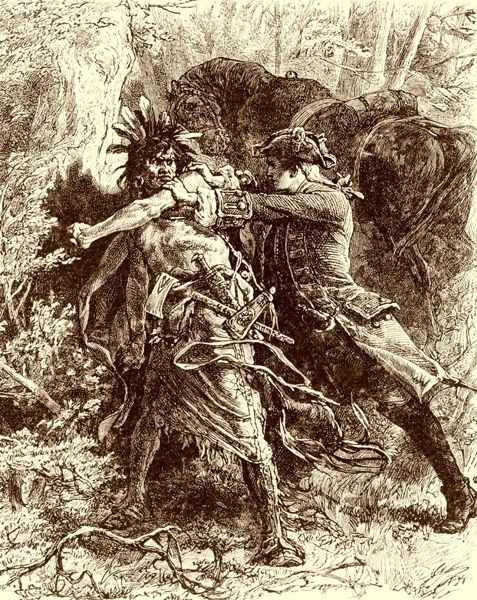
Struggle between a Mohawk Indian and a colonial militia man.
With the Iroquois League dissolved after the American Revolution, the Seneca settled in new villages along Buffalo Creek, Tonawanda Creek, and Cattaraugus Creek in western New York. The Seneca, Onondaga, Cayuga, and Mohawk, as allies of the British, were required to cede all their lands in New York at the end of the war, as Britain ceded its territory in the Thirteen Colonies to the new United States. The late-war Seneca settlements were assigned to them as their reservations in the Treaty of Fort Stanwix in 1784. Although the Oneida and Tuscarora were allies of the rebels, they were also forced to give up most of their territory.
On July 8, 1788, the Seneca and some Mohawk, Oneida, Onondaga, and Cayuga tribes sold their rights to land East of the Genesee River in New York.
On November 11, 1794, the Seneca and other Iroquois nations signed the Treaty of Canandaigua with the United States, agreeing to peaceful relations.
On September 15, 1797, at the Treaty of Big Tree, the Seneca sold their lands West of the Genesee River, retaining ten reservations. The sale opened up the rest of Western New York for settlement by European Americans.
During the 18th Century, some Iroquoian bands and tribal remnants occupied Ohio. Known collectively as Mingo or Seneca, they were the ancestors of today’s Seneca-Cayuga Tribe of Oklahoma.
In 1817, the United States established two reservations for the Ohio Seneca. One was for the Seneca of Sandusky, a mingling of Cayuga, Erie, Conestoga, and others along the Sandusky River, and the other was for a consolidated band of Seneca and Shawnee at Lewistown. In 1831, both groups exchanged their Ohio reserves for adjoining land in the Indian Territory.

Seneca Woman.
Approximately 358 Seneca of Sandusky reached the Elk River in present-day Delaware County, Oklahoma, in the summer of 1832. About 258 members of the Mixed Band of Seneca and Shawnee arrived later that year. Following negotiations with the Stokes Commission in December 1832, the tribes readjusted their reservation boundaries and joined as “the United Nation of Senecas and Shawnees.”
On January 15, 1838, the U.S. and some Seneca leaders signed the Treaty of Buffalo Creek, which required the Seneca to relocate to a tract of land West of Missouri. However, most refused to go.
In 1848, most Seneca in New York formed a modern, elected government: the Seneca Nation of Indians.
Despite their leaders’ pro-Confederate stance, most Seneca and Shawnee spent the Civil War years as refugees in Kansas. The U.S. government separated the Seneca from the Shawnee in 1867.
During the 1870s and early 1880s, the Seneca in Oklahoma received newcomers from Canada and New York, including Cayuga, Mohawk, and more Seneca. In 1890, the population was roughly 255.
Today, the Seneca culture and values remain strong and intact. Language, song, art, dance, and sports are all vital aspects of their culture.
In 2007, the Seneca language was rated “critically endangered,” with fewer than 50 fluent speakers, primarily the elderly. However, efforts began to preserve and revitalize the language.
In the 21st Century, more than 10,000 Seneca live in the United States, which has three federally recognized Seneca tribes. Two are centered in New York: the Seneca Nation of Indians, with five territories in western New York near Buffalo, and the Tonawanda Seneca Nation. The Seneca-Cayuga Nation is in Oklahoma, where their ancestors were relocated from Ohio during the Indian Removal. Approximately 1,000 Seneca live in Canada, near Brantford, Ontario, at the Six Nations of the Grand River First Nation. They are descendants of Seneca who resettled there after the American Revolution, as they had been allies of the British and forced to cede much of their lands.

Seneca War Chief Red Jacket by C.B. King, 1836.
©Kathy Alexander/Legends of America, updated September 2026.
Also See:
Native American Photo Galleries
Native Americans – First Owners of America
Sources:
Encyclopedia of Oklahoma History and Culture
Hodge, Frederick Webb; The Handbook of American Indians North of Mexico. Bureau of American Ethnology, Government Printing Office. 1906.
Seneca Nation
Wikipedia