
Summaries: A B C D E-I J-K L-M N O P Q-R S T-V W X-Z
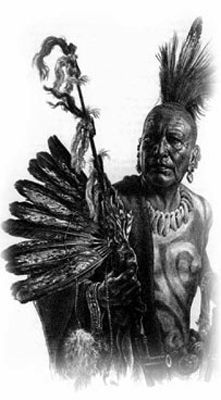
Quapaw Warrior.
Quapaw – The Quapaw people are a Siouan tribe, closely related to the Kanza, Omaha, Osage, and Ponca. Their name translates to “Downstream People,” a name given because they went down the Missouri River while the rest of the Sioux went upriver.
Quileute – A Chimakuan tribe who lived on the coast of Washington. An eastern division of the family, the Chimakum, formerly occupied the territory between Hood’s Canal and Port Townsend, and is now extinct. In customs, the Quileute resembled the Makah and Nootka; all were whalers. The language is now severely endangered. A few people speak it south of the Makah on the western coast of the Olympic Peninsula, South of Cape Flattery.
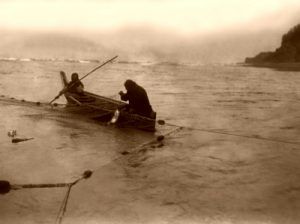
Quinault Indians Fishing, Edward S. Curtis, 1913.
Quinault – One of the few Indian tribes that continue to live on their native lands, the Quinault are located on the Pacific coast of Washington, primarily in northwestern Grays Harbor County. Like many Northwest Coast Indians, Quinault relied on fishing from local rivers and the Pacific Ocean, hunting, and berry picking for food. They lived in long wooden houses along the Quinault River and used forest trees to make canoes and bark for clothing. The tribe remained isolated from white settlers until a Spanish vessel first visited in 1775. Lewis and Clark also came in contact with them during their famed expedition in 1803. By the 1820s, more and more white trappers, traders, and settlers began visiting and settling in the area, and before long, fishing and lumber communities dotted the region. The Quinault were initially friendly, but friction began as new settlers heavily used the area’s resources. In January 1856, a treaty created a 10,000-acre reservation that included not only the Quinault but also other area tribes, including the Quileute, Queets, and Hoh. Wanting to accommodate more coastal tribes, including the Chehalis, Chinook, and Cowlitz, the government expanded the reservation by about 200,000 acres in 1873. Today, the Quinault Indian Nation accommodates about 1,400 residents, operates a casino and seaside resort at Ocean Shores, and a high-quality seafood packing business at Taholah, Washington.
Rappahannock – In 1607, the Rappahannock were the dominant tribe of the Rappahannock River valley, maintaining thirteen villages along the North and South banks of the river that bears their name. The Rappahannock People first met Captain John Smith at their capital town, “Topahanocke,” on the river banks bearing their name in December 1607. To solidify their tribal government and fight the state for recognition, the Rappahannock were incorporated in 1921. In 1998, they elected the first woman chief to lead in Virginia since the 1700s, Chief G. Anne Richardson. Currently, the tribe is working with six other Virginia tribes to acquire federal recognition.
Ree – See Arikara
Rogue River – A Native American group initially located in southern Oregon. This was not a single tribe but rather a group of tribes that French Canadian employees of the Hudson’s Bay Company called “coquins,” meaning “rogues.” The principal tribes commonly grouped under the generic name of Rogue River Indians were the Takelma, Shasta, and different subtribes of the Coquille. After the Rogue River Wars in 1856, Rogue River bands were split between the Confederated Tribes of Siletz and the Confederated Tribes of the Grand Ronde Community of Oregon, relocating to either the Siletz Indian Reservation North of the tribe’s traditional lands or the Grand Ronde Indian Reservation.
Summaries: A B C D E-I J-K L-M N O P Q-R S T-V W X-Z
©Kathy Alexander/Legends of America, updated September 2026.
Also See:
Native American Heroes & Leaders
Native American Photo Galleries
Native Americans – The First Owners of America
See Sources.