
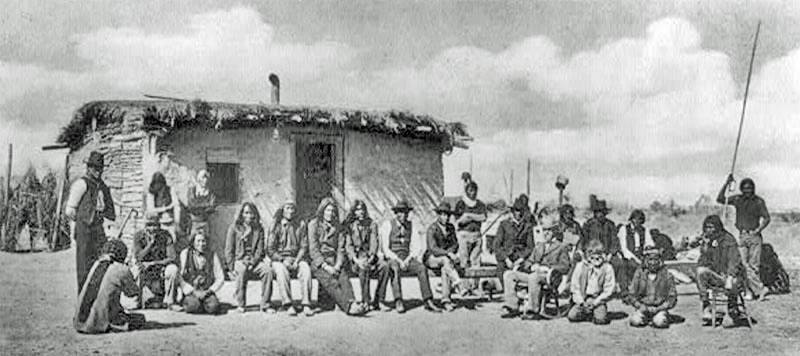
Pow-wow of Indian chiefs at Yuma reservation, Arizona, early 1900s.
The Yuman Family is an important linguistic group comprising various Native American tribes and bands that traditionally lived in the lower Colorado River and Gila River Valleys in western Arizona and southern California, in the United States, and in northern Baja California and northwestern Sonora, Mexico. They spoke related languages of the Hokan language stock.
Two major divisions of Yuman are recognized: the river Yuman, who lived along the lower Colorado and middle Gila Rivers and whose major groups included, from north to south, the Mojave, Halchidhoma, Yuma, and Cocopa, together with the Maricopa in the middle Gila; and the upland Yuman, who inhabited what is now western Arizona south of the Grand Canyon and whose major groups included the Hualupai, Havasupai, and Yavapai. They were said to have differed considerably, physically and otherwise, the river tribes being somewhat superior to the others.
Two other groups of Yuman-speaking people, the Diegueno and the Kumeyaay (now known as the Tipai and Ipai), lived in what is now southern California and northern Baja California. The Kiliwa and Paipai still live in northern Baja California.

Francisco Vasquez de Coronado.
The 16th-century Spanish expedition under Hernando de Alarcón, intending to meet Francisco Vázquez de Coronado’s overland expedition, visited the Baja California peninsula and then traveled along the lower Colorado River. This was the first European expedition to reach Yuman territory.
The Kiliwa first encountered Europeans when Juan Rodríguez Cabrillo reached the San Quintín area in 1542.
Sebastián Vizcaíno’s 1602 expedition mapped the northwest coast of Baja California and encountered the Paipai.
The Jesuit missionary-explorer Wenceslaus Linck came overland from the south into the eastern part of Kiliwa territory in 1766. More intensive and sustained contacts began in 1769, when the expedition to establish Spanish settlements, led by Gaspar de Portolà and Junípero Serra, passed through the western portions of California.
Juan Bautista de Anza and his party traveled into Quechan territory in the winter of 1774, marking the beginning of continuous interaction.
In the 18th century, Fray Francisco Garces described the Yuman:
“The Indian men of its banks are well-formed, and the Indian women fat and healthy; the adornment of the men, as far as the Jamajabs [Mohave], is total nudity; that of the women is reduced to certain short and scanty petticoats of the bark of trees; they bathe at all seasons, and arrange the hair, which they always wear long, in diverse figures, utilizing for this purpose a kind of gum or sticky stud.
They are always painted, some black, others red, and many with all colors. All those of the banks of the river are very generous and lovers of their country, in which they do not hunt game because they abound in all provisions.”
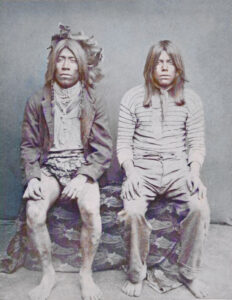
Yuman Men.
The Yuman people generally had a loose political organization and lived in small, impermanent settlements. Generally, the Yuman were physically powerful and warlike and valued success in battle over material possessions.
They wore minimal clothing, usually sandals and an apron or breechcloth. A Spanish explorer described them as “the tallest and the most robust that I have seen in all the provinces, and their nakedness the most complete.” In winter, they wore robes made from deer and rabbit skins.
They had no concept of inheritance. Upon the death of a tribe member, the land they had farmed was usually abandoned, and their property destroyed. Typical crafts included pottery and basketry.
A creation myth and belief in a supreme creator characterize traditional Yuman beliefs. They passed on their faith through traditional narratives and songs. Although Christian missions were established in their territories, particularly by the Spanish, belief in their old traditions has continued, albeit with some Christian influence. Today, educational programs work to preserve the ancient tribal ways and beliefs, while integrating contemporary cultural and technological understandings.
When Spanish explorers and missionaries arrived and encountered various Yuman tribes, they encountered resistance, both physical and ideological. Many Yumans died in conflicts with the Spanish and later the American cavalry, which defended forts along the Colorado River. Disease also reduced their numbers and weakened them to the point of submission when they were forced onto reservations.
Traditionally, the Yuman were primarily farmers. By placing their fields near rivers, the Yuman took advantage of the annual floods, which deposited rich silt on the floodplain, making irrigation unnecessary in an arid environment. The Maricopa were somewhat influenced by their neighbors, the Pima, and frequently allied with them against other river Yuman, such as the Mojave and the Yuma.
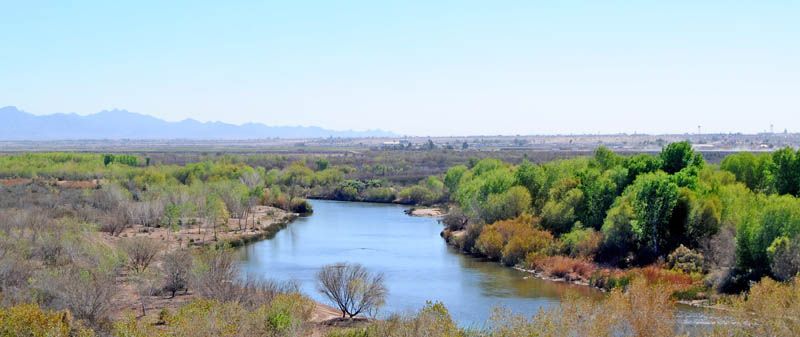
Colorado River in Yuma, Colorado by Kathy Alexander.
A significant part of subsistence was based on hunting and gathering wild foods. The Havasupai were exceptions, partly because of contacts with the Hopi and partly because of their location in Cataract Canyon, a side canyon of the Grand Canyon. The creek flowing through this canyon made extensive farming possible through irrigation. Unlike other Yuman, the Havasupai were very peaceful. The Yavapai frequently allied themselves with bands of western Apache for raiding and were sometimes called Yavapai-Apache.

Yuman People.
All Yuman peoples were similar in choosing to live in dispersed settlements or hamlets rather than in villages, in adopting loose forms of political organization rather than a centralized authority, and in their material culture, which included pottery. Yuman religion was characterized by belief in a supreme creator, faith in dreams, and the use of song narratives in rituals and ceremonies.
Their social groups were well-defined; they lived in communal huts, well-constructed of cottonwood and well-thatched, practiced agriculture, and made fine basketry and pottery. Interestingly, they did not borrow the art of irrigation from the Pueblo peoples, who often suffered from drought. They were also not boatmen. Instead, crossing rivers and transported their goods on rude rafts made of bundles of reeds or twigs. They cremated their dead and with them all articles of personal property. The climate favored nudity, with men wearing only a breechcloth, not always, while women generally wore short dresses made of strips of bark.
Today, Yuman tribes live on reservations, generally in part of their ancestral lands. Casinos, farming, and other enterprises provide economic support, as does tourism, particularly for the Havasupai, who inhabit a beautiful part of the Grand Canyon complex. Tourism, crafts, and casinos are valuable supplements to their subsistence farming. Educational programs have been established to preserve their traditional ways and beliefs while combining these with contemporary technology and knowledge to build a better future.
The Yuman–Cochimí languages are spoken in Baja California, northern Sonora, southern California, and western Arizona. Cochimí is no longer spoken as of the late 18th century, and most other Yuman languages are threatened.

Yuman Home.
The population of the Yuman tribes within the United States numbered about 3,700 in 1909.
Early 21st-century population estimates indicated about 9,000 people identified themselves as Yuman.
©Kathy Alexander/Legends of America, February 2026.
Also See:
List of Notable Native Americans
Native American Heroes and Legends
Native American Photo Galleries
Sources: