
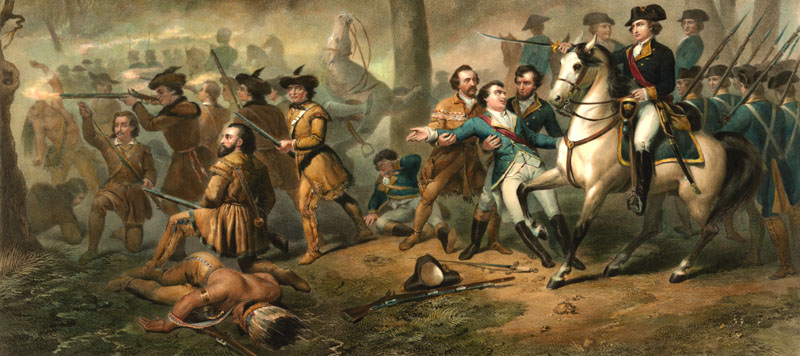
General George Washington in the American Revolution by Junius B. Stearns, 1854.
June 14, 1775 – The Continental Congress voted to raise ten companies of riflemen in Pennsylvania, Maryland, and Virginia. This was the effective birth of the United States Army. Militia units supplemented them from local communities. Weapons of the time included muskets, accurate to about 100 yards.
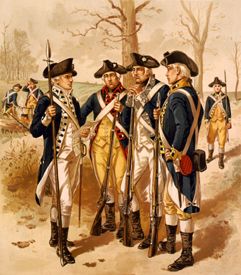
Continental Army by Henry Ogden.
June 15, 1775 – George Washington was appointed Commander-in-Chief of the Continental Army.
1775-1783 – The American Revolution occurred. It was an armed struggle for secession from the British Empire by the Thirteen Colonies, which would later become the United States.
June 1776 – Congress set up a Board of War and Ordnance, the lineal ancestor of the War Department.
August 22, 1776 – America’s first battle occurred on Long Island, New York (Brooklyn Heights), when General George Washington’s 3,500-man force engaged Major General William Howe’s 20,000-man army. Washington’s forces were outflanked and forced to retreat, suffering 1,000 casualties. The defeat forced the Americans to rearm and dramatically increase their standing army to take on the larger, better-trained, and better-equipped British forces.
December 26, 1776 – Washington and his army crossed the Delaware River and defeated the Hessian garrison at Trenton, New Jersey.
1776-1777 – The Cherokee War of 1776 takes place. It is a series of armed conflicts in which the Cherokee fought to prevent American settlers from encroaching on eastern Tennessee and eastern Kentucky; under British rule, this land had been preserved as native territory.
1776-1794 – The Cherokee War continued as the Second Cherokee War, which involved more Native tribes attempting to halt settler expansion into Kentucky and Tennessee.
September 11, 1777 – The Battle of Brandywine took place near Chadds Ford, Pennsylvania.
October 17, 1777 – British forces under Burgoyne surrendered at Saratoga, New York.

George Washington & Lafayette visiting sick troops at Valley Forge in 1777 by P. Haas.
Winter 1777-1778 – The Army received its first real military training at Valley Forge, Pennsylvania, from Prussian officer Baron von Steuben.
July 27, 1778 – The Battle of Monmouth took place in New Jersey.
January 17, 1781 – The Battle of Cowpens occurred in South Carolina.
October 19, 1781 – Lord Cornwallis surrendered at Yorktown, Virginia.
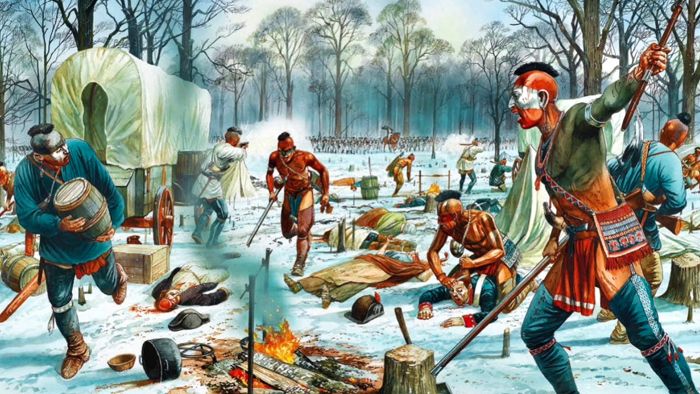
Northwest Indian War.
1785-1795 – The Northwest Indian War was a series of battles with various Native American tribes in present-day Ohio. The campaign aimed to affirm American sovereignty over the region and create more opportunities for settlement.
1786-1787 – Shays’ Rebellion takes place. It was a Western Massachusetts debtors’ revolt over a credit squeeze that had financially devastated many farmers. The federal government could not raise an army to help the state militias combat the uprising; the national government’s weakness bolstered arguments for replacing the Articles of Confederation with a new framework of government.
September 1787 – The United States Constitution, which specifically provided that the President should be Commander in Chief of the Army and Navy, was adopted and signed.
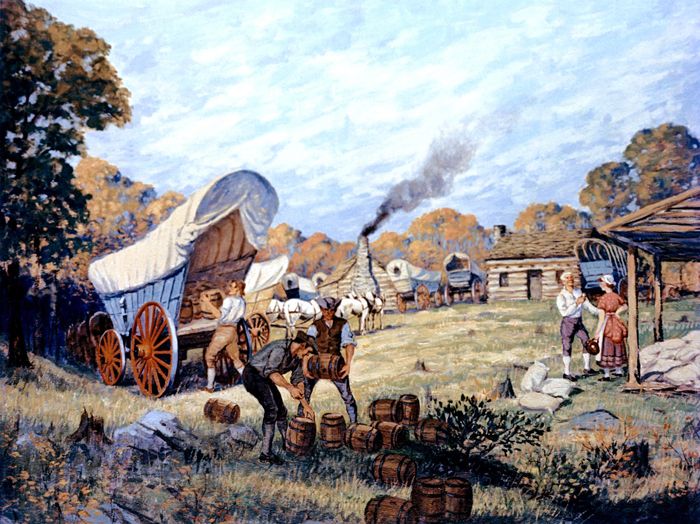
Whiskey Rebellion.
1791-1794 – The Whiskey Rebellion takes place. It was a series of protests against a federal tax on distilling spirits to repay the nation’s war bonds. The revolt was centered in southwestern Pennsylvania, although violence occurred throughout the Trans-Appalachian region.
August 7, 1789 – Congress established the Department of War.
1798-1800 – The Quasi-War was fought. It was an undeclared naval war between the French First Republic and the United States over the American default on its war debt. Another contributing factor was the continuation of American trade with Britain, which was at war with its former French allies. Congress authorized military action through a series of statutes.
1799-1800 – Fries’ Rebellion, a string of protests against the enactment of new real estate taxes to pay for the Quasi-War, occurred. Hostilities were concentrated in Pennsylvania Dutch communities.
1801-1805 – The First Barbary War occurred. It was a series of naval battles in the Mediterranean against the Kingdom of Tripoli, a quasi-independent Ottoman vassal state. The action followed the capture of numerous American ships by the infamous Barbary pirates. After the seizure of USS Philadelphia, American forces under William Eaton invaded coastal cities. A peace treaty resulted in the payment of a ransom for the return of captured American soldiers and only temporarily eased hostilities.
March 16, 1802 – Congress authorized the creation of a Corps of Engineers and a military academy under its control at West Point, New York. This was partly to train scientists and engineers to support national development.
1803-1806 – The Lewis and Clark Expedition takes place.
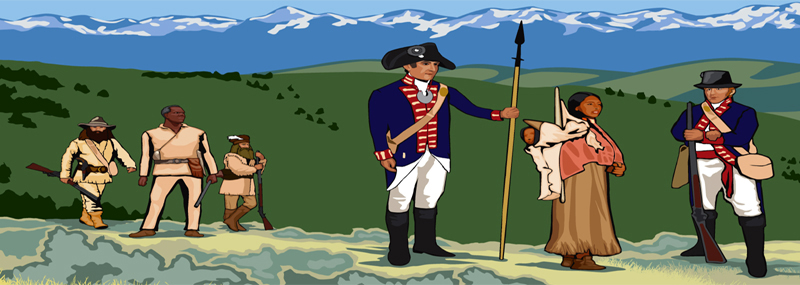
Lewis and Clark Expedition by the Bureau of Land Management.
1806 – Pike’s Expedition was an exploratory expedition ordered by General James Wilkinson. An Army platoon under Captain Zebulon Pike unintentionally entered Spanish Mexico at the headwaters of the Rio Grande. Pike and his troops were made prisoners without resistance at a fort he constructed in present-day Colorado, taken to Mexico, and later released after the seizure of his papers.
1810 – Governor William C.C. Claiborne of Louisiana, on orders of President James Madison, occupied West Florida (Spanish territory) in dispute east of the Mississippi River as far as the Pearl River, later the eastern boundary of Louisiana. He was authorized to seize as far East as the Perdido River.
In 1812, Amelia Island and other parts of East Florida were still under Spanish rule, but the region became the site of the Patriot War. American-supported forces, including “Patriots” and U.S. Navy gunboats, invaded the region, capturing Fernandina on Amelia Island in March. The rebels then marched toward St. Augustine, hoping to take the capital and end Spanish rule, but the Spanish and their allies ultimately repelled them. This conflict was a complex incident of the time, involving U.S. expansionist ambitions, American frontiersmen, and a weakening Spanish colonial government.
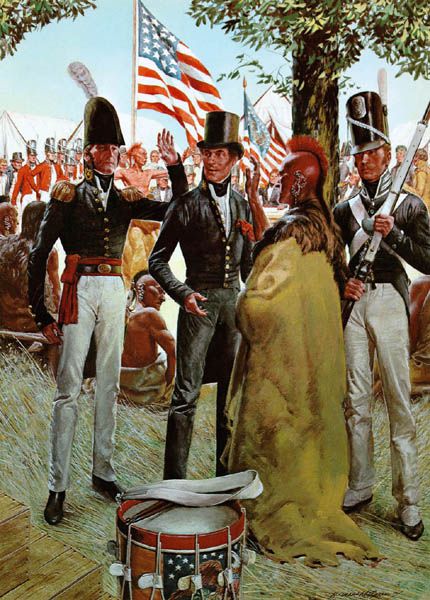
Soldiers in the War of 1812.
June 18, 1812 – December 24, 1814 – War of 1812. During the second “war of independence” against the British, the United States War Department reorganized after early mismanagement. Soldiers received more modern weapons and training and won a series of successful battles against the British. Notable battles include the defense of Fort McHenry near Baltimore, Maryland, which inspired the “Star-Spangled Banner,” and Major General Andrew Jackson’s victory at New Orleans, Louisiana, which led to United States control of the entire Mississippi Valley.
1813 – West Florida (Spanish territory) – On authority given by Congress, General Wilkinson seized Mobile Bay in April with 600 soldiers. A small Spanish garrison gave way. Thus, U.S. troops advanced into disputed territory to the Perdido River, as projected in 1810. There was no fighting.
1814 – Spanish Florida – General Andrew Jackson took Pensacola and drove out the British forces.
September 13-14, 1814 – The British failed to capture Baltimore, Maryland, when Fort McHenry withstood a naval bombardment.
January 8, 1815 – Battle of New Orleans. British forces were repulsed at Chalmette Plantation by American troops under the command of Andrew Jackson.
1815-1840 – During this period, the United States Army focused on internal threats and on exploration of the country’s South and West, often engaging in conflicts between settlers and Native Americans. West Point expanded and was the only school in the country producing qualified engineers until 1835. The Army established a professional system of branch schools and journals. Its medical corps contributed significantly to the study of smallpox vaccination and other illnesses.
1817-1818 – First Seminole War.
1823 – Arikara War – The first Plains Indian War between the United States and the western Native Americans.
1835-1842 – In the Florida Territory, the United States Navy supported the Army’s efforts to quell uprisings and attacks on civilians by Seminole Indians. The government’s efforts to relocate the Seminole to the area West of the Mississippi River were hindered by seven years of war.
1844: Mexico – President John Tyler deployed U.S. forces to protect Texas against Mexico, pending Senate approval of a treaty of annexation (which was later rejected). He defended his action against a Senate resolution of inquiry.
1835-1842 – Second Seminole War.
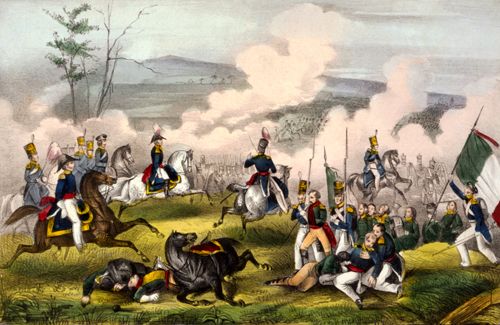
The Battle of Palo Alto took place on May 8, 1846, printed by E.B. and E.C. Kellogg,1846.
May 8, 1846 – Battle of Palo Alto.
May 13, 1846 to February 2, 1848 – Mexican-American War. In 1846, President James Polk ordered Brigadier General Zachary Taylor to the Rio Grande to establish a border with Mexico. When hostilities broke out, the Army employed rapid horse-drawn artillery to overcome Mexican forces. General Winfield Scott successfully marched to Mexico City and other key towns, while Colonel Stephen Kearney’s Army of the West secured territories that later became California, Arizona, and New Mexico. Officers such as Robert E. Lee, Ulysses S. Grant, and George McClellan participated in these campaigns. More than 17,000 United States soldiers were killed or wounded in this war.
March 9, 1847 – American forces land at Vera Cruz.
From August 20 to September 1847, battles around Mexico City resulted in the defeat of the Mexican Army and the capture of the capital.
On February 2, 1848, the Mexican-American War ended with the signing of the Treaty of Guadalupe Hidalgo. The treaty gave the U.S. undisputed control of Texas, established the U.S.-Mexican border of the Rio Grande, and ceded to the United States the present-day states of California, Nevada, Utah, Arizona, New Mexico, Wyoming, and parts of Colorado. In return, Mexico received U.S. $18,250,000 (about $663,000,000 in 2024)—less than half the amount the U.S. had attempted to offer Mexico for the land before hostilities began.
1857-1858 – The Utah War, a dispute between Mormon settlers in Utah Territory and the United States federal government, occurred. The Mormons and Washington, D.C., each sought control over the territory’s government, with the national government prevailing. The confrontation between the Mormon militia and the U.S. Army involved some destruction of property, but no actual battles between the contending military forces.
1861-1865 – Civil War – A major war between the United States (the Union) and eleven Southern states, which declared that they had a right to secession and formed the Confederate States of America.
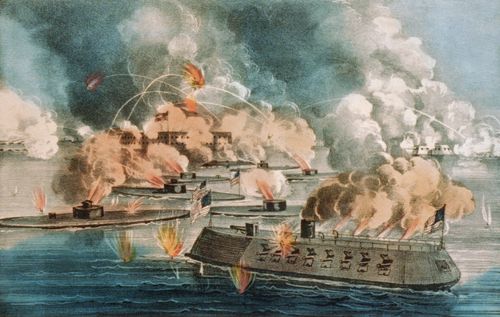
The great fight at Fort Sumter, South Carolina, April 7, 1863, by Currier & Ives.
April 12-13, 1861 – Confederate batteries bombarded Fort Sumter in Charleston harbor, South Carolina.
April 15, 1861 – President Abraham Lincoln called for 75,000 volunteers to augment the reduced Regular Army.
July 21, 1861 – First battle of Bull Run in Manassas, Virginia. Union forces of 38,000 men led by Brigadier Irvin McDowell attacked 32,000 Confederate forces led by Brigadier General P.G.T. Beauregard. The Confederates successfully counterattacked and pushed McDowell’s forces back to nearby Washington, D.C. Total casualties were close to 5,000, and the retreating Union forces lost huge caches of equipment. The battle forced the Union Army to reexamine its officer corps and develop new battle tactics.
1862-1890 – The Army engaged in an almost continuous series of campaigns and battles with Native American tribes on the western frontier.
April-July 1862 – The Peninsula Campaign ends outside Richmond with the U.S. forces under McClellan defeated by Confederate forces under Robert E. Lee.
April 6-7, 1862 – Battle of Shiloh, Tennessee.
September 17, 1862 – Battle of Antietam, Maryland.
December 12-14, 1862 – Battle of Fredericksburg, Virginia.
March 3, 1863 – Congress passed the Enrollment Act, which established national conscription.
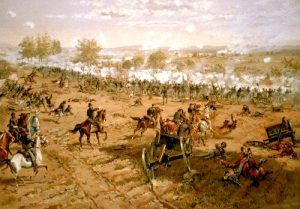
Battle of Gettysburg, Pennsylvania.
July 1-3, 1863 – Battle of Gettysburg, Pennsylvania.
July 4, 1863 – Vicksburg, Mississippi, surrendered.
July 18, 1863 – The 54th Massachusetts, an African-American regiment, leads the assault on Battery Wagner near Charleston, South Carolina.
September 18-20, 1863 – Battle of Chickamauga, Georgia.
March 9, 1864 – Ulysses S. Grant is promoted to lieutenant general and appointed as General-in-Chief of all Union armies.
May-June 1864 – Grant’s Overland Campaign in Virginia.
May-September, 1864 – Sherman’s Atlanta Campaign culminates in the capture of Atlanta, Georgia, on September 2.
July 1864-April 1865 – Siege of Petersburg, Virginia.
November 15 -December 21, 1864 – Union General William T. Sherman’s “March to the Sea” ends with the capture of Savannah, Georgia.
November 30, 1864 – Battle of Franklin, Tennessee.
December 15, 1864 – Battle of Nashville, Tennessee.
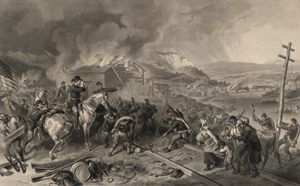
General William T. Sherman’s March to the Sea.
January- April 1865 – General William Sherman’s Carolina Campaign.
April 9, 1865 – Robert E. Lee surrendered to Ulysses S. Grant at Appomattox Court House in Virginia. Nearly a million men were killed or wounded in this war. The Union Army continued to occupy the South to enforce Congress’s “Reconstruction” policy. The last federal troops were not withdrawn until 1877.
1865-1877 – In the Southern United States, Reconstruction followed the Civil War, and the South was divided into five Union-occupied districts under the Reconstruction Act.
1866-1868 – Red Cloud’s War was fought between the Lakota Sioux, Cheyenne, and Arapaho over control of the Powder River Country and the security of the Bozeman Trail in Wyoming and Montana. The allied Indian tribes won the Fetterman Fight and negotiated favorable peace terms in the Treaty of Fort Laramie (1868), which established the Great Sioux Reservation.
1874 – The Honolulu Courthouse riot occurred. From February 12 to 20, detachments from American vessels were landed to protect the interests of Americans living in the Hawaiian Kingdom during the coronation of King Kalākaua.
1876-1877 – The Great Sioux War in the Dakota Territory, Wyoming Territory, and Montana Territory was an armed conflict between the Lakota Sioux and Cheyenne and the U.S. government over possession of the Black Hills following the discovery of gold there. Despite Native American victories like the Battle of the Little Bighorn, the U.S. government prevailed, forcing the tribes back onto their reservations.
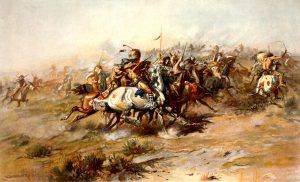
Battle of the Little Bighorn by C.M. Russell.
June 25, 1876 – Battle of the Little Bighorn in Montana
July 15-19, 1878 – During the Lincoln County War in New Mexico, the Battle of Lincoln occurred. At that time, 150 cavalrymen arrived from Fort Stanton, New Mexico, under the command of Lieutenant George Smith, to assist the Murphy-Dolan Faction in attacking the Lincoln County Regulators vigilante group. Five were killed, and 8-28 were wounded.
In 1787, Delegates to the Constitutional Convention formed a permanent military force comprising a regular army, a navy, and a militia. Congress placed it under civilian control, with Congress in charge of appropriations and the president as commander in chief.
December 29, 1890 – The Wounded Knee Massacre occurred at the Pine Ridge Indian Reservation in South Dakota. Soldiers of the U.S. Army’s 7th Cavalry killed 178 Lakota Sioux following an incident over a disarmament inspection at a Lakota Sioux encampment near Wounded Knee Creek. The massacre resulted in 89 Indians injured, and 150 were reported missing. Army casualties were 25 killed and 39 wounded.
April 11 to 13, 1892 – The Johnson County War took place in Wyoming. The U.S. Cavalry was sent to break up a gun battle at the TA Ranch.
In July 1892, the Homestead Strike Occurred. On July 6, striking miners attacked Pinkerton National Detective Agency agents who were attempting to break the strike by bringing non-union workers into the mine. As a result, 6,000 Pennsylvania state militiamen were sent to reinstate law and order, resulting in 6 dead and 27 to 47 wounded.
In 1794, President George Washington first used the permanent Army to help restore order to a tax rebellion by Pennsylvania farmers.
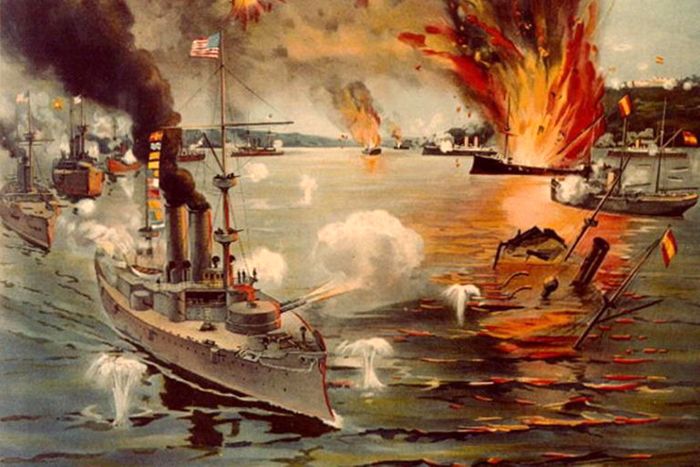
Spanish-American War.
April 25 to August 12, 1898 – The Spanish-American War took place. This was America’s first global conflict. President William McKinley ordered the Army to lead an expeditionary force to Cuba. Equipped with faster breech-loading rifles and rapid-firing Gatling guns, Army forces, including Colonel Teddy Roosevelt’s Rough Rider cavalry regiment, routed the Spanish forces. United States Army troops were also sent to oust Spanish forces in Puerto Rico and in the faraway Philippines, where 11,000 United States soldiers fought a protracted, bloody conflict against local insurgents. The Army effectively controlled the Philippines until 1902, when it returned the country to civilian control.
1899-1913 – In the Philippine-American War, U.S. forces protected American interests following the war with Spain, defeating Filipino revolutionaries seeking immediate national independence. The U.S. government declared the insurgency officially over in 1902, when the Filipino leadership generally accepted American rule. However, skirmishes between government troops and armed groups lasted until 1913, and some historians consider these unofficial extensions of the war.
In November 1901, Secretary of War Elihu Root directed the establishment of the Army War College to improve the Army’s education system. Also, it reorganized the Army’s outmoded system of bureaus, introducing a chief-of-staff system to facilitate long-term warfare planning and an improved promotion system for officers. He also improved the Army’s cooperation with the National Guard and the Navy.
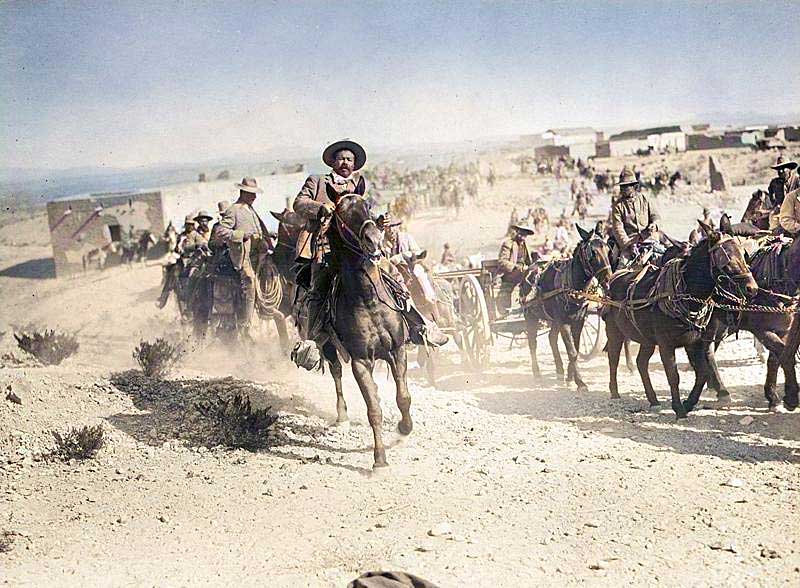
Pancho Villa at Columbus, New Mexico.
1914-1917: Mexico: The Tampico Affair led to the Occupation of Veracruz, Mexico. Undeclared Mexican-American hostilities followed the Tampico Affair and Pancho Villa’s raids. Also, the Pancho Villa Expedition—an abortive military operation conducted by the United States Army against the forces of Francisco “Pancho” Villa from 1916 to 1917, which included the capture of Veracruz. On March 19, 1915, on orders from President Woodrow Wilson, and with tacit consent from Venustiano Carranza. General John J. Pershing led an invasion force of 10,000 men into Mexico to capture Pancho Villa.
April 6, 1917 – The United States entered World War I, and the Army rapidly mobilized and modernized. It grew to 225,000 men while developing new weapons, such as tanks, long-range artillery, and aircraft, which became essential in the new global conflict. Led by Commanding General Pershing, the Army employed eight regular army divisions, 17 National Guard Divisions, and 17 newly formed National Army divisions in combat operations in France.
May 18, 1917 – The Selective Service Act was passed, initiating the first draft since the Civil War.
May 28-31, 1918 – The First Division under the command of Major General John Pershing fought the first major American battle of World War I against the German 18th Army at Cantigny. In a three-day seesaw battle with experienced German troops, American forces suffered heavy casualties. The army learns hard lessons about fighting open trench warfare and long-range artillery with infantry formations.
1918-1919: Mexico – After the withdrawal of the Pershing expedition, U.S. troops entered Mexico in pursuit of bandits at least three times in 1918 and six times in 1919. In August 1918, American and Mexican troops fought at Nogales in the Battle of Ambos Nogales.
November 11, 1918 – The Armistice ended fighting on the Western Front. Although the United States entered the war late, the total American casualties were 320,000.
In the 1930s, the Army focused on domestic problems, responding to the effects of the Great Depression at President Franklin Roosevelt’s request. Army officers organized the Civilian Conservation Corps, which employed over three million Americans, and the Army responded to various domestic problems.
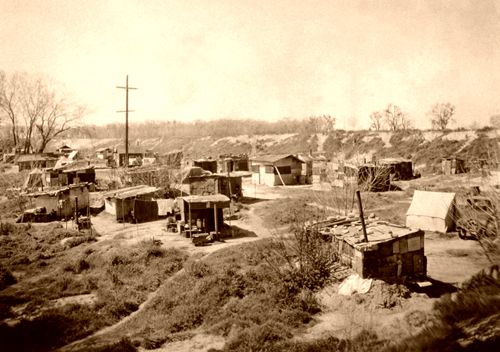
A Hooverville in Sacramento, California.
On July 28, 1932, the United States ‘ “Bonus Army” of 17,000 World War I veterans and 20,000 family members was cleared from Washington, D.C., and the Anacostia Flats “Hoovervilles” by the 3rd Cavalry and 12th Infantry Regiments under General Douglas MacArthur and Major Dwight D. Eisenhower.
September 16, 1940 – President Roosevelt signed the first peacetime Selective Service and Training Law. Army Chief of Staff General George Marshall greatly expanded and modernized the Army under the nation’s first peacetime draft. Marshall eliminated the horse-drawn cavalry and focused on modern mechanized armored units perfected by the Germans. It conducted massive maneuvers in Louisiana and the Carolinas to test its new equipment and division structures.
December 8, 1941 – The U.S. declared war on Japan following the attack on Pearl Harbor, Hawaii. U.S. forces in the Philippines surrendered to the Japanese. By that time, the Army had over 1.6 million men in uniform. On December 11, Nazi Germany and Fascist Italy declared war against the United States.
June 6, 1944 – D-Day landings in Normandy.
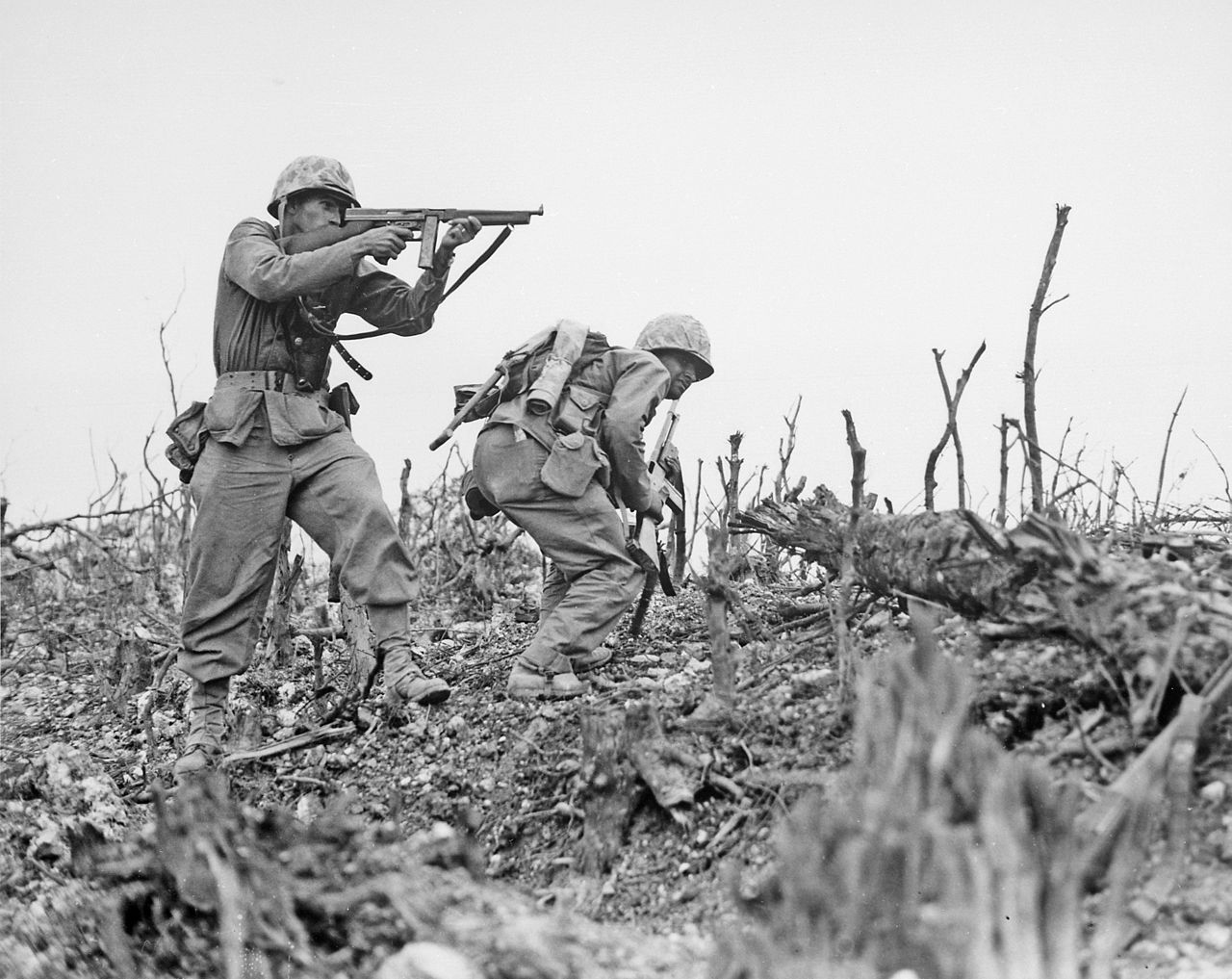
World War II Soldiers.
April 1, 1945 – American forces land on Okinawa, Hawaii.
May 8, 1945 – Victory in Europe. Germany surrenders.
September 2, 1945 – Victory over Japan. The Japanese surrender ceremony occurs aboard the United States Missouri in Tokyo Bay. By the end of the war, the army had more than 8 million men in uniform.
July 26, 1947 – President Harry S. Truman signed the National Security Act into law. The act established a “National Military Establishment” consisting of three military departments (Army, Navy, and Air Force) and a Secretary of Defense.
June 25, 1950, to July 27, 1953 – Korean War. The United States responded to the North Korean invasion of South Korea by going to its assistance, pursuant to United Nations Security Council resolutions. U.S. forces deployed in Korea exceeded 300,000 during the last year of the active conflict (1953). Over 36,600 U.S. military personnel were killed in action.
July 27, 1953 – An armistice was signed, ending the Korean War. Over 130,000 United States soldiers, sailors, and airmen were killed or wounded in the conflict.

Vietnam War.
1955-1975 – Vietnam War – U.S. military advisers had been in South Vietnam for a decade, and their numbers had been increased as the military position of the Saigon government became weaker. After citing what he falsely termed were Vietnam People’s Navy attacks on U.S. destroyers, in what came to be known as the Gulf of Tonkin incident, President Lyndon B. Johnson asked in August 1964 for a resolution expressing U.S. determination to support “freedom and protect peace in Southeast Asia.” Congress responded with the Gulf of Tonkin Resolution, granting President Johnson authorization to use conventional military force in Southeast Asia without a formal declaration of war. Following this resolution, and following a communist attack on a U.S. installation in central Vietnam, the United States escalated its participation in the war to a peak of 543,000 military personnel by April 1969.
January 27, 1973 – Paris Peace Accords signed, effectively ending American involvement in Vietnam. Over 200,000 United States forces were killed or wounded in action in Vietnam.
This was followed by the withdrawal of United States forces and a stinging defeat for the poorly motivated South Vietnamese army in 1975.
1980s – After the United States’ pullout from Vietnam, the Army reorganized as an all-volunteer force and received a significant funding boost from the Reagan Administration. Money poured into new weapon systems such as the M1 Abrams tank to strengthen Army forces in Europe. The Army also formed a rapid-deployment force to prepare for potential Soviet threats in regions such as the Middle East.
August 2, 1990 – Iraqi forces invade Kuwait. Operation “Desert Shield” of the Gulf War began. President George Bush sent General Norman Schwarzkopf to build up a United States-led coalition force of 500,000 at the Saudi Arabian border.

Operation Desert Storm.
January 17, 1991 – Operation “Desert Storm” began with air strikes in Iraq and Kuwait.
February 24-28, 1991 – Coalition ground forces attacked Iraqi positions and within 100 hours eliminated 36 Iraqi divisions, captured 60,000 Iraqi forces, and destroyed 4,000 tanks. United States forces killed or wounded a total of fewer than 800.
October 7, 2001 – Operation “Enduring Freedom” began in Afghanistan.
March 19, 2003 – Operation Iraqi Freedom began.
December 13, 2003 – Soldiers captured Saddam Hussein from the 1st Brigade, 4th Infantry Division.
December 18, 2011 – The last American combat troops left Iraq.
October 26, 2014 – The United States officially ended combat operations in Afghanistan after 13 years.
©Kathy Alexander/Legends of America, updated September 2026.
Also See:

U.S. Cavalry.
Sources:
Public Broadcasting Service
U.S. Army Center of Military History
Wikipedia – Military Operations
Wikipedia – History of the U.S. Army