

U.S. Military Academy, West Point, New York, photo by Cadet Zachary Brehm.
The United States Military Academy, commonly known as West Point, is a U.S. service academy in West Point, New York, that educates cadets to serve as commissioned officers in the United States Army. Founded in 1802, the academy is the oldest of the five American service academies. The Army has occupied the site since establishing a fort there in 1780 during the American Revolution. It was initially established as a fort on strategic high ground overlooking the Hudson River, 50 miles North of New York City.
The United States Military Academy at West Point’s mission is: To educate, train, and inspire the Corps of Cadets so that each graduate is a commissioned leader of character committed to the values of Duty, Honor, Country, and prepared for a career of professional excellence and service to the nation as an officer in the United States Army.
The military program instills in cadets the foundational military competencies needed to serve and succeed in a complex world, while inspiring them to achieve professional excellence. The Commandant of Cadets oversees the program, and a team of military and civilian professionals administers it, dedicated to building, educating, training, and inspiring the Corps of Cadets to become commissioned leaders of character committed to Army values and ready for a lifetime of service to the Army and nation.
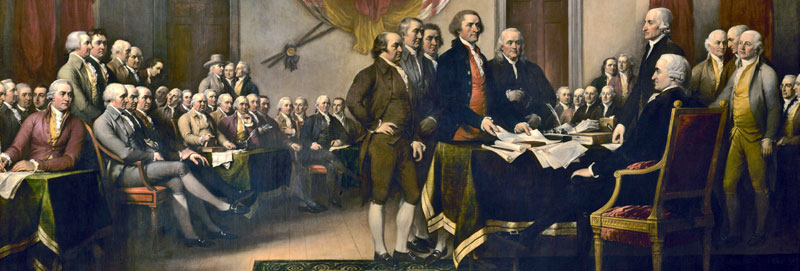
Continental Congress.
The academy traces its earliest roots to the 1776 Continental Congress authorization to establish a “Corps of Invalids.” This organization would “give service to disabled officers,” with one mission being to impart “military knowledge to young gentlemen.” General George Washington considered West Point to be the most strategically important location in America.
The harsh Winter of 1777-1778 froze the Hudson River, allowing elements of the Connecticut militia under the command of General Samuel Holden Parsons to march westward across the river. They first occupied West Point on January 27, 1778, making it the longest continually occupied post in the United States.
In 1778, George Washington selected Thaddeus Kosciuszko, a Polish engineer, to design West Point’s fortifications. Washington later transferred his headquarters to the vicinity of West Point in 1779. Kosciuszko’s small garden retreat still stands today.

West Point on the Hudson River, 1874.
To defend this crucial section of the river, several forts and redoubts were constructed. The closest to the river was Fort Clinton, which was initially named Fort Arnold in honor of his victory at Saratoga in 1777. Today, the remains of this fort can be seen on the western edge of the Plain, located between Thayer Road and the Hudson River. A few hundred feet higher in elevation stands Fort Putnam, near the site of the current Michie Stadium.
A series of smaller redoubts was built to protect these two forts. Several of these redoubts are still visible today, including Redoubt Four, which is located at the highest point of the academy, and Redoubt Seven, which is situated across the river on Constitution Island.
George Washington stationed his headquarters there in the summer and fall of 1779. After his victory over the British Army at the Battle of Yorktown, Washington kept the Continental Army garrisoned nearby at New Windsor at the New Windsor Cantonment until the official end of the war.
Continental Soldiers constructed forts, gun batteries, and redoubts, and installed a 65-ton iron chain across the Hudson River to block British invasions along the main transportation waterway.
The Great Chain and the elevated ground above the narrow “S” curve in the Hudson River allowed the Continental Army to prevent British ships from sailing upriver and splitting the colonies. Because of the river’s unique bend, ships of that era had to slow to a near stop to navigate the turn. Although the chain was never tested in battle, it effectively served its purpose by hindering British movement upstream.
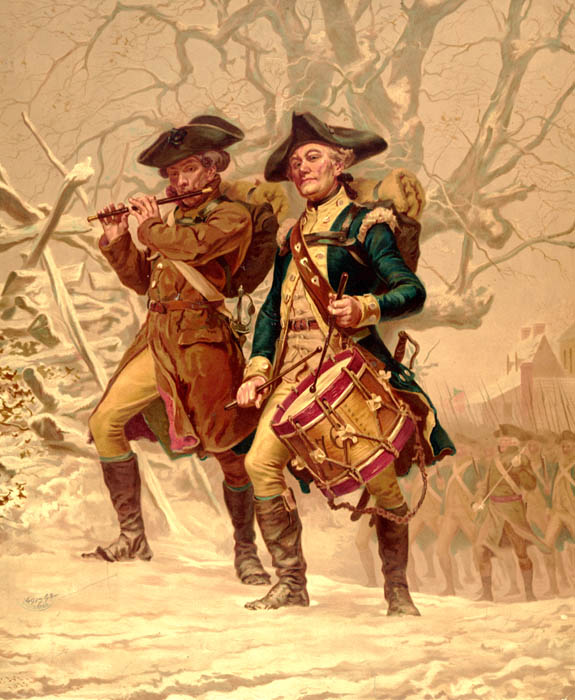
Continental Soldiers by Frank B. Mayer, 1875.
Fortress West Point was never captured by the British, despite Major General Benedict Arnold’s infamous act of treason when he attempted to sell it to the British in 1780.
The “Corps of Invalids” relocated to the garrison at West Point in 1781; however, few officers reported for duty, and it was disbanded following the end of the war in 1783.
In the years immediately following the Revolutionary War, West Point was the largest post in the Army, with more than half of the approximately 100 authorized men in the entire Army stationed there.
The Continental Army occupied the land for 12 years until Secretary of the Treasury Alexander Hamilton authorized its purchase for $11,085 in 1790.
In the 1790s, several distinguished Americans, including President Washington and most of his cabinet, wanted to establish an institution devoted to the art and science of warfare to train and develop Army officers. However, the proposal met opposition, especially from Secretary of State Thomas Jefferson, who objected to the concept because he opposed professional armies and the officer class so prominent in Europe.
Cadets underwent training in artillery and engineering studies at the garrison beginning in 1794. During the Quasi-War, Alexander Hamilton laid out plans to establish a military academy at West Point. He introduced “A Bill for Establishing a Military Academy” in the House of Representatives.
In 1801, shortly after his inauguration as president, Thomas Jefferson realized the importance of defending the new republic against possible invasion. He directed that plans be initiated to establish the United States Military Academy at West Point. He appointed Jonathan Williams as its first superintendent. The Academy fell under the auspices of the U.S. Army Corps of Engineers, and all the superintendents from 1801 to 1866 were engineer officers. Congress formally authorized the school’s establishment and funding with the Military Peace Establishment Act of 1802, which Jefferson signed on March 16. The academy officially commenced operations on July 4, 1802. The academy graduated its first official graduate, Joseph Gardner Swift, in October 1802.
Joseph Gardner Swift returned to West Point as Superintendent from 1812 to 1814. In its tumultuous early years, the academy featured few standards for admission or length of study. Cadets ranged in age from 10 to 37 and attended for between six months and six years. The impending War of 1812 caused Congress to authorize a more formal system of education at the academy and increased the size of the Corps of Cadets to 250. By the time of the War of 1812, only 89 officers had graduated, morale was low, and the academy was in danger of being disbanded.

Colonel Sylvanus Thayer.
Alden Partridge served as Superintendent from 1814 to 1817 and selected the gray uniforms students still wear today.
In 1817, Colonel Sylvanus Thayer, considered the “Father of the Military Academy, became the Superintendent and established the curriculum, elements of which are still in use. Thayer instilled strict disciplinary standards, set a standard course of academic study, and emphasized honorable conduct. He also created a teaching method known today as the Thayer Method, which emphasizes self-study, daily homework, and small class sizes. He also made civil engineering the foundation of the curriculum. For the first half-century, United States Military Academy graduates built most of the nation’s early railway lines, bridges, harbors, and roads. This tradition continues with the U.S. Army Corps of Engineers. The academy was the only engineering school in the country until Rensselaer Polytechnic Institute was founded in 1824. Its engineering curriculum was so successful that it significantly influenced every American engineering school founded before the Civil War. Thayer served as Superintendent until 1933. The tradition of the class ring began during Thayer’s tenure in 1835, when the first such university in the U.S. adopted it. After Thayer’s tenure, the academy faced challenges to its relevance, as many new Western State congressmen saw it as a breeding ground for an elitist, aristocratic Officer Corps.
In 1835, during the Army’s first year of the Second Seminole War, they had only three generals: Winfield Scott, Edmund P. Gaines, and Thomas S. Jesup. The Army’s remaining 14 generals held only brevet ranks, and none of them were West Point graduates. Nearly the only way to obtain a commission up to that time was through the academy, which raised loud complaints and added to the deep desire of the era’s Jacksonian Democracy “to get rid of the Academy, where, Jacksonians were sure, an aristocratic tradition was being bred.”
“It could not stand on more appropriate ground, and any ground more beautiful can hardly be.”
— Charles Dickens, after visiting the academy in 1841
During the 19th Century, United States Military Academy graduates were primarily responsible for building the nation’s earliest waterways, infrastructure, harbors, and the Washington Monument, as well as conducting surveys for future transcontinental railroads.
The Mexican-American War brought the academy to prominence as graduates proved themselves in battle for the first time. Future Civil War commanders Ulysses S. Grant and Robert E. Lee, who later became the academy’s superintendent, first distinguished themselves in battle in Mexico. In all, 452 of 523 graduates who served in the war received battlefield promotions or awards for bravery.
The school modernized rapidly during the 1850s. New barracks provided better heating and gas lighting, while new ordnance and tactics training incorporated advanced rifle and musket technology and accommodated transportation advances made possible by the steam engine.

Cadets Headquarters at the U.S. Military Academy by Detroit Photographic Co., 1901.
Robert E. Lee, a Confederate Civil War general who graduated from West Point in 1829, served as its Superintendent from 1852 to 1857.
In 1857, West Point began the current process of admitting candidates nominated by the members of the United States Congress, one for each congressional district.
After gaining experience and national recognition during the Mexican and antebellum Indian Wars, West Point graduates dominated the highest ranks in both the Federal and Confederate armies during the Civil War. When the war broke out, West Point graduates filled the general officer ranks of the rapidly expanding Union and Confederate armies. Some of these included Generals Ulysses S. Grant (Class of 1843), William T. Sherman (Class of 1840), Philip Sheridan (Class of 1853), and hundreds of others served for the Union Army, while some 304 graduates rejected their oath of allegiance to the United States and served in armed rebellion in the Confederate States Army. Two hundred ninety-four graduates served as general officers for the Union, and 151 served as general officers for the Confederacy. Of all living graduates at the time of the war, 105 (10%) were killed, and another 151 (15%) were wounded in action. Nearly every general officer of note from either Army during the Civil War was a graduate of West Point, and a West Point graduate commanded the forces of one or both sides in every one of the 60 major battles of the war.

U.S. Military Academy’s Civil War Battle Monument.
Immediately after the Civil War, the academy gained unprecedented fame because its graduates played a significant role in the war. At that time, tradition and austere discipline ruled the Corps of Cadets for the next several decades.
In 1870, the first black cadet, James Webster Smith of South Carolina, was admitted. Besides the integration of southern-state and black cadets, the post-war academy also struggled with the issue of hazing. In its first 65 years, hazing was uncommon or nonexistent beyond minor pranks played on incoming freshmen. However, the tone grew harsher as Civil War veterans began to fill the incoming freshman classes. The upper-class cadets saw it as their duty to “teach the plebes their manners.”
During this time, African American cadets entered the Academy and endured “silencing”— the practice of isolating unwanted cadets and intimidating them to resign. As a result, James Smith endured harsh treatment and was eventually dismissed for academic deficiency under controversial circumstances in 1874. Afterward, Henry O. Flipper of Georgia became the first black graduate in 1877, graduating 50th in a class of 76. Two other Black cadets graduated by the turn of the century. During this era, young commissioned officers served in the Indian Wars on the frontier army, facing the harsh realities of guerrilla warfare against skilled warriors. Two of the most notable graduates from this period were George Washington Goethals, class of 1880, and John J. Pershing, class of 1886. Goethals gained prominence as the chief engineer of the Panama Canal.
The Army-Navy football rivalry began in 1890 with a Navy victory at West Point, followed by the Army avenging the loss in Annapolis the following year. The academy’s other major sports teams began play during this period.

Army-Navy football in 1924.
The demand for junior officers during the Spanish-American War prompted the class of 1899 to graduate early.
By 1900, the academy admitted 12 African American cadets, with three graduating. Despite the low graduation rate, admitting African American cadets to West Point was unusual and progressive for the country as a whole at the time. By this time, the academy’s curriculum had shifted from a heavy focus on engineering to a more comprehensive education. The control of the academy was changed from the Corps of Engineers to the Secretary of War, and for the first time, Superintendents were not from the Engineer Branch. As the “Gilded Age” saw a blossoming of liberal arts education in the private sector, West Point struggled to adapt its engineering-heavy curriculum to the times.
The wars in Cuba at the turn of the 20th Century spurred Congress to authorize an increase in the Corps of Cadets to 481 in 1900. That year, hazing at the academy entered the national spotlight with the death of former cadet Oscar L. Booz on December 3, 1900. Congressional hearings, which included testimony by cadet Douglas MacArthur, investigated his death and the pattern of freshmen’s systemic hazing.
The Philippine-American War created another demand for junior officers in the class of 1901.
The period between 1900 and 1915 saw a construction boom as much of West Point’s old infrastructure was rebuilt. Many of the academy’s most famous graduates graduated during the 15 years between 1900 and 1915: Douglas MacArthur (1903), Joseph Stilwell (1904), Henry “Hap” Arnold (1907), George S. Patton (1909), Dwight D. Eisenhower, and Omar Bradley (both 1915). The class of 1915 is known as “the class the stars fell on” because an exceptionally high percentage of general officers rose from that class (59 of 164).
The period between 1900 and 1915 saw a construction boom as much of West Point’s old infrastructure was torn down and rebuilt. A new administration building, barracks, academic building, riding hall, gymnasium, and a cadet chapel were all completed by 1914.
In 1916, Congress increased the Corps of Cadets to 1,332.

Generals Obregon, Villa, and Pershing meet during happier times at Fort Bliss, Texas, August 27, 1914. George S. Patton is behind Pershing and to the right.
General John J. Pershing gained fame for his exploits against the notorious Pancho Villa in Mexico.
Perhaps the most remarkable engineering feat in world history was the Panama Canal, completed in 1914 under the direction of Colonel George W. Goethals (Class of 1880), an Army engineer.
In World War I, many graduates distinguished themselves on the battlefield, led by General John J. Pershing (Class of 1886), who commanded the American Expeditionary Force, comprising over two million American soldiers in Europe. Five classes graduated early to provide new officers at the front.
After the war, sweeping revisions and modernizations to the curriculum followed, driven by dramatic developments in science and technology and the emergence of new, younger, reform-minded leaders. One such leader was Brigadier General Douglas MacArthur (Class of 1903), who served as Superintendent from 1919 to 1922. He sought to bring his war experience to the Corps of Cadets through an intensive physical fitness program and realistic combat training for modern warfare, away from the Plains of West Point. MacArthur pushed major changes in physical fitness by establishing intramural programs and decreeing, “Every cadet an athlete.” He also worked to end hazing by placing Army sergeants in charge of training incoming freshmen during freshman summer. Hazing continued at some levels well into the late 20th century, but is no longer allowed today. MacArthur also established the cadet-run Honor System in 1922.
West Point became an officially accredited institution with the Association of American Universities in 1925 and, in 1933, officially began granting the title of Bachelor of Science to all graduates.
In 1935, the United States Congress increased the Corps of Cadets to 1,960. As more cadets filled the barracks and classrooms, the academy undertook and completed another building program by 1938.
Just before World War II, the academy expanded the reservation boundaries, growing to nearly 15,000 acres, which it comprises today.

Grant Hall at the U.S. Military Academy in West Point, New York. Photo by the Detroit Photographic Co., 1901.
In 1942, Congress expanded the Corps of Cadets to 2,496 members, and the United States Military Academy returned to a three-year course of study. The Class of 1943 graduated six months early in January 1943, and subsequent classes graduated within three years through 1947. During this period, military training became a priority, and summer training was moved to a newly acquired area that later became Camp Buckner. The academy graduated over 1,000 pilots between 1943 and 1946; however, nearly 500 of its graduates lost their lives during World War II.
Critics in Congress argued that the accelerated curriculum allowed young men to avoid combat. A proposal to convert the academy into an officer training school on a six-month schedule was ultimately rejected. West Point played a significant role during the war, with four of the five five-star generals being alumni.
In 1945, Maxwell Taylor (Class of 1922) became Superintendent, marking the beginning of the modern era at the Military Academy. Taylor expanded department sizes, added several new professors, abolished antiquated courses in fencing and horsemanship, inserted the study of amphibious operations into the military curriculum, and added courses in nuclear physics, electronics, and communications. In response to Eisenhower’s belief that American leaders needed to understand the psychology of the citizen soldier, the curriculum added courses in leadership and applied psychology. These changes provided graduates with a better understanding of how to motivate and lead the soldiers of a free society. Coursework in the humanities and social sciences increased to 40% of a cadet’s total workload.
After the U.S. Air Force became a separate service in 1947, and until the graduation of the first United States Air Force Academy class in 1959, West Point cadets who met the eligibility standards could apply to be commissioned as Air Force officers.
Unlike previous conflicts, the Korean War did not disrupt class graduation schedules. Over half of the Army’s leadership during the war consisted of West Point graduates. The Class of 1950, which graduated only two weeks before the war’s outbreak, suffered some of the heaviest casualties of any 20th-century class and became known, somewhat sourly, as “the class the crosses fell on.” A total of 157 alumni perished in the conflict.
In 1956, Garrison H. Davidson became Superintendent and implemented several reforms, including refining the admissions process, modifying the core curriculum to include electives, and raising the academic standards for academy instructors. During the 1960s, the Corps expanded to 4,400 cadets, prompting proportional growth in the barracks and academic support structures.

West Academic Building at the U.S. Military Academy, in West Point, New York, by Jet Lowe, 1982.
Based on the significance of both the Revolutionary War fort ruins and the military academy itself, the majority of the academy area was declared a National Historic Landmark in 1960.
Additional construction took place between 1964 and 1968, including the construction or renovation of new barracks and academic buildings.
West Point was not immune to the social upheaval of American society during the Vietnam War. In 1968, the first woman joined the faculty of the all-male institution amidst controversy. West Point granted its first honorable discharge in 1971 to Cornelius M. Cooper, an African American cadet from California who applied for conscientious objector status in 1969. The academy struggled to fill its incoming classes as its graduates led troops in Southeast Asia, where 333 graduates lost their lives.
In 1975, Congress passed legislation allowing women to enroll at the federal service academies for the first time. The following summer, 119 women arrived at West Point for Cadet Basic Training as part of the Class of 1980. Four years later, 62 women graduated, with Andrea Hollen, a Rhodes Scholar, as the first woman to graduate academically.

Females are allowed to enroll in the Military Academy.
Currently, women make up approximately 15% of incoming freshmen. They undergo the same academic and professional training as their male peers, although with different physical aptitude standards for the Army Physical Fitness Test and the Indoor Obstacle Course Test. Additionally, women participate in boxing during their freshman year of physical education, just like their male counterparts.
In 1985, cadets were formally authorized to declare an academic major; all previous graduates had been awarded a general Bachelor of Science degree. Five years later, the Fourth Class System underwent a major revision, as the Cadet Leader Development System became the guiding framework for developing all four classes.
Following the September 11, 2001, attacks, applications for admission to the academy increased dramatically, security on campus was increased, and the curriculum was revamped to include coursework on terrorism and military drills in civilian environments. One graduate was killed during the 9/11 terrorist attacks, and 90 graduates died during operations in Afghanistan, Iraq, and the ongoing Global War on Terror.
In 2008, gender-neutral lyrics were incorporated into West Point’s “Alma Mater” and “The Corps,” replacing lines like “The men of the Corps” with “The ranks of the Corps.”
After the Don’t Ask, Don’t Tell policy was lifted on September 20, 2011, the academy began admitting and retaining openly gay cadets. By March 2012, cadets were forming a gay-straight alliance group called Spectrum. By March 2015, Spectrum had two faculty members and 40 cadet members, a mixture of gay, straight, bi, and undecided.

Brigadier General Diana Holland.
Brigadier General Diana Holland became West Point’s first woman Commandant of Cadets in January 2016.
After the ban on transgender service members was lifted in 2016, the Class of 2017 saw the first openly transgender graduate. However, she was denied a commission and was honorably discharged.
In 2020, the campus faced its first major pandemic in a century, with COVID-19 limiting classes and forcing the traditional Army-Navy football game to be relocated to ensure social distancing. For the first time in many years, the 121st iteration of the game was held at West Point rather than the traditional Lincoln Financial Field in Philadelphia. Ultimately, West Point beat Navy 15–0.
In 2025, a new Cyber Engineering Academic Center is expected to be completed, modernizing the United States Military Academy’s engineering, technology, and cyber education capabilities.
Academy graduates have excelled in academia, business, science, government, and the military. Seventy-seven have received the Medal of Honor; two (Grant and Eisenhower) were presidents of the United States, and many are senior Army leaders today.
Today, the West Point student body consists of approximately 4,000 students. In addition to the Corps of Cadets, West Point is home to approximately 1,300 active-duty soldiers and approximately 3,000 family members. A civilian workforce of approximately 5,000 personnel supports the academy’s mission.
All cadets reside on campus for their entire four years in one of the nine barracks buildings. Most cadets are housed with one roommate, but some rooms are designed for three cadets. All companies live together in the same barracks area. On weekdays, all cadets dine together for breakfast and lunch in Washington Hall.
The Academy graduates approximately 1,000 to 1,200 cadets each year, who are commissioned as second lieutenants in the U.S. Army. The exact number can vary slightly by class, but this range is typical in recent years.
The four-year coeducational federal service academy comprises approximately 16,000 acres. It is one of the four U.S. military service academies, and one of the five U.S. service academies. As a military installation, West Point is a self-contained city and America’s oldest continuously occupied military post. It borders the town of Highland Falls.
West Point fields 15 men’s and nine women’s National Collegiate Athletic Association sports teams. Cadets compete in one sport every fall, Winter, and spring season at the intramural, club, or intercollegiate level. Its football team was a national power in the early and mid-20th Century, winning three national championships. Its alumni are collectively referred to as The Long Gray Line, which includes U.S. presidents Dwight D. Eisenhower and Ulysses S. Grant; Confederate president Jefferson Davis; Confederate general Robert E. Lee; American poet Edgar Allan Poe; U.S. generals Douglas MacArthur and George Patton; presidents of Costa Rica, Nicaragua, and the Philippines; and 76 Medal of Honor recipients.
The 31,000-square-foot Malek West Point Visitors Center, located just outside the Thayer Gate in the village of Highland Falls, offers guided tours. These tours, which are the only way the general public can access the academy grounds, leave the visitor center several times a day.

West Point Museum.
The West Point Museum is located directly adjacent to the visitor center, in the renovated Olmsted Hall on the grounds of the former United States Military Academy at West Point. Originally opened to the public in 1854, the West Point Museum is the oldest military museum in the country. During the summer months, the museum provides access to the Fort Putnam historic site on the main post and access to the 282-acre Constitution Island. Notable items on display include George Washington’s pistols, Napoleon’s sword, a dagger Hermann Göring carried when he was captured, a revolver belonging to Göring, and a silver-plated party book signed by Charles Lindbergh, Herbert Hoover, and Mussolini, among others. Additionally, a gold-plated Liliput pistol that belonged to Adolf Hitler is also on display.
More Information:
United States Military Academy at West Point
606 Thayer Rd, West Point, NY 10996
©Kathy Alexander/Legends of America, October 2026.
Also See:
Notable and Historic U.S. Military Bases
Soldiers and Officers in American History
War & Military in the United States
Sources:
Encyclopedia Britannica
Military Installations
Wikipedia – Military Academy
Wikipedia – Military Academy History