

Civil War on the Plains.
From 1861 to 1865, the Civil War focused on Northern efforts to prohibit slavery in western territories, including the Great Plains. Most battles occurred east of the Mississippi River. Federal officials considered the Western Theater secondary. Withdrawing regular troops from the Plains, they recruited volunteers, most of whom served in militias, to stay in the West and fight Native Americans.

Albert Sidney Johnston.
The secession of Texas and ten other Southern states from the Union in 1860 and 1861 did not end the military contest in the southern Plains. Among the earliest episodes that drew attention to the Western departments was the resignation of Albert Sidney Johnston, the Commander of the Department of the Pacific, who resigned on April 9, 1861, when his home state of Texas seceded from the Union. Still, he stayed at his post until his successor arrived. Afterward, he traveled across New Mexico to join the Confederate forces. From various directions, federal troops were sent to head him off, but he evaded them all and reached safety at the Rio Grande by August 1. Here, he could take an overland stage for the rest of his journey. The department he abandoned included all of the West, beyond the Rocky Mountains, except Utah and New Mexico. The country between the mountains and Missouri constituted the Department of the West.

Cherokee Chief John Ross.
John Ross, principal chief of the Cherokee Nation, tried to maintain his neutrality at the commencement of the conflict. Still, the fiction of Indian nationality was too thin for his effort to succeed. During the spring and summer of 1861, he struggled against the Confederate control, to which he succumbed by August, when Confederate troops had overrun most of Indian Territory, and disloyal Indian agents had surrendered United States property to the enemy. The following war resembled the guerrilla conflicts of Kansas, with the addition of the Indian element.
The fact that the fate of the United States’ outlying colonies should have aroused grave concerns at the beginning of the Civil War is unsurprising. The silver mines of the Santa Cruz Valley had drawn the American population to Tubac and Tucson, Arizona, several years before the war. California and Oregon, Carson City, Nevada, Denver, Colorado, and the other mining camps were indeed on the same continent as the contending factions. Still, the degree of their isolation was so great that an ocean might have as well separated them. Their inhabitants were more mixed than those of any portion of the older states, while in several of the communities, the parties were so evenly divided as to raise doubts of the loyalty of the whole.
The Confederate successes in the upper Rio Grande in the summer of 1861 had compelled the federal evacuation of the district. Colonel Edward Canby stripped the frontier forts and concentrated his forces on the Rio Grande to meet the Confederate threat to New Mexico. He devoted his small force to regaining the country around Albuquerque and Santa Fe. At the same time, the relief of the forts between the Rio Grande and the Colorado River was entrusted to General James Carleton’s California Column.
The struggle for the Rio Grande was as important as any of the military operations on the plains. At the beginning of the war, the Confederate forces seized the river around El Paso, Texas, in time to make clear the way for General Joseph E. Johnston as he hurried east. The Tucson, Arizona country was occupied at about the same time, so in the fall of 1861, the Confederate outposts were somewhat beyond the line of Texas, and the Rio Grande, with New Mexico, Utah, and Colorado threatened. In December, General Henry Hopkins Sibley assumed command of the Confederate troops in the upper Rio Grande, while Colonel Edward Canby, from Fort Craig, New Mexico, organized the resistance against further extension of the Confederate power.
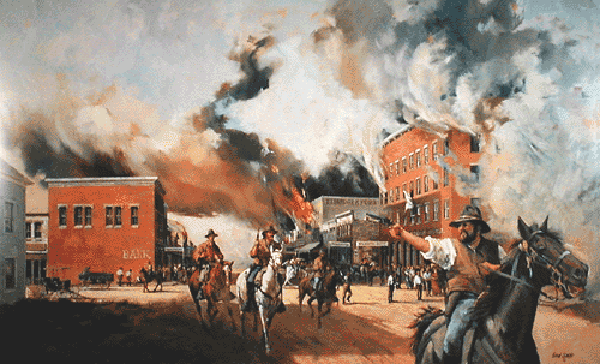
Border War between Missouri and Kansas.
Western campaigns along the frontier of struggle received little attention from the authorities, who directed weightier movements at the center. Less formal than these and more provocative of bitter feelings were the attacks of guerrillas along the central frontier—chiefly the Missouri border and eastern Kansas. Here, the passions of the struggle for Kansas had not entirely cooled down; southern sympathizers were easily found, and communities divided among themselves were the more intense in their animosities.
“The malignant secession element of this Territory,” wrote Governor William Gilpin of Colorado in October 1861, “has numbered 7,500. It has been ably and secretly organized from November last and requires extreme and extraordinary measures to meet and control its onslaught.” At best, the western population was scanty and scattered over a frontier that still possessed its virgin character in most respects. However, it was hovering on the edge of a transition period.
The Department of Kansas, where the most aggravated of these guerrilla conflicts occurred, was organized in November 1861 under Major-General David Hunter. From his headquarters at Fort Leavenworth, the commanding officer directed the affairs of Kansas, Nebraska, Dakota, Colorado, and “the Indian Territory west of Arkansas.” The department was often shifted and reshaped to meet the needs of the frontier.
By no means did all the Indians accept the Confederate control. When the Indian Territory forts—Gibson, Arbuckle, Washita, and Cobb—fell into the hands of the South, loyal Indians left their homes and sought protection within the United States lines. Almost the only way to fight a war where a population is generally divided is through depopulation and concentration. Along the Verdigris River, in southeast Kansas, these Indian refugees settled in 1861 and 1862, numbering 6,000. Here, the Indian Commissioner fed them as best he could and organized them to fight when that was possible. With the return of federal success in the occupation of Fort Smith and western Arkansas during the next two years, the natives began to return to their homes. However, the relationship between their tribes and the United States was tainted. The compulsory cession of their western lands, which came at the conflict’s close, belongs to a later chapter and the beginnings of Oklahoma. Here, as elsewhere, the condition of the tribes was permanently changed.
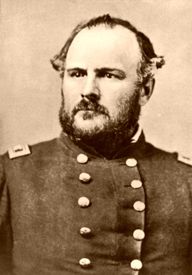
John M. Chivington.
As Sibley pushed up the river, passing Fort Craig, New Mexico, and brushing aside a small force at Valverde, the Colorado forces reached Fort Union, New Mexico. Between Fort Union and Albuquerque, which Sibley entered easily, was the turning point in the campaign. On March 26, 1862, Major John M. Chivington had a successful skirmish at Johnson’s ranch in Apache Canyon, about 20 miles southeast of Santa Fe. Two days later, at Pigeon’s Ranch, a more decisive check was given to the Confederates. Still, Colonel John P. Slough, senior volunteer in command, fell back upon Fort Union after the engagement, while the Confederates were left free to occupy Santa Fe. A few days later, Slough was deposed in the Colorado regiment, Chivington made colonel, and the advance on Santa Fe began again. Sibley, now caught between Canby advancing from Fort Craig and Chivington coming through Apache Canyon from Fort Union, evacuated Santa Fe on April 7, returning to Albuquerque. The Union troops, taking Santa Fe on April 12, hurried down the Rio Grande after Sibley in his final retreat. New Mexico was saved, and its security brought tranquillity to Colorado. The Colorado volunteers were back in Denver for the winter of 1862-1863. Still, Gilpin, whose vigorous and independent support had made possible their campaign, had been dismissed from his post as governor.
Bushwhacking, a composite of private murder and public attack, troubled the Kansas frontier from an early period of the war. Public animosities and difficulties in suppressing them easily arose, because the participating parties quickly retired into the body of peace-professing citizens. In it, asserted General Order No. 13 of June 26, 1862, “rebel fiends lay in wait for their prey to assassinate Union soldiers and citizens; it is therefore… especially directed that whenever any of this class of offenders shall be captured, they shall not be treated as prisoners of war but be summarily tried by drumhead court-martial, and if proved guilty, be executed… on the spot.”
The factors that had the greatest impact in shaping the course of the Great Plains during the Civil War were a mixed population, ever-present Indian danger, and isolation. Though the plains did not affect the war’s outcome, the war furthered the work already underway of making the West known, clearing off the Indians, and preparing for future settlement.
Like the rest of the United States, the West was organized into military divisions, for whose good order commanding officers were responsible. At times, the burden of military control fell chiefly upon the shoulders of territorial governors; at other times, special divisions were organized to meet particular needs, and experienced generals were detached from the main armies to direct movements in the West.

Colonel James H. Carleton.
After May 1862, General James Carleton was firmly established in Tucson and was later given command of the whole Department of New Mexico. There was almost no fighting with the Confederates. Instead, he prosecuted the Apache and Navajo wars and exploited the new gold fields that were now found. In much of the West, as in New Mexico, occasional ebullitions of Confederate sympathizers occurred, but the military task of the commanders was easy.
As the war advanced, new military departments were created, and boundaries were conveniently shifted. The Department of the Pacific remained an almost constant quantity throughout. A Department of the Northwest, covering the territory of the Sioux Indians, was created in September 1862 for the better defense of Minnesota and Wisconsin. Pope was assigned to this command after his removal from the command of the Army of Northern Virginia. Until the close of the war, when the great leaders were distributed, and General Phillip Sheridan received the Department of the Southwest, no detail of equal importance was made to a Western department.
The fighting on the plains was rarely important enough to receive the dignified name of battle. There was plenty of marching and reconnoitering, much police duty along the trails, occasional skirmishes with organized troops or guerrillas, aggressive campaigns against the Indians, and campaigns in defense of the agricultural frontier. But the armies so occupied were small and inexperienced. Commonly, regiments of local volunteers were used in these movements, or returned captives who were on parole to serve no more against the Confederacy. Disciplined veterans were rarely to be found. Due to the spasmodic character of the plains warfare and the inferior quality of the troops available, Western movements were often hampered and occasionally made useless.
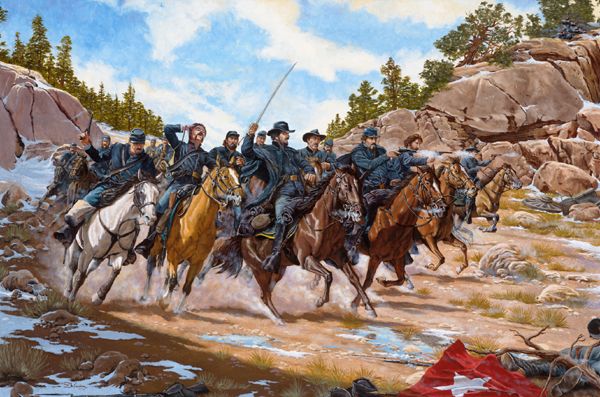
Colorado Volunteers.
Sibley’s manifest intentions against the upper Rio Grande country, around Santa Fe and Albuquerque, aroused federal apprehensions in the winter of 1862. Governor Gilpin, at Denver, was already frightened at the danger within his territory and scarcely needed the order from Fort Leavenworth, Kansas, through General David Hunter to reinforce Canby and look after the Colorado forts. He took responsibility easily, drew upon the federal treasury for funds that had not been allowed him, and shortly had the first Colorado and a part of the Second Colorado volunteers marching south to join the defensive columns. It is difficult to define this march in terms applicable to wartime movements. At least one soldier in the Second Colorado took with him two children and a wife, the last becoming the historian of the regiment and praising the chivalry of the soldiers, apparently oblivious of the fact that it is not a soldier’s duty to be a child’s nurse to his comrade’s family. But with wife and children and the degree of individualism and insubordination that these imply, the Pike’s Peak frontiersmen marched south to save the territory. Their patriotism, at least, was sure.
During the war, military campaigns of dislocation and pacification continued in the Plains and in the lands to the west of the United States. Some tribal governments allied themselves with the Confederacy and some with the Union, with varied consequences for land ownership after the war.
In 1863, after the Sioux outbreak, the Department of the Northwest was removed from it, its name was changed to Missouri, and the states of Missouri and Arkansas were added to it. Still later, it was modified again. But here, throughout the war, the troubles produced by the mixture of frontier and farmlands, partisan whites, and Indians continued.
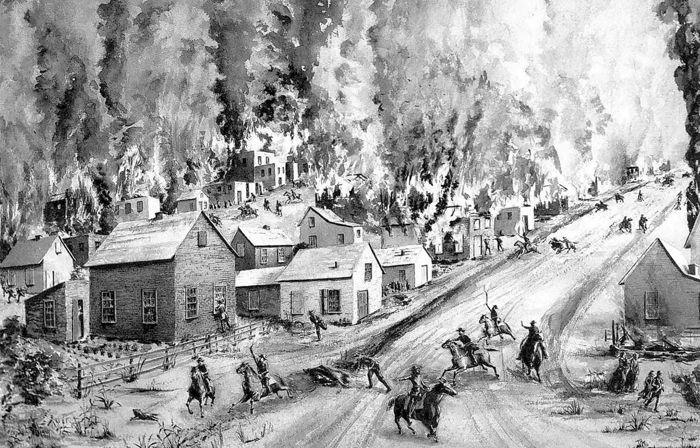
Lawrence Massacre by Lauretta Louise Fox Fiske.
In August 1863, William Quantrill’s notable raid, the Lawrence Massacre, into Kansas to terrify the border was already harassed enough. The old border hatred between Kansas and Missouri had been intensified by the “murders, robberies, and arson,” which had characterized the irregular warfare carried on by both sides. In western Missouri, loyal unionists were not safe outside the federal lines; here, the guerrillas came and went at pleasure, and here, about August 18, Quantrill assembled a band of about 300 men for a foray into Kansas. On August 20, they entered Kansas, heading at once for Lawrence, which he surprised on the 21st. Although the city arsenal contained plenty of arms and the town could have mustered 500 men on “half an hour’s notice,” the guerrilla band met no resistance. It “robbed most of the stores and banks, and burned 185 buildings, including one-fourth of the private residences and nearly all of the business houses of the town, and, with circumstances of the most fiendish atrocity, murdered 140 unarmed men.” A vigorous federal pursuit and partial devastation of the adjacent Missouri counties followed Quantrill’s retreat. Kansas, indignant, was in arms at once, protesting directly to President Abraham Lincoln of the “imbecility and incapacity” of Major-General John M. Schofield, commanding the Department of the Missouri, “whose policy has opened Kansas to invasion and butchery.” Instead of carrying out an unimpeded pursuit of the guerrillas, Schofield had to devote his strength to keeping the state of Kansas from declaring war against and wreaking indiscriminate vengeance upon the state of Missouri. A year after Quantrill’s raid came General Sterling Price’s Missouri expedition, with its pitched battles near Kansas City and Westport and its pursuit through southern Missouri, where Confederate sympathizers and the partisan politics of this presidential year made punitive campaigns anything but easy.
An English observer, hopeful for the worst, announced in the middle of the Civil War that:
“When that ‘late lamented institution, the once United States, shall have passed away, and when, after this detestable and fratricidal war—the most disgraceful to human nature that civilization ever witnessed—the New World shall be restored to order and tranquility, our hunters will not forget, that a single fortnight of comfortable travel suffices to transport them from fallow deer and pheasant shooting to the haunts of the bison and the grizzly bear. There is little chance of these animals being ‘improved off’ the Prairies, or even of their becoming rare during the lifetime of the present generation.”
The military problem of the plains was one of police, with the extinction of guerrilla warfare and the pacification of Indians as its chief elements. The careers of Canby, Carleton, and Gilpin indicate the nature of Western strategic warfare; Schofield illustrates that of guerrilla fighting and the Minnesota outbreak of Indian relations.
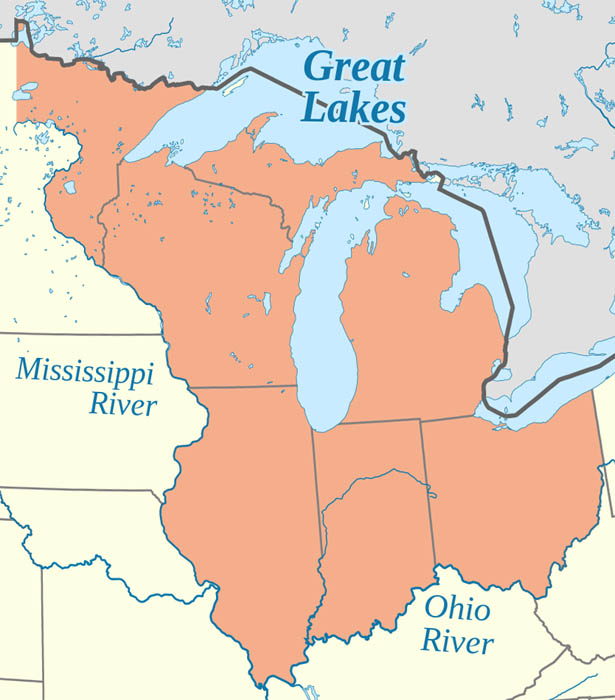
Old Northwest Territory, 1787.
In the Old Northwest, where the agricultural expansion of the 1850s had worked such great changes, the pressure on the tribes had steadily increased. In 1851, the Sioux bands ceded most of their territory in Minnesota and agreed upon a reduced reserve in the St. Peter’s, or Minnesota Valley. However, the terms of this treaty had been delayed in enforcement, while poor management by the United States and the habitual disregard for Indian rights created tense feelings that might break out at any time. No single grievance of the Indians caused more trouble than that over traders’ claims. The improvident Indians bought largely from the traders, on credit, at extortionate prices. The traders could afford the risk because, when treaties of cession were made, their influence generally secured a clause in the treaty to satisfy claims against individuals from tribal funds before these were handed over to the Indians. The memory of the Indian was short, and when he found that his allowance, the price for his lands, had gone into the traders’ pockets, he could not realize that it had gone to pay his debts but felt, somehow, defrauded. The answer would have been to prevent trade with the Indians on credit. However, the traders’ influence in Washington, D.C. was great. Investigating the connection between traders’ bills and agitation for new cessions would be interesting since the latter generally meant satisfying the former.
Among the Sioux, factionalism aroused the apprehensions of their agents before the war broke out. The “blanket” Indians continually mocked the “farmers” who took kindly to the efforts of the United States for their agricultural civilization. There was civil strife among the progressives and irreconcilable differences, making it difficult to determine the nation’s disposition. The condition was so unstable that an accidental row, culminating in the murder of five whites at Acton in Meeker County, brought down the most serious Indian massacre the frontier had yet seen.
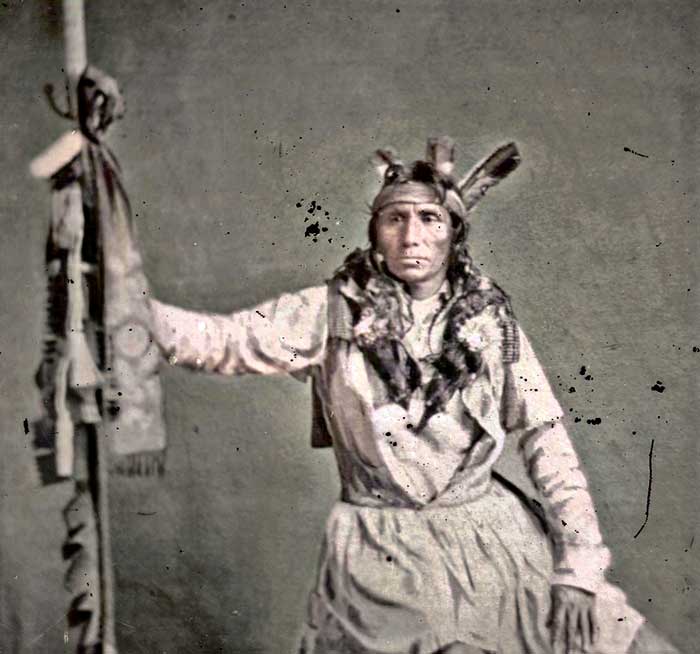
Dakota Chief Little Crow in Washington, D.C., 1858.
There was no more occasion for a general uprising in 1862 than there had been for several years. The wiser Indians realized the futility of such a course. Yet Little Crow, inclined though he was to peace, fell in with the radicals as the tribe discussed their policy, and he determined that since a massacre had been commenced, they had best make it as thorough as possible. Retribution was certain whether they continued the war or not, and the farmer Indians were unlikely to be distinguished from the blankets by angry frontiersmen. The attack fell first upon the stores at the lower agency, 20 miles above Fort Ridgely, where refugee whites fled to Fort Ridgely with news of the outbreak. All day on August 18, massacres occurred along St. Peter’s, from near New Ulm to the Yellow Medicine River. The incidents of the Indian war were all there, in surprise: the slaughter of women and children, mutilation, and torture.
The next day, the increasing bands fell upon the rambling village of New Ulm, 28 miles above Mankato, where fugitives had gathered and where Judge Charles E. Flandrau hastily organized a garrison for defense. He had been at St. Peter’s when the news arrived and had led a relief band through the drenching rain, reaching New Ulm in the evening. On Wednesday afternoon, Little Crow, his band still growing—the Sioux could muster some 1,300 warriors—surprised Fort Ridgely, though unsuccessfully. On Thursday, he renewed the attack with a dwindling force, as individual plundering expeditions drew his men to various parts of the neighboring country. On Friday, he attacked once more.
On Saturday, August 23, Little Crow came down the river again to renew his fight upon New Ulm, which, unmolested since Tuesday, had been increasing its defenses. Here, Judge Flandrau led out the whites in a pitched battle. A few of his men were old frontiersmen, cool and determined, of unerring aim, but most were German settlers who had recently arrived and were often terrified by their new experiences. During the week of horrors, the depredations covered the Minnesota frontier and lapped over into Iowa and Dakota. Isolated families, murdered and violated, or led captive into the wilderness, were common. Stories of those who survived these dangers make up a large part of the local literature in this section of the Northwest. At New Ulm, the situation had become so desperate that, on August 25, Flandrau evacuated the town and led the entire remaining population to safety in Mankato.
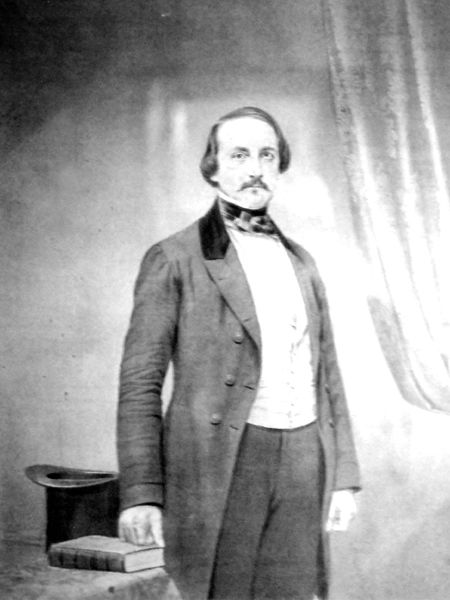
Henry Hastings Sibley.
Long before the week of suffering was over, aid had been sent to the harassed frontier. Governor Ramsey of Minnesota hurried to Mendota and organized a relief column to move up the Minnesota Valley. Quite different from him, who was of Rio Grande fame, Henry Hastings Sibley commanded the column and reached St. Peter’s on Friday with his advance. By Sunday, he had 1,400 men with whom to quiet the panic, restore peace, and repopulate the deserted country. He was now joined by Ignatius Donnelly, lieutenant governor, sent to urge greater speed. The advance was resumed. By Friday, August 29, they had reached Fort Ridgely, passing through the country “abandoned by the inhabitants; the houses, in many cases, left with the doors open, the furniture undisturbed, while the cattle ranged about the doors or through the cultivated fields.” The country had been settled up to the very edge of the Fort Ridgely reserve. It was entirely deserted, though only partially devastated. Donnelly commented in his report upon the prayer books and old German trunks of “Johann Schwartz,” strewn upon the ground in one place and upon bodies found “bloated, discolored, and far gone in decomposition.” The Indian agent, Thomas J. Galbraith, who was at Fort Ridgely during the trouble, reported in 1863 that 737 whites were known to have been massacred.
Sibley, having reached Fort Ridgely, proceeded at first to reconnoiter and bury the dead, then to follow the Indians and rescue the captives. More than once, the tribes had found that it was wise to carry off prisoners, who, by serving as hostages, might mollify or prevent punishment for the original outbreak. Early in September, there were pitched battles at Birch Coolie, Fort Abercrombie, and Wood Lake. At this last engagement, on September 23, Sibley was able not only to defeat the tribes and take nearly 2000 prisoners but to release 227 women and children, who had been the “prime object,” from whose “pursuit nothing could drive or divert him.” The Indians were handed over under arrest to Agent Galbraith to be conveyed first to the Lower Agency and then, in November, to Fort Snelling, Minnesota.
The punishment of the Sioux was heavy. Inkpaduta’s massacre at Spirit Lake was still remembered and unavenged. Sibley now cut them down in battle in 1862, though Little Crow and other leaders escaped. In 1863, Pope, who had been called to command a new department in the Northwest, organized a general campaign against the tribes, sending Sibley up the Minnesota River to drive them west and Sully up the Missouri River to head them off, planning to catch and crush them between the two columns. The maneuver was badly timed and failed, and punishment gradually drifted into a prolonged war.
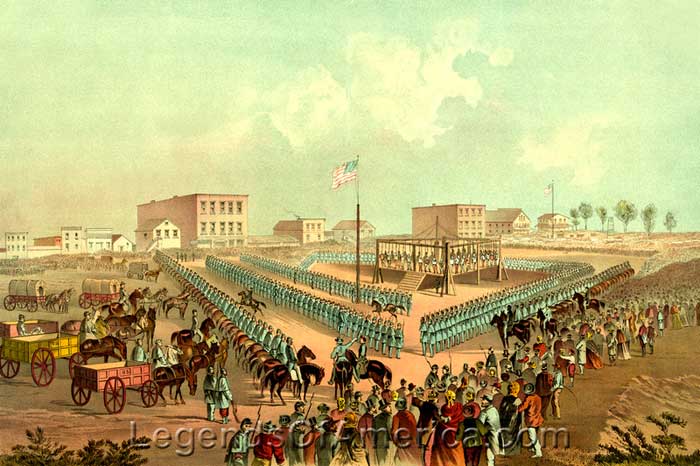
Execution of 38 Sioux, Mankato, Minnesota, December 26, 1862.
Civil retribution was more severe and fell, with judicial irony, on the Sioux farmer who had been drawn reluctantly into the struggle. At the Lower Agency, at Redwood, the captives were held while more than 400 of their men were singled out for a murder trial. Nothing is more significant of the anomalous nature of the Indian relation than this trial for the murder of prisoners of war. The United States held the tribes nationally accountable, yet it felt free to punish individuals as though they were its citizens. The military commission sat at Redwood for several weeks with the missionary and linguist, Reverend S.R. Riggs, “in effect, the Grand Jury of the court.” Ultimately, 303 men were condemned to death by the court for murder, rape, and arson, their condemnation starting a wave of protest over the country, headed by the Indian Commissioner, W. P. Dole. To the indignation of the frontier, naturally revengeful and never impartial, President Lincoln yielded to the protests in the case of most of the condemned. Yet 38 of them were hanged on a single scaffold at Mankato on December 26, 1862. The innocent and uncondemned were also punished when Congress confiscated all their Minnesota reserve in 1863 and transferred the tribe to Fort Thompson on the Missouri River, where less desirable quarters were found for them.
All along the edge of the frontier, from Minnesota to the Rio Grande, were problems that drew the West into the Civil War. The situation was trying for both whites and Indians, but nowhere did the Indians suffer between the millstones as they did in the Indian Territory (Oklahoma), where the Cherokee, Creek, Choctaw, Chickasaw, and Seminole had been colonized in the years of the creation of the Indian frontier. These nations had resided in comparative peace and advanced civilization for a generation, but were undone by causes beyond their control.
The Confederacy was no sooner organized than its commissioners demanded the allegiance and support of the tribes colonized west of Arkansas, professing to have inherited all the rights and obligations of the United States. For the Indian leaders, half-civilized and better, this demand posed difficulties that would have strained even the most seasoned diplomacy. If they remained loyal to the United States, the Confederate forces, adjacent to Arkansas and Texas and already coveting their lands, would cut them to pieces. If they adhered to the Confederacy and the latter lost, they might anticipate the resentment of the United States. Yet they were too weak to stand alone and were forced to go one way or another. The resulting policy was a temporary measure and brought them heavy punishment from both sides, as well as the United States’ subsequent wrath.
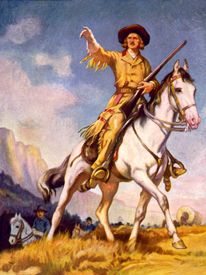
Kit Carson.
In 1863, Kit Carson led the Union Army in an attack on the Navajo in the American Southwest. Union Soldiers destroyed crops, orchards, livestock, and homes in a campaign to relocate the tribes to a federal reservation. Thousands of Navajo surrendered to U.S. troops in 1864. These men, women, and children were forced to walk 300 miles to Fort Sumner, New Mexico. This legendary “Long Walk” ended at a small, disease-filled camp that served as a Navajo prison for four years.
The Great Plains and the Far West were only the outskirts of the Civil War. At no time did they shape its course, for the Civil War was, from their point of view, only an incidental sectional contest in the East and merely an episode in the grander development of the United States. During the years of sectional strife, the West was occasionally connected with the struggle. At their close, it passed rapidly into a period where it became the admitted center of interest. The last stand of the Indians against the onrush of settlement is a warfare with an identity of its own.
Attacks against non-Indian travelers increased in early 1865, and for a month that spring, all contact between the city of Denver, Colorado, and points east was severed. Tribal economies could not long support such a conflict, however, and most native peoples of the central Plains soon returned to their normal patterns of life, the raids having satisfied their need for revenge. Midyear offensives by the army, in turn, failed to locate significant numbers of Indians. The prohibitive costs of the U.S. military campaigns, amounting to more than $20 million that year alone, the scathing humanitarian criticism of the butchery at the Sand Creek Massacre, and the general weariness after four long years of civil war led federal officials to sign peace agreements later in 1865 with a variety of Native American emissaries.
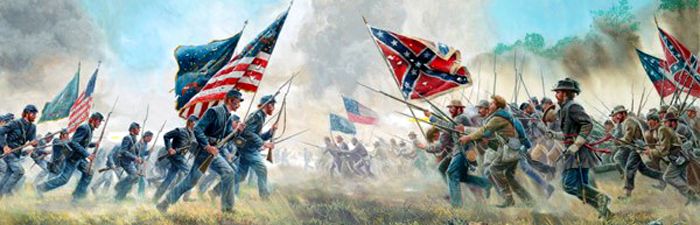
Civil War.
©Kathy Alexander/Legends of America, updated June 2026.
Also See:
Sources:
Encyclopedia Britannica
Encyclopedia of the Great Plains
Library of Congress
Paxson, Frederic L.; Last American Frontier, The MacMillan Company, New York, 1910.