

Treaty of Guadalupe Hidalgo Mexican Cession, courtesy Colorado Encyclopedia.
At the conclusion of the Mexican-American War, the Treaty of Guadalupe-Hidalgo was signed on February 2, 1848, in Guadalupe Hidalgo, a city located north of the capital, where the Mexican government had fled in the advance of U.S. forces.
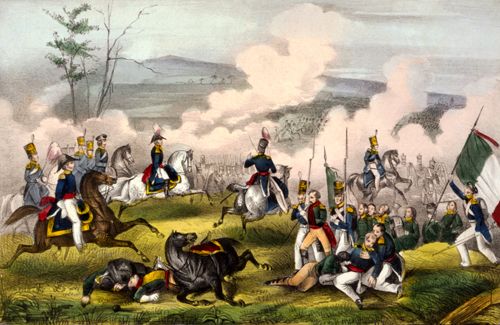
Mexican-American War.
With the defeat of its army and the fall of Mexico City, the capital, in September 1847, the Mexican government surrendered to the United States and entered into negotiations to end the war. The peace talks were negotiated by Nicholas Trist, chief clerk of the State Department, who had accompanied General Winfield Scott as a diplomat and President James Polk’s representative.
When the Senate ratified the treaty on March 10, 1848, it removed the guarantee of the protection of Mexican land grants. Following the ratification, the United States withdrew its troops from the Mexican capital.
By the treaty’s terms, Mexico ceded approximately 525,000 square miles (55% of its territory) in exchange for a $15 million lump sum payment and the assumption by the U.S. Government of up to $3.25 million worth of debts owed by Mexico to U.S. citizens.
The treaty extended the boundaries of the United States west to the Pacific Ocean, which included the present-day states of California, Nevada, Utah, New Mexico, most of Arizona and Colorado, and parts of Oklahoma, Kansas, and Wyoming. Mexico also relinquished all claims to Texas and recognized the Rio Grande as the southern boundary with the United States.
Other provisions included the protection of the property and civil rights of Mexican nationals and Indigenous communities living within the new boundaries of the United States, the United States’ commitment to policing its borders, and compulsory arbitration of future disputes between the two countries. Unfortunately, some of the guaranteed rights of Mexicans and Indigenous communities living in the ceded lands were often ignored by Americans moving west. Many of them lost their lands and rights, and some weren’t officially given citizenship until decades later.
The Treaty of Guadalupe Hidalgo was a massive win for the United States. Not since the Louisiana Purchase had so much new territory been added to the United States. Within no time, thousands of settlers began making their way to the new lands, and gold was discovered in California shortly thereafter: the new land would pay for itself almost immediately.
For Mexico, the Treaty of Guadalupe Hidalgo was a national embarrassment and a chaotic time when generals, politicians, and other leaders put their own self-interests above those of the nation. However, Mexican officials had little choice but to do so.
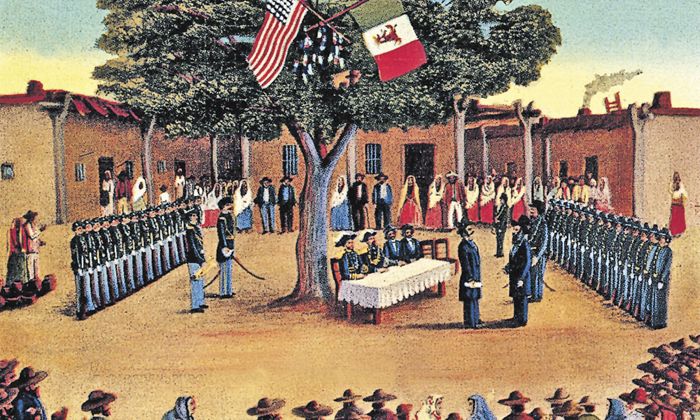
Gadsden Purchase Celebration in Mesilla, current-day New Mexico.
A subsequent treaty, the Gadsden Purchase, of December 30, 1853, altered the border by adding 47 more boundary markers to the original six.
As time passed, it became difficult to determine the exact location of the markers, with both countries claiming the originals had been moved or destroyed. To solve the problem, a convention was concluded between the two countries in the 1880s, and a survey was conducted to verify the need for a definite demarcation of the boundary. The International Boundary Commission was created to relocate the monuments and mark the boundary line. The U.S. commissioners employed a survey photographer to record various views of each monument located and erected by the U.S. Section.
This agreement, along with the 1853 Gadsden Purchase, created the southern border of the present-day United States.

Westward Expansion.
©Kathy Alexander/Legends of America, October 2025.
Also See:
Westward Expansion & Manifest Destiny
Sources: