
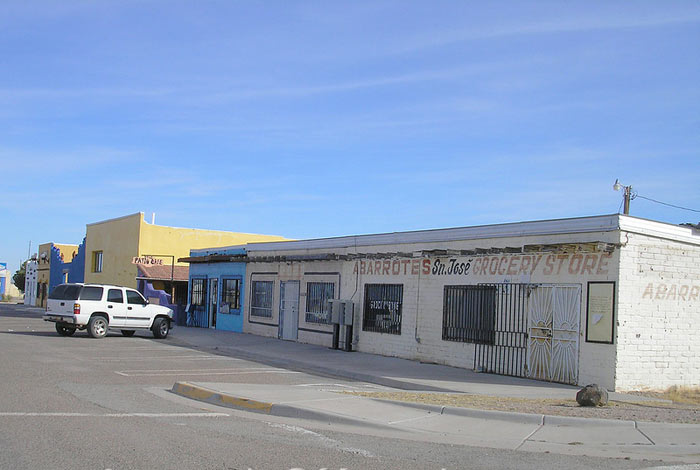
Columbus, New Mexico, Main Street. Photo by Kathy Alexander.
Columbus, New Mexico, was established in 1891 just across the Mexican border from Palomas, Chihuahua, Mexico, and was named after the 15th-century explorer Christopher Columbus.
The history of Columbus began on June 4, 1888, when Luis Huller signed a colonization contract with Carlos Pacheco, the Secretary of Public Works in Mexico City. Huller promised to transform the desert region into a place ripe for both agricultural production and cattle raising, but his promises did not come to fruition.
However, Huller’s efforts initially drew in a handful of settlers, including Columbus founder Colonel Andrew O. Bailey, who acquired extensive holdings just North of the Mexican border. Bailey, independently wealthy, held stock in Standard Oil and Hudson’s Bay Company.
In 1889, the Mexican government imprisoned Louis Huller for misappropriating the International Company’s funds, and his company began trying to sell the Palomas property.
In the meantime, the Baileys moved to the U.S. side of the border, into New Mexico, and he built a two-story frame house and began promoting Columbus Township. In the meantime, Bailey kept a suite at the Astor Hotel in New York City, where he met with prospective investors to promote railroad construction.
To this end, he invested heavily in a proposed railroad known as the Deming, Sierra Madre, and Pacific. John W. Young, a son of deceased Mormon leader Brigham Young, headed the venture. The proposed route would have connected Columbus with Salt Lake City, Utah, through the railroad hub of Deming, New Mexico, 34 miles North of Columbus. However, they didn’t follow through with the venture.
Although Columbus gained a post office in 1891, Bailey’s early efforts to promote the town were largely unsuccessful. However, the construction of another railroad signaled a brighter future for the village. In 1901, the Phelps Dodge Company proposed a line to connect its smelters in Douglas, Arizona, to the thriving industrial hub of El Paso, Texas. However, the railroad’s right of way was three miles North of the Columbus townsite.
El Paso & Southwestern Railroad.
With the arrival of the El Paso & Southwestern Railroad, the customs house was relocated to Columbus, making it the port of entry to Mexico and helping keep the small town intact. However, once the railroad line was in place, the capitalists who created the Columbus & Western New Mexico Townsite Company took control of the town’s development and proposed a new location to attract settlement.
By 1905, it was a tiny town with a population of about 100. At this time, Columbus had only one general store and a saloon.
In 1907, James W. Blair, John Ross Blair, Louis Hellberg, and Charles L. Higday came together to form the Columbus & Western New Mexico Townsite Company, and Higday platted the townsite not far from the Bailey home, directly adjacent to the border. That year, postmaster J.W. Blair started a mobile notions company, from which he sold buttons, thread, and other sewing accessories in towns across Kansas, Oklahoma, and Texas.
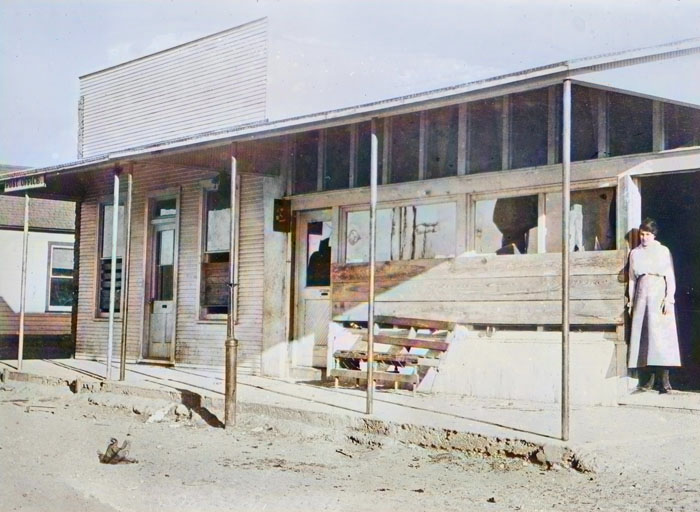
Columbus, New Mexico Post Office, by Bain News Service, 1916.
Higday’s partners, J.R. Blair and Lewis Hellberg, soon persuaded Bailey to relocate the town three miles North, placing it directly on the El Paso and Southwestern Railroad line. Bailey allowed the Townsite Company to take the reins to promote the village.
The Townsite Company soon published tracts, including the town newspapers, and organized excursions to advertise the benefits of living in the Lower Mimbres Valley. Editors of the Columbus News and its successor, the Columbus Courier, mailed copies of their newspapers to prospective settlers across the United States, and agents of the Townsite Company published pamphlets and flyers to promote the up-and-coming town.
The new townsite included about 200 acres purchased by the company’s members and registered in May 1909. Almost immediately, they initiated promotional activities. They organized an excursion on the El Paso & Southwestern Railroad that brought prospective buyers from El Paso to Columbus, where they enjoyed a barbecue and music.
At times, newspaper editor Perrow G. Mosely even argued that Columbus would exceed El Paso, Texas, in size and notoriety within only a few short years.
The endeavor was relatively successful, and many lots were sold to people like C.C. Parks, who drilled the first town well. Two more booster excursions from El Paso were organized within the next six months, and the Blair brothers and their partners made regular trips, mainly to California and the Midwest, to promote Columbus as the “Queen of the Mimbres.”
Between 1909 and 1911, almost every issue of the weekly newspaper reported on newcomers who either arrived to investigate the town’s opportunities or had purchased land in the area. The newspaper and the Townsite Company also strove to reframe preconceived ideas and stereotypes of the area, including images of dry, desert landscapes; lawlessness and disorder; and the presence of Spanish-speaking Mexican people.
Conveying the virtues of Columbus, the Town Company and the local newspaper portrayed Columbus as “The Only Port of Entry between Old Mexico and New Mexico,” and as a bastion of American political and economic values. They also emphasized irrigated farming, the cattle industry, and stockyards, American nationalism, and family values. They also promoted the idea that the arid local climate was conducive to good health.
“Her [New Mexico’s] people, proud of its resources, certain of its future, look upon Statehood as the beginning of a marvelous development era, which within a few years will place New Mexico among the most densely populated and prosperous of the western States.”
— Columbus Town Company
By 1910, a school had been constructed in town, and a local school board was in place to administer instruction.
“No man need be afraid to bring his children here, for no matter in what section he goes, he will find ample educational facilities.”
— Columbus Pamplet
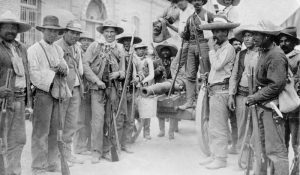
Mexican Revolution.
However, the boosters’ failure can largely be attributed to events in Mexico that were beyond the control of the Townsite Company or local newspaper editors. In November 1910, Francisco Madero’s Plan de San Luis Potosí launched the Mexican Revolution, aimed at ousting aging Mexican dictator Porfirio Díaz. Throughout 1911, pitched battles between federal and revolutionary armies took place at various sites along the U.S.-Mexican border.
Although these events transpired in and around Cíudad Juárez, Americans’ fears of Mexican insurgents perpetrating violence against smaller towns like Columbus had an enormous impact on their economies and development.
Columbus elites downplayed the potential for revolutionary violence spilling into the Lower Mimbres Valley, and the newspaper was reluctant to report on violence near the border. In February 1911, Troop C of the Fourth Cavalry was stationed at Columbus to guard against Mexican revolts. This increased the fears of would-be emigrants, but the boosters focused on the federal troops’ protection of Columbus’ property and lives. In fact, the newspapers incorporated the soldiers into social events and activities.
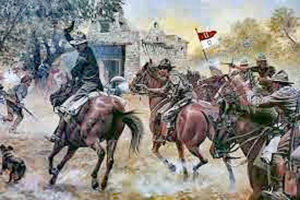
4th Cavalry from Fort Bliss, Texas.
The Fourth Cavalry was recalled to Fort Bliss in August 1911, leaving locals to infer that the worst in Mexico was over. Still, the resurgence of the civil war to the South of the border following the assassination of President Madero made the military presence permanent between 1913 and 1916.
By 1915, the town had 700 residents; the Columbus State Bank was built; four hotels were constructed; and several stores and a Baptist church were established. At that time, the area around Columbus also contained rich deposits of silver, copper, lead, and zinc.
By early 1916, Colonel Herbert Slocum of the 13th Cavalry was stationed in Columbus, as were other U.S. military officials along the border. At that time, news of impending attacks and potential cross-border raids poured in so frequently that they were taken with a grain of salt. There was no way to verify each one, and most turned out to be unfounded.
At approximately 4:00 a.m. on March 9, 1916, the rumors became reality when about 485 Mexican revolutionaries attacked the sleeping town of Columbus, New Mexico. Led by Mexican General Francisco “Pancho” Villa, the fighters quietly cut the barbed wire fence about three miles East of the border gate, and Colonel Candelario Cervantes led the advance guard across the border into the United States, filling the air with rifle fire and shouts of “Viva Villa! Viva Mexico!” They took the small town and its adjacent military encampment of the 13th Cavalry, Camp Furlong, completely by surprise. At the same time, other officers moved against various other targets in town, including the Commercial Hotel, the Columbus State Bank, and the Lemmon and Romney store.
The ensuing battle lasted for about six hours as Villa’s Army burned a part of the town and killed ten civilians and eight soldiers before retreating into Mexico. The death toll for Villa’s men was 70 to 75. The raid shattered lives and completely devastated Columbus’ central business district. The infrastructure was never rebuilt, and the attack signaled the death of the Town Company’s dreams for Columbus.
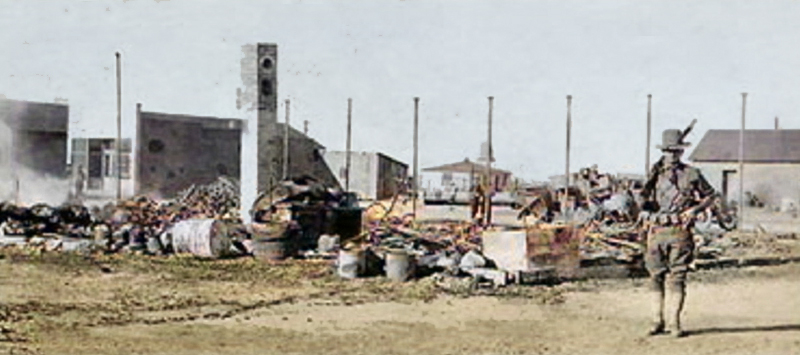
Smoking ruins of Columbus, New Mexico, after Pancho Villa’s Raid in 1916.
Afterward, Colonel Frank Tompkins and other members of the 13th Cavalry pursued the Mexican into Chihuahua, Mexico, for almost four additional hours. The assault was the only ground invasion of the continental United States after the War of 1812.
By March 10, just one day after the raid, the first of several thousand troops began to arrive in Columbus. By late 1916, due to the growth of the camp population, Columbus had the largest population of any city in New Mexico.
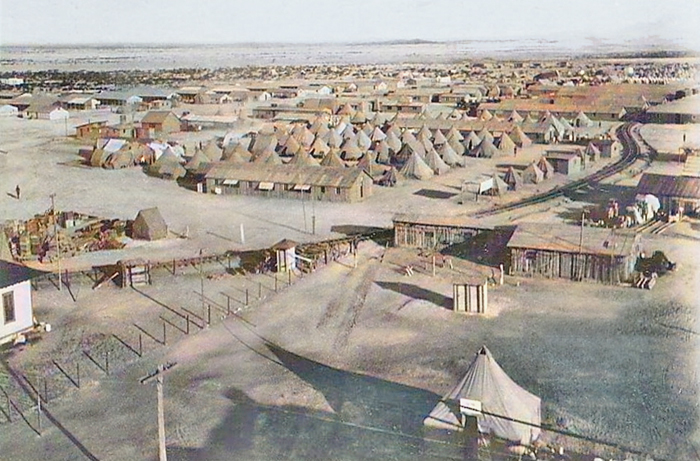
Camp Furlong in Columbus, New Mexico.
An extended period of Mexican political unrest and controversial American foreign policy fueled the historic invasion. The attack further strained relations between the United States and Mexico when President Woodrow Wilson ordered a punitive expedition into Mexico to capture Villa without first consulting the Mexican government. General John J. Pershing gathered several thousand U.S. troops at Camp Furlong for the undertaking.
Afterward, Camp Furlong became a large military installation to protect against further raids. Camp Furlong also had supply facilities and repair yards for the early motor trucks used in Mexico. At its peak, the camp was headquarters for more than 5,000 troops. The Pershing expedition brought prosperity and international attention to Columbus. During this time, Columbus experienced economic prosperity as more soldiers arrived and local merchants and entrepreneurs saw their businesses boom.
By early 1917, Pancho Villa had yet to be captured by Pershing’s punitive expedition. Carranza’s regular Mexican soldiers had attacked the U.S. troops, demonstrating that Carranza opposed the expedition to capture Villa and threatening war between the United States and Mexico. However, President Wilson became convinced that the revolutionaries were no longer a major threat to the United States and ordered Pershing and his troops to withdraw from Mexico. The last members of Pershing’s command marched into Columbus in February 1917, almost a year after Villa’s initial raid.
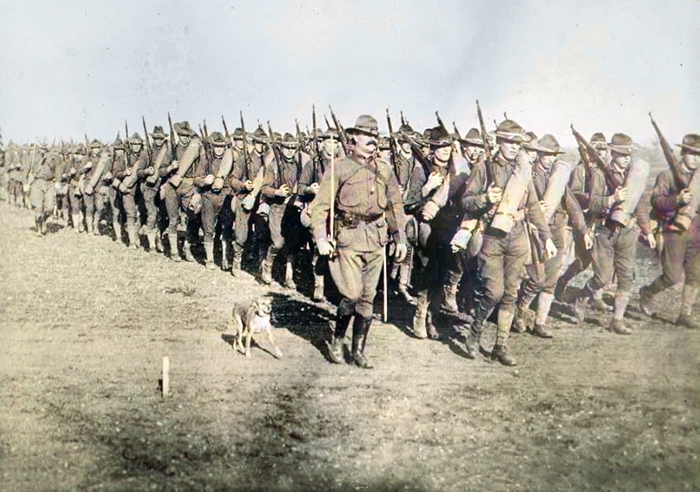
Punitive Expedition to Mexico.
Following the withdrawal of the Punitive Expedition, the 24th Infantry Regiment was headquartered at the post. In the summer of 1919, they were called to help chase Pancho Villa’s troops out of Ciudad Juárez. With the conclusion of the Mexican Revolution, the post lost its importance, and only 100 men were garrisoned there in 1921.
When the permanent presence of military forces ended in 1923, the town began to decline rapidly. The next year, the Southern Pacific acquired the El Paso and Southwestern Railroad.
Toward the end of 1926, the Army decided to close its camp, and Columbus started to decay. By 1930, its population had plummeted to 391. In 1940, it had slipped further to 265. The trains stopped running through Columbus in the 1950s.
The El Paso & Southwestern Railroad officially abandoned its operations in 1961 due to declining profitability and the rise of truck transport. The tracks were removed by 1965.
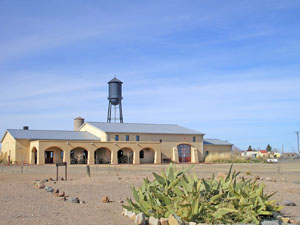
Pancho Villa State Park in Columbus, New Mexico, by Kathy Alexander.
In 1961, the former site of Camp Furlong was dedicated as Pancho Villa State Park, which displays several buildings from Villa’s 1916 raid that are listed on the National Register of Historic Places. These include the 1902 U.S. Customs House, two adobe structures dating from the Camp Furlong era, and the Camp Furlong Recreation Hall. The old Customs House is now the State Park visitor center, with exhibits that describe the history of Pancho Villa, the Columbus Raid of 1916, and Pershing’s Punitive Expedition.
The historic district also includes the former airfield East of the state park and the former El Paso & Southwestern Railroad. This adobe structure is the local historical society museum and the former Hoover Hotel, one of the few other buildings to survive. The park’s exhibit hall and historic structures capture the history of the Pancho Villa Raid and of historic Camp Furlong. A large campground offers utility hookups for RV campers and a playground for kids. The park’s main exhibit hall and visitor center are open year-round, from 8:00 a.m. to 5:00 p.m., seven days a week.
In the 1990s, Columbus began to revitalize, with the development of city and state parks, museums, RV parks, and historical attractions.
As of the 2020 census, Columbus had a population of 1,442. The incorporated village is in Luna County, New Mexico, about three miles North of the Mexican border, 35 miles South of Deming, New Mexico, and 60 miles East of El Paso, Texas.
More Information:
The Historic Village of Columbus, New Mexico.
©Kathy Alexander/Legends of America, updated August 2026.
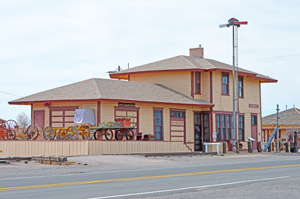
Columbus, New Mexico Historical Museum by Kathy Alexander.
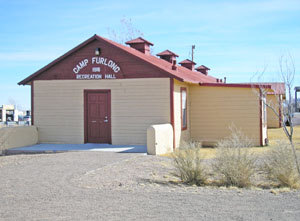
Camp Furlong building in Columbus, New Mexico, by Kathy Alexander.
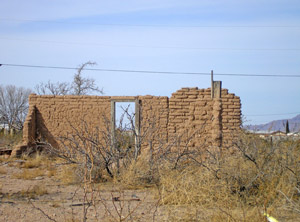
Adobe ruins in Columbus, New Mexico by Kathy Alexander.
Also See:
New Mexico – The Land of Enchantment
Pancho Villa Attacks Columbus, New Mexico
Sources:
Columbus Facebook
Historic Village of Columbus, New Mexico
Morgan, Brandon; Columbus, New Mexico – The Creation of a Border Place Myth
National Park Service
Wikipedia