
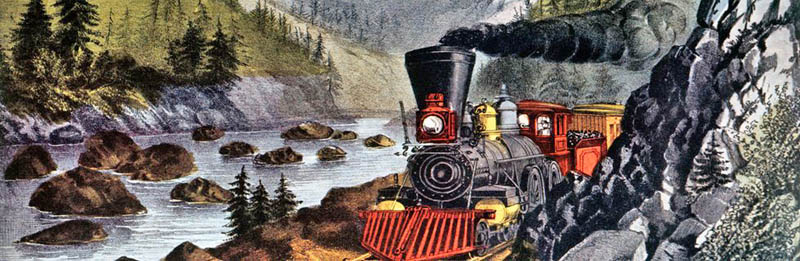
Transcontinental Railroad.
By Frederic L. Paxson, 1910.
Twenty years before the great tribes of the plains made their last stand against the invading white settlers, overland travel had begun. Ten years earlier, Congress had authorized a survey of railroad routes along the trails. On the eve of this struggle, the first continental railway had received its charter, and hostilities had temporarily ceased. At the same time, in 1867, Congress sent its Peace Commission to facilitate safe passage. It was inevitable that the tribes would have to yield, and this surrender would be both ungracious and destructive for them. Too weak to compel their adversaries to respect their rights and uncertain of what those rights were, they did not realize that the more they resisted, the worse their suffering would become. Thus, they fought against the construction of the railway that spanned the continent, which was completed in 1869.
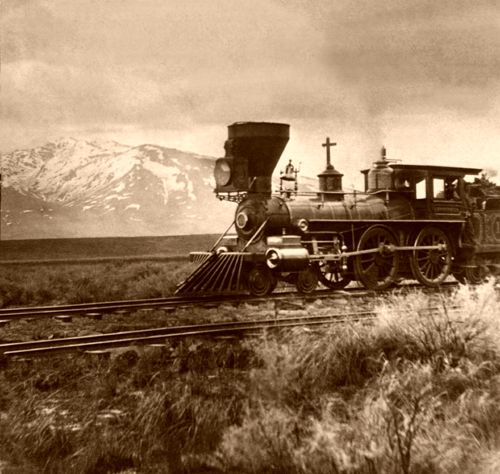
Central Pacific Railroad, 1865.
After years of tedious debate, the earliest Pacific railway was chartered in 1862. The withdrawal of southern claims had agreed upon a possible route, while the spirit of nationality engendered by the Civil War gave the project its final impetus. Under the management of the Central Pacific Railroad of California, the Union Pacific Railroad, and two or three border railways, provisions were made for a road from the Iowa border to California. Land grants and bond subsidies were dangled for two years before the capitalists of America, in a vain attempt to entice them to construct it. Only after these were increased in 1864 did active organization begin; by the end of 1865, 40 miles of the Union Pacific Railroad had been built.
Building a railroad from the Missouri River to the Pacific Ocean was the greatest engineering achievement America had ever undertaken. In its time, the Cumberland Road, the Erie Canal, and the Pennsylvania Portage Railway were all considered American wonders. However, none of these projects faced the complex challenges that arose over the 1,800 miles of track to be laid across plains and deserts, through hostile Indian territories, and over mountains. To make matters worse, the railroad could expect little assistance from the vast regions it traversed. Apart from a few small settlements in Carson City, Nevada, Salt Lake City, Utah, and Denver, Colorado, which it missed by 100 miles, the route ran for nearly the entire distance through unsettled wilderness. Much like the trusses of a cantilever bridge, the advancing ends of the railroad extended across the continent, relying on the firm connection with established areas in Iowa and California until the two ends finally met. Although the challenges presented at either end were varied, they were equally difficult to overcome.
The Central Pacific Railroad’s efforts began at its western end, two years earlier than at the eastern end, but initial progress was slow. Constructing the line eastward through the Sierra Nevada was challenging due to the terrain. Workers faced steep gullies, and their progress involved extensive bridging, tunneling, and filling to maintain a manageable grade and minimize curvature. During the years 1863, 1864, and 1865, only 20 miles of track were completed each year. In 1866, progress improved slightly with 30 miles finished, followed by 46 miles in 1867. Overall, this amounted to just 136 miles constructed during the first five years of work. Nature posed significant obstacles by placing mountains and valleys in the railroad’s path. However, these mountains were heavily forested and rich in stone, providing easy access to construction materials in the most challenging sections of the route. Workers were able to build bridges and trestles using local resources.
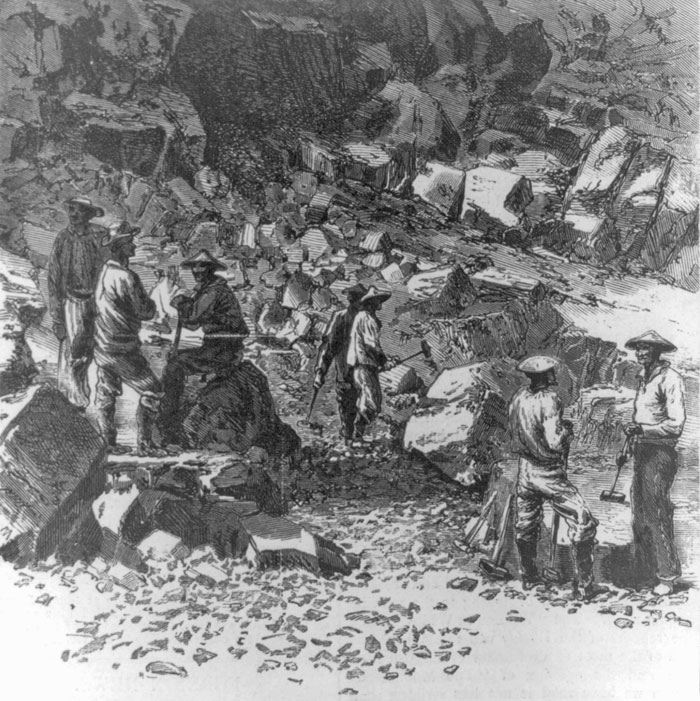
Chinese working on the Central Pacific Railroad, 1867.
The labor problem vexed the Central Pacific managers at the start. When construction began, California had a scanty and inefficient supply of workmen. Like all new countries, California possessed more work than workmen. Economic independence was to be had almost for the asking. Free land and fertile soil made it unnecessary for men to work for hire. The slight results of the first five years were due as much to lack of labor as to refractory roadways or political opposition.
However, by 1865, the employment of Chinese laborers had begun. Coolies imported by the thousands and ably directed by Charles Crocker, the most active constructor, brought new rapidity to construction.
“I used to go up and down that road in my car like a mad bull, stopping along wherever there was anything amiss and raising Old Nick with the boys that were not up to time.”
Once the roadbed was graded, new challenges emerged. California lacked the capacity to manufacture iron, so rolling stock and rails had to be imported from Europe or the East. These supplies arrived in San Francisco after a costly sea voyage via either the Panama or Horn routes. However, the leaders of the Central Pacific—Stanford, Crocker, Huntington, and their associates—rose to the challenge. After successfully navigating the mountains, they swiftly crossed the Nevada desert in pursuit of subsidies.
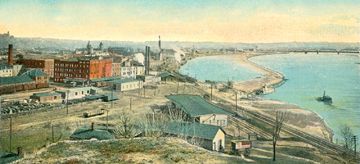
St. Joseph, Missouri on the Missouri River.
The eastern end started nearer to a base of supplies than the California terminus. However, until 1867, there was no railroad from the East to Council Bluffs, Iowa, where the President had determined that the Union Pacific should begin. There had been a railway connection to the Missouri River at St. Joseph, Missouri, since 1859, and various lines were hurrying across Iowa in the 1860s. Still, the Union Pacific had to get rolling stock and iron from the Missouri steamers or the laborious prairie schooners for more than two years of construction. Until its railway connection was established, its difficulty in this respect was less remarkable than that of the Central Pacific. The compensation of the Union Pacific came, however, in its roadbed. Following the old Platte Trail, flat and smooth as the best highways, its construction gangs could do the light grading as rapidly as the finished single track could deliver the rails at its growing end. But for the needful culverts and trestles, there was little material at hand. The willows and Cottonwood trees lining the river would not do. The Central Pacific could cut its wood as needed, often within sight of its track. The Union Pacific had to haul much of its wood and stone, like its iron, from its eastern terminus.
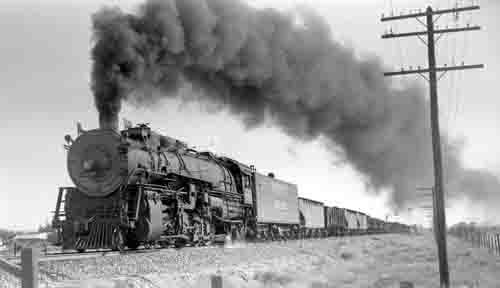
Union Pacific Train, late 1800s.
The eastern end of the Union Pacific Railroad began closer to a supply base than its terminus in California. However, until 1867, there was no railroad connection from the East to Council Bluffs, Iowa, which is where the President decided the Union Pacific should start. A railway had been established to the Missouri River at St. Joseph, Missouri, since 1859, and various lines were rapidly being constructed across Iowa during the 1860s. Nevertheless, the Union Pacific had to rely on steamboats to transport rolling stock and iron from Missouri or use labor-intensive prairie schooners for over two years of construction. The challenge it faced in this regard was not as significant as that faced by the Central Pacific.
The Union Pacific’s labor problem was intimately connected with the solution to its Indian problem. The Central Pacific had almost no trouble with the tribes through whom it ran, but the Union Pacific was built during the very years when the Great Plains were most disturbed and hostile forays were most frequent. Its employees included significant elements of the newly arrived Irish and recently discharged Civil War veterans.
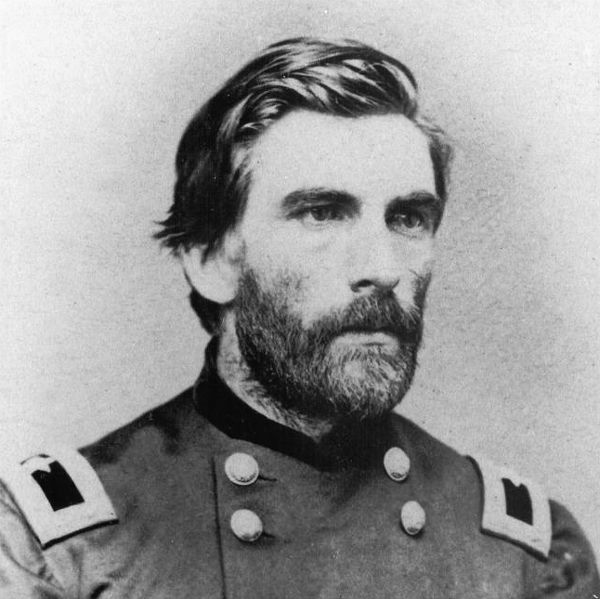
Grenville M. Dodge.
General Grenville Dodge, its chief engineer, described the military guards who “stacked their arms on the dump and were ready at a moment’s warning to fall in and fight” and the construction gangs’ military capacity. The “track train could arm a thousand men at a word,” and from chief constructor down to chief spiker, “could be commanded by experienced officers of every rank, from general to captain. They had served five years at the front, and over half of the men had shouldered a musket in many battles. This illustration came to me after our track had passed Plum Creek, 200 miles west of the Missouri River. The Indians had captured a freight train and had it and its crews.” Dodge came to the rescue in his car, “a traveling arsenal,” with about 20 men, most of whom were strangers to him, yet “when I called upon them to fall in, to go forward and retake the train, every man on the train went into line, and by his position showed that he was a soldier… I gave the order to deploy as skirmishers, and at the command, they went forward as steadily and in as good order as we had seen the old soldiers climb the face of Kenesaw under fire.”
By an act passed in July 1866, Congress did much to accelerate road construction. The junction point had been in the Nevada Desert, 150 miles east of the California line. It was now provided that each road might be built until it met the other. Since the mountain section, with the highest accompanying subsidies, was at hand, each company was spurred on by its desire to get as much land and as many bonds as possible. The race, which began in the autumn of 1866, ended only with the track’s completion in 1869. A mile a day had seemed like quick work at the start; seven or eight a day were laid before the end.
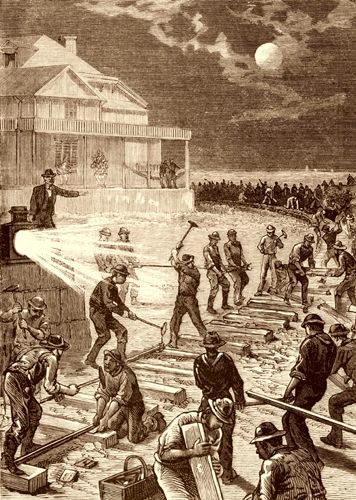
Laying track to join the railroads by Frank Leslie’s Illustrated Newspaper.
The English traveler Andrew Bell, who published his New Tracks in North America in 1869, found somewhere an enthusiastic quotation admirably descriptive of the process.
“Track-laying on the Union Pacific is a science, and we pundits of the Far East stood upon that embankment, only about 1,000 miles this side of sunset, and backed westward before that hurrying corps of sturdy operatives with mingled feelings of amusement, curiosity, and profound respect. On they came. A light car, drawn by a single horse, gallops up to the front with its load of rails. Two men seize the end of a rail and start forward, the rest of the gang taking hold by twos until it is clear of the car. They come forward at a run. At the word of command, the rail is carefully dropped into place, right side up, while the same process is repeated on the other side of the car. Each gang has less than 30 seconds to a rail, so four rails go down to the minute! You say Quick work, but the Union Pacific Railroad fellows are tremendously in earnest. The moment the car is empty, it is tipped onto the side of the track to let the next loaded car pass, then tipped back again. It is a sight to see it fly back for another load, propelled by a horse at full gallop at the end of 60 or 80 feet of rope, ridden by a young Jehu, who drives furiously. Close behind the first gang come the gaugers, spikers, and bolters, and a lively time they make of it. It is a grand Anvil Chorus that these sturdy sleds are playing across the plains. It is in a triple time, three strokes to a spike. There are ten spikes to a rail, 400 rails to a mile, and 1,800 miles to San Francisco. That’s the sum; what is the quotient? Twenty-one million times are those sleds to be swung—twenty-one million times are they to come down with their sharp punctuation before the great work of modern America is complete!”
Handling, housing, and feeding the thousands of laborers who built the road was no mean problem. Ten years earlier, the builders of the Illinois Central Railroad had complained that their road from Galena and Chicago, Illinois, to Cairo, Illinois, generally ran through uninhabited country where they could not live as they went along. Moreover, the continental railways, building rapidly away from the settlements, were forced to carry their dwellings with them. Their commissariat was as important as their general offices.
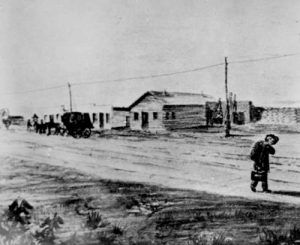
Julesburg Station, Colorado.
An acquaintance of Andrew Bell told of standing in Cheyenne, Wyoming, where he saw a long freight train arrive “laden with frame houses, boards, furniture, palings, old tents, and all the rubbish” of a mushroom city. “The guard jumped off his van and, seeing some friends on the platform, called out with a flourish, ‘Gentlemen, here’s Julesburg.'” The head of the serpentine track, sometimes indeed “more crooked than the horn that was blown around the walls of Jericho,” was the terminal town; its tongue was the stretch of track thrust a few miles in advance of the head, repeatedly as the tongue darted out the head followed, leaving across the plains a series of scars, marking the spots where it had rested for a time. Every few weeks, the town was packed onto a freight train and moved 50 or 60 miles to the new end of the track. Its vagrant population followed it. It was at Julesburg early in 1867, at Cheyenne at the end of the year, and at Laramie, Wyoming, the following spring. It was always the most disreputably picturesque spot on the anatomy of the railroad.
In the fall of 1868, “Hell on Wheels,” as Samuel Bowles, editor of the Springfield Republican, appropriately designated the terminal town, was at Benton, Wyoming, 698 miles from Omaha, Nebraska, and near the military reservation at Fort Steele. Amid the gray desert, with sand ankle-deep in its streets, the town stood dusty white—”a new arrival with black clothes looked like nothing so much as a cockroach struggling through a flour barrel.” A less promising location could hardly have been found, yet within two weeks, a city of 3,000 people had sprung up with ordinances and a government suited to its size, and with facilities for vice ample for all. The needs of the road accounted for it: to the East, the road was operating for passengers and freight; to the West, it was yet constructing the tracks. Here was the end of rail travel and the beginning of the stage routes to the coast and the mines. Two years earlier, a similar point had been at Fort Kearny, Nebraska.
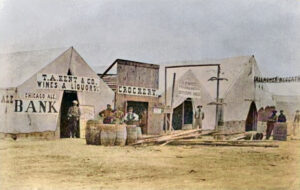
Early day, Benton, Wyoming.
The city of tents and shacks contained, according to the count of John H. Beadle, a peripatetic journalist, 23 saloons and five dance houses. It had all the worst details of the mining camp. Gambling and rowdyism were the order of the day and night. Its great institution was the “‘Big Tent,’ sometimes, with equal truth but less politeness, called the ‘Gamblers’ Tent.'” This resort was 100 feet long by 40 wide, well-floored, and given over to drinking, dancing, and gambling. The sumptuous bar provided refreshment much desired in a dry alkali country; all the games known to the professional gambler were in full blast; women, often fair and well-dressed, were there to gather in what the bartender and faro-dealer missed. When these people came and how they learned their trade were mysteries to Bowles. “Hell would appear to have been raked to furnish them,” he said, “and to it they must have naturally returned after graduating here, fitted for its highest seats and most diabolical service.”
Behind the terminal town, real estate disappointments, like beads, were strung along the cord of rails. Land companies would commonly survey town sites before the construction gangs in preparation for a boom. Brisk speculation in corner lots was a form of gambling in which real money was often lost, and honest hopes were regularly shattered. Each town had its advocates who believed it was to be the great emporium of the West. Yet generally, as the railroad moved on, the town relapsed into a deserted prairie, with only the street lines and debris to remind it of its past. Omaha, though Beadle thought in 1868 that no other “place in America had been so well lied about,” and Council Bluffs retained a share of greatness because of their strategic position at the commencement of the main line. Tied together in 1872 by the great iron bridge of the Union Pacific, their relations were as harmonious as those of the cats of Kilkenny, as they quarreled over the claims of each to be the real terminus. But the future of both was assured when the eastern roads began to be connected to the West. Cheyenne, too, remained a city of some consequence because the Denver Pacific Railroad branched off at this point to serve the Pike’s Peak region. But the names of most of the other one-time terminal towns were writ in sand.
The construction of the road after 1866 progressed rapidly enough. At the end of 1865, though the Central Pacific had started two years before the Union Pacific, it had completed only 60 miles of track, compared with the latter’s 40. In 1866, the Central Pacific built 30 laborious miles over the mountains; in 1867, 46 miles, while the Union Pacific built 500 in the same two years. In 1868, the western road, past its worst troubles, added more than 360 miles to its mileage; the Union Pacific, unchecked by the continental divide, set a new record of 425 miles. The line was completed by May 10, 1869, 1,776 miles from Omaha to Sacramento, California. For the last 16 months of the continental race, the two roads together had built more than two and a half miles for every working day. Never before had construction been so highly systematized, or the rewards for speed so great.

Great Salt Lake Valley, Utah.
Whether regarded as an economic achievement or a national work, the road building deserved the attention it received, yet it was scarcely finished before the scandal-monger was at work. Beadle had written a chapter of “floridly complimentary notices” of the men who had made possible the feat, but before he went to press, their reputations were blasted, and he thought it safest “to mention no names.” “Never praise a man,” he declared in disgust, “or name your children after him till he dies.” Before the end of Grant’s first administration, the Credit Mobilier scandal proved that men high in the national government had speculated in the project whose success depended on their votes. That many of them had been guilty of indiscretion was clear, but they had done what many of their greatest predecessors had done. Their genuine fault was made more prominent by their misfortune in being caught by an aroused national conscience, which suddenly awoke to heed a call it had disregarded in the past.
The acts of 1862 and 1864 had variously fixed the junction point for the Union Pacific and Central Pacific. In 1866, it was left open to fortune or enterprise, and had not Congress intervened in 1869, it might never have existed. In their rush for the land grants, the two rivals hurried on their surveys to the vicinity of Great Salt Lake, where their advancing ends began to overlap and continued parallel for miles. Congress, noticing their indisposition to agree upon a junction, intervened in the spring of 1869, ordering the two to bring their race to an end at Promontory Point, a few miles northwest of Ogden, Utah, on the shore of the lake. Here, in May 1869, the junction was celebrated in due form.
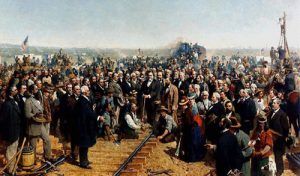
The Last Spike near Ogden, Utah.
Since the “Seneca Chief” carried DeWitt Clinton from Buffalo, New York, to the Atlantic Ocean in 1825, it has been customary to make the completion of a new road an occasion for formal celebration. On May 10, 1869, the United States stood still to signalize the junction of the tracks. The railways agreed upon the date on short notice, and small parties of their officials, Governor Stanford for the Central Pacific and President Dillon for the Union Pacific, had come to the scene of activities. The latter wrote up the “Driving the Last Spike” for one of the magazines 20 years later, telling how General Dodge worked all night of May 9, laying his final section, and how at noon on the appointed day, the last two rails were spiked to a tie of California laurel. The immediate audience was small, including few beyond the railway officials, but within hearing of the telegraphic taps that told of the last blows of the sledgehammer was much of the United States. President Dillon told the story as it was given in the leading paragraph of the Nation on Thursday. “So far as we have seen them,” wrote Godkin’s censor of American morals, “the speeches, prayers, and congratulatory telegrams… all broke down under the weight of the occasion, and it is a relief to turn from them to the telegrams which passed between the various operators, and to get their flavor of business and the West. ‘Keep quiet,’ the Omaha man says when the operators all over the Union begin to pester him with questions. ‘When the last spike is driven at Promontory Point, we will say “Done.”‘ By and by, he sends the word, ‘Hats off! Prayer is being offered.’ Then, at the end of 13 minutes, he says, apparently with a sense of having at last come to business: ‘We have got done praying. The spike is about to be presented.’ …Before sunset, the event was celebrated, not very noisily but very heartily, throughout the country. Chicago made a procession seven miles long; New York hung out bunting, fired 100 guns, and held thanksgiving services in Trinity; Philadelphia, Pennsylvania rang the old Liberty Bell; Buffalo sang the ‘Star-spangled Banner’; and many towns burnt powder in honor of the consummation of a work which, as all good Americans believe, gives us a road to the Indies, a means of making the United States a halfway house between the East and West, and last but not least, a new guarantee of the perpetuity of the Union as it is.”
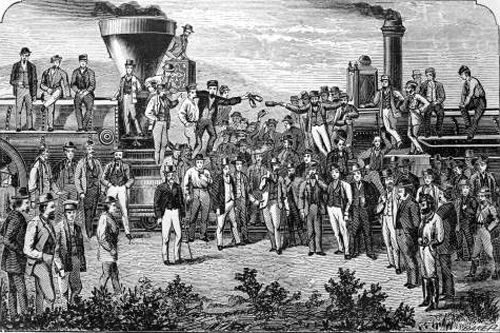
Promontory Point, Utah.
No event in the struggle for the last frontier had a greater significance for the immediate audience or posterity than this act of completion.
The oriental trade of Whitney and Benton yet dazzled the eyes of the men who built the road, blinding them to the prosaic millions lying beneath their feet. The East and West were united, but, more importantly, the intervening frontier ceased dividing. When the road was undertaken, men thought naturally of the East and Pacific Coast, unhappily separated by the waste of the mountains, the desert, and the Indian Country. The mining flurry of the early 1860s raised hopes that this intervening land might not all be wasted. As the railway had advanced, the settlement had marched with it, the two treading upon the heels of the Peace Commissioners sent out to lure away the Indians. With the road’s opening, the new period of national assimilation of the continent began. In 15 years, as other roads followed, there was no unbridgeable gap between the East and West, and the frontier had disappeared.
©Frederic L. Paxson, 1910, compiled and edited by Kathy Alexander/Legends of America, April 2026.
Also See:
Indian Troubles During Construction
Source: Paxson, Frederic L.; Last American Frontier, The MacMillan Company, New York, 1910. The text as it appears here is not verbatim; it has been edited for clarity and ease of reading for the modern reader.