
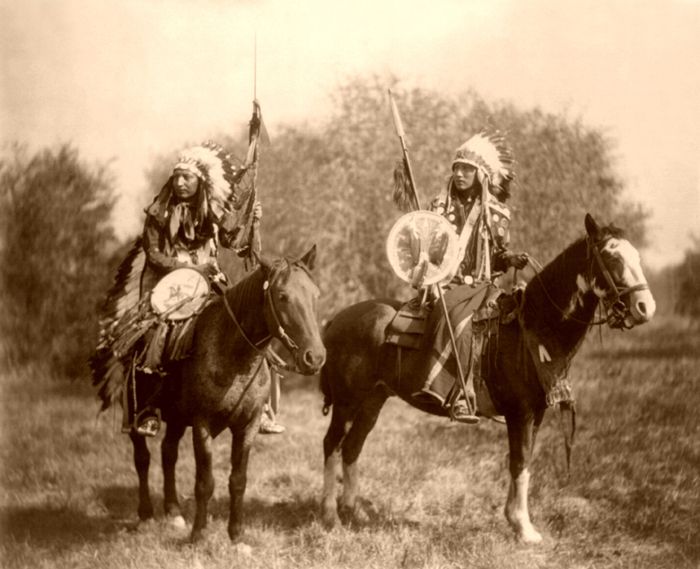
Sioux Indians on Horseback, by Heyn, 1899
“The American Indian is of the soil, whether it be the region of forests, plains, pueblos, or mesas. He fits into the landscape, for the hand that fashioned the continent also fashioned the man for his surroundings. He once grew as naturally as the wild sunflowers; he belongs just as the buffalo belonged.”
— Luther Standing Bear, Oglala.
The history of the American West is never complete without the tales of the many Americans who first lived on these vast lands.
Here, you’ll find summaries of many chiefs, heroes, warriors, and medicine men who are recorded as significant in the United States’ westward expansion.
Although thousands of men and women could be mentioned, this ever-growing list begins with the most famous.
Also See: Native American Heroes & Leaders
Notable Native Americans in History:
A
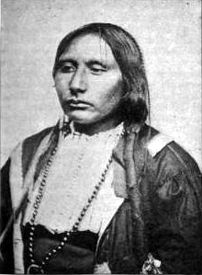
Adoeette, aka Big Tree.
Adoette, aka Big Tree (1845?-1871) – Known to his Kiowa tribe as Adoette, to the white man as “Big Tree.”
American Horse (1800-1876) – American Horse, an Oglala Sioux chief, was one of the principal war chiefs during the Battle of the Little Bighorn. General George Crook’s troops killed him in 1876.
B
George Bent (1843-1918) – George Bent was a Cheyenne-American interpreter, historian, Civil War soldier, and Cheyenne Dog Soldier who lived in Colorado.
Big Bill – A Paiute chief, Big Bill led the Indians who aided the notorious Mormon John D. Lee in the Mountain Meadows Massacre in southwest Utah on September 11, 1857.
Big Elk (1765-1846) – Chief of the Omaha tribe. Known as Ongpatonga to the Omaha tribe, Big Elk earned a reputation as a warrior when he was still very young, primarily in skirmishes against the Pawnee. When Omaha Chief Washinggusaba (Black Bird), known as a tyrant, died in 1800, Big Elk, who had gained a reputation for fairness in making decisions, became the principal chief. Afterward, the Euro-Americans began to pass through Omaha Territory. In 1821 and 1837, he traveled to Washington, D.C., to negotiate treaties and became a spellbinding orator. He led the Omaha Indians until he died of fever in 1846. He was buried in Bellevue, Nebraska, at Elk Hill, but to the Omaha, called Onpontonga Xiathon, meaning “the Place Where Big Elk Is Buried.”
Big Foot, aka Sithanka, Spotted Elk (1826?-1890) – A Hunkpapa Sioux, Big Foot was the chief of the Cheyenne River Reservation. He was killed on December 29, 1890, along with almost 300 other members of his tribe, at the Wounded Knee Massacre.
Big Mush (??-1839) – Fought in the Cherokee War in Texas and was killed in the Battle of the Neches on July 16, 1839. Though little is known of Chief Big Mush or Gatun-wa-’li to his people, he was known to exercise authority in civil matters when some Cherokee bands made their home in northeast Texas. Thought to have lived in the northwestern part of Rusk County, he was closely associated with Chief Bowles in 1827 and was one of the signers of the treaty made with General Sam Houston to assign the lands to the Cherokee; however, the Texas Senate refused to ratify the treaty, which soon led to the Cherokee War. Big Mush was killed in the Battle of the Neches, along with Chief Bowles, on July 16, 1839
Black Elk (1863-1950) – Known as Hehaka Sapa to his people, Black Elk was a famous Lakota holy man. He participated in the Battle of the Little Bighorn at the age of 12. In 1886, Black Elk joined Buffalo Bill Cody’s Wild West Show and toured eastern cities and Europe. In 1890, he was wounded in the massacre that occurred at Wounded Knee 1890. Living on the reservation, he was baptized as a Catholic and took the name Nicholas Black Elk. He served as a spiritual leader among his people; he saw no contradiction between what he found valid in his tribal traditions and in Christianity. He then began traveling, helping to convert the Arapaho, Winnebago, Omaha, and other Native American groups to Christianity. He later combined his missionary work with showmanship at various tourist attractions in South Dakota, using his reputation as a Lakota holy man to draw visitors. He died in August 1950.
Big Tree – See Adoeette
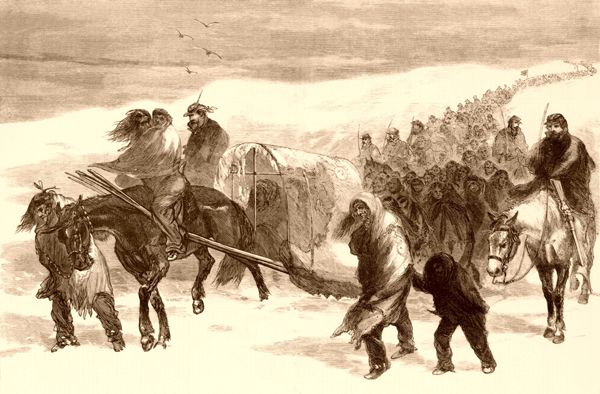
Prisoners from Black Kettles camp, captured by General Custer, Theodore R. Davis,1868.
Black Kettle (1803-68) – Peaceful leader of the Southern Cheyenne tribe. He was killed by General George Armstrong Custer and his troops at the Battle of Washita.
Chief Bowl (1756-1839) – Known to the Cherokee as Diwal’li, Bowl led his people to Texas and was killed at the Battle of the Neches.
Edward “Ned” Wilkerson Bushyhead (1832-1907) – Bushyhead was a Cherokee miner, publisher, and lawman who traveled on the Cherokee Trail of Tears to Oklahoma and later became the Chief of Police in San Diego, California.
C
Captain Jack – See Kintpuash
Cochise (18??-1874) – Apache Chief and one of the last holdouts resisting white settlement.
Chief Levi Colbert (1759-1834) – Also known as Itawamba in the Chickasaw language, Colbert was a leader and chief of the Chickasaw in Alabama and Mississippi. He and his brother, George Colbert, were prominent interpreters and negotiators who worked closely with Andrew Jackson, serving as appointed negotiators in connection with the Indian Removal.
Crazy Horse (1842-1877) – A brave and skilled warrior who continually resisted white encroachment into the Black Hills.
Crow Dog (1833-1910) – One of the leaders who popularized the Ghost Dance among the Lakota.
Natawista Culbertson (1825?-1895) – Natawista, the daughter of a Blackfeet chief, married fur trader Alexander Culbertson and worked as a diplomat, a hostess, and an interpreter.
Also See: Native American Heroes & Leaders
D
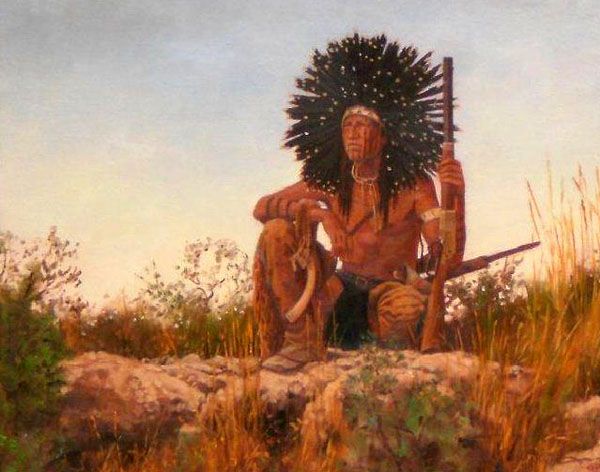
Cheyenne Dog Soldier.
Dog Soldiers – A warrior society of the Cheyenne tribe.
Dull Knife – (18??-1879) – Placed on a reservation in Oklahoma, Dull Knife defied the authorities and led his people home in September 1878.
E
Dr. Charles Alexander Eastman, aka Ohiyesa (1858-1939) – Santee Sioux author, physician, and reformer. He was active in politics and helped found the Boy Scouts of America.
Ehyophsta: Yellow Haired Warrior Woman of the Cheyenne – Ehyophsta, the Yellow-Haired Woman of the Cheyenne, was born around 1826, and inherited a legacy of leadership and strength as a Cheyenne Warrior Woman.
G
Chief Gall (1840-1895) – Lakota battle leader and one of the commanders who took part in the Battle of the Little Bighorn.
Ganado Mucho (1809-1893) – A prominent Navajo Leader, his name means “many cattle.” He was born into the Tótsohnii (Big Water) Clan of the Navajo and became a successful cattle grower and sheepman. He diligently worked with other Navajo leaders, such as Manuelito, to keep the peace with the white settlers. When the Navajos attacked Fort Defiance, Arizona, in 1859, Ganada Mucho did not participate in the peace negotiations. In February 1861, he attended a council meeting with Colonel Canby, who was then commanding New Mexico and attempting to negotiate peace, but no settlement was reached. He led his people on a four-year trek from their homeland to the Bosque Redondo Reserve at Fort Sumner, New Mexico. The reserve, however, was a disaster, and in 1868, he led his people back to their homelands in northeastern Arizona. He spent the rest of his life promoting fairness for his tribe and died at his home near Kagetoh, Arizona, in 1893.
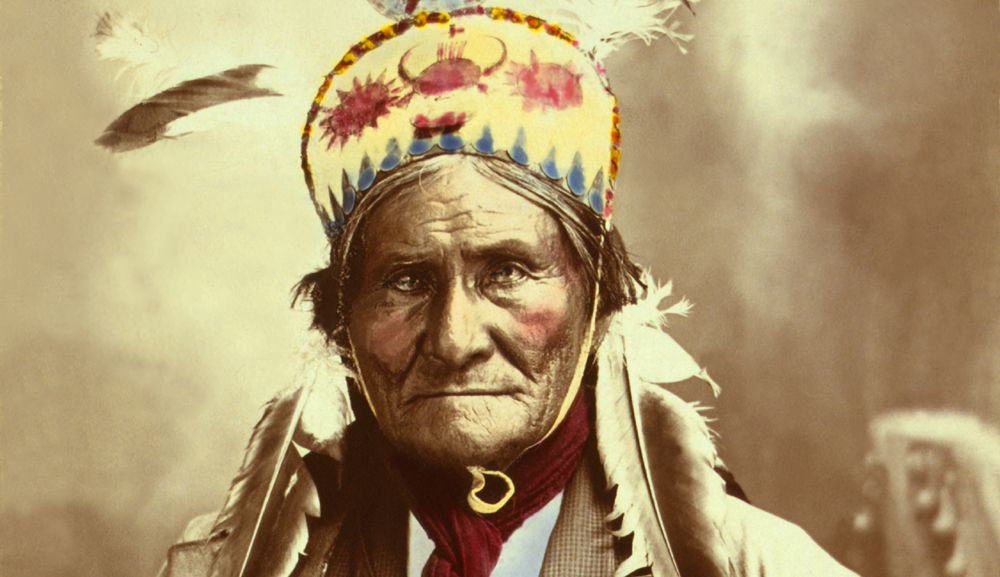
Geronimo, 1903, by J.W. Collins.
Geronimo (1829-1909) – Chiricahua Apache Chief who warred against the encroachment of settlers on his tribal lands for over 25 years.
Glikhikan (17??-1782) – A Delaware warrior and orator, he initially rejected Christianity, often challenging priests to debates. Ultimately, he was converted and went to live with the United Brethren. In the Revolutionary War, his diplomacy saved the Christian settlements from destruction at the hands of the Seneca Indians in 1777. Half-King later captured him, but he was later released. The white men under Colonel David Williamson were later scalped and murdered at the Gnaden-Huetten Mission on March 8, 1782.
Going Snake – Cherokee Chief
H
Captain James Hobbs (1819-1880) – Also known as Comanche Jim, Hobbs was the Great-grandson of renowned Indian Chief Tecumseh. Starting as a fur trader, he would later spend time with the likes of Kit Carson before becoming a Texas Ranger and fighting in the Mexican-American War and the Civil War.
Sarah Winnemucca Hopkins (1841?-1891) – The first Native American woman known to secure a copyright and publish in the English language. Her book, Life Among the Piutes: Their Wrongs and Claims, is an autobiographical account of her people during their first forty years of contact with explorers and settlers.
Hollow Horn Bear, aka Matihehlogego (1850-1913) – Hollow Horn Bear was a Brule Lakota leader who fought in many of the battles of the Sioux Wars, including the Battle of the Little Bighorn.
J
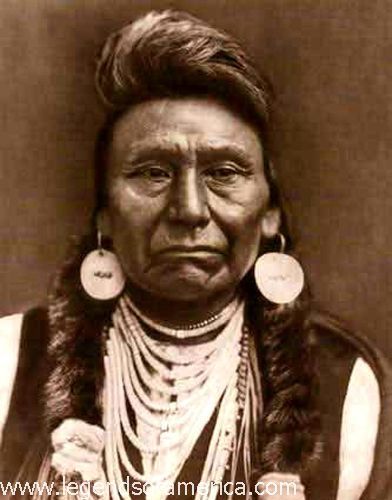
Chief Joseph.
Chief Joseph (1840-1904) – Nez Perce Chief resisted the forced removal of his band to a reservation in Idaho. He became renowned as a humanitarian and peacemaker for his principled resistance to the removal.
K
Kaitchkona Winema, also known as Toby Riddle (1848-1932), was a Modoc woman better known simply as Winema. She served as an interpreter and played a significant role during the Modoc War of 1872-1873.
Kintpuash, also known as Captain Jack (1840?-1873), was a Modoc subchief and warrior who led the Modoc War of 1872-73. After killing an unarmed General, Edward Richard Canby, at a peace negotiation meeting, he was tracked down, captured, and hanged in October 1873.
L
Chief Little Crow (1815-1863) – Sioux Chief who led the first significant armed engagement between the U.S. and the Dakota tribe.
Little Raven, aka Hósa, “Young Crow” (18??-1889) – Little Raven was an Arapaho chief and the first signer, for the Southern Arapaho, of the treaty of Fort Wise, Colorado, February 1861. Later, he participated in the war along the Kansas border alongside the allied Arapaho and Cheyenne. Still, he joined the Medicine Lodge Treaty in 1867, by which these tribes agreed to relocate to a reservation. After agreeing to the treaty, his efforts were consistently directed toward maintaining peace between his people and the government and leading them toward civilization. Through his influence, most Arapaho remained at peace with the whites when their allies, the Cheyenne and Kiowa, went on the warpath in 1874-75. Little Raven died at Cantonment, Oklahoma, in the winter of 1889, having maintained for 20 years a reputation as the leader of the progressive element. He was succeeded by Nawat, known as the “Left-hand.”
Little Wolf (1818-1904) – With Dull Knife, Little Wolf led the Cheyenne from exile in Indian Territory to their homeland in present-day eastern Montana during the late 1870s.
Lone Wolf (1820?-1879) – Known as Gul-Pah-Go to his tribe, Lone Wolf was a primary chief of the Kiowa tribe who became violent after being forced onto a reservation.
George Lowrey – A cousin of Sequoya and the second chief of the Eastern Cherokee under John Ross. A cousin of Sequoya and the second chief of the Eastern Cherokee under John Ross, commonly known as Mayor Lowrey. His native name was Agin’agi’ll, “Rising-fawn.” He joined Ross in steadily opposing all attempts to force his people to relocate from their eastern lands, and later, after this had been accomplished, he served as chief of the council of the Eastern Cherokee at the 1839 meeting that unified the eastern and western divisions into the present Cherokee Nation.
Lozen, aka “Dextrous Horse Thief” (1840-1887) – The sister of Apache Chief Victorio, Lozen was a skilled warrior and shaman. Her brother, Victorio, said, “Lozen is my right hand… strong as a man, braver than most, and cunning in strategy. Lozen is a shield to her people.”
Also See: Native American Heroes & Leaders
Mangas Coloradas (1793?-1863) – Chiricahua Apache leader considered by many to be the most important of the 19th century, uniting the Apache nation against the United States.
Manuelito (1818-1893) – A principal Navajo war chief, Manuelito, and his followers were the last of the Navajo tribe to be forced onto a reservation.
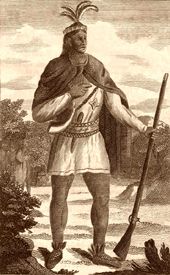
Wampanoag Chief Metacom, also called King Philip.
Metacomet (1639?-1676) – Also known as King Philip or Metacom, this war leader of the Wampanoag tribe was the second son of Chief Massasoit and led an alliance against white settlers to push them out of New England in what is known as King Philip’s War.
N
Nah-deiz-az, aka: “Carlisle Kid” (1865-1889) – A so-called Apache “outlaw,” Nahdeizaz is often confused with the “Apache Kid.”
Naiche (1856?-1919) – Son of Cochise, he led the Apache and Geronimo in resisting white encroachment.
Nana (1800-1896) – An Apache War Leader who led a band of warriors in New Mexico when he was already 80 years old.
Old Crow – Old Crow was allegedly one of the members of the Dull Knife band of Cheyenne, which left the reservation in Indian Territory and made the memorable raid across Kansas in September and October 1878.
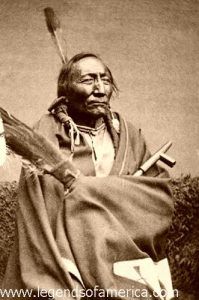
Old Man Afraid of His Horse.
Old Man Afraid of His Horse (1808-??) – A noted Ogallala Sioux warrior, Old Man Afraid of His Horse, was also known as Tasunka Coquipah. He was born in the Lakota Territory in 1808 and married a Medicine Woman in about 1856. He witnessed the signing of the Treaty of Fort Laramie by Dull Knife in 1868. This treaty guaranteed the Lakota ownership of the Black Hills and more land and hunting rights in South Dakota, Wyoming, and Montana. This region was to be henceforth closed to all whites, marking the end of Red Cloud’s War. However, when gold was discovered in the Black Hills, an increasing number of white settlers invaded the territory, which led to the Black Hills War.
Opechancanough (1545?-1644?) – A Powhatan chief, he was the brother of Chief Powhatan and, upon his brother’s death in 1818, took control of the Powhatan Confederacy.
Chief Osceola (1804-1838) – Born as Billy Powell, he became an influential leader of the Seminole in Florida.
Chief Ouray (1833-1880) – Born near Taos, New Mexico, Ouray was the leader of the Uncompahgre band of the Ute tribe and was known as a man of peace.
P
Quannah Parker (1845?-1911) – The last Chief of the Quahadi Comanche, Parker was both a major resistor to white settlers and a leader in the tribe’s adjustment to reservation life.
King Philip – See Metacomet.
Susan La Flesche Picotte – First Native Physician.
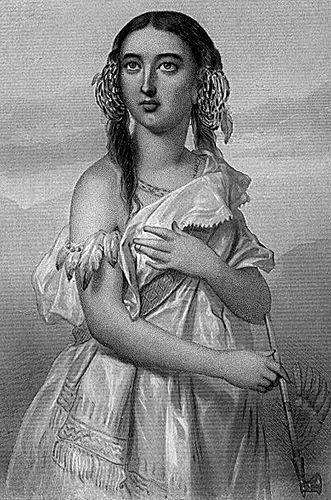
Pocahontas.
Pocahontas (1595? -1617) – A Powhatan Indian Princess, she was known for assisting colonial settlers at Jamestown and allegedly saving the life of the colony’s leader, Captain John Smith.
Chief Pontiac (1720?-1769) – Called Obwandiyag by his people, Pontiac was a great leader of the Ottawa tribe and became famous for organizing Pontiac’s Rebellion (1763–1766).
Chief Powhatan (1545-1618) – Known as Wahunsunacawh to the Powhatan tribe, he founded the Powhatan Confederacy in Virginia, uniting approximately 30 tribes by the early 17th century.
Chief Pohibit Quasha, aka Iron Shirt (18??-1858) – In the 1850s, fearless bands of skilled Comanche warriors were busy raiding white settlements and Mexican ranches of Texas and Oklahoma at will. Chief Pohibit Quasha or Iron Shirt led one of the marauding bands. Described by many as having almost supernatural abilities, the cunning and ruthless warrior was seemingly immune to bullets. Several pursuers told stories of how they had shot him numerous times with no effect. However, when the governor hired 100 new Texas Rangers in 1858, the time was near for Iron Shirt. In the Antelope Hills Expedition, led by John Salmon “Rip” Ford, some 100 men began to go after the marauding Comanche bands. On May 12, Ford’s Rangers, Anadarko, and Shawnee scouts pursued the Indians into the Antelope Hills in Oklahoma. Coming upon a Comanche village in the Canadian River Valley, they soon attacked the village, and Iron Shirt was killed by an expert Indian marksman named Jim Pockmark. Carrying a .58 caliber Henry buffalo rifle, the Indian scout waited for his chance and shot Iron Shirt when his mount was turned sideways. Afterward, it was found that Chief Iron Shirt didn’t have any “Indian Magic” protecting him from the several shots he had received in the past. Instead, it wore an old piece of an iron breastplate from the early days of the Spanish conquistadors. After the battle, the Rangers reported four casualties, killed some 76 Comanche, and took 18 prisoners.
Also See: Native American Heroes & Leaders
R
Rain-in-the-Face, aka: Ito-na-gaju, Exa-ma-gozua (1835?-1905) – On June 25-27, 1876, Lieutenant-Colonel George Custer, with thirteen commissioned officers, a surgeon, and 255 men, was slaughtered in the Black Hills. Sitting Bull has received notoriety and credit for this fight, but his cousin, Rain-in-the-Face, planned and executed the battle. He received a wound in the fight, which resulted in his using crutches for the rest of his life.
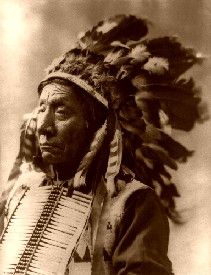
Chief Red Cloud, 1900.
Chief Red Cloud (1822-1909) – One of the most capable chiefs who resisted white settlement, led the successful resistance known as Red Cloud’s War in 1866-1868.
Red Jacket, Seneca War Chief (1750-1830) – The renowned Seneca warrior and orator, Sa-go-ye-wa-thee, or Red Jacket, was a war chief of the Wolf Clan who lived in Western New York.
Red Shirt (1845-1925) – An Oglala Sioux warrior who served as chief of the Sioux, a position he was appointed to in 1866 by the War Department. He was the son of Victor Renville and a nephew of the celebrated Joseph Renville. He was born at Sweet Corn’s Village, Big Stone Lake, South Dakota, in April 1824. He was a valued friend of the whites during the Sioux War of 1862-65. He died at the Sisseton Agency on August 26, 1902.
Gabriel Renville (1824-1902) – He was the last chief of the Sisseton Sioux, a position he was appointed to in 1866 by the War Department. He was the son of Victor Renville and a nephew of the celebrated Joseph Renville. He was born at Sweet Corn’s Village, Big Stone Lake, South Dakota, in April 1824. He was a valued friend of the whites during the Sioux War of 1862-65. He died at the Sisseton Agency on August 26, 1902.
Toby Riddle – See Kaitchkona Winema
Roman Nose – (1835?-1868) – Cheyenne warrior and leader of the Plains Indian Wars of the 1860s.
Chief John Ross (1790-1866) – John Ross was the first and only elected Chief of the Cherokee Nation from when it was formed until he died in 1866.
Sacagawea (1790?-1812?), A Shoshone Indian woman who married French Canadian trapper Toussaint Charbonneau and became an integral part of the Lewis and Clark expedition.
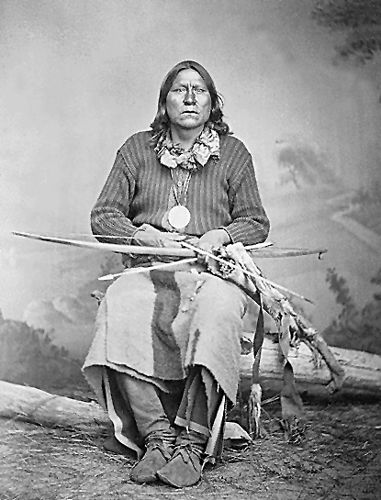
Chief Satanta of the Kiowa tribe.
Satanta (1820-1878) – Known to his people as Set-Tainte, meaning “White Bear Person,” Satanta was a great Kiowa warrior who would later become the principal chief in the Kiowa Wars of the 1860s-1870s and was known as “The Orator of the Plains.”
Scarface Charley (1851?-1896) – A celebrated Modoc warrior and chief of the Modoc tribe, he is best known through his connection with Captain Jack, or Kintpuash, during the Modoc War of 1872-73.
Schonchin, aka Old Schonchin, Skonches (1797-1892) – The recognized head chief of the Modoc Indians during the Modoc War of 1872-73.
Chief Seattle, aka Sealth, Seathle, Seathl, or See-ahth (1780?-1866) – Leader of the Suquamish and Duwamish Native American tribes in present-day Washington. He was known as a great leader, orator, warrior, and negotiator.
Sequoya, aka George Guess (1767?-1843) – The inventor of the Cherokee alphabet, silversmith, and politician.
Setangya, aka Satank, Sitting Bear (1810?-1871) – Setangya was a noted Kiowa chief, medicine man, and leader of the Kiowa honor society called “Koitsenk” or the “Ten Bravest Warriors.”
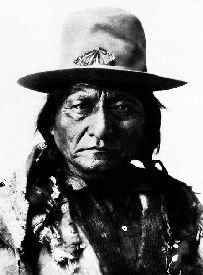
Sitting Bull.
Sitting Bull (1831-1890) – Lakota chief and holy man, most notable for his premonition of defeating the army at the Battle of the Little Bighorn.
Spotted Elk – See Big Foot, aka Si Tanka
Chief Tecumseh (1768-1813) – Shawnee Chief Tecumseh was a highly skilled warrior, orator, and statesman who advocated “civilized resistance.”
Tall Bull (1815?-1869) – A Southern Cheyenne Chief, Tall Bull was also the leader of the fierce Dog Soldiers during the 1850s and 1860s in the Plains states. He was killed at the Battle of Summit Springs.
Awa Tsireh (1898-1955) – Awa Tsireh, also known as Alfonso Roybal, was one of the first Pueblo painters to receive recognition by the Santa Fe, New Mexico art community.
Chief Victorio (1825-1880) – Known as Bidu-ya or Beduiat to his Apache people, Victorio was a warrior and chief of the Chihenne band of the Chiricahua Apache in what is now New Mexico. Becoming hate-filled due to being forced onto an Arizona reservation and the subsequent ill-treatment of his people, Victorio escaped the reservation and went on a rampage in 1879-1880.
Fred Waite – Chickasaw Outlaw Turned Politician.
Stand Watie – Brigadier General of the Civil War.
Chief Walkara, aka Walker (1808?-1855) – The leader of the Ute Timpanogo band, Walkara had a reputation as a diplomat, horseman, and warrior, and was the primary leader in the Walker War.
Wovoka – Paiute Medicine Man & the Ghost Dance.
©Kathy Alexander/Legends of America, updated April 2026.
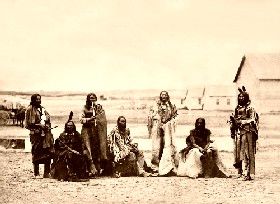
Spotted Tail, Roman Nose, Old Man Afraid of His Horses, Lone Horn, Whistling Elk, Pipe, and an unknown Indian at Fort Laramie, Wyoming, in 1868.
Also See:
Native American Heroes & Leaders
Legends, Myths & Tales of Native Americans
See Sources.