
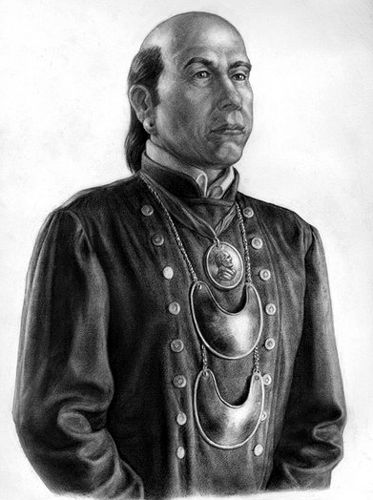
Chickasaw Chief Levi Colbert.
Along the Natchez Trace in Alabama is a place called Buzzard Roost. On Chickasaw lands in the 19th century, a man named Levi Colbert built a “stand,” or inn, at a site called Buzzard Sleep. When Levi built the inn in 1801, he renamed it Buzzard Roost. Located near a spring, the site was a perfect spot to serve the many travelers along the Trace.
Levi Colbert was one of six sons of James Logan Colbert, a North Carolinian settler of Scots descent, and his second wife, Minta Hoye, a Chickasaw woman. Levi was born in Alabama in 1759, grew up bilingual, and was educated in both Chickasaw and European-American traditions. The Chickasaw knew him as Itawamba, and he became a leader and chief of the Chickasaw people. But only half of the Chickasaw chiefdom passed matrilineally.
His brother, George Colbert, operated Colbert’s Stand and Ferry across the Tennessee River on the Natchez Trace, about five miles to the North of Buzzard Roost. Levi had an interest in the prosperous ferry, which at one time charged future U.S. President Andrew Jackson $75,000 to ferry his army across the river. Historians indicate that Jackson’s troops and their horses were fed by the Chickasaw tribe both coming and going due to the troops’ shortages of food, and that was the reason George Colbert charged the $75,000, a fact that resulted in descendants of General John Coffee formally thanking the Chickasaw Nation 200 years later.*
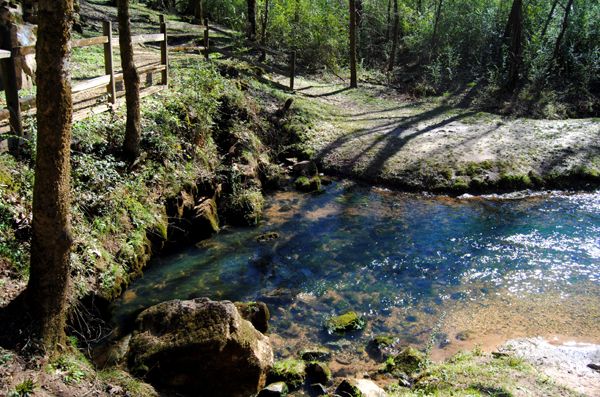
Buzzard Roost Spring, Natchez Trace, Alabama.
Though opposed to the Indian Removal Act of 1830, both Levi and George Colbert became prominent interpreters and negotiators, hoping to keep the peace and secure the best deal for their people.
While a young man, Levi had earned the title of Itawamba Mingo, meaning “Bench Chief.” This occurred when Levi had learned that Creek Indians were going to attack the Chickasaw. Unfortunately, he learned this in the fall, and many Chickasaw warriors were away hunting. Acting quickly, Levi gathered as many young Chickasaw as he could and took the offensive against their approaching enemy. Though severely outnumbered, they caught the Creek by surprise and killed or wounded most of them. When the hunters returned and learned of Levi’s bravery, they awarded him a bench to sit on in council. Before this, the custom was for all warriors to sit on the ground. The Chickasaw sometimes called him “Okolona,” meaning calm or peaceful, because of his quiet manner. White men, who also respected him as a leader, nicknamed him “Levi the Incorruptible.” Travelers who stopped at the Buzzard Roost Inn remarked that it was a good place for them to be well received, well-fed, and kindly treated.
Levi married several wives during his lifetime, including Seletia Colbert, who lived with him at Buzzard Roost, another who lived at what is now known as the French Farm, not far from Okolona, in Monroe County, and a third named Minto-Ho-Yo, a full-blood Chickasaw. Levi and his wives had many children. One of his daughters with Minto-Ho-Yo, Phalishta ‘Pat’ Colbert, would marry a man named Kilpatrick Carter. An Irish man, Kilpatrick settled among the Chickasaw in about 1817 and was hired by Levi Colbert to build a new home at Buzzard Roost. Later, when Levi moved on, he would give the home to Carter and his daughter, Phalishta.
Levi’s father, James Logan Colbert, moved to Cotton Gin Port, Mississippi, around 1819. Located on the East bank of the Tombigbee River, at a crossing of vital Indian trails, Cotton Gin Port was the first town established in northern Mississippi. As part of a “plan of civilization” for the Chickasaw Indians, the U.S. Government built a cotton gin here in 1801. The Gaines Trace road was built to the town in 1811, running from the head of Muscle Shoals on the Tennessee River in Alabama to Cotton Gin Port, where it crossed the Tombigbee River before heading South to Fort Stoddert, Alabama.
Levi’s father, James, built a mill for Levi in the quickly growing town, and Levi soon joined him there. Over the years, Levi became prosperous and built a new home on the bluff West of the river. While living in Cotton Gin Port, he was said to have owned 4,000 cattle, 500 horses, a large sheep herd, and several heads of swine.
The Colbert brothers signed several treaties as Chickasaw leaders, but in the 1830s, they began to question the terms. Meetings continued between the leaders and the U.S. Government. Unfortunately, Levi fell ill and could not attend all the meetings. In 1834, he was on his way to Washington, D.C., to discuss the Pontotoc Treaty. After stopping at his old home on Buzzard Roost to visit his daughter and son-in-law, he fell ill again. He died of pneumonia on June 2, 1834, years before his people finally agreed to a treaty and were removed to Indian Territory (Oklahoma). While some claim his grave is in the Oakwood Cemetery in Tuscumbia, Alabama, there is no record. According to one member of the Chickasaw Tribe, they don’t want anyone to know the exact location to protect against treasure seekers*.
Itawamba County, Mississippi, and the town of Okolona, Mississippi, are both named for him. The once prosperous town of Cotton Gin Port no longer exists. The arrival of the Kansas City, Memphis & Birmingham Railroad caused the town to disappear as the residents moved to Amory, Mississippi.
Meanwhile, Buzzard Roost continued to provide a post office until the 1850s. Today, Buzzard Roost is a stop on Alabama’s 33-mile stretch of the Natchez Trace Parkway. A marker designates the spot, and the spring is just a short walk away. The site has picnic tables and restrooms.
Buzzard Roost Spring is located on the Natchez Trace Parkway at milepost 320.3.
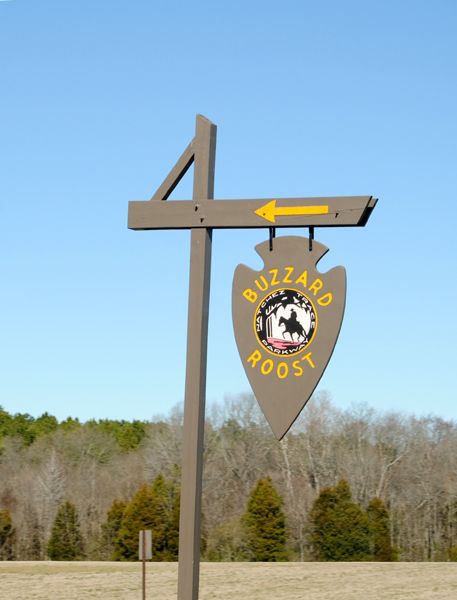
Buzzard Roost Sign.
A couple of legends are associated with Buzzard Roost and the Colbert Brothers. At Buzzard Roost, several visitors have told of paranormal-type events. These may be explained” by ‘residual memories’ or, perhaps, some of the many travelers along the Trace never left.” Several people have said they heard voices, some so clear they turned around to see who was talking, but no one was there. Others have felt as if someone touched them or that something wafted across their face or body. Yet more tales of ghostly legends and one of lost treasure surround the Colbert brothers at GeColbert’sert’s Ferry and inn site located just a few miles down the Trace. But that’s a whole ‘nuther story.
©Kathy Alexander/Legends of America, updated September 2026.
Also See:
Natchez Trace – Traveled For Thousands of Years
Legends and Mysteries of the Natchez Trace
Samuel “Wolfman” Mason Takes On the Natchez Trace
Primary Sources, Natchez Trace Parkway Association. *Additional information provided by Robert Perry, Alabama.