
By the Office of the Chief Of Military History
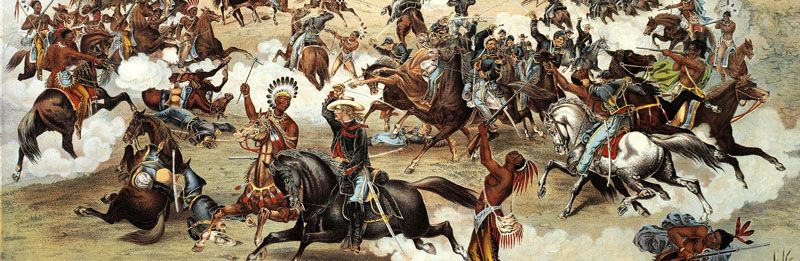
American Indian Wars.
Perhaps because of a tendency to view the record of a military establishment in terms of conflict, the U.S. Army’s operational experience in the quarter-century following the Civil War has come to be known as the Indian Wars. Previous struggles with the Indians, dating back to colonial times, had been limited in scope and opponent and took place in a period when the Indians could withdraw or be pushed into vast reaches of uninhabited and as yet unclaimed territory to the west. By 1865, this safety valve was fast disappearing; routes of travel and pockets of settlement had multiplied across the western two-thirds of the nation, and as the Civil War closed, white Americans, in more significant numbers and with greater energy than before, resumed the quest for land, gold, commerce, and adventure that had mainly been interrupted by the war.
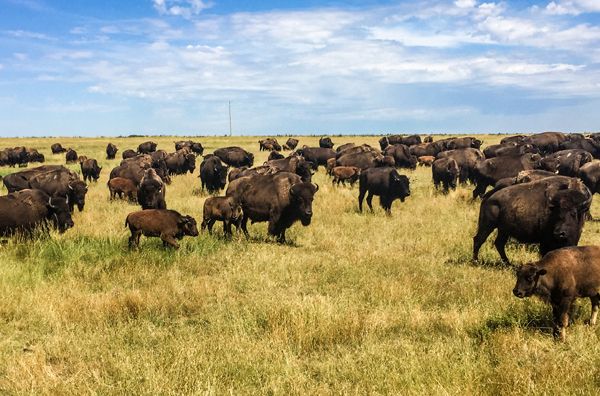
Kansas Buffalo.
The showdown between the older Americans and the new — between two ways of life that were incompatible — was at hand. The besieged Red Man, with white civilization pressing in and the primary source of livelihood—the buffalo—threatened with extinction, faced a fundamental choice: surrender or fight. Many chose to fight, and over the course of some 25 years, the struggle ranged across the plains, mountains, and deserts of the American West, a guerrilla war characterized by skirmishes, pursuits, massacres, raids, expeditions, battles, and campaigns of varying size and intensity. Given its central role in dealing with the Indians, the Army contributed to continental consolidation.
The Setting and the Challenge
After Appomattox, the Army had to muster out over a million volunteers and reconstitute a Regular establishment that had languished during the Civil War, when bounties and short enlistments made service in the volunteers more profitable. There were operational commitments to sustain during and after the transition. Some were an outgrowth of the war that had just ended, others the product of internal and external situations that could not be ignored. Whereas the prewar Army of the 1850s was essentially a frontier Army, the postwar Army became something more. To the defense of the frontier were added the military occupation of the southern states, the neutralization of the Mexican border during Napoleon’s colonial enterprise under Maximilian, the elimination of a Fenian (Irish Brotherhood) threat to Canada in the Northeast, and the dispersion of white marauders in the border states. But these and other later involvements were passing concerns. The conflict with the Native Americans was the overriding consideration for the next twenty-five years, until their power was broken.
Unfortunately, the military assets released from other tasks were lost through reductions in force instead of being diverted to frontier defense. Even though the country was at war during the Indian campaigns, neither Congress nor the war-weary citizens in the populous Atlantic states were prepared to consider it a state of war. In any case, there was a strong sentiment against a large standing army and a widely held belief that the Indian problem could be settled by means other than military force.
As the postwar Army took shape, its strength began a decade of decline, dropping from an 1867 level of about 57,000 to half that in the year General Custer was killed, then leveling off at an average of about 26,000 for the remaining years up to the War with Spain. Adequate strength always lies somewhere below authorized strength, seriously impaired, for example, by high rates of sickness and desertion.
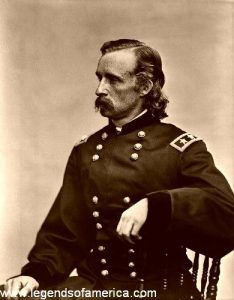
George A. Custer.
Because the Army’s military responsibilities were of continental proportions, involving sweeping distances, limited resources, and far-flung operations, an administrative structure was required for command and control. Therefore, the Army was organized on a territorial basis, with various geographical segments designated divisions, departments, and districts. Organization modifications, boundary rearrangements, and transfers of troops and posts to meet changing conditions were frequent.
The development of a basic defense system in the trans-Mississippi West followed the course of the empire. Territorial acquisition and exploration, succeeded by emigration and settlement, brought whites increasingly into collision with the Indians and progressively raised the need for military posts along the transcontinental trails and in settled areas.
The annexation of Texas in 1845, the settlement of the Oregon boundary dispute in 1846, and the successful conclusion of the Mexican War with the cession to the United States in 1848 of vast areas of land all drew the outlines of the primary task facing the Army in the West in the middle of the 19th century. Between the Mexican and Civil Wars, the Army established a reasonably comprehensive system of forts to protect the arteries of white travel and areas of white settlement across the frontier. At the same time, operations were launched against Indian tribes that represented actual or potential threats to movement and settlement.
Militarily successful in some cases, these operations nevertheless hardened Indian opposition, prompted wider red provocation, and delineated an Indian barrier to westward expansion extending down the Great Plains from the Canadian to the Mexican border. For example, Brigadier General William S. Harney responded to the massacre of Lieutenant John L. Grattan’s detachment by the Sioux with a punishing attack on elements of that tribe on the Blue Water in Nebraska in 1855. Farther south, Colonel Edwin V. Sumner hit the Cheyenne on the Solomon Fork in Kansas in 1857. Brevet Major Earl Van Dorn fought the Comanche in two successful battles: Rush Spring in Oklahoma and Crooked Creek in Kansas in 1858 and 1859.
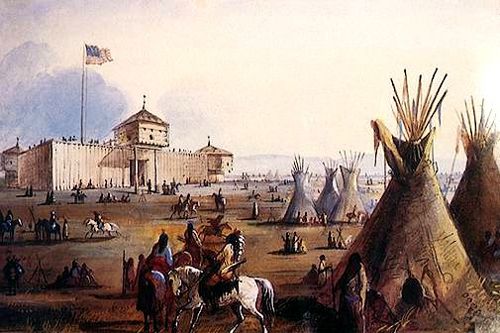
Fort Laramie, Wyoming, painting by Alfred Jacob Miller.
In the Southwest between the wars, Army units pursued Apache and Ute in New Mexico Territory, clashing with the Apache at Cieneguilla and Rio Caliente in 1854 and the Ute at Poncha Pass in 1855. There were various expeditions against different branches of the elusive Apache, involving hard campaigning but few conclusive engagements, such as the one at Rio Gila in 1857. In 1861, Lieutenant George N. Bascom moved against Chief Cochise in this region, precipitating events that opened a quarter-century of hostilities with the Chiricahua Apache.
In the Northwest, where numerous small tribes existed, occasional hostilities existed between the late 1840s and the mid-1860s. Their general character was similar to operations elsewhere: white intrusion, Indian reaction, and white counteraction with superior force.
The more critical events involved the Rogue River Indians in Oregon between 1851 and 1856. The Yakama, Walla Walla, Cayuse, and other tribes on both sides of the Cascade Mountains in Washington in the second half of the 1850s. The Army, often at odds with civil authority and public opinion in the area, found it necessary on occasion to protect Indians from whites and the other way around.

Indian War Map
The Regular Army’s frontier mission was interrupted by the onset of the Civil War, and the task of dealing with the Indians was transferred to the volunteers. Although the Red Man demonstrated an awareness of what was going on and took some satisfaction from the fact that white men were fighting each other, there is little evidence that he took advantage of the transition period between the removal of the Regulars and the deployment of the volunteers. The so-called Great Sioux Uprising in Minnesota in 1862, which led to active campaigning in the Upper Missouri River region in 1863 and 1864, was spontaneous. Other clashes around the West were the result, not of the withdrawal of the Regular Army from the West, but rather the play of more fundamental and established forces.
By 1865, Army strength in the frontier departments was about double what it had been at Fort Sumter. The volunteers were generally able to keep pace with a continuing and gradually expanding westward movement by further developing the system of forts that their predecessors had begun.
Thus, the regional defense systems established in the West in the 1850s and 1860s provided a framework for deploying the Army as it turned from the Civil War to frontier responsibilities. In the late summer of 1866, the general command and administrative structure for frontier defense comprised the Division of the Missouri, containing the Departments of Arkansas, Missouri, Dakota, and the Platte; the Division of the Pacific, consisting of the Departments of California and the Columbia; and the independent Department of the Gulf, whose area included Texas.
The Army’s challenge in the West was one of the environment and an adversary. In the summer of 1866, General Ulysses S. Grant sent several senior officer inspectors across the country to observe and report on conditions. The theater of war was uninhabited or only sparsely settled. Its great distances and extreme variations of climate and geography accentuated manpower limitations, logistical and communications problems, and movement difficulties.
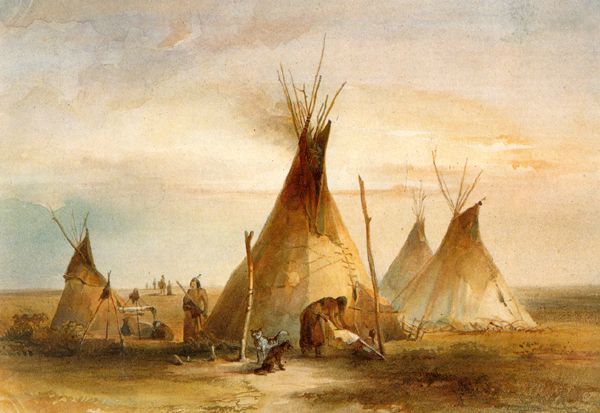
Plains Indians.
The extension of the rail system only gradually eased the situation. Above all, the mounted tribes of the Plains were a different breed from the Indians the Army had dealt with previously in the forested areas of the East. Even though the Army had fought Indians in the West in the period after the Mexican War, much of the direct experience of its officers and men had been lost during the Civil War years. Until frontier proficiency could be re-established, the Army would depend upon the somewhat intangible body of knowledge that marks any institution fortified by the seasoning of the Civil War.
Of the officers who moved to the forefront of the Army in the Indian Wars, few had frontier and Indian experience. At the top levels at the outset, Grant, as a captain, had had only a taste of the loneliness of the frontier outpost. Western duty was unknown to Sherman. While Sheridan had served about five years in the Northwest as a junior officer, neither Nelson A. Miles nor Oliver Otis Howard knew frontier service of any kind. Wesley Merritt, George Armstrong Custer, and Ranald S. Mackenzie graduated from West Point into the Civil War. John Gibbon had only minor involvement in the Seminole War and some garrison duty in the West. Alfred Sully, also a veteran of the Seminole War and an active campaigner against the Sioux during Civil War years, fell into obscurity, while Philip St. George Cooke was overtaken by age, and Edward R. S. Canby’s experience was lost prematurely through his death at Indian hands. Almost alone among the Army leaders at the upper levels of the Indian Wars, George Crook had pre-Civil War frontier experience, dating back to 1852, that he could bring to the West in 1866.
Thus, to a large degree, the officers of the Indian Wars were products of the Civil War. Many brought outstanding records to the frontier, but this was a new conflict against an unorthodox enemy. Those who approached their new opponent respectfully and learned his ways became the best Indian fighters and, in some cases, the most helpful in promoting a solution to the Indian problem. Some who had little respect for the “savages” and placed too much store in Civil War methods and achievements paid the penalty on the battlefield. Captain William J. Fetterman was one of the first to fall as the final chapter of the Indian Wars opened in 1866.
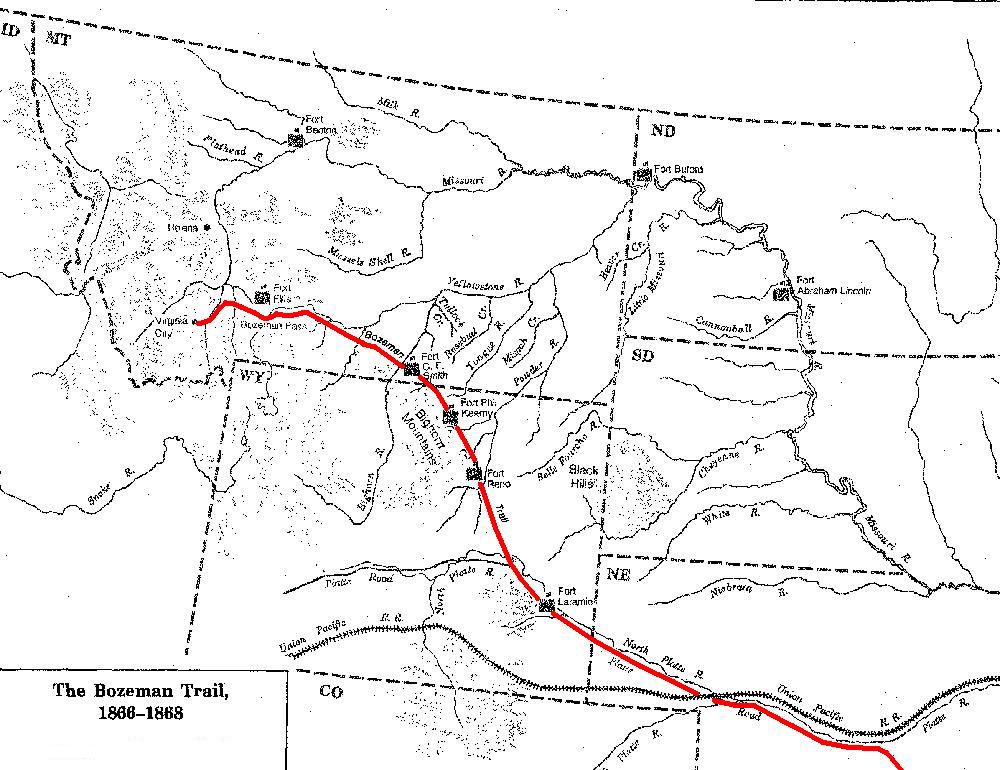
Bozeman Trail map.
Gold was discovered in Montana while the Civil War was still in progress, and fortune seekers flocked to the area. Lines of communication to the fields around Virginia City lay along circuitous routes, and pressure mounted for more direct access. The Army explored the possibilities and adopted a route pioneered by John Bozeman, extending from Fort Laramie on the North Platte River and Oregon Trail northwestward along the eastern base and around the northern shoulder of the Big Horn Mountains. Unfortunately, the trail cut through hunting grounds reserved for the Sioux, Northern Cheyenne, and Arapaho by treaty in 1865.
The Indians resisted white incursions, and Major General Patrick E. Connor’s Powder River Expedition failed to stop their depredations. In 1866, the government, under public pressure and officially drawn to the gold resources to alleviate the financial strains of the Civil War, initiated new negotiations, but with indifferent results. A few friendly chiefs signed a new agreement at Fort Laramie. Still, others led by Red Cloud of the Sioux stalked out defiantly when Colonel Henry B. Carrington marched in with a battalion of the 18th Infantry on his way to establish posts along the Bozeman Trail, even before an agreement with the Indians had been reached.
Although motivated by a sense of justice, treaty-making with the Indians often proved to be an exercise in futility for both parties. On the Indian side, the tribes were loosely knit societies of individualists living a nomadic existence under leaders whose control and influence fluctuated with the fortunes of war. A treaty was no more binding than the degree of power, authority, and allegiance a leader might muster at any given time, as Washington understood. On the white side, although the authority of negotiating officials was unquestioned, the power to enforce treaty provisions on highly independent, wandering whites was another thing. As breach after breach provoked the red man to action, the Army was invariably called to protect the offending citizens and punish the Indians.
Colonel Carrington’s battalion of about 700 men departed Fort Laramie in June 1866 for the Big Horn country. Despite Chief Red Cloud’s threat to oppose the move, several families, including the commanding officers, accompanied the force. At Fort Reno on Powder River, some miles beyond the end of the telegraph, Carrington, with a Regular company, relieved two companies of the 5th U.S. Volunteers, former Confederate prisoners who became so-called galvanized Yankees when they agreed to a frontier Indian service in exchange for their freedom. Farther northwestward, 225 miles from Fort Laramie, he selected a site on the Piney tributary of Powder River to construct his headquarters post — Fort Phil Kearny. Five companies remained there while the remaining two were sent out to establish Fort C. F. Smith at the northern edge of the Big Horns.

Fort Phil Kearny became the focus of enemy attention and, during its brief existence, remained virtually in a state of siege. On December 21, 1866, the Indians attacked a wood train six miles from the fort.
Captain Fetterman, who had been brevetted lieutenant colonel in Civil War actions and now boasted that he could ride through the whole Sioux Nation with 80 men, asked to lead a relief column. Indian decoys demonstrated invitingly before the rescue party, withdrawing gradually over Lodge Trail Ridge northwest of the post. Fetterman fell for the ruse and crossed the ridge against Carrington’s orders with 80 men behind him. In a carefully executed ambush, the Indians wiped out the entire force, including two civilians who had gone along to try out their new Henry repeating rifles, weapons far superior to the Springfield muzzle-loaders carried by the infantrymen and the Spencer carbines carried by the cavalrymen in the detail.
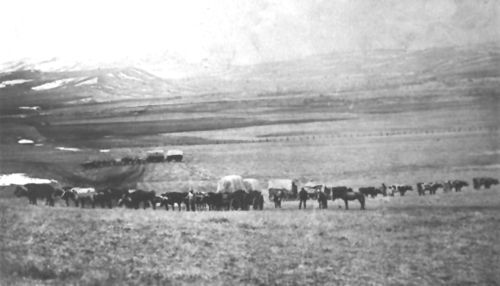
A wagon train on the Bozeman Trail, 1883.
The Army was more successful in two other notable actions on the Bozeman Trail. In August 1867, the Indians launched separate but coordinated attacks against a haying detail near Fort Smith and a wood detail outside Fort Kearny. In the Hayfield Fight, 19 soldiers and six civilians, under Lieutenant Sigismund Sternberg, equipped with converted breech-loading Springfields and several repeating rifles, held off vastly superior odds with a loss of only three killed and three wounded. In the Wagon Box Fight, Captain James Powell, with 31 men similarly armed and stationed behind wagon boxes removed from their running gear, held off an investing force of several thousand Sioux and Cheyenne for a good four hours, withstanding mounted and dismounted attacks by several hundred warriors at various times with only three killed and two wounded.
It is risky to deal with statistics concerning Indian participation and casualties in Western campaigns. Accounts vary widely, are founded on shaky evidence, and require some balancing and juggling to reach a general order of magnitude, much less an accurate assessment of the facts in a given situation. The Sioux and Cheyenne undoubtedly suffered severe casualties in the Hayfield and Wagon Box fights. However, these were defensive engagements for the Army, and it lacked sufficient force in the Upper Plains to undertake offensive operations. At the same time, there was the sentiment in the East to treat rather than chastise the Indians. The government withdrew the garrisons and abandoned the Montana road in July 1868.
The Southern Plains
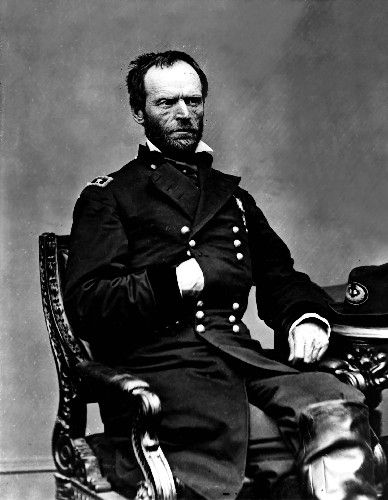
General William T. Sherman.
During the Indian Wars, the Army was frequently unable to balance resources with requirements due to limited manpower and the vast size of the theater of operations. As Lieutenant General William T. Sherman, commanding the Division of the Missouri, put it, “Were I or the department commanders to send guards to every point where they are clamored for, we would need alone on the plains a hundred thousand men, mostly of cavalry. Each spot of every road and each little settlement along five thousand miles of frontier wants its regiment of cavalry or infantry to protect it against the combined power of all the Indians because of the bare possibility of their being attacked by the combined force of all the Indians.”
It was the good fortune of the Army and the citizens in the West that the Indians rarely acted in concert within or between tribes. However, had they done so, the Army might have been able to employ large units regularly instead of dispersing troops in small detachments all over the frontier, and might also have had better luck in forcing the elusive opponent to stand and fight. However, troops and units were at a premium, so much so that in 1868, Major General Philip H. Sheridan decided to try an unusual expedient to carry out his responsibilities in the Department of the Missouri.
Sheridan directed Major George A. Forsyth to “employ fifty first-class hardy frontiersmen, to be used as scouts against the hostile Indians, to be commanded by yourself.” Recruited at Forts Harker and Hays in Kansas, the command took the field in late August in a region frequented by Comanche, Kiowa, Southern Cheyenne, and Arapaho, augmented by some Sioux roaming south of the Platte. The tribes were restive. The Kansas Pacific Railroad was advancing through their country, frightening the buffalo — their source of food, clothing, and shelter — and attracting white settlement. The Cheyenne were still fuming over the massacre of some 200 of Black Kettle’s band, including women and children, by Colonel John M. Chivington and his Colorado volunteers on Sand Creek in 1864. They demonstrated their mistrust of the whites when Major General Winfield Scott Hancock penetrated their area with a large-scale and presumably peaceful expedition in 1867.
Forsyth and the Indians collided on the Arickaree Fork of the Republican River at dawn on November 17, 1868, when a combined war party of about 600 Cheyenne, Sioux, and Arapaho attacked him in a defensive position on a small island in the riverbed. The Indians pressed the fight for three days, wounding Forsyth and upwards of 20 of his scouts and killing his second in command, Lieutenant Frederick H. Beecher, his surgeon, and three scouts. Among the Indian casualties in this Battle of Beecher Island was the influential Cheyenne leader Roman Nose. The first rescue force on the scene was Captain Louis H. Carpenter’s company of Negro troopers of the 10th Cavalry Regiment.
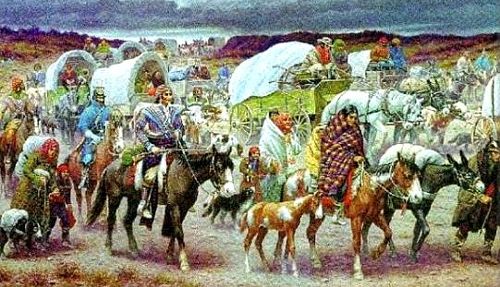
Trail of Tears painting by Robert Lindneux.
By the late 1860s, the government’s policy of removing Indians from desirable areas (graphically represented by the transfer of the Five Civilized Tribes from the Southeast to Oklahoma — the Cherokee called it the “Trail of Tears” — had run its course and was succeeded by one of concentrating them on reservations.
The practice of locating tribes in places other than native or wholesome surroundings and joining uncongenial bands led to more than one Indian War. Some bands found it convenient to accept reservation status and government rations during winter, returning to the warpath and hunting trail in the milder seasons. Many bands of tribes refused to accept the treaties offered by a peace commission and resisted the government’s attempt to confine them to specific geographical limits; it fell to the Army to force compliance. In his area, General Sheridan now planned to hit the Indians in their permanent winter camps.
While a winter campaign presented severe logistical problems, it offered opportunities for decisive results. If the Indians’ shelter, food, and livestock could be destroyed or captured, the warriors, their women, and children would be at the mercy of the Army and the elements, and there would be little left but surrender. The technique of total war raised specific moral questions for many officers and men that were never satisfactorily resolved.
Sheridan devised a plan whereby three columns would converge on the wintering grounds of the Indians just east of the Texas Panhandle: one from Fort Lyon in Colorado, one from Fort Bascom in New Mexico, and one from Fort Supply in Oklahoma. The 7th Cavalry Regiment under Lieutenant Colonel George Armstrong Custer fought the significant engagement of the campaign. Custer found the Indians on the Washita River and struck Black Kettle’s Cheyenne village with eleven companies from four directions at dawn on November 29, 1868, as the regimental band played “Gerry Owen.”
A fierce fight ensued, and the Indians continued to emerge from the surrounding terrain. By midmorning, Custer learned that this was only one of many villages of Cheyenne, Arapaho, Kiowa, and Comanche extending for miles along the Washita.
Facing such odds, Custer hastened to destroy the village and its supplies and horses, used an offensive maneuver to deceive the enemy, and, under cover of darkness, withdrew from the field, taking 53 women and children as prisoners. The 7th lost 21 officers and men killed and 13 wounded in the Battle of the Washita; the Indians, perhaps 50 killed and as many wounded.
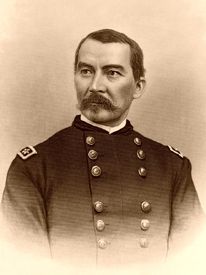
General Philip H. Sheridan.
The Kiowa and Comanche did not lightly relinquish their hunting grounds and forsake their way of life. Some lived restlessly on a reservation in Indian Territory around Fort Sill; others held out. Sherman, now Commanding General of the U.S. Army, Sheridan, commanding the Division of the Missouri, and their field commanders were forced into active campaigning before these tribes were subdued. In 1871, the Kiowa warriors raided Texas, killing some teamsters of a government wagon train. General Sherman, visiting Fort Sill, had the responsible leaders — Satanta, Satank, and Big Tree — arrested in a dramatic confrontation on the post between armed Indians and soldiers. Only Sherman’s coolness prevented an explosion. Satank was later killed attempting escape, while Satanta and Big Tree were tried and imprisoned for two years. Again, in custody in 1876, Satanta took his own life.
There were other incidents on the Southern Plains before the Indians were subjugated. An Army campaign in 1874, involving approximately 3,000 troops under Colonel Nelson A. Miles‘ overall command, was launched in five columns from bases in Texas, New Mexico, and Indian Territory against the Texas Panhandle refuge of the Plains tribes. On September 24, Colonel Ranald S. Mackenzie and the 4th Cavalry found the Comanche, Kiowa, Cheyenne, and Arapaho winter camp in the last stronghold, the deep Palo Duro Canyon on the Staked Plains. Mackenzie’s surprise attack separated the Indians from their horses and belongings, which were destroyed. With winter coming on, the Indians had little alternative to the reservation.
The Northwest
Not all the Indian Wars were fought with the Plains tribes. In the 1870s, the Army engaged in wars with several Pacific slope tribes, and the operations were widely scattered over the mountainous northwestern quarter of the trans-Mississippi West.
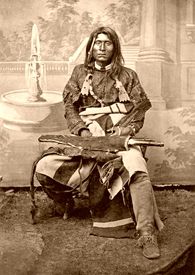
Captain Jack was hanged for killing General Canby during peace negotiations.
The Modoc War of 1872-73 began when the Modoc, placed on a reservation in southern Oregon with the more numerous and traditionally unfriendly Klamath, returned without permission to their home in the Lost River country on the California border. When the Army attempted in November of 1872 to take them back to the reservation, fighting broke out, and the Indians retreated into a natural fortress — the Lava Beds at the southern end of Tule Lake.
For six months, there were four engagements in which Regular and volunteer troops, despite having superior strength and weapons, incurred heavier losses than their opponents. The extended efforts of a peace commission made little headway. They ended in tragedy when two members, Brigadier General Edward R. S. Canby and Reverend Eleaser Thomas, were shot while in conference with the Indians. The Modoc finally surrendered, and four leaders, including Canby’s murderer, Captain Jack, were hanged.
The practice of uprooting the Indians from their homeland was also the cause of the Nez Perce War in 1877. The Nez Perce had been friendly to the whites from the days of their contact with Lewis and Clark. Although they ceded some of their lands to the whites, they refused to give up the Wallowa Valley in northeastern Oregon. White encroachment increased, stiffening the lines of political pressure and sending it back to Washington. This led to decisions favorable to white settlement and the removal of the Nez Perce to the Lapwai Reservation across the Snake River in Idaho. Some tribe elements complied, but Chief Joseph and his people did not, and the Army was ordered to move them. An inevitable course of events and irresponsible actions by both Reds and Whites made hostilities unavoidable.
In a remarkable campaign that showcased the unique capabilities of guerrilla forces and the challenges formal military units face in confronting them, the Nez Perce led the Army on a 1,300-mile chase across the Continental Divide, punctuated by several sharp engagements. The Indians used the terrain to great advantage, fighting when circumstances favored them, slipping around opposing forces to the side, or breaking contact when the situation dictated it. They lived off the land while the Army was tied to supply trains vulnerable to Indian attack. However, their women and children hindered their freedom of movement, while the Army’s superiority in strength and weapons gradually began to tell. Indian rifles were no match for howitzers and Gatling guns, and Indian mobility could not outstrip the Army’s use of the telegraph to alert additional forces along the Nez Perce line of flight. The battles of White Bird Canyon, Clearwater, Big Hole, Canyon Creek, and Bear Paw Mountain involved hundreds of troops and numerous units under the command of Howard, Gibbon, Samuel D. Sturgis, and Miles. There were heavy casualties on both sides before Chief Joseph, in a poignant speech, surrendered. “Hear me, my Chiefs,” were his closing words to Generals Howard and Miles, “My heart is sick and sad. From where the sun now stands, I will no longer fight.”

Umatilla Chief in the Bannock War.
In 1878 and 1879, Army forces took the field against various bands of Indians in the mountain areas of the Northwest. Operations against the Bannock, Sheepeater, and Ute were relatively minor. The Bannock War was caused by the white intrusion on the Camas Prairie in Idaho, where camas roots were a prime food source for the Indians. The Sheepeater War also centered in Idaho; Indians were charged with several murders they probably did not commit. The Ute War in northwestern Colorado grew out of the misguided methods and impractical idealism of Indian Agent Nathan C. Meeker. These clashes represented the last convulsion against fate for the tribes involved, while they meant hard campaigning and casualties for the Army.
The Apache were among the Army’s most formidable opponents in the Indian Wars. The zone of operations embraced the territories of Arizona and New Mexico, western Texas, and Mexico’s northern provinces. Even though hostile Apache were relatively few and the theater was essentially a secondary one, they tied down sizable forces over a long period.
Post-Civil War Apache troubles extended from the late 1860s, when the Army campaigned against Cochise, through the seventies and eighties, when Victorio and Geronimo came to the fore. On the Army side, the critical factor was the assignment of Brevet Major General George Crook to the Southwest, where he served two tours between 1871 and 1886. Crook was an able administrator and an outstanding soldier, and proved to be a relentless opponent of the Indians on the battlefield and a steadfast friend of it.
As commander of the Department of Arizona, he organized several mobile striking forces at key locations under the leadership of experienced frontier officers. He launched them in a concerted campaign supported by mule pack trains. Acting under an 1866 Congressional act, which authorized the Army to enlist up to a thousand Indian scouts (they came from traditionally friendly tribes like the Crow and Pawnee or friendly elements of warring tribes), Crook also employed Apache scouts. Converging columns and persistent pursuit brought results, and he left Arizona in relative quiet when he went to the Department of the Platte in 1875.
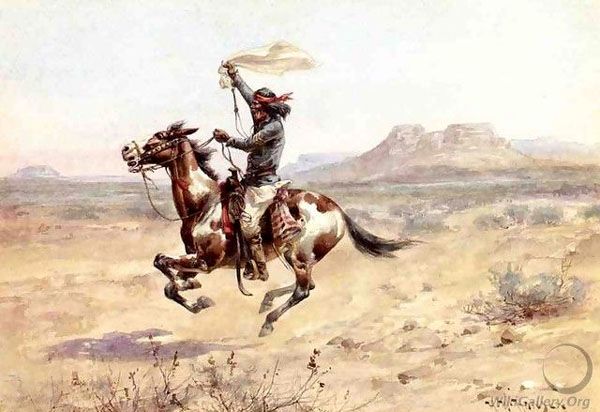
Apache Warrior by Herman Wendleborg Hansen.
But the quiet in the Southwest did not last long. Mainly at the instigation of politicians, merchants, contractors, and other self-serving whites, several bands of mutually uncongenial Apache were transferred from desirable areas to the unhealthy San Carlos Reservation in the Arizona lowlands. As a result, much of what Crook had accomplished was undone as disgruntled Apache again turned to raiding and killing. For example, in the summer of 1881, an Apache medicine man stirred the Indians to heights of religious fervor that led to a sharp clash on Cibicu Creek with troops commanded by Colonel Eugene A. Carr, one of the Army’s most experienced Indian fighters. The action was highlighted by perhaps the most notable instance of disaffection when the Indian scouts with the command turned on the Regulars.
Throughout the Indian Wars, there was constant friction between the War and the Interior Departments over the conduct of Indian affairs. A committee of the Continental Congress had first exercised this responsibility. In 1789, it was transferred to the Secretary of War, and in 1824, the Bureau of Indian Affairs was established within the War Department. When the Department of the Interior was established in 1849, the Indian Bureau was transferred to that agency. Thus, one department handled the affairs administration while enforcement lay with another. As General Crook put it to a Congressional committee in 1879: “As it is now, you have a divided responsibility. It is like having two captains on the same ship.”
Crook returned to Arizona in 1882 to restore confidence among the Apache in white administration, move them along the paths of civilization, and constantly spar with the Indian Bureau. He took the field against dwindling numbers of hostiles on the military side, cooperating with Mexican officials and authorized to cross the international boundary in pursuit of the renegades. Crook met with Geronimo in the Sierra Madre Mountains in March of 1886 and negotiated a surrender that brought in all but Geronimo and a few followers who backed out at the last moment. When Washington, D.C., failed to support the field commander in the conditions he had negotiated for the surrender, Crook asked to be relieved. Nelson A. Miles replaced him, and Lieutenant Charles B. Gatewood entered Geronimo’s mountain quickly to arrange a surrender and bring the Apache campaigns to a close.
The Northern Plains
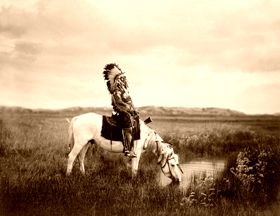
Oglala Sioux at an oasis in the Badlands.
All of the elements of the clash of red and white civilizations were present in the events leading to the final subjugation of the Indians. The mounted tribes of the Great Plains were astride the main corridors of westward expansion, and this was the area of decision. The treaty of 1868 had set aside the Great Sioux Reservation in South Dakota, and the Army had abandoned the Bozeman Trail, leaving the Powder River region as an unceded Indian country. The Sioux and their allies were thus north of the main transcontinental artery along the Platte River. Although the arrangement worked for several years, it was doomed by the irresistible march of civilization.
The Sioux rejected white overtures for a right-of-way for the Northern Pacific Railroad. When surveyors proceeded, they encountered Indian resistance, which prompted the dispatch in 1873 of a large military expedition under Colonel David S. Stanley up the Yellowstone Valley.
The following year, General Sheridan sent Custer and the 7th Cavalry on a survey through the Black Hills within the Sioux Reservation. When geologists with the expedition discovered gold, the news spread rapidly, and prospectors flooded into the area, despite the Army’s best efforts to keep them out. Another treaty was broken, and band by band, angry reservation Indians slipped away to join non-treaty recalcitrants in the unceded Powder River region of Wyoming and Montana.
In December 1875, the Indiana bureau notified the Sioux and Cheyenne that they had to return to the reservation by the end of the following month. Since the Indians were in winter quarters in remote areas and had little chance against the elements, they did not obey. As the deadline passed, the Commissioner of Indian Affairs appealed to the Army to force compliance. Knowing his success with converging columns against the Southern Plains tribes, Sheridan determined on a similar campaign in the north.
Columns were organized to move on to the Powder River area from three directions. Brigadier General Alfred H. Terry marched westward from Fort Abraham Lincoln in the Dakota Territory, his principal element, the 7th Cavalry, under Custer. Colonel John Gibbon moved eastward from Fort Ellis in western Montana with a mixed force of infantry and cavalry. In contrast, Brigadier General George Crook moved northward from Fort Fetterman on the North Platte in Wyoming with a force heavily weighted in the cavalry. In March 1876, a part of Crook’s force under Colonel Joseph J. Reynolds had entered the Powder Valley and surprised a Cheyenne-Sioux camp. Still, Reynolds had failed to press an initial advantage and had withdrawn without punishing the Indians. With the significant campaign underway in June, Crook made the first contact. The Sioux and Cheyenne learned of his approach along Rosebud Creek, and some 1,500 warriors moved to meet him. Crook had 15 cavalry units, five infantry companies, approximately 1,000 men, and 300 friendly Indians and civilians. The two forces met on roughly equal terms on the 17th in heavy fighting. Tactically, neither side carried the field conclusively enough to claim a victory. Strategically, Crook’s withdrawal to a supply base southward gave the Battle of the Rosebud the complexion of a defeat for the Army, primarily because of developments on the Little Bighorn River about 50 miles northwestward, which his continued advance might have influenced decisively.
While Crook was moving northward to his collision on the Rosebud, Terry and Gibbon, marching from east and west, joined forces on the Yellowstone River at its confluence with the Powder, and a supply base serviced by a river steamer was established. Terry sent the 7th Cavalry to scout for Indian signs, and Major Marcus A. Reno, with six companies (the cavalry “company” was not called a “troop” until 1883), reconnoitered up the Powder River, across the Tongue River, and into the valley of the Rosebud.
On June 17, Reno found a fresh trail leading west out of the valley and across the Wolf Mountains in the direction of the Little Bighorn. He was unaware and thus unable to inform his superiors that Crook was also in the Rosebud Valley and had been engaged by a large force of Indians not far upstream on the same day.
Terry held a council of war aboard the steamer Far West to outline his plan. Custer’s 7th Cavalry would move south up the Rosebud, cross the Wolf Mountains, and enter the Little Bighorn valley from the south. Joined by Terry, Gibbon would ascend the Bighorn River and its tributary, the Little Bighorn, from the north, trapping the Indians between the two forces.
As it happened, Custer moved at least a day ahead of schedule for the cooperative action envisioned in Terry’s plan. On June 25, 1876, the 7th crossed the Wolf Mountains and moved into the valley of the Little Bighorn.
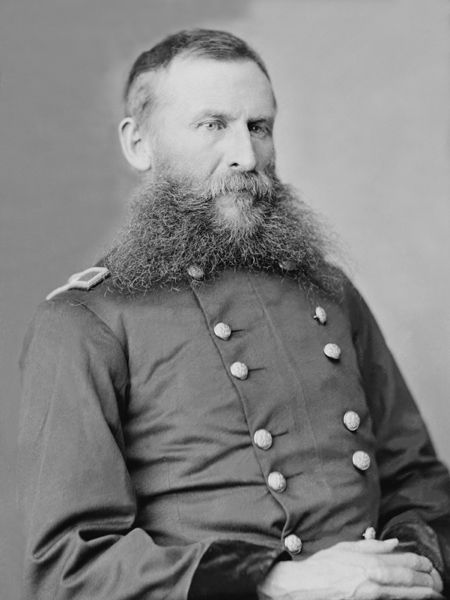
General George Crook, about 1870.
Custer was confident of his capability to handle whatever he ran up against, convinced that the Indians would follow their usual practice of scattering before a show of force, and completely unaware that he was descending upon one of the largest concentrations of Indians ever assembled on the Plains — perhaps as many as 12,000 to 15,000 Sioux and Northern Cheyenne, with between 3,000 and 4,000 warriors under such leaders as Crazy Horse, Sitting Bull, Gall, Crow King, Lame Deer, Hump, and Two Moon.
Around noon this Sunday in June, Custer sent Captain Frederick W. Benteen with three companies to scout to the left of the command, a not-unusual move for a force still attempting to locate an elusive enemy and expecting it to slip away upon contact. About 2:30 p.m., still two miles short of the river, when the upper end of an Indian village came into view, Custer advanced three more companies under Major Reno with instructions to cross the river and charge the Indian camp. With five companies, Custer moved off to the right, still screened by a fold of ground from observing the extent of his opposition, perhaps with the thought of hitting the Indians from the flank — of letting Reno hold the enemy by the nose. At the same time, he, Custer, kicked him in the seat of the pants. As he progressed, Custer rushed Sergeant Daniel Kanipe to the rear to hurry the pack train and its one-company escort forward. Shortly afterward, he dispatched Trumpeter John Martin with the last message to Benteen, informing him that a “big village” lay ahead and that he should “be quick — bring packs.”
The main phase of the Battle of the Little Bighorn lasted about two hours. Reno, charging down the river with three companies and some Arikara scouts, ran into hordes of Indians, not retreating but advancing, perhaps mindful of their credible performance against Crook the week before and certainly motivated by a desire to protect their women and children and cover a withdrawal of the villages. Far outnumbered, suffering heavy casualties, and in danger of being overrun, Reno withdrew to the bluffs across the river and dug in.
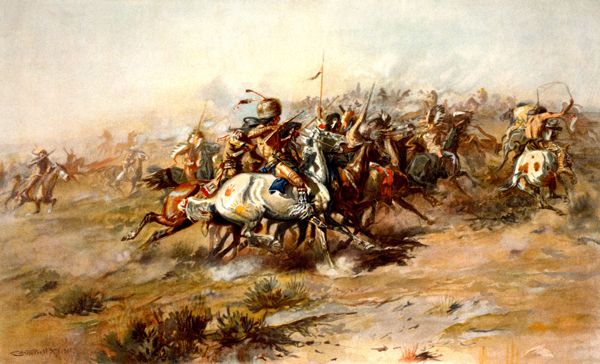
Battle of the Little Bighorn by C.M. Russell.
Custer and his five companies–about 230 strong–moved briskly along the bluffs above the river until, some four miles away, beyond supporting distance and out of sight of the rest of the command, they were brought to bay and overwhelmed by an Indian force that outnumbered them by perhaps 20 to 1. When the last man had fallen and the dead had been plundered, the Indians again turned their attention to Reno.
While the Indians had been chiefly absorbed on the Custer section of the field, Benteen’s battalion, the pack train, and its escorting company had moved up and gone into a defensive perimeter with Reno’s force. Despite a complete lack of knowledge of his location and situation, an attempt to move in force in Custer’s direction failed; Major Reno’s defensive position was reoccupied and remained under attack until the dark of the 25th and on through daylight hours of the 26th. The siege was finally lifted with the arrival of the Terry-Gibbon column on June 27.
The Custer disaster shocked the nation and was the climax of the Indian Wars. The Army poured troops into the Upper Plains, and the Indians scattered, some, like Sitting Bull’s band, to Canada. But gradually, under Army pressure or seeing the futility of further resistance, the Indians surrendered and returned to the reservation.
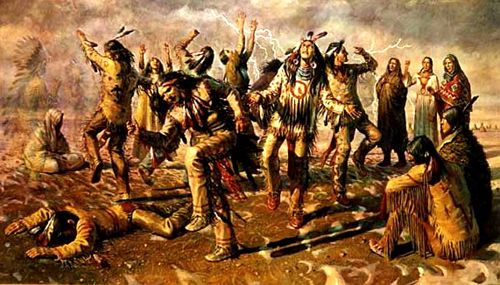
Ghost Dance.
The last gasp of the Indian Wars occurred in 1890, stemming from the fervor of the Ghost Dance religion. The Sioux were particularly susceptible to the emotional excitement and the call of the old way of life represented in these ceremonies. Their wild involvement frightened the agents on the Sioux Reservation into calling for military protection. The 7th Cavalry, now commanded by Colonel James W. Forsyth, moved to Wounded Knee Creek on the Pine Ridge Agency, where, on December 29, 1890, the regiment attempted to disarm Big Foot’s band. An Indian’s rifle was discharged into the air as two soldiers disarmed him, precipitating a battle where more than 150 Indians, including women and children, were killed and a third as many wounded. In comparison, 25 soldiers were killed and another 37 were wounded.
The Battle of Wounded Knee was the last Indian engagement to fall in the category of warfare; later, incidents were more in the realm of civil disturbance. The 19th century was drawing to a close, and the frontier was rapidly disappearing. States were replacing territories, and people, settlements, governments, and laws spread across the land. The buffalo were gone, and the Indians were confined to reservations and dependent upon the government for subsistence. An expanded rail system was available to move troops quickly to trouble spots. The Army could now concentrate its forces at the larger and more permanent posts and relinquish numerous smaller installations that had outgrown their usefulness. By 1895, the Army was deployed more or less equally based on regional rather than operational considerations.
In the quarter-century of the Indian Wars, the Army met the Indians in over a thousand actions, large and small, all across the American West. It fought these wars with peacetime strength and on a peacetime budget. At the same time, it helped shape Indian policy, contributed to the red man’s acculturation, and was centrally involved in numerous other activities that were part and parcel of westward expansion and the nation’s attainment of its “manifest destiny.” Operations against the Indians seasoned the Army and forged a core of experienced leaders who would serve the republic well as it moved onto the world scene at the turn of the century.
By Richard W. Stewart, General Editor; Office Of The Chief Of Military History (2007). Compiled and edited by Kathy Alexander/Legends of America, updated October 2025.
Also See:
Indian Wars, Battles & Massacres
Military Campaigns of the Indian Wars
Soldiering Begins in the American West
Indian Wars of the Frontier West by Emerson Hough
Source: U.S. Army Center of Military History
Author Notes: Winning The West: The Army In The Indian Wars, 1865-1890 is extracted from the book American Military History, Volume 1, The United States Army and the Forging Of A Nation, 1775-1917; Richard W. Stewart, General Editor; Office Of The Chief Of Military History, United States Army. U.S. Government Printing Office, Washington, D.C. This article, however, is not verbatim, as it has been edited for clarity and ease for the modern reader.