Legends of America


Follow the links to the various pages of Legends of America

The Old West Legends of America Outhouse Madness Ghostly Legends Outlaws Old West Saloons Rocky Mountain General Store Legends Photo Store The Book Store Make your travel reservations here! Route 66 Native Americans The Old States - Back East


  Search Our Sites

Custom Search

Google

 Legends Of America's Facebook PageLegends Of America's Twitter Page

Legends Home

Site Map

What's New!!


Content Categories:

American History

Destinations-States

Ghost Towns

Ghostly Legends

Historic People

Native Americans

Old West

Route 66

Travel Center

Treasure Tales


Legends Of America's

Rocky Mountain General Store


Old West Mercantile
Route 66 Emporium
TeePee Trading Post

Book Shelf

DVDs
Postcard Rack

Tin Signs

and Much More!


  Legends Of America's Rocky Mountain General Store - Cart View


Legends Of America's Photo Print Shop

Legends Of America's Photo Print Shop
 

Ghost Town Prints

Native American Prints

Old West Prints

Route 66 Prints

and Much More!!
 

Legends Of America's Photo Print Shop - Cart View


About Us

Advertising

Article/Photo Use

Copyright Information

Blog

Forum

Guestbook

Links

Newsletter

Privacy Policy

Writing Credits


We welcome corrections

and feedback!

Contact Us


Texas Forts of the Old West - Page 6


Get your Old West bumper stickers here!


<< Previous 1 2 3 4 5 6 7 8 Next >> 


Fort Grigsby (1862-1863) - A small Confederate post during the Civil War, Fort Grigsby was located on the Neches River at the site of present-day Port Neches. The post was built by Major Julius Kellersberg in October, 1862. It was to be but one of a series of posts built as river defenses to block a possible Union advance up the Neches River after the fall of Fort Sabine. Though consisting only of mud embankments, reinforced by upright pointed logs, the post was defended by two 24-pound guns, overlooking a bend in the river. It was no longer necessary after the construction of Fort Manhassett and was abandoned sometime after July 1863. The site is located eleven miles southeast of Beaumont in eastern Jefferson County.


Fort Hancock (1881-1895) - First established as Camp Rice in 1881, the fort was a subpost to Fort Davis. After the death of Union Major General Winfield Scott Hancock in 1886, the post was renamed in his honor.


Neches River at Port Neces.

Neches River at Port Neces.


Camp Rice Texas markerIt was first located near the site of Old Fort Quitman, but  was moved in 1882 to be nearer to the Southern Pacific Railroad. In 1884, it became an independent post. Over the years, the fort was frequently flooded by the Rio Grande River, despite a number of small dams troops had built. The fort also suffered several fires, before it was closed in 1895. Today, all that is left is a sad concrete marker sitting in front of a dusty field.


Fort Henderson (1837) - Built by Major William H. Smiths Texas Ranger battalion early in 1837, the post was part of a defensive line established by the Republic of Texas to protect against Indian raids. It was named in honor of General James Pinckney Henderson, the Secretary of State. Located n the upper Navasota River near the present boundaries of Robertson and Leon counties, the fort was difficult to supply and was therefore, abandoned in the Fall of of 1837.


Fort Houston (1836-1841?) - A stockade and blockhouse of the Republic of Texas, the post was built by Captain Michael Costley's Company of Texas Rangers, to protect area settlers from Indian attacks. It was named for General Sam Houston. A settlement called Houston, had been platted in 1835, and the fort was built in the middle of the town square. Survivors from the massacre at Fort Parker (among them Cynthia Parker's parents) fled to Fort Houston in May, 1836. The fort was abandoned in 1841 or 1842, and the settlement then became known as Fort Houston. When Palestine became the county seat, the settlement and the old military site was purchased by a private individual. Today, the site, located  two miles west of Palestine, is designated by a Texas historical marker. Nearby is the old Fort Houston Cemetery. It is located on Farm Road 1990 and U.S. Highway 79, in Anderson County.


Fort Inge (1849-1869) - First called Camp Leona, the fort was situated on the Leona River a mile south of present-day Uvalde, Texas. Built in March, 1849, it was established as one of several federal forts and served as a base of operations for army troops and Texas militia. Its name was changed in December, 1849 in honor of Lieutenant Zebulon M. P. Inge, who was killed in  the Mexican War battle of Resaca de la Palma. Missions included security patrols for the construction of the San Antonio-El Paso military road, escorts for supply trains and mail, protection of settlers from from bandits and Indian attacks, raiders, and guarding the international boundary with Mexico. The post included about 12 buildings arranged around the parade ground, most built of adobe. However, the hospital was constructed of limestone. Sometime during or after the Civil War, a low stone wall was built around the fort.


Typically, the post was manned by only one company but for a brief period in 1854 it served as the regimental headquarters for the United States Mounted Rifle Regiment with a garrison of 200. During the Civil War, the post was occupied by Confederates, but was reoccupied by federal troops in 1866. Three years later, in March, 1869, the post was closed and the troops transferred to Fort McKavett. In 1871, soldiers returned to the post to tear down some of the buildings and recover the timber and stone to be used in construction at Fort Clark. The site was later used as a camp by the Texas Rangers until 1884. Today, it is the Fort Inge Historical Site County Park in Ulvalde, Texas.


Fort Inglish (1837-1840s) - During the early years of the Republic of Texas, residents in what is now Fannin County lived in constant danger of Indian attacks and in the summer of 1837, a man named Bailey Inglish built a single blockhouse where settlers could take refuge. Although the fort was private, it was used by the Army of the Republic of Texas in several campaigns against the Indians, including being utilized by General John H. Dyer's the militia brigade during the Rusk-Dyer Indian expedition. In October, 1840 Colonel William G. Cooke's troops took refuge at the fort while building during the Military road expedition, in which drought, loss of supplies, bitter cold, and scarcity of game, had nearly led them to starvation. Once the Indian menace was removed in Northeast Texas in the early 1840s; however, Fort Inglish fell into disrepair and was eventually dismantled. The site was located on the grounds now occupied by a Veterans Administration center, north of East Ninth Street and east of Lynn Street, in downtown Bonham.


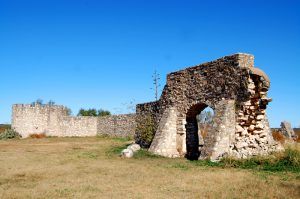
Ruins of Fort Lancaster, Texas

Ruins of Fort Lancaster, photo courtesy Friends of Fort Lancaster.

Fort Lancaster (1855-1861) - Established in 1855 on the east bank of live Oak Creek just above where it joins the Pecos River, the fort was tasked to pursue and subdue the Comanche and Mescalero Apache Indians, as well as guarding the Pecos Crossing of the San Antonio-El Paso Road. At the height of development, it consisted of 25 permanent buildings and had an average complement of 72 men and four officers. When the Civil War erupted, federal troops abandoned the fort in 1861. During the war, it was occupied by 2nd Texas Cavalry and was an important location on the supply line to and Arizona and New Mexico in 1861-62. After the Civil War, the post was not re-commissioned, but was frequently used as a sub-post for other Texas forts. It remained a stopping off place for travelers, attracted by the water supply. Later, it was sold to private individuals.


In 1965, the owners donated the 39-acre site to Crockett County for preservation as a historic site. Today, there are extensive stone ruins of the fort, including partial stone walls, some rising 6 to 8 feet; chimneys and fireplaces; and piles of rubble.


The old fort site is located in Crockett County, just off U.S. 290, about 10 miles east of Sheffield.


Contact Information:


Friends of Fort Lancaster

P.O. Box 306

629 Fort Lancaster Road

Sheffield, Texas 79781

432-836-4391


Continued Next Page

<< Previous 1 2 3 4 5 6 7 8 Next >> 

From the Rocky Mountain General Store

Civil War & Military Photographs - From our personal Photo Print Shop, you can now order prints that provide dramatic glimpses into the Civil War and other military expeditions and battles that occurred during the days of the Old West. From battlegrounds, to generals, Indian Campaigns, the cavalry, and everything in between, you'll find it here and check back often as this varied collection grows daily.


                                                              Copyright © 2003-2012, www.Legends of America.com