
Summaries: A B C D E-I J-K L-M N O P Q-R S T-V W X-Z
Erie – With French contact limited to a single brief meeting, very little is known for sure about the Erie, except that they were important and were there. The Dutch and Swedes also heard about them through their trade with the Susquehannock, but never met the Erie. All information about their social and political organization has come from early Jesuit accounts of what the Huron had told them.

Eyak Indian.
Eyak – The Eyak, literally “inhabitants of Eyak Village,” are a Native American indigenous group traditionally located on the Copper River Delta near Cordova, Alaska. The Eyak’s territory reached present-day Cordova east to the Martin River and north to Miles Glacier. The Eyak moved out of the interior down the Copper River to the coast. There, they harvested the rich salmon fishing grounds. When the Russians arrived, they recognized the Eyak as a distinct culture and described their territory on their maps. They also traded with the Eyak and sent them missionaries. Because of their small population, they were often raided, and their territory boundaries were under pressure from the Chugach to the west. The Tlingit on the east side had better relations with the Eyak, leading to intermarriage and the assimilation of many Eyak. This pushed the Eyak’s territorial boundary further west and contributed to the Eyak’s decline. When the Americans arrived, they started canneries and competed with the Eyak for salmon. This, along with integration with diseases introduced by non-native settlers, led to further decline. As populations decreased, the remaining Eyak began congregating near the village of Orca. In 1880, the village of Alaganik had a population of 117, and by 1890, it had declined to 48. In 1900, the total population was estimated at 60. As more settlers arrived, this last village became the town of Cordova. As of 1996, there were 120 living, partial Eyak descendants. The last full-blooded Eyak died in 2007.
Eno – A tribe associated with the Adshusheer and Shakori in North Carolina in the 17th century. Historians believe it is doubtful that the Eno and the Shakori were of Siouan stock, as they seem to have differed in physique and habits from their neighbors. However, their alliances were all with Siouan tribes. Little is known of them as they disappeared from history as tribal bodies about 1720, having been incorporated with the Catawba on the south or with the Saponi and their confederates on the north. However, they still retained their distinct dialect in 1743. The Eno and Shakori were first mentioned in 1654, when the Tuscarora tribe described them as living next to the Shakori, “a great nation,” by whom the northern advance of the Spaniards was valiantly resisted. The next mention of these two tribes was in 1672, stating they lived south of the Occaneechi near the headwaters of the Tar and Neuse rivers. The general locality is still indicated in the names of Eno River and Shocco Creek. In 1701, the Eno and Shakori confederated, and the Adshusheer united in the same locality. Their village, called Adshusheer, was on the Eno River, about 14 miles east of the Occaneechi village, near the site of present-day Hillsboro.
Eskimo – See Inuit
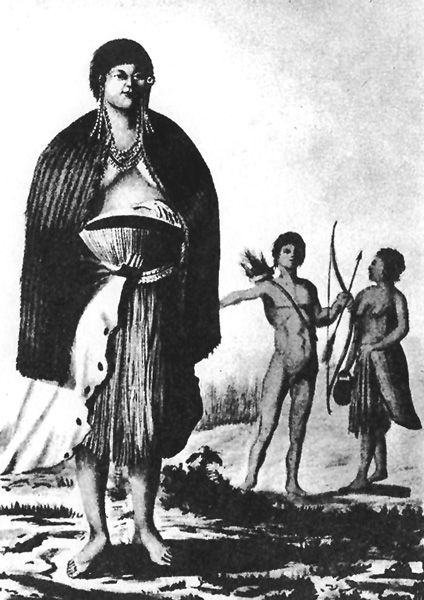
Esselen native 1791, by Jose Cardero.
Esselen – The Esselen were a tribe of California Indians indigenous to the Santa Lucia Mountains, now known as Big Sur, in Monterey County, California.
Eufaula – The Eufaula tribe, a Muscogean-speaking people, was part of the Muscogee Creek Confederacy and originally lived in the southeastern United States. Their descendants primarily live in Oklahoma today.
Eyeish – The Eyeish were a tribe of the Caddo Confederacy, but spoke a now-extinct dialect that was very different from those of the other Caddo tribes; hence, it is probable they were part of an older confederacy that was incorporated into the Caddo when the latter became dominant.
Five Civilized Tribes – A group of southeastern tribes noted by whites for their advanced culture. All were Muskogean-speaking peoples except for the Cherokee. The five tribes included the Cherokee, Chickasaw, Choctaw, Creek, and Seminole.
Fox – An Algonquian tribe; they were so named because, once, while some Wagohugi, members of the Fox clan, were hunting, they met the French, who asked who they were. The Indians gave their clan the name, and ever since, the Foxes have been known throughout the tribe. Their own name is Měshkwa`kihŭg, which means red-earth people” because of the kind of earth from which they are supposed to have been created. They were known to the Chippewa and other Algonquian tribes as Utŭgamig, or “people of the other shore.”
Fremont – The Fremont people lived throughout Utah and adjacent areas of Idaho, Colorado, and Nevada from 700 to 1300 AD. The culture was named for the Fremont River and its valley, where many of the first Fremont sites were discovered.
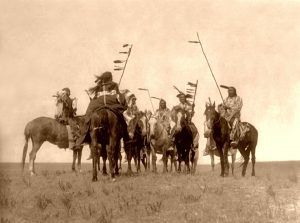
Gros Ventre Warriors, 1908.
Gros Ventre, aka Ahe, A’aninin, Ahahnelin, A’ane, Atsina – Pronounced “Grow Vaunt,” the word means “big belly” in French. The Gros Ventre were kinfolk of the Arapaho and called themselves A’aninin, the White Clay People.
Guale – Guale was a historic Native American chiefdom of Mississippian culture peoples located along the coast of present-day Georgia and the Sea Islands. Spanish Florida established its Roman Catholic missionary system in the chiefdom in the late 16th century. During the late 17th and early 18th centuries, Guale society was shattered by extensive epidemics of new infectious diseases and by attacks by other tribes. Some surviving remnants migrated to the mission areas of Spanish Florida, while others remained near the Georgia coast. Joining other survivors, they became known as the Yamasee, an ethnically mixed group that emerged during the process of ethnogenesis. See more HERE.
Hidatsa – Also known as the Minitari and a band of the Gros Ventre, the Hidatsa spoke a Siouan language. They occupied several agricultural villages on the upper Missouri River in North Dakota; they were in close alliance with the Arikara and Mandan tribes.
Ho-Chunk – Also known as Hoocaagra or Winnebago, the Ho-Chunk are a Siouan-speaking Native American people whose historic territory included parts of Wisconsin, Minnesota, Iowa, and Illinois. Today, there are two federally recognized tribes: the Ho-Chunk Nation of Wisconsin and the Winnebago Tribe of Nebraska.
Hohokam – Around 400 B.C., these Indians migrated from northern Mexico and settled at a place now called Snaketown, near Phoenix, Arizona. This group, who lived in pit houses, wisely invented an early form of irrigation, digging canals up to ten miles in length, then damming and directing the water through rows of crops. They made pottery using a unique dye from the saguaro cactus. Their culture lasted almost 2,000 years, and they are most likely the ancestors of the Pima and Papago tribes.
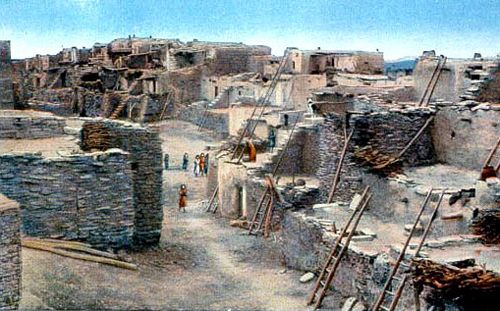
Hopi Pueblo.
Hopi – The Hopi’s occupation of Arizona is the longest authenticated history of occupation of a single area by any Native American tribe in the United States. The Hopi located their villages on mesas for defensive purposes, but clans and families also utilized the surrounding land for medicinal and religious purposes.
Houma – Originally, the Houma were from east-central Mississippi and were of the Chakchiuma. By 1682, the Houma had separated from the Chakchiuma and were living a few miles inland from the east bank of the Mississippi River, just below the present border between Mississippi and Louisiana. Over time, they drifted south into Terrebonne and Lafourche Parishes southwest of New Orleans. Most of their descendants still live in or near Montagne, Golden Meadow, and Dulac-Grand Caillou.
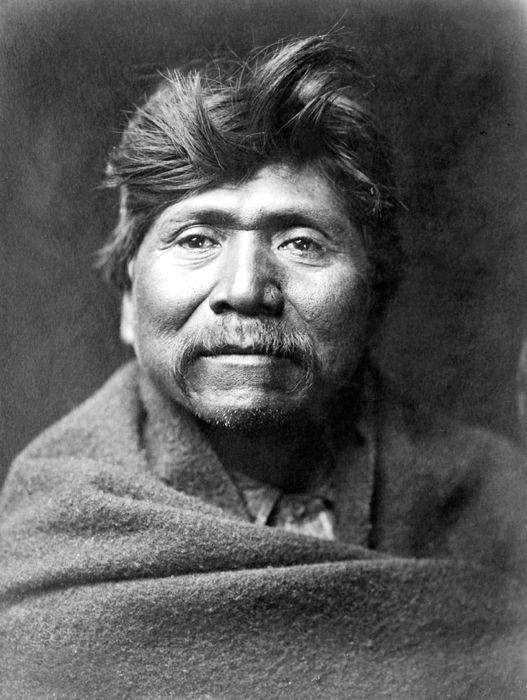
Pachilawa, Hualapai Chief by Edward S. Curtis, 1907.
Hualapai, aka Walapai – The Hualapai, meaning “People of the Tall Pine,” have lived along the Colorado River and the Grand Canyon for centuries. Their tribal capital is located at Peach Springs, Arizona, with a total population of some 1,600 members. Their economy is based on tourism, river rafting, cattle ranching, hunting expeditions, timber cutting, and the crafting of traditional and modern folk arts.
Huron – Many people today do not realize that Huron and Wyandot are the same people. Initially, more than a dozen Iroquoian-speaking tribes of southern Ontario referred to themselves as Wendat, meaning “island people” or “dwellers on a peninsula.”
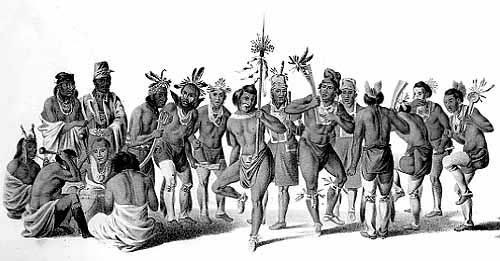
Illinois Indian War Dance
Illinois-Illini-Illiniwek – Of the Algonquian language family, the Illinois Confederation was a group of 12–13 Native American tribes who lived in the upper Mississippi River Valley. The five main tribes were the Cahokia, Kaskaskia, Michigamea, Peoria, and Tamaroa. During European contact in the 17th century, they were believed to have numbered over 10,000 people. However, by 1778, their numbers had declined dramatically due to wars and disease. In 1832, the tribes joined together with the Peoria and ceded all of their remaining territory in Illinois. They are now part of the Peoria Tribe of Oklahoma.
Inuit/Eskimo – The Inuit are the indigenous peoples inhabiting the Arctic regions of Alaska, Greenland, and Canada, with close relatives in Russia. A common cultural heritage and a common language unite them. Over the years, they have been called “Eskimo” but prefer to be called by their own name, “Inuit,” meaning simply “people.” Traditionally, they have relied on fish, sea mammals, and land animals for food, heat, light, clothing, tools, and shelter. According to archaeological research, the Inuit originated in northwestern Alaska, where they lived in houses made of driftwood and sod. The Inuit began moving eastward into Arctic Canada about a thousand years ago. Within a few hundred years, they had replaced the earlier inhabitants of the region, a now-extinct people known as Tunit. By about 1250 AD, the first Inuit had entered Greenland through the Smith Sound area, far northwest of the island. Here, they may have first encountered Viking hunters from the Norse colonies in southwest Greenland. In many areas, the old sod and whalebone winter houses were abandoned in favor of houses made of blocks of snow. They were easier to build because they could be put up anywhere, even on sea ice, and required only an hour or two to construct. Today, the Inuit continue to live in the Arctic regions, working in all sectors of the economy, though many still supplement their income through hunting. Tourism is a growing industry, as guides take tourists on dog-sledding and hunting expeditions and work with outfitting organizations.
Iowa/Ioway – Iowa, or Ayuwha, was a term borrowed by the French from the Dakota that signifies “Sleepy-ones.” The Iowa people are of Sioux stock and closely related to the Otoe and Missouri tribes. They moved frequently, mainly in Iowa and Minnesota. They lost their lands in Minnesota and Missouri through various treaties with the U.S. Government. The Ioway practiced farming and lived in villages; however, bands farther west adopted more Plains Indian customs. In 1836, another treaty assigned part of them a reservation along the Great Nemaha River in present-day Brown County, Kansas, and Richardson County, Nebraska.
Innu – The Montagnais and Naskapi have different tribal names but consider themselves part of the same culture, Innu. The Innu are indigenous people of eastern Quebec and Labrador, Canada. Most Innu people live in their traditional territory today, which they call Nitassinan.
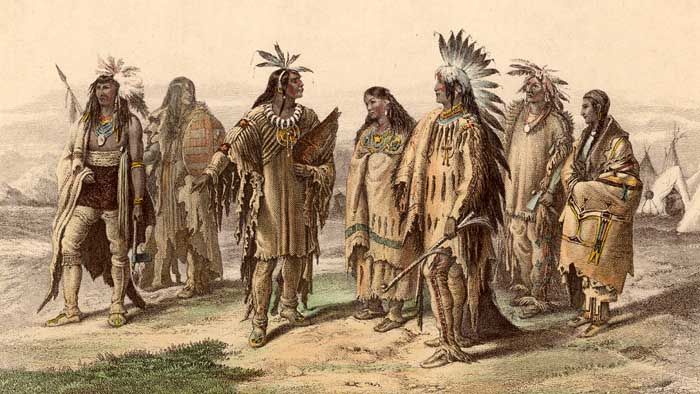
Iroquois Tribe.
Iroquois – The Iroquois, or Haudenosaunee, were a powerful Native American confederacy in the Northeast. Before Europeans arrived, they lived in New York and Canada. Technically, “Iroquois” refers to a language rather than a particular tribe. Early on, it began to refer to a “nation” of five tribes, including the Seneca, Onondaga, Oneida, Cayuga, and Mohawk. Later, they were joined by the Tuscarora. This group of tribes was known as the Iroquois Confederacy, the Iroquois League, or the Six Nations. Other tribes of Iroquoian stock not part of the Six Nations were the Huron, Tionontati, the Neutral Nation of Ontario, the Erie and Conestoga in Ohio and Pennsylvania, and the Meherrin, Nottoway, and Cherokee of Virginia and Carolina. Some 80,000 people in the United States today claim an Iroquois heritage.
Summaries: A B C D E-I J-K L-M N O P Q-R S T-V W X-Z
©Kathy Alexander/Legends of America, updated October 2025.
Also See:
Native Americans – The First Owners of America
Native American Heroes & Leaders
Native American Photo Galleries
See Sources.