
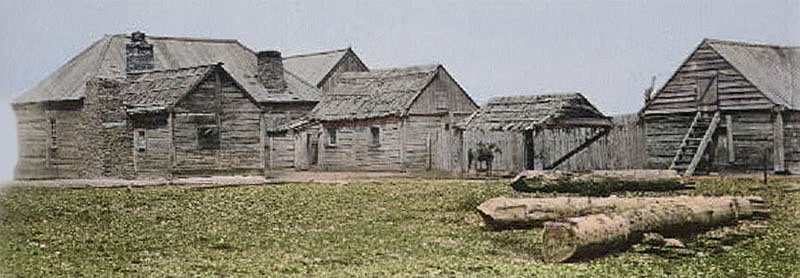
Fort Colvile, Washington, 1861.
This trading center, just North of Kettle Falls, Washington, was first spelled Colvile when the Hudson’s Bay Company established the post in 1825.
The second spelling, Colville, was a U.S. Army post about three miles northeast of the City of Colville. The name Colvile/Colville came from Lord Andrew Colvile, a governor of the Hudson’s Bay Company in London, England. Americans changed the spelling to Colville, and it also became the name of the general area.
For centuries, Euro-American fur traders traveled across North America, exchanging manufactured goods, rifles, tobacco, and alcohol with Native Americans in return for animal furs, particularly beaver pelts. Once the furs and pelts were obtained, they were shipped to European factories, where they were transformed into high-end fashion items. Men often wore beaver pelts as top hats, while women used them to create scarves and coats. These fashionable items became symbols of upper-class status and were frequently passed down through generations within families.
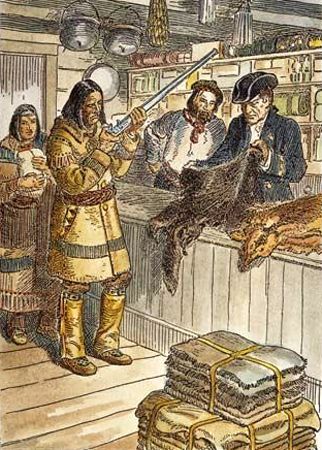
Trading with Native Americans.
By the 1800s, the Pacific Northwest was one of the last areas in North America yet to be explored by Euro-Americans. While the American expedition of Lewis and Clark traversed the southern portion of the Columbia River and followed it to the Pacific Ocean from 1805 to 1806, the mission was primarily exploratory.
The fur trade proved to be a highly profitable business. In the 1800s, a rifle valued at one pound and six shillings (approximately $100 in today’s U.S. currency) could be exchanged for 20 to 25 beaver pelts, which could then be sold at the factory for 50 pounds each. To put this into perspective, a dockworker’s salary at that time was only 10 pounds a year.
Beginning in 1807, David Thompson, a fur trader, explorer, and cartographer from the Montreal-based fur trading firm, the North West Company, began a series of expeditions in the Canadian Rockies. His goal was to find a viable waterway from the interior, which contained a plentiful supply of pelts, to the Pacific Ocean. During his search, he directed the establishment of several fur trading houses in the Pacific Northwest, most notably the Spokane House in 1810 on the confluence of the Spokane and Little Spokane Rivers.
On June 19, 1811, Thompson came to Kettle Falls on the Upper Columbia River, becoming the first Euro-American to do so. Thompson arrived at a time when representatives from several Native American tribes across a 200-mile radius of the falls came to harvest the abundance of salmon and steelhead. Kettle Falls was the second largest fishery on the 1,243-mile-long Columbia River. Kettle Falls was a trading mecca. Tribesmen traded other items, including camas root bulbs, seashells, hides, and beads. News and information were also exchanged. Thompson quickly realized the potential of a fur trading post. Thompson’s discovery of Kettle Falls would make him the first person to explore the river’s full length.
Under the Treaty of 1818, Great Britain and the United States of America both claimed rights to the Oregon Country.
The Hudson’s Bay Company merged with its rival, the North West Company, in 1821. Along with the North West Company possessions and houses, the Columbia Department reconsolidated to close old, unproductive houses and open new ones. In the merger, Hudson’s Bay Company acquired Fort Spokane at the junction of the Spokane and Little Spokane Rivers, 60 miles South.
In the 1820s, yearly purchases of furs rarely exceeded 20 blankets. Increased amounts of animal hides were gathered by Fort Colvile, starting with the “Flat Head brigade,” which joined the Bitterroot Salish on their annual migrations past the Rocky Mountains.
David Thompson’s desire for a fur trading post at Kettle Falls would not be realized until 1824, when the Hudson’s Bay Company formed the Columbia Department, a vast region from Sitka, Alaska, to Yerba Buena, California (San Francisco) and from the crest of the Rocky Mountains to Honolulu, Hawaii.
In April 1825, Governor George Simpson, head-in-chief for the Hudson’s Bay Company in North America, chose the sites of the two most important houses for the Columbia Department: Fort Vancouver near the mouth of the Columbia River and Fort Colvile next to Kettle Falls. Just 1/3 mile South of Kettle Falls, the site Simpson chose was in a horseshoe-shaped nick surrounded by tall, steep hills. The site was donated to the Hudson’s Bay Company by a Colville Salish chief under a verbal treaty, provided the fur traders did not interfere with the salmon fishery. Governor Simpson named the future post, Fort Colville, in honor of the London Governor of the Hudson’s Bay Company, Andrew Colvile. The Hudson’s Bay Company, with its fur trading enterprise and the Columbia Department, would maintain control of the large area of land for Great Britain.
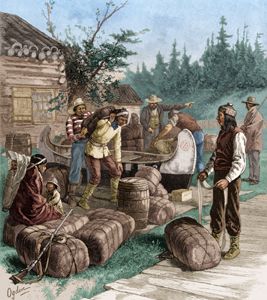
Hudson Bay Company traders by Henry Alexander Ogden.
Simpson ordered John Work to construct a trade center just North of Kettle Falls. John Work completed the assets move from the Spokane House to Fort Colvile by March 1826.
Construction on Fort Colvile began in August 1826. John Work, a contractor for the Hudson’s Bay Company, tore down the Spokane House and brought the wood to the new site to begin assembly of a store. Cedar was brought down from Canada to build more buildings, including numerous cellars, storehouses, a saw gristmill, a residence, a blacksmith’s house, trade houses, boat houses, a chief trader’s house, servant’s quarters, stables, and more. For protection, the fur traders built a stockade and bastions.
Simpson also gave instructions to Chief Factor John McLoughlin for “every possible exertion be used to lay up an abundant stock of fish and other provisions” due to limited capacity to send freight from Fort Vancouver.
Silt from glacial floods during the last Ice Age enriched the flat area surrounding Fort Colvile with valuable nutrients for agriculture. Over 340 acres of land were dedicated to farming, producing crops such as potatoes, wheat, oats, peas, barley, carrots, and a variety of garden vegetables. Additionally, the White Mud Farm, located nine miles away, served as a farm and cattle post, providing livestock, hay, and dairy products. Natives would bring salmon to the post in exchange for manufactured goods. Food was regularly shipped to households and posts throughout the Columbia Department, and any surplus was sent to Hawaii. Hawaiians were brought to Fort Colvile to assist in crop cultivation. Fur traders and missionaries from nearby St. Paul’s Mission encouraged Native Americans to adopt Euro-American cultural practices, which included converting to Christianity and growing crops.
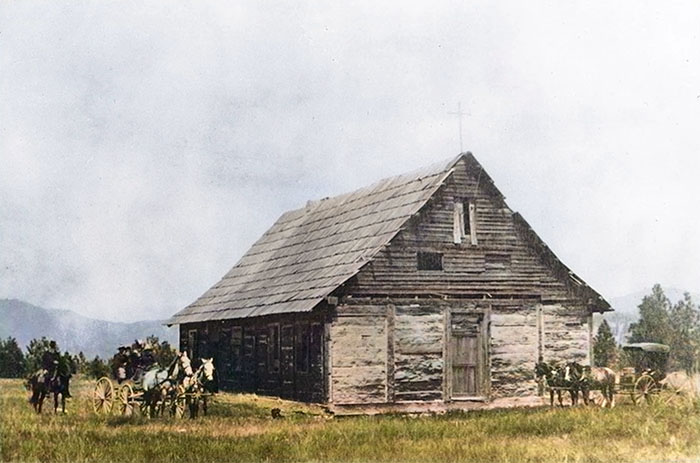
St. Paul’s Mission, Washington.
Approximately 20 to 25 people worked and lived at Fort Colvile. The social structure and employment at the post and within the company were based on social class and were fixed, with little to no opportunity for promotion. Upper-class gentlemen led the post from Canada, Britain, and Scotland. They served as company-commissioned officers and filled the positions of clerks, apprentice clerks, and chief trader. The chief factor held the senior rank and was in charge of the post.
The principal labor force was called the engagés, the French word for “servant.” They were lower-class men, French-Canadian and of other nationalities. They worked 16 hours a day and performed a variety of roles, including servants, apprentices, carpenters, blacksmiths, mechanics, coopers, interpreters, guides, and more. The legendary voyageurs, men who traveled throughout the district in canoes, brought supplies to the post. Twice a year, pelts from all fur trading posts and houses on the Columbia River and its tributaries were brought to Fort Colvile to be shipped to Fort Vancouver.
By 1828, Fort Colvile supplied all of the interior Columbia River Basin posts of Hudson’s Bay Company, allowing Simpson to reduce the number of men employed in transporting goods from Fort George, at Astoria, or Fort Vancouver to the interior.
Between 1826 and 1830, more than 15,000 beaver pelts were processed through the forest. Still, their numbers steadily declined — in part due to the company’s decision to trap as many as possible to discourage competition from Americans.
In a letter written by John Pitchler, he describes the prosperity of Fort Colvile in 1829:
“A proprietor of the company, a couple of clerks, and about 25 men are stationed at this post. It consisted of log houses for the accommodation of the company, and for storehouses for the merchandise and furs. A stockade was begun before I left there. Some swivels, in addition to common firearms, were all the defenses that I saw. About 60 or 70 acres of ground were under cultivation, and the crops were fine and abundant. Wheat, barley, oats, Indian corn, Irish potatoes, peas, and garden vegetables of every description grew well and were equal in quality to any in this country. The wheat was ground at the post on hand mills through a windmill, and a plentiful supply of flour was obtained. Of domestic animals, there were cattle, hogs, and horses; the post being well supplied with its own bacon, butter, milk, etc.”
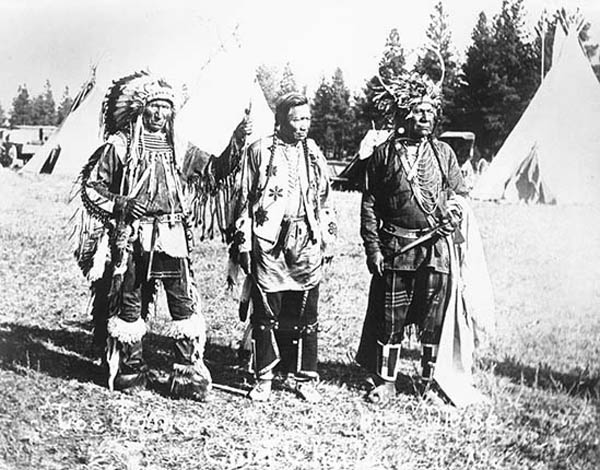
Salish Indians
A skirmish in 1829 between the Bitterroot Salish and inhabitants of Columbia Lake caused fears among Hudson’s Bay Company employees about the defenseless state of Fort Colvile. Additional employees were sent to erect a palisade and establish the mill during the Winter.
Because of the lack of Euro-American women, men at Fort Colvile often married Native American women. Their children of mixed-blood ancestry were called Métis. By the 1830s, Fort Colvile was the largest Euro-American settlement between the Rocky Mountains and the Cascade Mountains.
The fort played a prominent role with the Hudson’s Bay Company due to the land’s fertility and abundant bounty. Visitors to the fort included Paul Kane, a traveling artist; David Douglas, a Scottish botanist; members of the U.S. Exploring Expedition, surveying the Pacific Ocean region from 1838-1842; and Isaac Stevens, first Washington Territorial governor and head of a survey for a possible transcontinental railroad route.
The Hudson’s Bay Company considered Fort Colville second in importance only to Fort Vancouver, near the mouth of the Columbia River, for some time.
By the 1840s, the fur trade was in decline, yet Fort Colville remained open.
With the signing of the Oregon Treaty of 1846, the fort finally fell under American jurisdiction, marking the 49th Parallel as the international border. While the Hudson’s Bay Company ceded almost all of its possessions and holdings South of the new international border to the United States, the U.S. government allowed the company to keep Fort Colvile and continue operation.
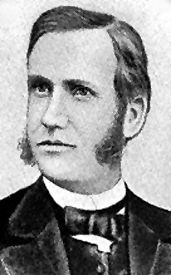
Dr. Marcus Whitman.
In 1847, Marcus Whitman and 12 others were killed at his mission near Walla Walla. The threat of a native attack on missionaries at the Tshimakain mission, 70 miles South of Fort Colvile, forced the Walker and Eells families to close it and relocate to the trading post for safety.
The unrest of the Indian Wars in the 1850s led the company to gradually shift its operations North into Canada.
The United States Army established its own Fort Colville in 1859, about 14 miles South of the Hudson’s Bay Company’s post, initially to provide escorts to parties that were surveying the international boundary.
In 1853, Washington Territory Governor Isaac I. Stevens proposed a series of reservation policies to place Native American tribes on specific parcels of land to facilitate the arrival of American settlers. These proposals angered many of the tribes throughout the territory. That same year, a devastating smallpox epidemic killed most of the Native Americans in the Kettle Falls area.
While traveling through in 1853, Washington Territorial Governor Isaac Stevens described Fort Colvile as:
“The buildings consist of a dwelling house, three or four storehouses, and some smaller buildings, used as blacksmith shops, etc., all of one story and constructed of squared logs. The whole was once surrounded by a stockade, forming a square of about 70 yards on each side. This has been removed, except on the North side, where it encloses a narrow yard containing offices. One bastion remains. About 30 yards in the rear of this square are the cattle yards, hay sheds, etc., enclosing a space of 40 by 60 yards, roughly fenced in, and the sheds covered with bark. On the left side of the front are seven huts occupied by the company’s lower-level employees. They are of rude construction and much decayed. On the right of the square, in the rear, at a distance of a few hundred yards, are three more buildings, used for storing produce.”
In 1855, gold was found in the vicinity of Fort Colvile, and a gold rush ensued. American settlers encroached and established homes and mines, further disrupting relations with the surrounding tribes.
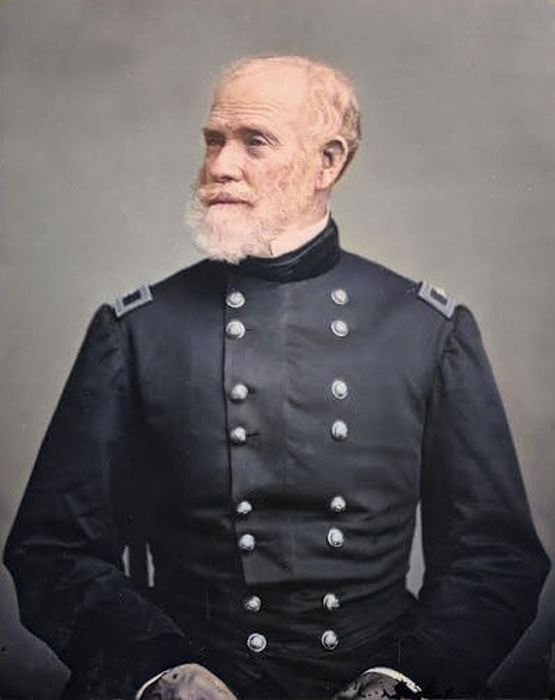
General William S. Harney.
Brigadier General William S. Harney, commander of the Department of Oregon, opened up the district North of the Snake River to settlers in 1858 and ordered Brevet Major Pinkney Lugenbeel, of the 9th Infantry Regiment to establish a military post to restrain the Indians who had been hostile to the U.S. Army’s Northwest Division and to protect miners who flooded into the area.
In 1858, the Colville and nearby tribes sided with the Spokane against the U.S. Army. Chief Trader and Factor Angus McDonald and missionaries at St. Paul’s Mission served as intermediaries on behalf of the Colville after Colonel George Wright defeated the Indians. The fur trade also began to stagnate and decline. Only the rich agricultural exports made the trading post profitable.
In June 1859, Brevet Major Pinkney Lugenbeel, with the 9th Infantry Regiment, established Harney’s Depot to support the U.S. Northwest Boundary Survey. The depot was named for Brigadier General William S. Harney, commander of the Department of Oregon. Fairly quickly, the name Fort Colville came into use. The U.S. Army post was located three miles North of Colville, Washington, and about 15 miles to the East of the 1826 Hudson’s Bay Company’s Fort Colvile. The post was originally known as Harney’s Depot, then as Camp Colville, and later as Fort Colville.
It was common practice to use existing Indian trails to develop military roads and only make necessary improvements for the movement of artillery or supply trains. Brevet Major Lugenbeel followed the long-established Hudson’s Bay Company Brigade Trail from the Fort Walla Walla area to Fort Colvile, but had to leave the trail at the current Orin-Rice Road, two miles South of Colville, when the southernmost land claims of the Hudson’s Bay Company started. The U.S. Department of State ordered Washington Territorial Governor Isaac Stevens and the U.S. Army to honor land ownership claims by the Hudson’s Bay Company. The road became the Fort Walla Walla Fort Colville Military Road.
Major Lugenbeel’s command arrived from Fort Walla Walla, Washington, on June 20, 1859. He was appointed as a special agent for the area Indians near Fort Colville.
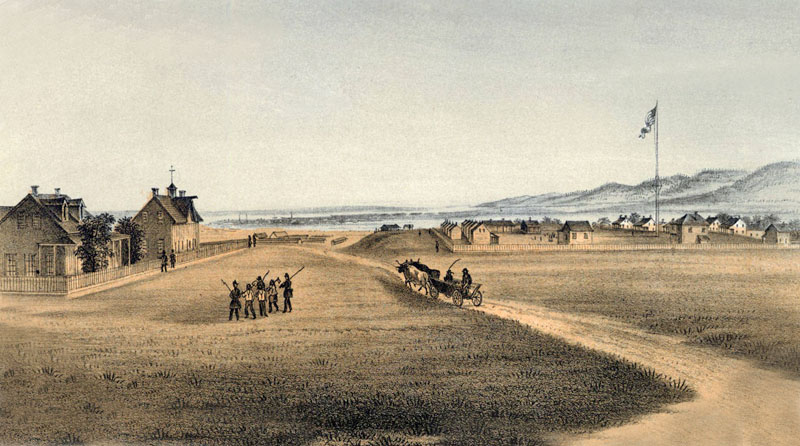
Fort Walla Walla, Washington.
During the gold rushes of the 1850s and 1860s, Fort Colville, especially in 1860, became an important center for mining activity and supplies.
A small town developed outside the post, Pinkney City, Washington, named after Lugenbeel’s first name. In 1860, Pinkney City became the original county seat of Spokane County, Washington, and in 1864, when Spokane County and Stevens County, Washington, merged, it remained the county seat of Stevens County. From 1860 to January 1864, Spokane County used the fort jail for any incarcerations.
By March of 1860, the post returns showed four companies of the 9th U.S. Infantry at the fort with about 288 enlisted men and 13 officers.
On September 28, 1860, First Lieutenant August V. Kautz arrived at Fort Colville with 150 recruits. His journal recorded the route from Coeur d’Alene to the fort along the road built by the U.S. Northwest Boundary Commission above the Spokane River and then along the Fort Walla Walla Fort Colville Military Road.
A major activity of the garrison in the pre-Civil War years was supporting the U.S. Northwest Boundary Survey team, which was tasked with detailing the U.S./Canada land border in the Northwest. Survey team personnel arrived at the fort on December 3, 1859, but found their quarters not completed, and they were forced to live in tents in −22 °F weather until their quarters were completed. The team spent the next two years, from 1860 to 1861, surveying and cutting the border along the 49th Parallel to the Rocky Mountains. The fort provided a detachment of troops to accompany the survey team for support and security.
The election of President Abraham Lincoln in 1860 and his inauguration in early 1861 led to the secession of some southern states and to the capture of Fort Sumter, South Carolina, on April 13, 1861. Within the regular U.S. Army, commissioned officers were ultimately forced to choose sides. In June 1861, President Lincoln directed that all commissioned officers must renew their oath of office or resign or be removed. There were only 1,108 officers in the U.S. Army in December 1860, and in the end, 313 resigned, 19 were dismissed, and seven were dropped from the rolls. About 270 of those who resigned went South. At Fort Colville, four of the seven officers eventually resigned. By July, the number of officers had fallen to three. In November, the regular army troops were withdrawn and replaced by the 2nd California Volunteer Infantry, with eight officers and 140 enlisted men.
The November 1861 Fort Colville’s regular U.S. Army troops were changed to Federalized Volunteer State troops.
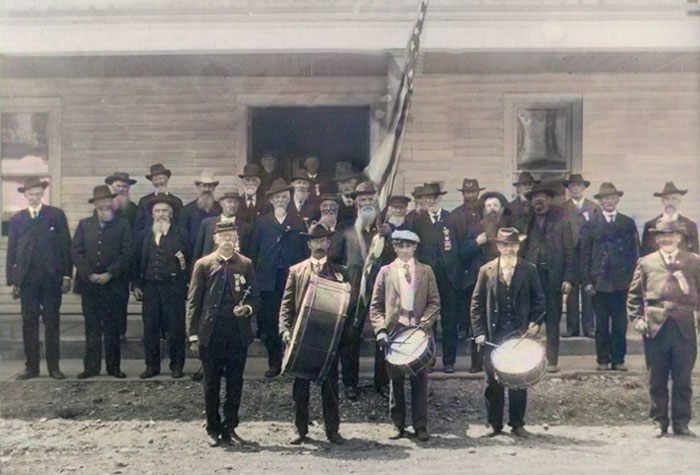
Washington Territory Volunteers.
Washington Territory Volunteers replaced the California Volunteers in July 1862, and they remained at the fort until December 1868, when regular federal infantry troops replaced them.
On November 3, 1865, regular troops of G Company, 14th Infantry Regiment of the U.S. Army, returned to man the fort.
On February 18, 1867, soldiers of G Company killed Deputy Sheriff Horace P. Stewart as he tried to break up a beating of his business partner, Jack Shaw, at the saloon owned by both men.
On May 6, 1867, G Company, 23rd Infantry Regiment, took over responsibility for the fort.
On February 10, 1869, Company D, 23rd Infantry, took over manning the fort.
In 1869, the U.S. Government and the Hudson’s Bay Company agreed to purchase Fort Colvile for $450,000.
In 1871, the U.S. State Department and Hudson’s Bay Company completed negotiations to reimburse the Hudson’s Bay Company for land and assets lost, and the land became U.S. government property.
On June 10, 1872, E Company, 21st Infantry Regiment, took over manning the fort.
In 1875, for the first time, cavalry troops were assigned to the fort when M Company of the 1st Cavalry Regiment reinforced E Company, with 1st U.S. Cavalry troops under the command of Captain Moses Harris. Accommodations for horses were added to the fort.
In 1876, Indian unrest in the Montana Territory continued to show the need for the fort. In 1877, many soldiers stationed at Fort Colville took part in the pursuit and battles against the Nez Perce.
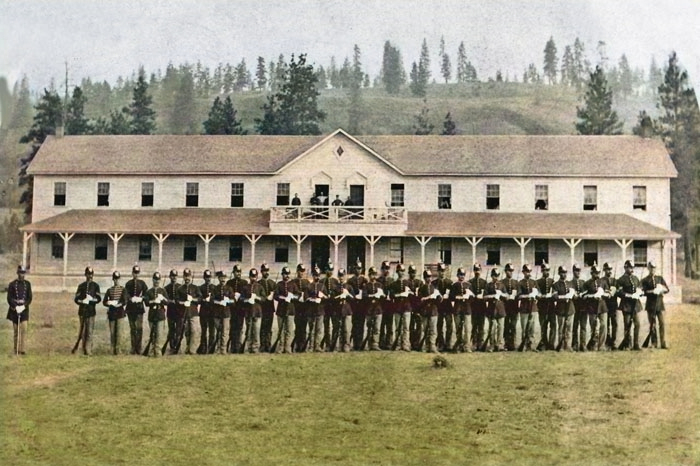
Fort Spokane, Washington.
On October 21, 1880, Fort Spokane was established by the U.S. Army at the junction of the Columbia and Spokane Rivers. The Cavalry often stayed at Fort Colville due to a scarcity of hay and grain around Fort Spokane until the summer of 1885.
One of the last actions from the fort was First Lieutenant Henry H. Pierce’s expedition from Fort Colville to Puget Sound, in Washington Territory, by way of Lake Chelan and the Skagit River in August and September 1882.
The post was abandoned on November 1, 1882.
Nine months after the garrison was withdrawn, Commanding General of the United States Army William Tecumseh Sherman visited Fort Colville in August 1883 in a tour of Army posts in the West.
The fort was transferred to the Interior Department on February 26, 1887, for disposition.
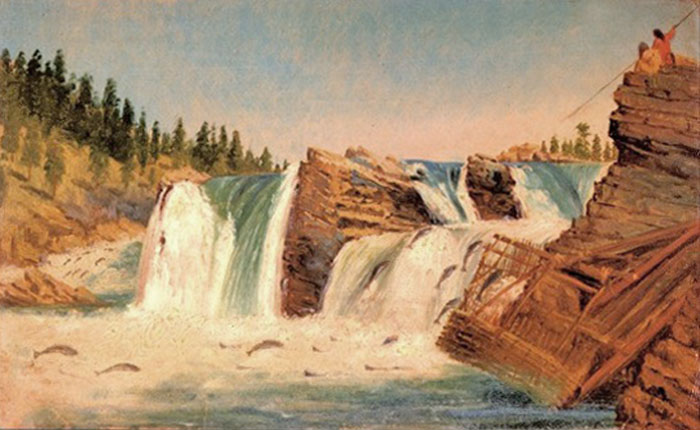
Kettle Falls, Washington, before the Grand Coulee Dam produced Lake Roosevelt.
Chief Factor McDonald resigned his post as master of Fort Colville but retained possession of the buildings as a residence for him and his family until 1907. After the family left, the buildings began to decay. Visitors to Kettle Falls stopped at the fort to have their pictures taken as part of the tourist attraction.
Some buildings continued to stand until July 7, 1910, when a suspicious grass fire spread across the Marcus Flat plain and destroyed all of the remaining posts’ buildings.
On September 11, 1929, Colville civic leaders dedicated a monument to the fort.
In 1933, the construction of Grand Coulee Dam began. The bodies of soldiers who died while serving at the fort were disinterred and moved to the Presidio of San Francisco and the San Francisco National Cemetery. Those who stayed in the area are likely buried at the Evergreen Cemetery established immediately West of the old fort.
Completion of the dam resulted in the site being flooded in 1940, as was Kettle Falls.
In 1974, Fort Colville was added to the National Register of Historic Places for its historic significance.
Today, the site lies underneath the backwaters of Grand Coulee Dam within the boundaries of Lake Roosevelt National Recreation Area.
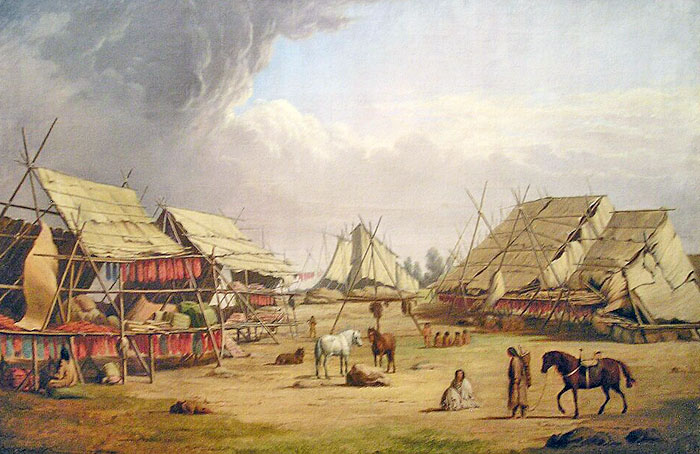
Indian camp at Fort Colvile, Washington, by Paul Kane.
©Kathy Alexander/Legends of America, updated August 2026.
Also See:
Washington Fun Facts and Trivia
Washington Historical Timeline
Sources:
Fort Wiki
National Park Service
Northwest Power and Conservation Council
Stevens County Historical Society
Wikipedia – 1
Wikipedia – 2