
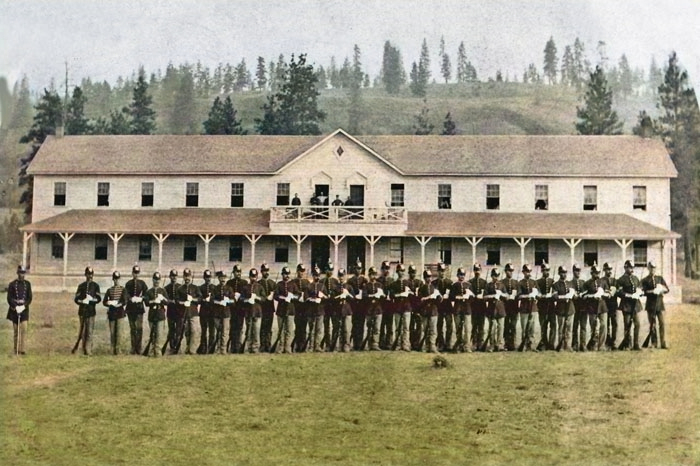
Fort Spokane, Washington.
Fort Spokane, Washington, was a frontier outpost in Lincoln County. It was approximately 50 miles west-northwest of Spokane, at the confluence of the Columbia and Spokane Rivers. The U.S. Army post was used to separate the Colville and Spokane tribes on their reservations from the newly established city of Spokane. It was the last army frontier post established in the Northwest.
The arrival of the railroads in the 1870s allowed for more settlers to arrive by rail, causing the government to move more tribes onto reservations. Many tribes, already facing a loss of land, saw resettlement attempts as an attack on tribal sovereignty and independence. By the late 1870s, a series of armed resistance, including the 1858 battles of Four Lakes, the Spokane Plain, and the Sheepeater troubles of 1879, all raised tensions. As a result, many settlers called for increased military presence in the area.
The U.S. Army stationed troops at White Bluffs on the Columbia River, at Foster Creek on the Okanogan River, and at Spokane Falls to manage potential unrest among the Colville, Spokane, and Palouse peoples. In 1878, the troops at White Bluffs and Foster Creek were relocated to a post South of Lake Chelan. However, Camp Chelan was difficult to supply and was eventually abandoned. The troops then moved to a new site, Camp Spokane. After the establishment of the Colville Reservation in 1872 and the Spokane Reservation in 1881, the U.S. Army took on policing responsibilities until 1890.
In 1880, General 0.0. Howard, military commander of the Department of the Columbia, appointed a survey team to explore the Northern Columbia Plateau to locate a site for a new post. The site identified by the team was strategically located on a sparsely wooded level plateau about 400 feet above the river, with abundant fresh water, open land for grazing, and timbered rolling hills.
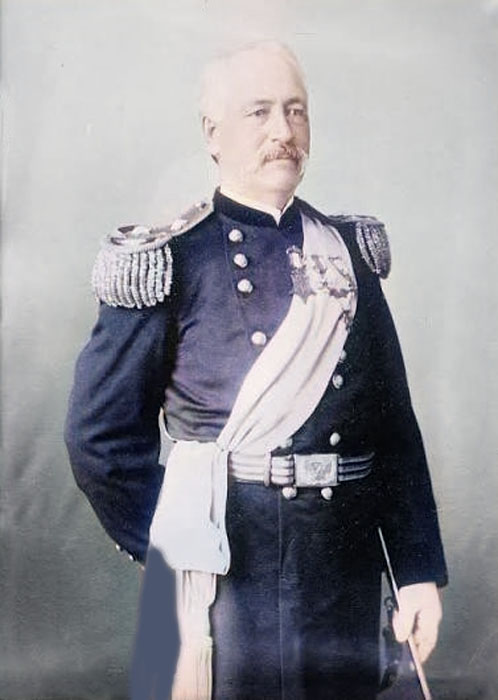
Lieutenant Colonel Henry C. Merriam.
Fort Spokane was founded in the fall of 1880 by Lieutenant Colonel Henry C. Merriam and the Second Infantry Regiment as Camp Spokane. Soon, troops were living in tents at the site. By the next year, General Howard allocated funds to begin construction, and several structures were built. It was occupied by troops of the Department of the Columbia from 1880 to 1898.
In 1882, General Nelson Miles replaced Howard, the War Department approved the new post, and President Chester Arthur signed the authorization establishing the Fort Spokane Military Reserve. At that time, it was renamed Fort Spokane.
In 1884, there were about 25 buildings, including six barracks, a schoolroom, an ice house, and a two-story administrative building topped with a glass-sided cupola.
The Fourth Infantry Regiment took over in 1886, and the 16th Infantry Regiment in 1896.
Eventually, around 50 buildings were constructed on the post. These included officers’ quarters, barracks for enlisted men, a hospital, a chapel, post headquarters, a morgue, quartermaster warehouses, shops, stables, and a post trader store. The large parade ground was bordered and divided by an elevated boardwalk. Two-story wood-frame residences for officers lined the northwest side of the parade ground, with the commanding officer’s house positioned at the center of officers’ row. The grounds surrounding the officers’ homes were more ornamental and lush compared to the surrounding landscape. Rose bushes, climbing vines, locust trees, and well-maintained lawns were irrigated with water pumped from the reservoir, and white picket fences once marked the perimeter of each officer’s yard. The post integrated older installations like Fort Colville, which were closer to populated areas, and served as a buffer between nearby Indian reservations and the settlers in the region.
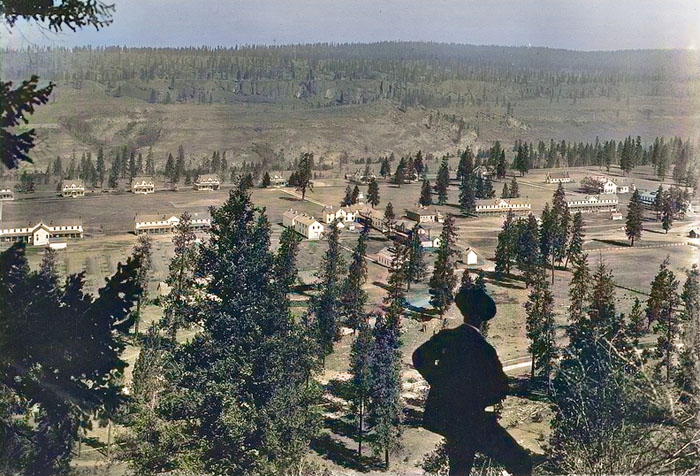
Fort Spokane, Washington, 1895.
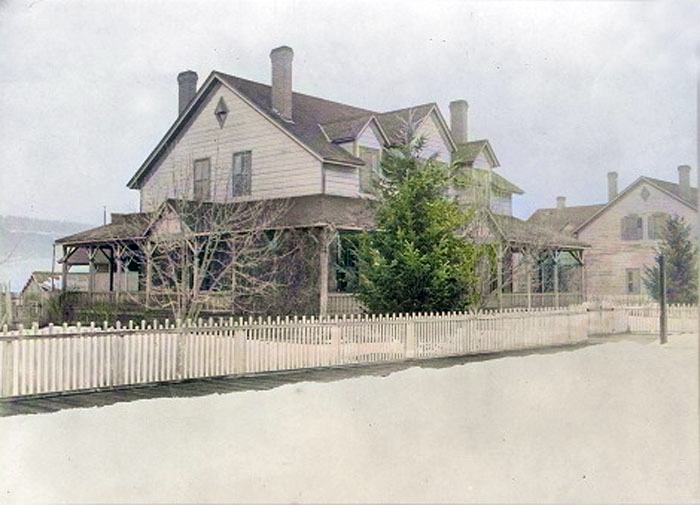
Commanding Officer’s Quarters at Fort Spokane.
For the most part, life at the fort was relatively quiet, with little in the way of violent conflict. The soldiers followed a rigorous training schedule that had begun in response to the Indian victories at Little Bighorn and Big Hole in Montana. They marched and trained for battles that ultimately never occurred. Outside of their drills, the soldiers occupied their time by hunting, fishing, enjoying activities by the river, socializing at the local saloon, and forming a baseball team known as the “Boys in Blue.”
When the Spanish–American War broke out in 1898, the troops at Fort Spokane were moved elsewhere, and the fort was turned over to the Colville Indian Agency.
A new post for the area, Fort George Wright, was built as its replacement, close to Spokane, after heavy lobbying by the town’s business leaders.
In 1900, it reopened as the Indian Agency’s boarding school for children from the Colville Indian Reservation across the river. It was one of almost 150 Indian boarding schools opened in the United States in the late 19th and early 20th centuries. These boarding schools carried out a federal policy of coerced assimilation of Native American children. Children from the Colville and Spokane reservations were taken from their homes and forced to attend. Some as young as five were taken for up to nine months at a time. The overarching intent of the schools was to strip the children of their native culture so they would function in a way deemed appropriate by the federal government and the dominant European-American culture.
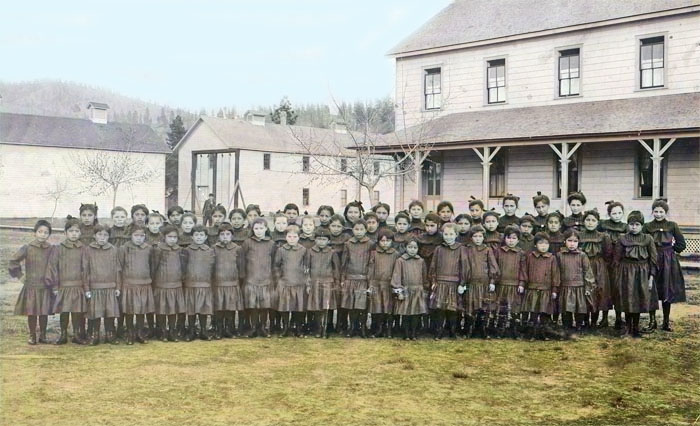
Fort Spokane, Washington boarding school.
The complex provided sufficient space for the agency’s headquarters, which included housing for nearly 300 students and school employees, an excellent water system, and plenty of open areas for the agricultural, industrial, and domestic education of Indian children. Many of the buildings, such as the residences, the administration building, and the bakery, were used for purposes similar to their original functions. Others were adapted to meet the students’ needs; for example, the eastern group of barracks housed a gym, a hospital, and classrooms, while the brick guardhouse was converted into a bathhouse and sewing room. At least half of the military structures were utilized by the school, and the complex as a whole remained remarkably intact during the school’s operation. The most significant change to the landscape was the planting of an orchard with approximately 700 fruit trees arranged in a grid pattern in the southern and southeastern quadrants, along with a large vegetable garden. Box elder trees were also planted along the boardwalk in front of the former barracks.
The school closed in 1908 as parents wanted their children to be educated closer to home, and the complex was expensive to maintain. The Indian Agency headquarters remained, however, and several of the structures were intermittently used as a hospital until 1929, when the distance from the reservation and heavy maintenance costs forced it to close. Many of the fort’s structures were dismantled and/or relocated during the hospital period.
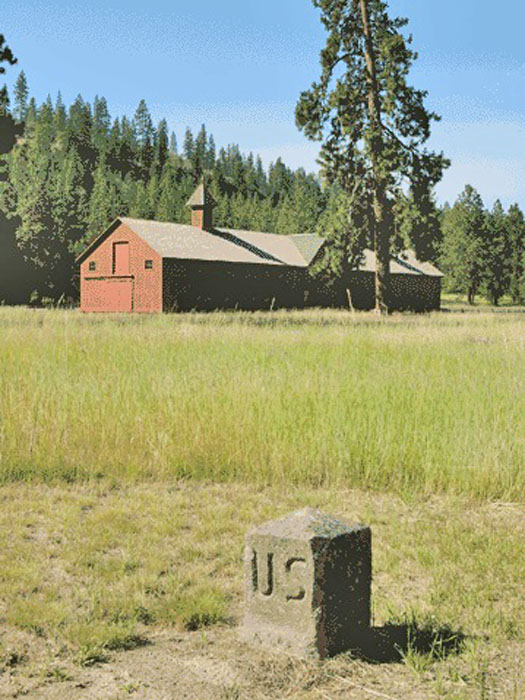
Quartermaster’s Stables at Fort Spokane, Washington, courtesy National Park Service.
The site was abandoned by the government in 1929.
From 1930 to 1960, most of the remaining structures were removed, the orchards and plantings decayed, and local farmers used the open areas for pasture and cultivating crops.
In 1942, with the completion of Grand Coulee Dam and the creation of Lake Roosevelt, the waters directly below Fort Spokane rose more than 100 feet, reducing the number of benches between the fort and the river.
After 31 years of vacancy, the National Park Service took over the site in 1960 with only four original buildings remaining from the fort. These were preserved, including the 1884 stable, the 1888 powder magazine, the 1889 reservoir, and the 1892 guard house. These structures were enhanced through an interpretive trail that follows the path of the original boardwalk that encircled the complex.
The site is now part of the Park Service’s Lake Roosevelt National Recreation Area. It is listed on the National Register of Historic Places.
©Kathy Alexander/Legends of America, updated August 2026.
More information:
Lake Roosevelt National Recreation Area
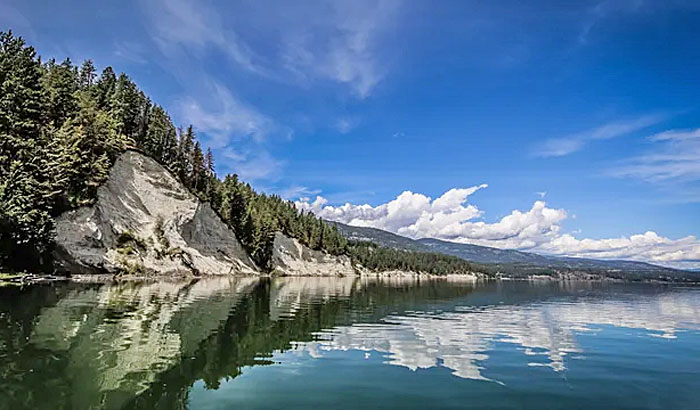
Lake Roosevelt, Washington, courtesy of the National Park Service.
Also See:
Washington – The Evergreen State
Sources: