
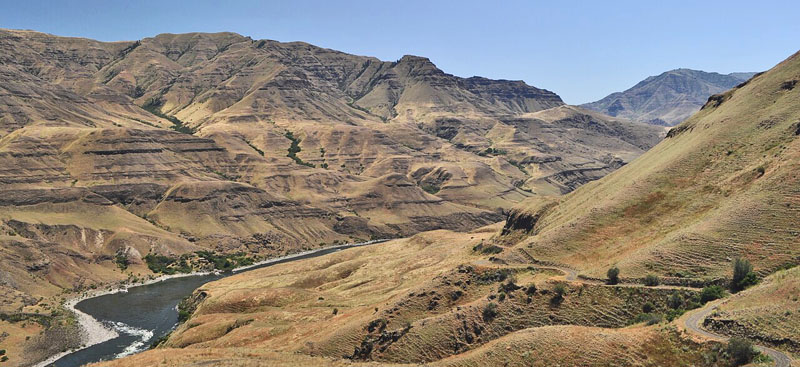
Snake River in Hells Canyon, Oregon, courtesy Wikipedia.
In May 1887, Chinese Massacre Cove, along the Snake River in Wallowa County, Oregon, was the location of the Hells Canyon Massacre, where up to 34 Chinese gold miners were ambushed, murdered, and robbed by a gang of horse thieves and schoolboys from Wallowa County, several of whom were from prominent families.
Also known as the Hells Canyon Massacre and the Snake River Massacre, it is located in the Wallowa–Whitman National Forest and the Hells Canyon National Recreation Area, upriver from the Snake River’s confluence with the Imnaha River.
With the onset of the 1849 California Gold Rush, tens of thousands of Chinese laborers arrived on the Pacific Coast. They mined for gold, worked on the railroads, and provided essential services to newly developed communities.
As Chinese immigrants began to settle in Portland, Oregon, they found housing wherever property owners were willing to rent to them. However, Oregon has a long history of racial and national exclusion. In 1859, it became the only state to join the Union with an Exclusion Clause in its constitution, which prohibited Black people from settling there. This clause also targeted future Chinese residents, stating: “A Chinaman, not a resident of this State at the time of the adoption of this Constitution, shall never hold any real estate or mining claim.”
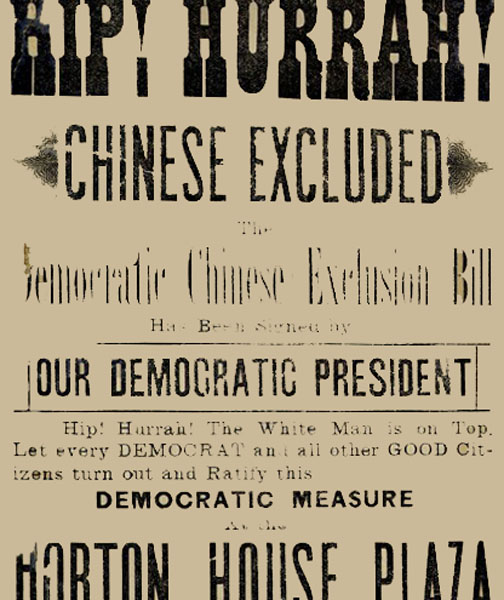
Chinese Exclusion Act.
Despite this law, thousands of Chinese immigrants continued to move to Oregon. In 1870, the census recorded over 3,000 Chinese individuals in the state. By 1880, that number had nearly tripled to almost 10,000.
The growing Chinese population faced hostility from white settlers, who blamed them for taking jobs away from white workers and for any economic downturns in the United States. In 1882, Congress enacted legislation barring new immigration from China for 10 years from the law’s passage, known as the Chinese Exclusion Act. It made it nearly impossible for Chinese residents nationwide to gain citizenship or legally own property.
Some believed the Exclusion Act would reduce tensions, but it did not achieve this goal. As historian Dr. Marie Rose Wong noted, “If you look at the incidents of violence post-exclusion, it didn’t stop; in some ways, it was even worse. Chinatowns were burned down, Chinese individuals were shot, hung, and chased.”
Throughout the 1880s, Chinese immigrants witnessed their communities being attacked and destroyed by racist mobs. In 1885 in Tacoma, Washington, the town’s mayor, judge, and city council members participated in the violent removal of 300 Chinese residents and the burning of two Chinatowns, resulting in the deaths of at least two Chinese men.
In October 1886, two groups of Chinese miners, led by Chea Po and Lee She, departed Lewiston, Idaho, and headed upriver along the Snake River into Oregon’s Hells Canyon to search for gold. Chea’s group stopped on the Oregon side of the Snake River, near Robinson Gulch and the cove where Deep Creek empties into the Snake River. Lee’s group continued upriver to Salt Creek. Chea Po had chosen a location just upstream of Dug Bar, a ford used by horse and cattle thieves to cross the Snake River.
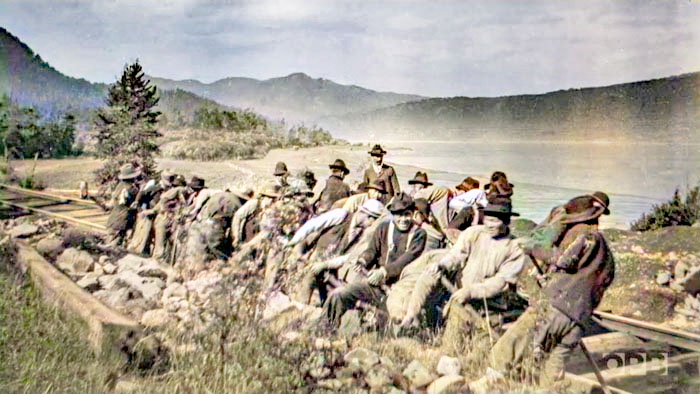
Chinese men working in Hells Canyon, Oregon.
Dug Bar was named for Thomas J. Douglas, a thief who had used the area to graze his horses. Douglas was killed in 1883, and a gang led by Bruce Evans, known locally as “Old Blue”, began using Douglas’s abandoned cabin in the spring of 1887, about 1⁄2 mile downstream from Chea Po’s makeshift camp and gold mining operation. The gang consisted of Evans, J.T. Canfield, C.O. LaRue, Hank Vaughn, Carl Hughes, Hiram Maynard, and Robert McMillan, a 15-year-old boy.
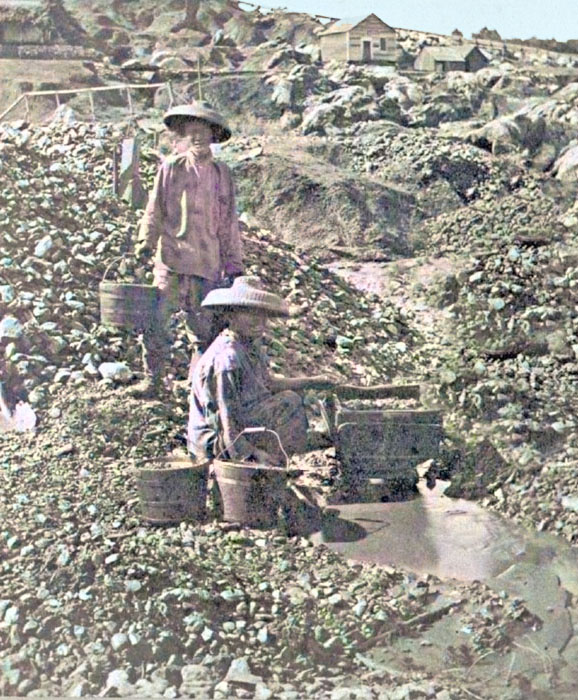
Chinese gold miners working along a small stream.
In late May 1887, the horse gang members, utilizing high-powered rifles, robbed, murdered, and mutilated between 10 and 34 Chinese employees of the Sam Yup Company for their gold. News accounts reported that the bodies showed evidence of torture. Estimates of the value of gold stolen range from $4,000 to $50,000. The gold dust was given to Canfield for safekeeping, but he double-crossed the rest of the gang and fled the county.
Hank Vaughn stayed behind to prepare dinner, while the other six rode to ambush the miners. McMillan minded the horses; Canfield and LaRue shot from the rim of Robinson Gulch, while Evans shot from the river level; Hughes and Maynard were positioned upstream and downstream to catch any miner who tried to flee along the river.
After the first day’s onslaught at Robinson Gulch, the killers wrecked and burned the camp and threw the mutilated corpses into the Snake River.
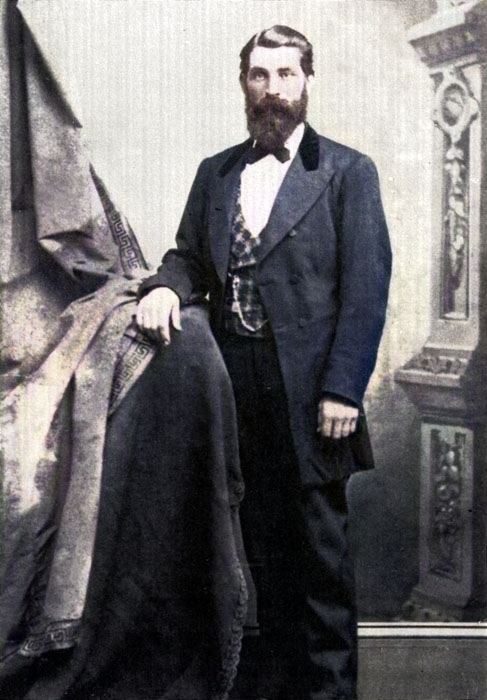
Hank Vaughan, Oregon Outlaw.
The gang then returned to the Douglas cabin and restocked their ammunition. The following day, Evans, Canfield, and LaRue ambushed a group of eight Chinese miners who returned to the cove, and finally sailed to a second camp, where they killed 13 more miners.
Since it was the high-water stage of the spring runoff, the dead Chinese were found for months afterward along the lower river. The bodies of some murder victims began washing ashore soon afterward, swept downstream to places as far away as Lime Point (South of the mouth of the Grande Ronde River), Log Cabin Island (now the site of the Lower Granite Dam), and Penawawa, Washington. Each body showed clear signs of severe violence. J.K. Vincent, a federal official who investigated the crime, later stated, “Every one was shot, mutilated, stripped, and thrown into the river.”
In early June 1887, Lee She’s group visited Chea Po’s group at Robinson Gulch and discovered three bodies in the deserted, ransacked camp. Horrified, they fled to Lewiston to report the crimes.
The Sam Yup Company of San Francisco, California, employer of the Chinese miners, offered a reward and hired a local investigator, Lee Loi, who may have lived near where the bodies were found, to pursue the matter. Lee hired Lewiston Judge Joseph K. Vincent to investigate the murders. Vincent, disguising himself as a miner, began his work in Lewiston, Idaho, where he personally examined remains of the victims whose bodies bore evidence of bullet and ax wounds. He reported his findings substantiating the basic details of the crime to the Chinese consulate in San Francisco, which unsuccessfully sought help from the U.S. State Department.
A second investigation soon got underway, this time by Wallowa County officials. It was prompted by a rancher’s discovery of more bodies of the murdered miners at Deep Creek. Like the Sam Yup investigation, this one soon stalled with no real progress being made.
A news article published in July 1887 called the corpses a “severe warning to Chinese miners” and blamed the victims: “More than likely, it was the whites who look with an evil eye upon Chinese intrusion in American mines. The American miner kicks hard at the Chinese miner.”
Other local Chinese Americans believed that all Chinese miners along the Snake River had been killed once the mutilated bodies began to surface. Initially, “a thorough investigation” described in a July 17, 1887, article concluded rival Chinese miners had murdered the Chinese, since the victims had been “shot in the back and mutilated by cleavers, a weapon in general use by the Chinese.” George S. Craig owned the Douglas cabin and discovered numerous skeletons in the area when he returned to winter his stock in the fall of 1887.
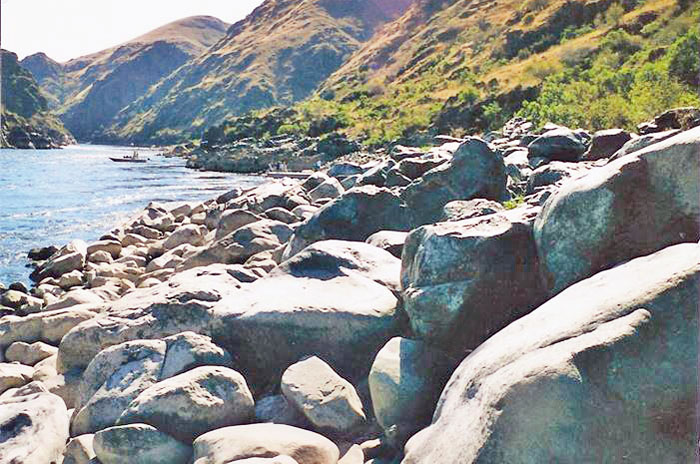
Cove Rock Beach at Chinese Massacre Cove, Courtesy Gregory Nokes.
Only 10 bodies were identified on February 16, 1888: Chea-po, Chea-Sun, Chea-Yow, Chea-Shun, Chea Cheong, Chea Ling, Chea Chow, Chea Lin Chung, Kong Mun Kow, and Kong Ngan. Little is known about these identified men.
In February 1888, nine months after the massacre, the Chinese government’s minister in Washington, D.C., officially informed Secretary of State Thomas Bayard about the murders. Although the message included all available information and documents, Bayard responded quickly but without any substantive action. He claimed that the information was “confusing and even contradictory” and provided no grounds for legal action.
He promised to send the information to the governors of Oregon and the Idaho Territory. Former Senator James Slater, who lived in Joseph, Oregon, also applied additional pressure by corresponding with Oregon’s U.S. attorney, seeking federal intervention in the case. Slater’s letter was eventually forwarded to Secretary of State Bayard. In line with his earlier position, Bayard sent Slater’s letter to the Chinese government, stating that the federal government was powerless to intervene in a matter governed by state law.
In March 1888, Hank Vaughn confessed to the crime and turned state’s evidence against six others, leading to an indictment of the other six gang members on March 23, 1888. In consideration for his grand jury testimony, Vaughn was given immunity from prosecution. Still, the grand jury indictment determined that Vaughn and the six other men charged had acted together in the killing of the 10 known murder victims.
According to a New York Times article, Vaughn’s statement read, “We entered into an agreement nearly a year ago to murder these Chinese miners for their gold dust…the men went down to the camp and opened fire on the Chinamen, killing them all.”
In follow-up testimony given on April 16, Vaughn blamed Evans, Canfield, and LaRue for the massacre, and said that Hughes, Maynard, McMillan, and himself had not participated. Vaughn was arrested on April 18, by which time almost the entire gang had left America, except Vaughn and Hughes.
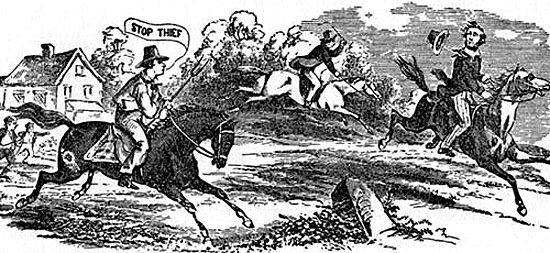
Horse Thieves.
Maynard, McMillan, and Hughes were brought to trial in Enterprise, Oregon, but no one was convicted. They were arraigned on August 28, 1888, and pleaded not guilty on August 29. Their testimony was consistent with Vaughn’s: blame for the crime fell squarely on Evans, Canfield, and LaRue, who were absent. The jury found the three men not guilty on September 1, 1888, following a short trial. In the end, no one was held accountable.
Robert McMillan died of diphtheria in 1888 at the age of 16. He made a deathbed confession to his father, Hugh, recounting details of the massacre. He said the Chinese miners were ambushed by a party consisting of himself, Bruce Evans, J.T. Canfield, Max Larue, and Hank Vaughn in late April 1887. Hiram Maynard and Carl Hughes were traveling with the others, but did not participate in the ambush. Canfield and Larue first attacked the camp of 13 Chinese from the bluffs overlooking the cove, driving them towards Evans and Vaughn, who were in the path of their retreat. Twelve Chinese were killed in the initial attack, and the remaining man was beaten in the head. His confession was published in 1891.
J.T. Canfield was imprisoned in Kansas for stealing mules and returned to Wallowa County to search for gold after his release. He was noted to be in the area during the trial and moved to Texas before settling in Idaho and opening a blacksmith shop under the name of Charley Canfield. Bruce Evans was arrested within a week of the massacre on an unrelated rustling charge. He escaped from custody two weeks later, possibly with the help of Hughes and Vaughn. When he fled, he left two children and his wife behind. His name is engraved on a memorial arch in the courthouse square of Enterprise, Oregon, honoring the county’s early pioneers. C.O. LaRue was rumored to have died in a dispute over a card game in California.
Over the years, the massacre was largely forgotten. However, in 1995, a collection of documents related to the 1888 trial was discovered in an old safe that had been donated to the Wallowa County Museum. The documents included a copy of the 1888 grand jury indictment, details about the escape from jail by the gang’s leader, Bruce Evans, a lengthy deposition by Hank Vaughan outlining his version of the events surrounding the murders, and notes from the trial. Although Vaughan’s deposition was self-serving—he placed all the blame on Evans and the two others who escaped prosecution—he did acknowledge witnessing the shooting and provided additional important details about what actually occurred.
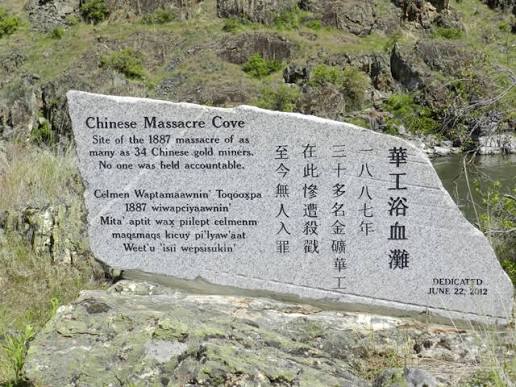
Chinese Massacre Memorial at the cove.
When the news reached R. Gregory Nokes, a reporter for The Oregonian, he began his own research into the massacre and went on to publish a journal article in 2006. He also published a nonfiction book, Massacred for Gold: The Chinese in Hells Canyon, in 2009 after his retirement in 2003 allowed him to conduct research full-time.
The United States Board on Geographic Names officially named the five-acre Deep Creek massacre site Chinese Massacre Cove in 2005 over the objections of Wallowa County commissioners. This was the first official recognition of the crime.
In 2012, Gregory Nokes organized the Chinese Massacre Memorial Committee to install a granite monument measuring 4 by 5 feet. It was engraved with words in three languages: English, Nez Perce, and Chinese. It was dedicated on June 22, 2012.
©Kathy Alexander/Legends of America, updated August 2026.
Also See:
Chinese Immigration to the United States
Immigration – Challenges For New Americans
Riot in Rock Springs Leads to Massacre
Sources:
Oregon Encyclopedia
Oregon Public Broadcasting
Oregon State Bar
Wikipedia