
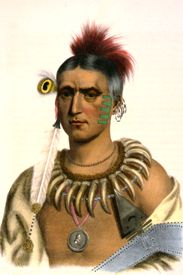
Ma-Has-Kah, or White Cloud, an Ioway chief, by Charles King, 1837.
The Ioway tribe, also known as the Iowa and Baxoje, is a Native American Siouan people. The French thought they had borrowed their name from Ayuhwa, the Dakota term applied to them, which signifies “sleepy ones.” They called themselves Pahodja, which means “dusty noses.” Along with the Missouri and the Otoe, the Ioway were the Chiwere-speaking people, claiming the Ho-Chunks (Winnebago) as their “grandfathers.” The state of Iowa, where they once lived, was named after them.
The close linguistic relationship bears out this tribe’s single origin with the Winnebago, Otoe, and Missouria. Specific migration legends have been preserved, describing this tribal complex’s movements and the time and circumstances of its separation.
According to tradition, after separation from the Winnebago, the Ioway-Otoe-Missouri mother tribe moved first to Rock River, Illinois, near its junction with the Mississippi River, and then to the Des Moines River some distance above its mouth. After separating at the Iowa River into two bands, one, which became the Ioway, moved to the northwest. The Otoe-Missouri went on to the mouth of the Grand River, where part remained, while the rest, the Otoe, went on westward up the Missouri River.
The Ioway continued to roam about the region, later moving into the northwestern part of the state around the Okoboji Lakes and probably extended into southwestern Minnesota to the neighborhood of the Red Pipestone Quarry and the Big Sioux River. In the latter part of the 18th century, they passed over to the Missouri River and settled South of the spot where Council Bluffs now stands. About 1760, they moved East and lived along the Mississippi River between the Iowa and Des Moines Rivers. Their principal town was on the Des Moines River and, for a long time, in the northwestern part of Van Buren County. Early in the 19th Century, some moved farther up the Des Moines River, while others established themselves on the Grand and Platte Rivers in Missouri. At this time, they seem to have come into contact with the Dakota and suffered considerably as a consequence.
Their estimated population in 1760 was 1,100; however, it had dropped to about 800 by 1804, mainly because of smallpox, to which they had no natural immunity.
In 1814, they were allotted lands in what was known as “the Platte Purchase,” extending from the Platte River of Missouri through western Iowa even to the Dakota country. By treaties signed on August 4, 1824; July 15, 1830; September 17, 1836; and November 23, 1837, they ceded all of their claims to lands in Missouri and Iowa, and by the Treaty of Prairie du Chien, signed on August 19, 1825, they surrendered all claims to land in Minnesota. Another treaty in 1836 assigned part of them a reservation along the Great Nemaha River, in present-day Richardson County, Nebraska, and Brown County, Kansas. However, treaties made on May 17, 1854, and March 6, 1861, considerably reduced it. Later, part of the tribe was removed to Oklahoma to settle in present-day Lincoln and Noble Counties. Later, the Oklahoma tract held by the Ioway was granted to its occupants in severalty.
Today, they are enrolled in one of two federally recognized tribes: the Iowa Tribe of Oklahoma or the Iowa Tribe of Kansas and Nebraska.
More Information:
Iowa Tribe of Oklahoma
335588 E. 750 Road
Perkins, Oklahoma 74059
405-547-2402
Iowa Tribe of Kansas and Nebraska
3345 B. Thrasher Rd.
White Cloud, Kansas 66094
785-595-3258
Compiled & edited by Kathy Alexander/Legends of America, updated March 2025.
Also See:
Native Americans – First Owners of America
Native American Photo Galleries
Source: Hodge, Frederick Webb; Handbook of American Indians North of Mexico; Smithsonian Institution; 1910