
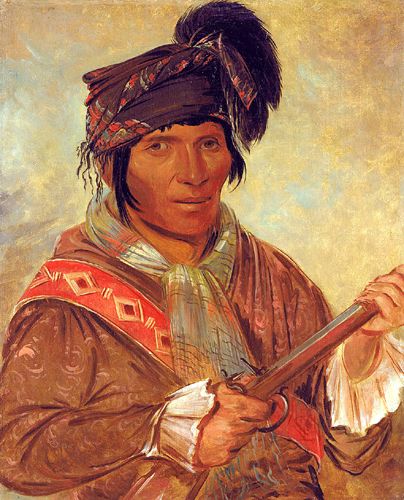
Seminole Chief Coeehajo.
Part of the Creek Confederation, the Seminole were initially made up of emigrants from the Lower Creek towns on the Chattahoochee River who moved into Florida after the destruction of the Apalachee and other Native American tribes. They were first classed with the Lower Creek tribe but began to be known by their present name around 1775.
They consisted chiefly of descendants of the Creek and Hitchiti tribes, with a considerable number of refugees from the Upper Creek after the Creek War, together with remnants of Yamasee and other conquered tribes, Yuchi, and a sizeable African-American element of runaway slaves. In 1799, they had about seven villages, a number that increased over time.
While still under Spanish rule, the Seminole became hostile toward the United States, particularly during the War of 1812 and again in 1817-18, during what became known as the First Seminole War. General Andrew Jackson quelled the war by invading Florida with more than 3,000 men. This ultimately led Spain to cede the territory to the United States in 1819.
By the Treaty of Fort Moultrie in 1823, the Seminole ceded most of their lands except a central reservation. Still, under pressure from the border population to remove them completely, the U.S. negotiated another treaty at Paynes Landing in 1832. They were bound to be removed beyond the Mississippi River within three years.
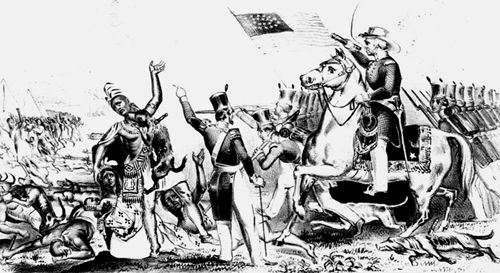
The Seminole Wars.
A large portion of the tribe repudiated the treaty and, under the leadership of Chief Osceola, immediately prepared for resistance. Thus began the Second Seminole War in 1835, with the killing of Emathla, the principal signer of the removal treaty, and General A.R. Thompson, who had been instrumental in applying pressure to those who opposed the arrangement. The war lasted nearly eight years, ending in August 1842, with the practical expatriation of the tribe from Florida to the West, but at the cost of the lives of nearly 1,500 American troops and the expenditure of $20,000,000.
One incident was the massacre of Major F.L. Dade’s command of 100 men, with only one man escaping alive. The Seminole African-Americans took an active part throughout the war.
As a result of the Second Seminole War, about 3,800 Seminole were forcibly removed to Indian Territory (Oklahoma) and organized into the “Seminole Nation.” They became one of the so-called “Five Civilized Tribes.” During the Civil War, the Oklahoma Seminole primarily fought for the Union, even though few held slaves. However, the vast majority of the African Americans who lived with them were free and became known as “Black Indians.”
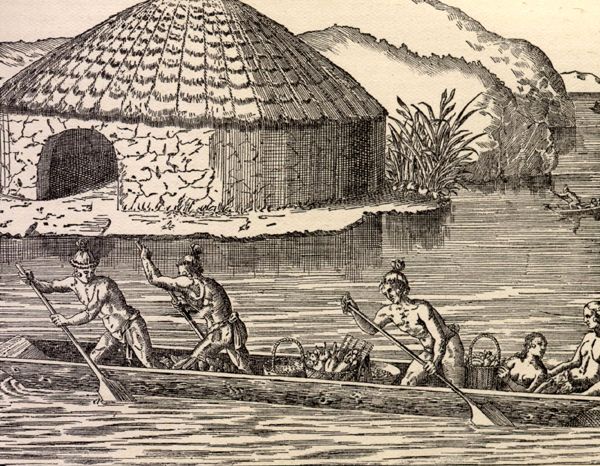
Seminole Indians.
Today, the Seminole Nation of Oklahoma has about 6,000 enrolled members, with its capital at Wewoka, Oklahoma. They are divided into 14 bands, two called “Freedmen Bands” or “Black Seminole” because they descended partly from escaped slaves freed after the Civil War. Band membership is matrilineal, and an elected council rules the entire group, with two members from each band.
A few hundred Seminole remained in Florida, hiding and surviving in the Everglades. After the Third Seminole War (1855-58), the Seminole in Florida were divided into two groups, part of which moved to a reservation and became the Seminole Tribe of Florida. Those who chose the traditional way broke off into the Miccosukee Tribe of Florida. Both tribes are federally recognized today.
The Seminole Tribe of Florida worked to adapt but was highly affected by the rapidly changing American environment and several natural disasters. In the 1930s, the Seminole slowly moved onto federally designated reservation lands within the region. In 1957, the nation reorganized and established formal relations with the U.S. government. The Seminole Tribe of Florida is headquartered in Hollywood, Florida, but also has lands in Big Cypress, the Brighton Seminole Indian Reservation, the Dania, Florida State Reservation, and a Tampa Reservation.
In 1957, Florida recognized the Everglades Miccosukee Tribe of Seminole Indians, and they received federal recognition in 1958. A further division among the latter group led to the Miccosukee Tribe of Indians of Florida, formed in 1961-1962. This tribe was primarily composed of Mikasuki-speaking descendants of the Chiaha, or Upper Chehaw, who had initially lived in Georgia’s Tennessee Valley. In contrast, most Seminoles spoke Creek. The Miccosukee Tribe established a 333-acre reservation on the northern border of Everglades National Park, about 45 miles West of Miami; however, it has not been federally recognized.
Seminole Nation of Oklahoma
P.O. Box 1498
Wewoka, Oklahoma 74884
405-257-7200
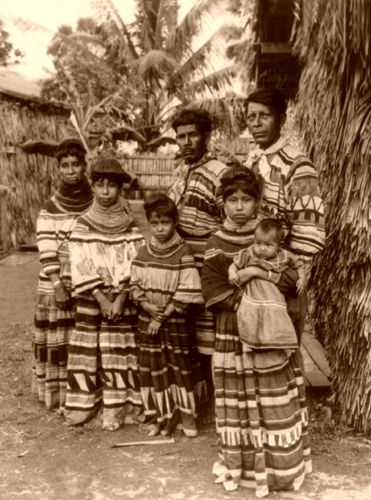
Seminole Indians in Miami, Keystone View Co., 1926.
Seminole Tribe of Florida
6300 Stirling Road
Hollywood, Florida 33024
800-683-7800
©Kathy Alexander/Legends of America, updated September 2026.
Also See:
Native Americans – First Owners of America
Native American Photo Galleries
See Sources.