
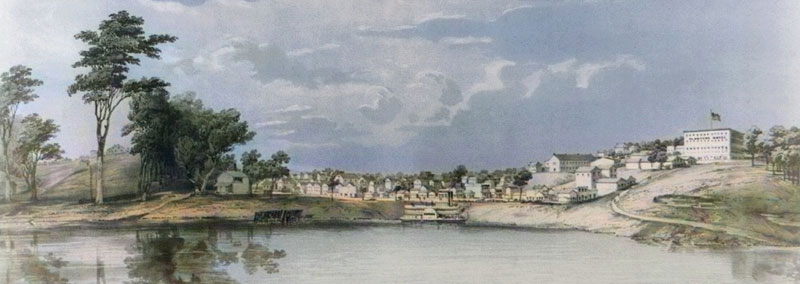
Leavenworth, Kansas by John Bachmann, 1856.
The City of Leavenworth was founded in 1854, largely to support Fort Leavenworth, but it quickly became a springboard to the West. The settlement was the first official town in Kansas.
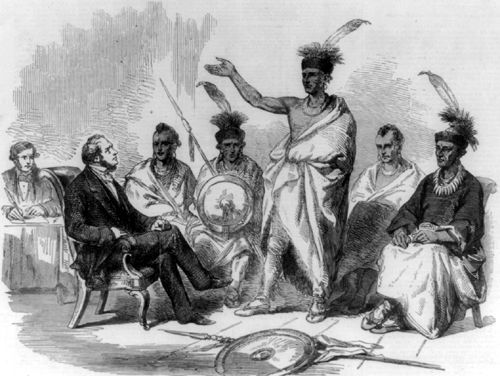
The Kanza or Kaw Indians.
Before the United States acquired Kansas in the Louisiana Purchase of 1803, it belonged to eight Indian tribes, including the Kanza, Osage, Wichita, and Pawnee. During the 18th century, the French and Spanish competed for the region, but the French prevailed due to their better relations with the Native Americans. Founding Fort Cavagnial in 1744 in the approximate vicinity of where Fort Leavenworth stands today, the French evacuated 20 years later when France ceded the Louisiana territories West of the Mississippi River to Spain. The territory then reverted to France before the United States acquired it.
Lewis and Clark explored the area in their famous expedition between 1803 and 1806, and the area became known as the “Great American Desert.” Considered unsuitable for settlement due to its barrenness, the region was designated as a permanent home for the Native Americans. From 1825 to 1840, nearly 30 tribes relinquished land in the northern and eastern parts of the nation, relocating to the Kansas Territory. Some of these tribes included the Shawnee, Delaware, Chippewa, Iowa, Wyandot, and Kickapoo.
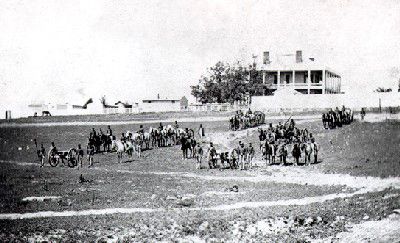
Leavenworth City grew up around Fort Leavenworth, which was established in 1827.
Meanwhile, in 1827, white men officially came to the area when Colonel Henry Leavenworth and the Third Infantry Regiment from St. Louis, Missouri, established Fort Leavenworth. The post was the first settlement in Kansas Territory and is the oldest active Army post West of the Mississippi River. Sitting on the bluffs overlooking the western bank of the Missouri River, the fort initially served as a quartermaster depot, arsenal, and troop post. It was dedicated to protecting the fur trade and safeguarding commerce on the Santa Fe Trail.
Fort Leavenworth quickly became a primary destination for thousands of soldiers, surveyors, and settlers passing through on their way to the vast West. During these early years, soldiers from the fort protected wagon trains hauling supplies over the Santa Fe, Oregon, and other trails to other forts and military camps of the West, some as far West as the Pacific Ocean. In 1839, Colonel S. W. Kearny marched against the Cherokee with ten companies of dragoons from the fort, the largest U.S. mounted force ever assembled.
In the 1840s, Kansas lay in the path of the settlers rushing to Oregon and California. Though thousands of wagons passed through, other pioneers, seeing the agricultural promise of Kansas, settled in the area instead.
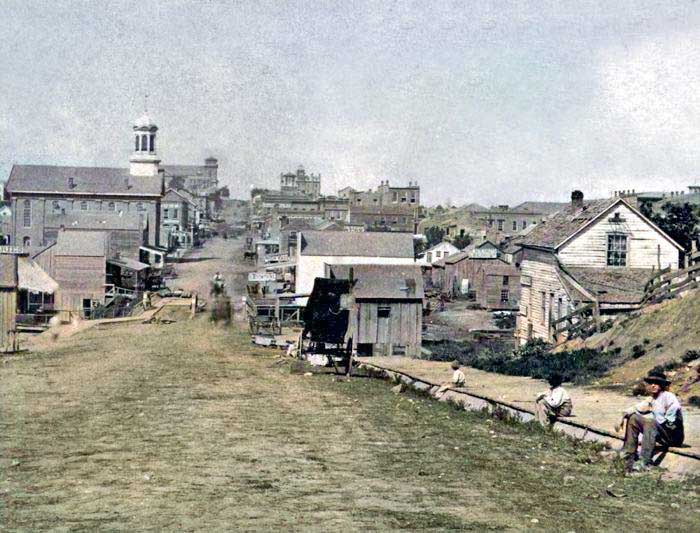
Fifth Street in Leavenworth, Kansas by Alexander Gardner, 1867.
The City of Leavenworth was founded in 1854 primarily to support Fort Leavenworth, but quickly became the springboard to the West. The settlement was the first officially incorporated town in the state of Kansas. With the rush of white settlers, many treaties with the Indians were made and broken, and the Indians along the westward trails began to retaliate with uprisings and raids that continued until 1878. Although Indians never attacked the city of Leavenworth or the fort, the military personnel at Fort Leavenworth initially attempted to protect the pioneers on these early trails. Later, dozens of forts would be erected West of Fort Leavenworth.
The city of Leavenworth originated at a meeting in Weston, Missouri, just a few days after the passage of the Kansas-Nebraska bill. On June 12, 1854, the townsite was marked off by George W. Gist, John C. Gist, and Samuel Farnandis on the Delaware Trust Lands immediately south of the Fort Leavenworth military reservation. Many squatters had already agreed to relinquish their rights to the town association. The townsite, situated on 320 acres, was platted into lots and divided into 175 shares, which were given over to the 32 members of the town association. The first sale of town lots was held on October 9, 1854.
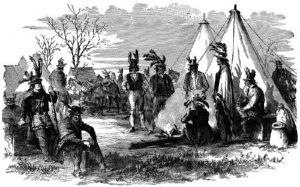
Delaware Indians.
The Delaware Indians were unhappy with this encroachment upon their lands and, stirred up by emissaries from the rival city of Atchison, sent a petition to the government asking that something be done.
As a result, the government ordered the troops at Fort Leavenworth to disperse the settlers. However, the Leavenworth Town Association quickly delayed the order, and upon assuring the Delaware chiefs that they would pay the price fixed by the government, they were allowed to stay.
In the meantime, several businesses had already been established, including the Herald newspaper in the first building erected in Leavenworth, a small warehouse and general store operated by Lewis N. Rees, and the Leavenworth Hotel. Jerre Clark built the first dwelling on Walnut Street. In October, the Murphy & Scruggs sawmill was established at the mouth of Three Mile Creek, where much of the lumber for the future buildings was cut. On October 8, W. C. Capels, an elder of the Methodist Church, held the first religious service in the town under the shade of a large tree.
By January 1, 1855, the fledgling city had 200 inhabitants. When a post office opened in the general store on March 6, Lewis Rees became the first postmaster in the town, officially called Leavenworth City. More businesses also began to operate, including a brickyard and another sawmill. Within six months, 100 buildings of various kinds had been erected, and by May 1855, Leavenworth City was home to more than 400 people. The town was incorporated in the summer of 1855, and an election was held on September 3 for councilmen and officers.
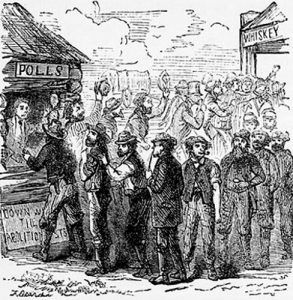
Pro-slavery advocates flood the voting polls in Kickapoo City, Kansas.
Leavenworth County was established in July 1855, and an election was scheduled in October to determine the county seat. The primary contenders were Leavenworth City, Kickapoo City, and Delaware City.
Like other Kansas counties, the struggle for the county seat was almost vicious and was burdened with fraudulent voters. Two steam ferries, crowded with voters from Weston, Platte City, and other Missouri towns under the pro-slavery thumb, plied between the eastern shore, Kickapoo City, and Delaware City. Ultimately, Kickapoo City won, with Delaware City coming in second and Leavenworth City third. However, Delaware City claimed that some of her citizens had been barred from voting, and her polls were thrown open a second day, resulting in a win for Delaware City. Afterward, a legal contest ensued between the three towns, but Delaware City was declared the county seat in January 1856.
The early commercial development was rapid, as it became the starting point of the overland transportation company owned and operated by Majors, Russell & Company in the Fall of 1855. Eventually employing more than 500 wagons, 7,500 head of cattle, and nearly 1,800 men, it was a boon for Leavenworth City.
Their arrival brought numerous new stores and businesses that would have otherwise not arrived for years. Salt Lake and California traders soon made their starting point Leavenworth rather than points in Missouri. Leavenworth was also made the starting point for the Kansas Stage Company. A Lutheran minister rented a small building near the levee for religious purposes. H. D. McCarty taught the first school in the community. By October 1855, just one year from the first sale of lots, about 1,200 people lived in Leavenworth City.
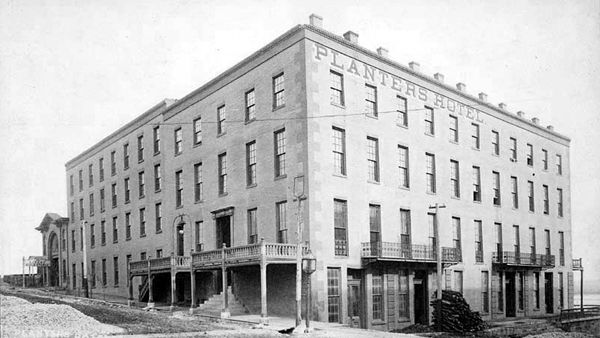
The Planters Hotel was completed in December 1856 and stood at the corner of Main and Shawnee Streets.
These freight companies’ many employees and the transient population demanded more hotel accommodations. This led to the erection of the Planters’ Hotel, completed in the fall of 1856, which became one of the most famous hotels on the Missouri River. However, for a brief period during 1856, Leavenworth City, like many other Kansas towns of the time, was embroiled in the vicious Kansas-Missouri Border War, which hindered its growth.
Into this tumultuous time in Leavenworth came a brave young African-American named William Dominick Matthews. A black freeman from Maryland, Matthews established the Waverly House, a boarding establishment located on Main Street between Shawnee and Seneca Streets. His boarding house soon became a “station” on the Underground Railroad. This was a courageous undertaking, as Matthews arrived at the worst time of Leavenworth’s border troubles. Despite the turmoil, or perhaps because of it, he was extremely active in harboring slave fugitives from Missouri and Arkansas, with the assistance of area abolitionists, including Daniel R. Anthony, a local newspaper editor and brother of Susan B. Anthony. Matthews would be one of the few colored captains in the Civil War.
In the meantime, a 30’x20′ two-room county building was completed in Delaware City in February 1857, and plans were made to build a new jail. However, the Kansas Legislature ordered another county seat vote to be conducted in October 1857. This time, the election resulted in a win for Kickapoo City. However, Leavenworth City petitioned that the Kickapoo City returns be thrown out because voting was not confined to the county. Joseph W. Hall, a commissioner from Kickapoo City and leader of the county seat war, had died during the preceding June, or it may have been that Leavenworth City would again have been slighted. This time, Leavenworth’s claims were no longer overlooked, and it was finally decided that Leavenworth had received the majority of the legal votes and was entitled to the county seat. Leavenworth remains the county seat today.
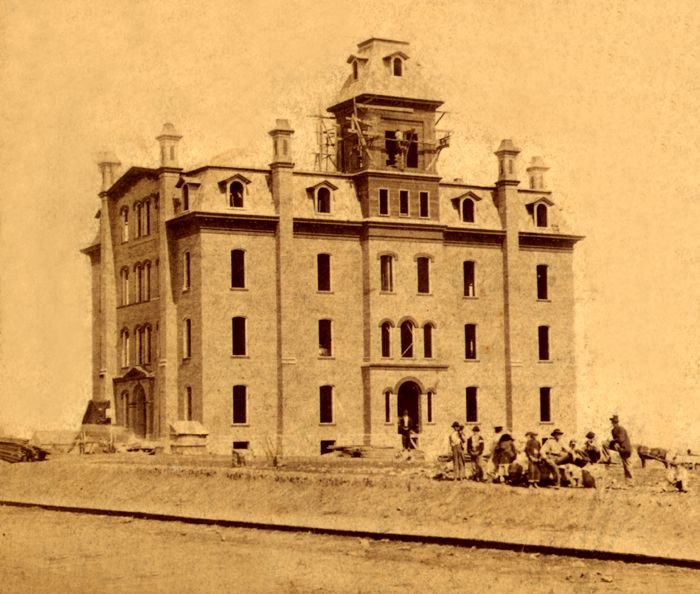
Public school in Leavenworth, Kansas by Alexander Gardner, 1867.
Though the land was donated for a courthouse square and bonds were voted in to build one, it would be years before a courthouse would be built. Instead, the courts and county offices were located for many years in the City Hall, over the Market House, and in a building that the Fire Department later occupied.
By the Fall of 1857, the town had grown to 5,000 people and would double over the next year. In July 1858, the city’s first school board was organized, a house was rented for the school, and a teacher was hired. That same month, however, a blow was dealt to Leavenworth in the form of a disastrous fire. Starting in the theater on the corner of Third and Delaware Streets, it swept away a large part of the business district, and for a time, it looked as though the whole city would be wiped out. However, due to the heroic efforts of the citizens and a lucky rainstorm, the fire was finally quelled, but not before over $200,000 worth of property was destroyed.
The year 1858 also brought thousands of westward-bound emigrants through the city when gold was discovered in Colorado. More importantly, the year also saw the arrival of the Sisters of Charity of Leavenworth to the city.

The University of St. Mary in Leavenworth, Kansas by Kathy Alexander.
Before making their way to Leavenworth, the Sisters, who had lived in Nashville, Tennessee, found themselves burdened with a debt not of their making. After selling nearly everything they had to pay their creditors, they established a new base of operations in Leavenworth that would eventually grow into a hospital and a college that still exists today. They were teaching in a boys’ school within a week of their arrival. In November, they opened a day and boarding school for girls on the North side of Kickapoo Street. The following year, the girls’ school was moved to downtown Leavenworth and called St. Mary’s Institute. They also tended to the sick, entering homes and wagon trains and traveling to towns during epidemics. They educated black children who had fled to the free state of Kansas, took in orphans, visited prisoners, and cared for the poor.
In 1859, Leavenworth City received telegraph lines to communicate with the East; its streets were graded, sidewalks laid, and gas works constructed. That same year, on December 3, 1859, the day after Kansas abolitionist John Brown was hanged, Abraham Lincoln made a speech in Leavenworth. Speaking on the steps of the Planters Hotel, he urged voters not to use violence but to use their vote at the ballot box to keep slavery from expanding into the territory. His speech is said to be similar to what is considered to be his first presidential campaign speech, delivered months later at Coopers Union in New York. From that day forward, the Planters Hotel became a Leavenworth landmark and continued to serve the traveling public for decades. However, by the 1950s, it was declared unsafe for occupancy and eventually torn down.
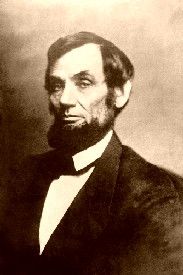
Abraham Lincoln.
With the growth of the city, it soon became a crossroads point. Two great military roads from Fort Leavenworth joined the emigrant road at Whitfield City, as did another known as the Oregon and California Road. Roads were laid out to connect Leavenworth with towns up and down the Missouri River and to Lawrence, Lecompton, and Topeka; hack and mail lines were established, making weekly and tri-weekly trips to towns of importance in the territory; the telegraph line was extended from St. Louis, Missouri to Leavenworth in June 1859, and the following spring, the Pike’s Peak Express Line began running from Leavenworth to Salt Lake, Utah. The first railroad to come near Leavenworth was the Atchison & St. Joseph, completed in Weston, Missouri, in 1861 and connected with river transportation to Leavenworth. Two years later, Leavenworth became a terminus of the Kansas Pacific Railroad, connecting with the main line at Lawrence. Over the years, numerous other railroads would pass through the city, including the Union Pacific, Missouri Pacific, Atchison, Topeka & Santa Fe, Chicago & Rock Island, Chicago, Burlington & Quincy, Leavenworth, Kansas & Western, and the Kansas City-Leavenworth electric line, which connected the two cities.
In May 1860, it was first proposed that the county establish a poor house, and before long, a 200-acre poor farm was established about four miles southwest of the city. It also included a pest house and averaged about 30 occupants.
In 1861, the African Methodist Episcopal Church was organized by Reverend John Turner. The first meetings were held in an old basement room, and a small building was soon erected. The church was actively involved in the Underground Railroad. Though a permanent church building wasn’t constructed until 1865, it continues to stand in Leavenworth as a reminder of its service as an Underground Railroad station. The current church is located at 411 Kiowa Street.
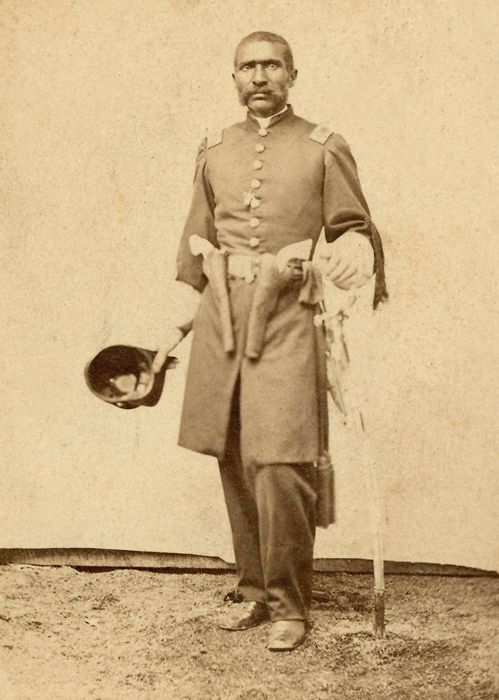
Lieutenant William D. Matthews, First Kansas Colored Infantry, Civil War.
By the time the Civil War erupted, pro-slavery sentiments had become a thing of the past. As the largest town in the State, Leavenworth raised more troops and furnished a longer array of prominent leaders than any other city in the region. Its proximity also caused many Unionists of Missouri and other exposed localities to flee to Leavenworth for safety. Many of these men enlisted in the Union army’s ranks and helped swell Leavenworth’s enrollment of Union soldiers.
The first Leavenworth company regularly mustered into the United States service was the Steuben Guards on May 27, 1861. Comprised entirely of German men, they joined the Union as Company I of the First Kansas Infantry. They participated in the Battles of Wilson’s Creek, Tuscumbia, Tallahatchie, Bayou Macon, Lake Providence, and others. Other Leavenworth military organizations also joined, including the Kickapoo Guards, Captain Black’s Guards, the Lyon Guards, the Fourth Ward Guards, the Third Ward Guards, the Leavenworth Mercantile Guards, and others.
Some of the Leavenworth men who made names for themselves as Union leaders included Powell Clayton, who became a brevetted Brigadier-General in August 1864 and later became a U.S. Senator for Arkansas; Daniel McCook, who was first commissioned as Captain of the Shield Guards, was later appointed Brigadier-General by the President of the United States, and was killed during the Civil War; Thomas Moonlight, who joined as a Captain of the Leavenworth Light Battery, became a brevetted Brigadier-General in February 1865, and after the war, served as the Adjutant-General of the State of Kansas; John A. Halderman, who served as Governor Andrew Reeder’s private secretary, during his short term as the first territorial governor of Kansas, became a Major-General during the war, and later served two terms as the Mayor of Leavenworth, a regent of the State University, a member of both Houses and Consul to Siam (later Thailand.) These are a few of the many men from Leavenworth who bravely served in the Civil War.
Unlike many cities during the Civil War, Leavenworth didn’t suffer; the town prospered with the constant activity at the military reservation. By the war’s end, the city’s population had increased to about 20,000.

Kansas State Penitentiary at Lansing, Kansas, 1909.
Amid the Civil War, some who were not actively involved in the conflict were busy with another matter: the construction of the Kansas State Penitentiary, located south of Leavenworth at Lansing. Though the Kansas Legislature had passed an act authorizing a state penitentiary in 1859, it would be years before it was completed. Forty acres were purchased in November 1861 on Seven Mile Creek about five miles south of Leavenworth. Before construction even began, a warden was appointed in 1862 and directors in 1863 to determine the design and layout of the prison. Visiting eastern prisons, the Kansas penitentiary was modeled after the Joliet Prison in Illinois. Construction began in the summer of 1864 using convict labor, but it would not be ready for prisoners until 1868. Several years later, the town of Lansing would grow around the penitentiary.
In March 1864, the Sisters of Charity opened the first private hospital in Kansas—St. John’s Hospital. It was operated by Sister Joanna Bruner, the first trained nurse in the state and likely the first woman in the West to serve as a hospital administrator. Sister Bruner also taught nursing care to other sisters. The hospital continues to operate today.
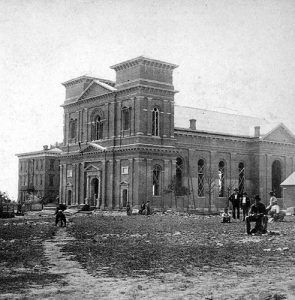
Cathedral of the Immaculate Conception, Alexander Gardner, 1867.
Later the same year, the cornerstone of the Cathedral of the Immaculate Conception was laid in September. Work on the beautiful church would continue for the next four years before it was dedicated in 1868. A boys’ school was also opened in connection with the cathedral. Unfortunately, the magnificent church was destroyed by a fire in 1961. The present church was begun in 1962 and was dedicated in May 1964.
In the meantime, the Sisters of Charity opened the St. Vincent Orphan Home in 1866. It continued to operate until it was relocated to Topeka in 1948.
In 1865, Fred Harvey, of Harvey House fame, moved his family to Leavenworth. Beginning work as a ticket agent and moving up through the ranks of a couple of different railroad companies, he would eventually persuade the manager of the new Atchison, Topeka & Santa Fe Railroad that he could provide quality food in pleasant restaurants inside railroad stations. Soon, Harvey Restaurants and Hotels were born, featuring the popular Harvey girls. Harvey would later purchase a lovely three-story stone building for his family. Today, the building is preserved as the Fred Harvey Museum.

Home of Frederick Henry Harvey, Leavenworth, Kansas, courtesy Travel Kansas.
One of the most significant events of 1866 that caused quite a stir in Leavenworth, as well as in the state and the rest of the country, was the suicide of General James H. Lane. Though Lane certainly had his faults, he was recognized for his vigorous efforts in securing Kansas as a Free-State. After the Civil War, Lane was re-elected as a United States Senator and, in June 1868, left Washington to return to Kansas for a brief period.
Though he seemed to be in poor health and depressed, he began his return to Washington with his wife. Still, upon reaching St. Louis, Missouri, his symptoms were so alarming that his physicians expressed fear for his recovery and expressed the opinion that he was suffering from softening of the brain. Under doctors’ advice, he returned to Kansas on June 29 and stopped with his brother-in-law, Captain McCall, at the Government Farm outside Leavenworth. Here, his symptoms were said to have gotten worse. On Sunday, July 1, he expressed a desire for a carriage ride and was accompanied by Captains McCall and Adams. As they stopped to open one of the farm gates, Lane jumped out of the carriage exclaiming “Good-bye, gentlemen!” and discharged a revolver in his mouth, the ball passing upward through the head and out almost at the center of the cranium. He was carried to the farmhouse and remained comatose, with erratic motions of the arm and right leg, until July 11, when he died. He seemed to recover and recognized friends at one time, even naming them in a whisper. His remains were returned to his home in Lawrence, where he was buried in the Oak Hill Cemetery.
Lane’s despondency has been attributed to various causes. Still, many felt it was because he had begun to lose favor among his supporters when he backed then-President Andrew Johnson’s reconstruction policies, including the president’s veto of the Civil Rights Bill. He soon became despondent and was accused of abandoning his fellow Radical Republicans, as well as rumors of financial irregularities.
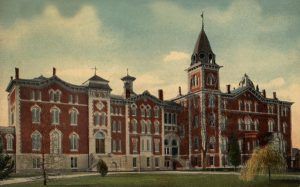
St. Mary’s Academy, Leavenworth, Kansas
By 1870, the post-Civil War effects had waned, and the population of Leavenworth had declined by several thousand. This, however, didn’t affect the busy Sisters of Charity, who began work on St. Mary’s Academy in April 1870. The following month, the Kansas State Legislature granted the school a charter to confer degrees and academic honors.
The school still stands in Leavenworth, and many of its original buildings are still utilized. Today, called the University of St. Mary, the private liberal arts university is coeducational and continues to be sponsored by the Sisters of Charity of Leavenworth. St. Mary’s Academy for high school students is on the same campus. The mother-house of the order is also located on the premises.
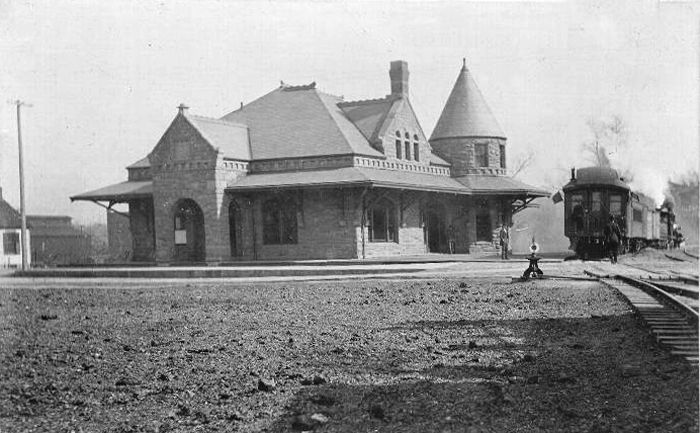
Atchison, Topeka, & Santa Fe Railroad Depot at Leavenworth, Kansas.
In 1871, the town’s name was officially changed from Leavenworth City to Leavenworth. The following year, the Leavenworth County Jail was finally built, and following years of delay, the Leavenworth County Courthouse was completed in February 1873. Built of red brick with stone trimmings, the two-story building was topped with an elegant mansard roof, a lofty tower, and a fine clock. Unfortunately, the first courthouse building was destroyed by a fire in the Spring of 1911. A new courthouse was built at the same location the following year. It continues to be used today.
Although its population had dropped from a high of 20,000 following the end of the Civil War to approximately 16,500 by 1880, Leavenworth was still a bustling city. It would become even more so as the city turned its attention to manufacturing. With its ideal location on the Missouri River, several railroads running through the city, and several coal mines which opened in the area, Leavenworth became a hub of factories producing mine and mill machinery, steam engines, stoves, wagons, shoes, bakers’ ovens, pumps and implements, furniture, and more. By the turn of the century, her population had grown again to almost 21,000 people. The city also boasted packing houses, flour mills, and creameries, and Leavenworth was a jobbing point for a large territory. During these flourishing times, numerous stately homes were built to house the families whose wealth grew as the city grew. Many of these beautiful homes continue to stand today.
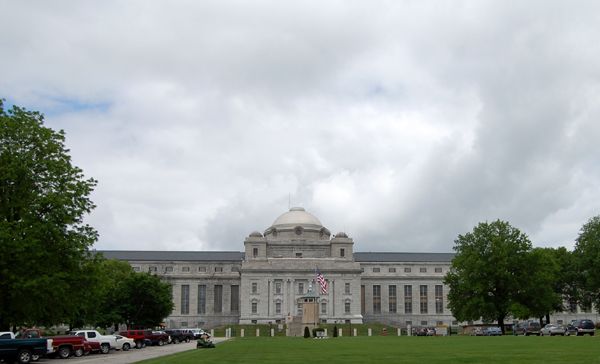
Leavenworth, Kansas Penitentiary by Kathy Alexander.
In 1897, the War Department deeded the reservation for the U.S. Penitentiary to the Department of Justice to build a new Federal Penitentiary in Leavenworth County. The decision was made, in part, based on the labor available from the U.S. Disciplinary Barracks at Fort Leavenworth. Prisoners were used in the first construction phase and were also the first to be incarcerated in the new prison in 1903. In 1906, the first cell house in the United States Federal Penitentiary was opened, but it would not be entirely completed until the mid-1920s. The walls are 40 feet high and 40 feet below ground. It was the largest maximum-security prison in the United States until 2005, when it was downgraded to a medium-security facility. Housing more than 2,000 male inmates, the prison carried out the judgments of the Federal Courts. Famous inmates over the years included Al Capone, Machine Gun Kelly, and Robert Stroud – the famous “Birdman of Alcatraz.” Stroud’s bird work began at Leavenworth, where he served 28 years before being transferred to Alcatraz.
Over the years, the population of Leavenworth fluctuated, dropping like many other U.S. cities during the Depression. However, it revived again and grew steadily to its peak of about 38,500 in 1990. Today, Leavenworth is a community of about 35,000 people. Situated just on the outskirts of the Kansas City metropolitan area, it continues to provide a small-town flavor with quick access to the amenities of a larger city. The city continues to thrive with several large employers, including Hallmark Cards, as well as federal institutions such as Fort Leavenworth, the Dwight D. Eisenhower Veterans Affairs Medical Center, and the Leavenworth Federal Penitentiary. Saint Mary College has continued to operate for over 140 years, and numerous small businesses and family-owned venues welcome visitors to Leavenworth.
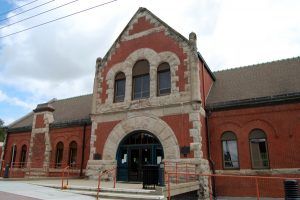
Leavenworth, Kansas Depot by Kathy Alexander.
Leavenworth offers many historical attractions, including the Parker Carousel Museum, the Carroll Mansion, the Fred Harvey Museum, the Black History Museum, the Frontier Army Museum, and much more. The city is home to eight National Register Historic Districts and twelve National Register properties associated with the city’s early development. These historic districts reflect the eclectic nature of commercial development throughout the years, and beautiful old homes are scattered throughout the community.
A historic wayside walking and driving tour commemorates many notable events, people, and locations in the community. The interactive displays feature local artwork depicting images of significant historical people, structures, or events associated with each site and include recorded narratives.
There are 13 Waysides in the riverfront downtown area that can be experienced as a walking tour, and eight Waysides as a driving tour. Another Wayside tour is also available at Fort Leavenworth. In Leavenworth, brochures and maps can be obtained from the Leavenworth Convention & Visitors Bureau, located at 518 Shawnee Street, or from the Welcome Center at the North entrance to town on North Highway 7/73.
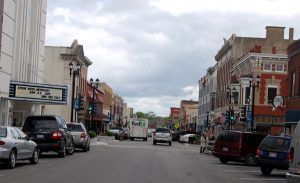
Leavenworth, Kansas Today by Kathy Alexander.
These interactive panels inform visitors about Leavenworth’s rich Native American history, the Bleeding Kansas era, the Wild West, Prohibition, and more. They also provide information on some of the city’s historic buildings, interesting residents, and notable individuals who have spent time in the community. In its early years, the city was marked by notable visitors and residents, including Lewis and Clark, Buffalo Bill Cody, Wild Bill Hickok, Calamity Jane, George and Tom Custer, General William T. Sherman, Abraham Lincoln, Susan B. Anthony, and dozens of others.
Many who visit Leavenworth are interested in the area’s prisons, which have been widely publicized over the years. Leavenworth and Fort Leavenworth have four prisons in the area, none of which allow public tours. The U.S. Penitentiary can only be photographed from across the street. The First City Museum, located at 742 Delaware Street, features several exhibits on jails and prisons for those interested in learning more.
More Information:
Leavenworth Convention and Visitors Bureau
518 Shawnee
P.O. Box 44
Leavenworth, Kansas 66048
913-682-4113
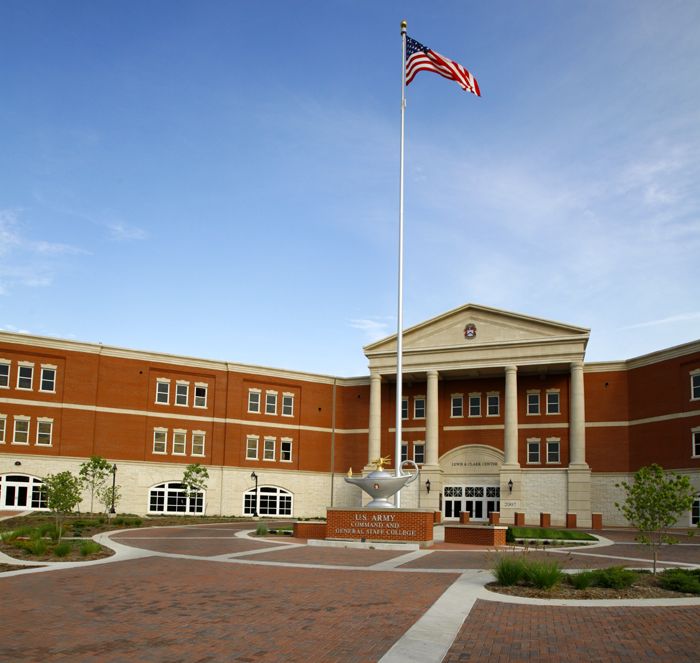
Lewis & Clark Army War College, Leavenworth, Kansas by Harland Schuster, courtesy Kansas Travel.
©Kathy Alexander/Legends of America, updated July 2026.
Also See:
Fort Leavenworth – History & Hauntings
Weston Missouri – The Town that Refused to Die
General James H. Lane – Grim Leader in the Free-State Fight
See Sources.