
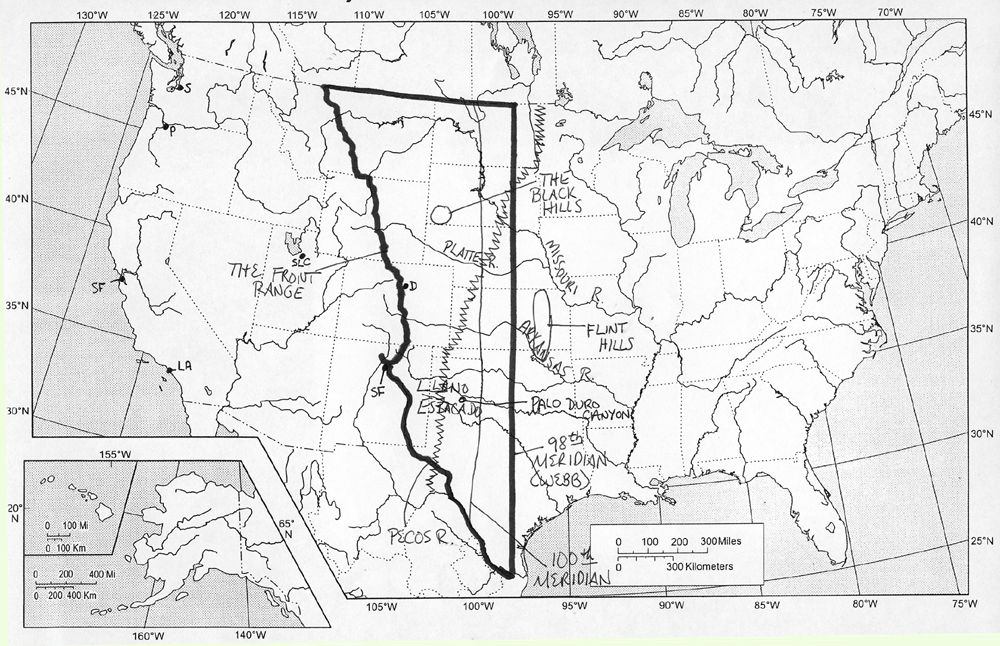
Great American Desert Map.
The “Great American Desert” was a term used by people East of the Mississippi River to characterize their perception of the country West of the Mississippi, which was largely unknown at the time. Carey and Lee’s Atlas of 1827 located the Great American Desert as an indefinite territory in what is now Colorado, Kansas, Nebraska, Oklahoma, and Texas. Bradford’s Atlas of 1838 depicts a vast desert extending from the Arkansas River into Colorado and Wyoming, encompassing South Dakota, parts of Nebraska, and Kansas. Others thought the desert included an area 500 miles wide lying directly East of the Rocky Mountains and extending from the United States’ northern boundary to the Rio Grande.
Its boundaries changed from period to period, for Mitchell’s Atlas of 1840 placed the Great American Desert West of the Rocky Mountains. The area shown by the various geographies shrank each year until only sandy plains in Utah and Nevada bore the name “desert.”
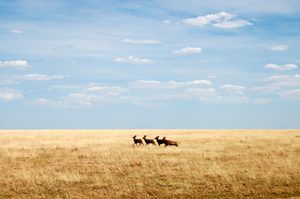
The Plains of Southwest Kansas by Kathy Alexander.
The history of this portion of the continent began with the earliest explorations in the New World. Spaniards conducted expeditions from the South following Christopher Columbus. After Mexico and Florida were discovered, Alvar Núñez was sent from Spain to explore Florida. His journey took him to the mouth of the Mississippi River, where he suffered a wreck, and only 15 of his men survived — eleven of these were killed by the Indians. The four remaining men were made prisoners and separated. Nunez, also known as Cabeca de Vaca, was carried by the Indians North into the Great Plains in sight of the Rocky Mountains. He and his companions reunited, escaped the Indians, and, working their way slowly, found the Spanish settlement in Mexico in 1836.
In 1538, Hernando de Soto left Spain to explore Florida. At about the same time, Coronado, inspired by Cabeza de Vaca’s tales, set out North to find the seven golden cities. His search for Quivira took him to what is now central Kansas.
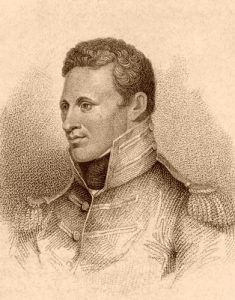
Zebulon M. Pike, early 1800s.
Early in the 19th century, the United States government sent out exploring expeditions. One of these was under the command of Lieutenant Zebulon Montgomery Pike, who, in 1806, went West from St. Louis, Missouri, to hunt the source of the Arkansas River. In his description of the country, he wrote, “From these immense prairies may arise one great advantage to the United States, viz: The restriction of our population to some certain limits, and thereby a continuation of the Union. Our citizens, being so prone to rambling and extending themselves on the frontier, will, through necessity, be constrained to limit their extent to the West to the borders of the Missouri and Mississippi Rivers. At the same time, they leave the prairies incapable of cultivation to the wandering and uncivilized aborigines of the country.” His explorations are referred to as Pike’s Expedition.
The report of Major Stephen H. Long’s Expedition in 1819 and 1820 verified the words of Pike. He considered a significant part of the country unfit for cultivation and uninhabitable by people who depended on agriculture for their subsistence. In speaking of the whole section from the Mississippi to the Rocky Mountains, he said, “From the minute account given in the narration of the particular features of this expedition, it will be perceived to be a manifest resemblance to the deserts of Siberia.”
Washington Irving, in his Astoria, published in 1836 and founded on a brief tour he made on the prairies and into Missouri and Arkansas, said:
“This region, which resembles one of the ancient steppes of Asia, has not inaptly been termed ‘The Great American Desert.’ It spreads forth into undulating and treeless plains and desolate sandy wastes, wearisome to the eye from their extent and monotony. It is a land where no man permanently abides, for, at certain seasons of the year, there is no food for the hunter or his steed.”
Pike, Long, and Irving’s reports played a significant role in shaping public opinion about this previously unknown land. Pike and Long’s expeditions were essentially the last government-sponsored exploration work for several years. While the government was idle, private enterprise was expanding westward.
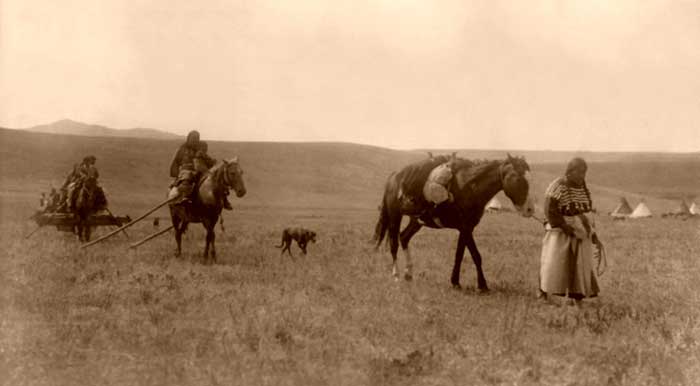
Gros Ventre (Atsina) demonstrating Moving Camp, by Edward S. Curtis, 1908.
Westward travel accelerated in 1849 following the discovery of gold in California. Previously, overland travel had been relatively light, but in 1849, an estimated 42,000 persons crossed the plains.
The trip was complete with every kind of danger. Indians, storms, and disease attacked caravans, but many returned to settle in preferred locations. The lands along the streams were the first to be taken by the settlers. Gradually, the country yielded to the influence of law and order. Even the most dismal spots were developed into gardens of usefulness and beauty by the work of irrigation; the government began doing much for the protection of forest and range, and by feats of engineering, a variety of rich mines were opened; railroads crossed seemingly impassable plains; factories of all kinds sprung up; gases from underground were controlled for light and fuel; educational institutions opened their doors to millions of children, and churches of all denominations were erected. The free library, the telegraph, the telephone, rural mail delivery, and the complexities of modern times were soon crowded upon the Great American Desert.
Compiled and edited by Kathy Alexander/Legends of America, updated July 2026.
Also See:
Adventures in the American West
About the Article: The majority of this historic text was published in Kansas: A Cyclopedia of State History, Volume I, edited by Frank W. Blackmar, A.M., Ph.D.; Standard Publishing Company, Chicago, IL, 1912. However, the text presented here is not verbatim; it has been revised and updated.