

Union Pacific Railroad Engine.
After the Pacific Railroad Act of 1862 approved aid for building a railroad and telegraph line from the Missouri River to the Pacific Ocean, the Union Pacific Railroad was incorporated on July 1, 1862, under the guidance of its dominant stockholder, Thomas C. Durant.
Headquartered in Omaha, Nebraska, the company began laying tracks in its hometown, then gradually moved westward through some of the nation’s most challenging terrain. As the Union Pacific built westward, the Central Pacific Railroad of California built eastward from Sacramento, California. By the end of 1865, Union Pacific had already spent half a million dollars but laid only 40 miles of track, or as one newspaper put it: “two streaks of rust across the Nebraska prairie.”
However, when a young Union General and civil engineer named Grenville Dodge was appointed Chief Engineer, progress began in earnest. He hired thousands of men, who braved frequent Indian attacks, extreme weather, and almost insurmountable canyons and mountains.
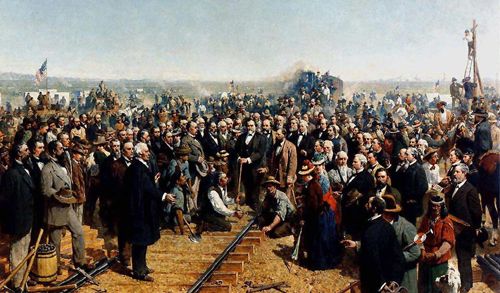
The Last Spike at Promontory, Utah
The Union Pacific and the Central Pacific Railroads finally came together at Promontory, Utah, on May 9, 1869. The railroad was complete, ending the many wagon trails across the West. However, it was just the beginning of the Union Pacific Railroad. The Panic of 1873 led to Union Pacific’s bankruptcy, but under the leadership of Jay Gould, the organization stayed afloat and, for the next two decades, expanded rapidly. However, over-speculation again led to bankruptcy in 1893. Again, the company made it through difficult financial times and, by 1901, had recovered enough to take control of the Southern Pacific Railroad.
Over the years, Union Pacific also acquired the Missouri Pacific, Chicago & North Western, Western Pacific, Missouri-Kansas-Texas, and the Rio Grande Railroads. Today, the company is one of the largest transportation companies in the United States and the oldest railroad company in continuous operation under its original name West of the Mississippi River. It continues to be headquartered in Omaha, Nebraska.
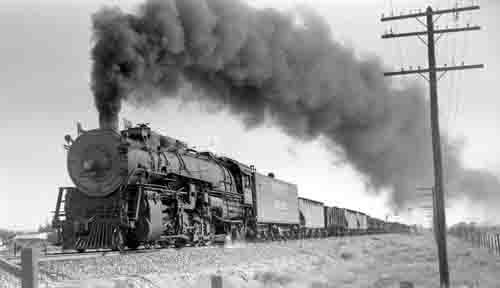
Union Pacific Train, late 1800s

Union Pacific Logo.
©Kathy Alexander/Legends of America, updated October 2026.
Also See:
A Century of Railroad Building
Linking the Oceans By Railroad
Vintage Photographs of Railroads & Depots
See Sources.