
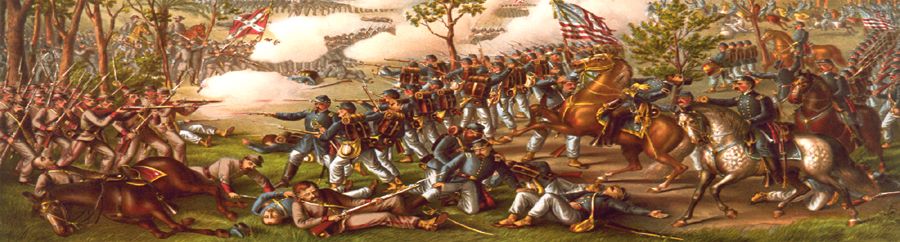
Battle of Atlanta, Georgia by Kurz & Allison, 1888.
We here highly resolve that these dead shall not have died in vain, that this nation under God shall have a new birth of freedom, and that government of the people, by the people, for the people shall not perish from the earth.
— Abraham Lincoln, November 19, 1863, The Gettysburg Address
From 1861 to 1865, the United States was torn apart by the Civil War, primarily by the issue of slavery. Though many disagreements between the North and South had been brewing since the American Revolution ended in 1782, the crisis came to a head in the 1850s. It was at this time that northern factions feared that those supporting slavery had too much control in government, and the South feared losing that control to anti-slavery forces. Other issues included states’ rights vs. federal power, the economic merits of free labor vs. slave labor, expansionism, modernization, and taxes.
Adding fuel to the fire was the nation’s growth westward. As new territories such as Kansas and Nebraska were added, the Southern factions felt that slavery should be allowed in these new territories, while the “Free Soiler“ was set against it. This led to open warfare between Kansas and Missouri, generally referred to in history as “Bleeding Kansas.” One of the many precursors to the Civil War, these battles pitted neighbor against neighbor.
This dispute over the expansion of slavery into the new territories and Abraham Lincoln’s election as president on November 6, 1860, finally led to the secession of eleven Southern states. Though Lincoln did not propose federal laws making slavery unlawful where it already existed, his sentiments regarding a “divided nation” were well known.
On December 20, 1860, South Carolina was the first state to secede from the Union, and within two months, Mississippi, Florida, Alabama, Georgia, Louisiana, and Texas followed. On February 9, 1861, the Confederate States of America was formed with President Jefferson Davis at its helm.
Fighting began on April 12, 1861, when Confederate forces attacked a Federal military installation at Fort Sumter in South Carolina.
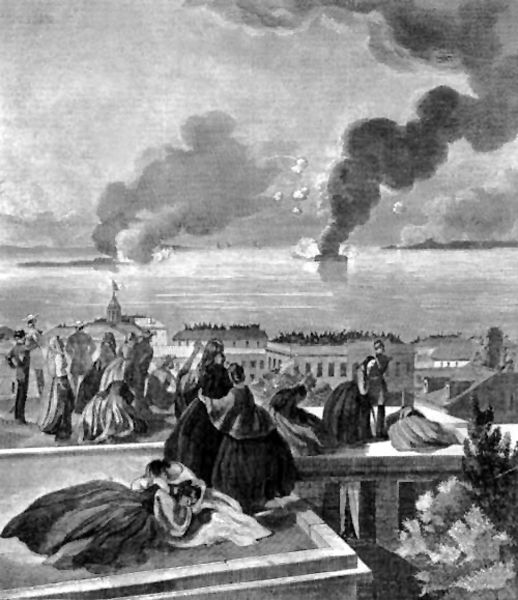
Fort Sumter, South Carolina, is bombed by the Confederates while the people of Charleston look on.
In the beginning, most believed the war would be short-lived, but the North underestimated the South’s determination to remain independent. The battles raged over four long years, with some three million men fighting for their cause, resulting in the loss of some 620,000 lives. Confederate General Robert E. Lee, after being forced to abandon the Confederate capital of Richmond, surrendered at Appomattox, Virginia, on April 9, 1865, effectively ending the Civil War. However, small sporadic battles would occur months later.
In the end, the Union prevailed, restoring the United States and ending slavery.
Our heaven-born banner painted by William Bauly, 1861.
Categories:
Bleeding Kansas & the Missouri Border War
Battles of the Eastern Theater
Battles of the Lower Seaboard & Gulf Approach
Battles of the Trans-Mississippi Theater
Battles of the Western Theater
Articles:
A Boy Soldier in the Civil War
Bring Civil War History to Life at These Iconic War Sites
Confederate Graves on the Natchez Trace
The Confederate States of America
Deadlier Than the Male — Female Spies
Death & Dying in the Civil War
Evolution of National Cemeteries
Fort Sumter, South Carolina – Starting the Civil War
General “J” Shelby and His Great Raid through Missouri
The Little Monitor and the Merrimac
Native Americans of the Civil War
Non-Combat Branches in the Civil War
Pick & Shovel Warfare in the Civil War
Riding on the Underground Railroad
The Significance of Tags, Badges, and Insignia During the American Civil War
A house divided against itself cannot stand. I believe this government cannot endure permanently half-slave and half-free. I do not expect the Union to be dissolved — I do not expect the house to fall — but I do expect it will cease to be divided. It will become all one thing or all the other.
— Abraham Lincoln in his acceptance speech for the Republican State Senatorial nomination on June 16, 1858.
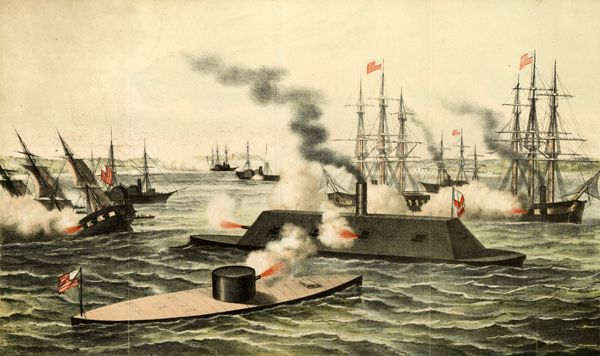
Civil War Ships by Henry Bill, 1862.
Compiled and edited by Kathy Alexander/Legends of America, updated March 2026.
Also See:
African American History in the United States
Soldiers & Officers in American History
War & Military in the United States
See Sources.