

Battle of the Little Wichita River, Texas.
The Battle of the Little Wichita River, a military engagement between troopers of the Sixth United States Cavalry and about 100 Kiowa Indians led by Chief Kicking Bird, took place in Archer County, Texas, on July 12, 1870. Though the exact location of the conflict remains unclear, experts claim it occurred in the northwestern part of the county, along the Little Wichita River, about six miles northwest of Archer City, just south of the site of present-day Lake Kickapoo.
The origins of the hostilities lay in the Kiowa’s dissatisfaction with life on their reservation in southeastern Indian Territory (Oklahoma). Frustrated by broken treaty agreements, confinement, inadequate supplies, threats to the tribe’s traditional way of life, many warriors responded by crossing the Red River into Texas to raid white settlements across Wichita, Archer, Young, and Jack Counties. The Fort Sill reservation soon became a place of refuge for the marauding bands that went forth unmolested to raid in Texas, Oklahoma, and Mexico. Their raids enraged settlers and further aggravated an already tense situation. On the reservation, however, the raiders were greeted as heroes, and their new status as warriors effectively undercut the authority of those chiefs who counseled peace.
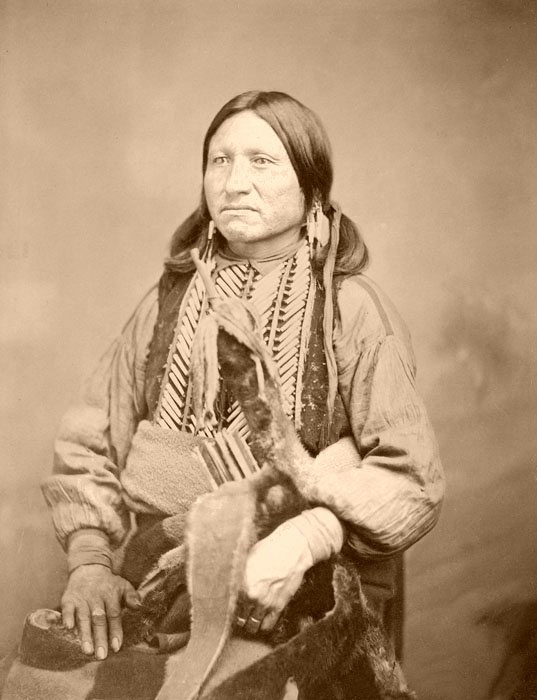
Kiowa Chief Kicking Bird.
Chief Kicking Bird was among those accused of making peace with the white man, which brought accusations of cowardice. His tribesmen thought that he was consorting too much with the whites at Fort Sill, Oklahoma. With his influence waning, and to save face, he formed a war party of his own and sought to restore his prestige by engaging in battle with white soldiers. In late June or early July, he led about 100 warriors across the Red River and into Wichita County. Their journey, which took them through portions of Archer and Young Counties, was uneventful until a small group of young warriors broke away from the leading group and, disregarding Kicking Bird’s orders forbidding hostile contact with civilians, attacked and robbed a mail stagecoach at Rock Station, near the site of present Jermyn, in Jack County.
Word of the attack reached Fort Richardson on the morning of July 6. In response, Captain Curwen B. McLellan, commander of the Sixth Cavalry, assembled a force of 55 troopers, two officers, a surgeon, and a civilian scout to fight the Indians. About an hour and a half out of camp, McLellan arrived at Rock Station and found the stagecoach upturned, part of the mailbag, and one package addressed to the quartermaster at Fort Richardson. After gathering the remaining bits of mail, the cavalry resumed its search for Kicking Bird. Moving northwest, McLellan’s force pursued the Indians’ trail for five days and about 50 miles, but, despite several false alarms, failed to find the leading group of Kiowa. In his report, McLellan claimed that Kicking Bird was difficult to track because he divided his party and skillfully masked his trail.
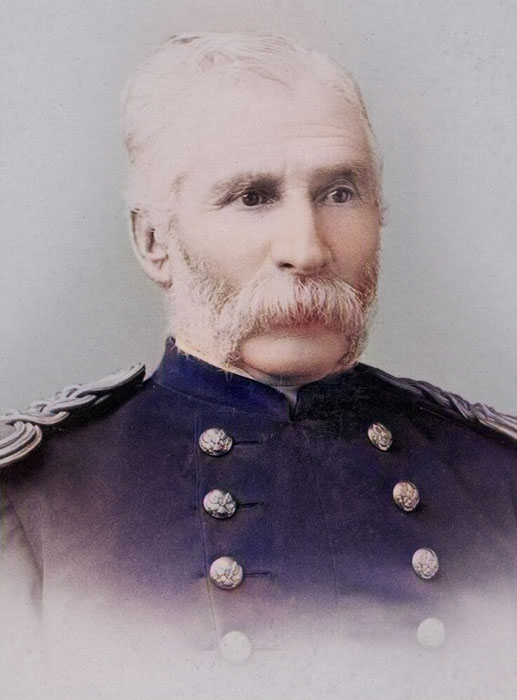
Captain Curwen B. McLellan.
Captain McLellan and his troops finally caught up with the Kiowa on the evening of July 11, several miles east of the site of Seymour, Texas. !t 10:00 the following morning, his forces attacked the Indian camp. The Indians were painted and decorated in their finest costumes.
Shortly after attacking, McLellan realized he was outnumbered by more than two to one. Making matters worse, they faced a group armed with Spencer rifles and superior weaponry. The attack quickly became a retreat. Kicking Bird led the warriors who soon surrounded the whites. Making the most of his opportunity, Kicking Bird led a charge on the disorganized cavalrymen and personally killed Corporal John Given with a lance. For the rest of the afternoon, McLellan’s men were attacked from all sides as they tried desperately to retreat. Although the unit lost just two more soldiers during several hours of battle, the fighting was so fierce that the army was forced to abandon its dead on the field. Finally, after the Kiowa cut off their attack early in the evening, the cavalry was able to escape across the West Fork of the Trinity River. Exhausted and suffering 12 wounded in addition to the three killed, McLellan and his troops made camp ten miles northwest of Flat Top Mountain at midnight. There they were reinforced by a group of cowboys from Terrell Ranch and 20 cavalrymen stationed at nearby Jean. Toward evening, the Indians disappeared.
The next morning, McLellan dispatched couriers to Fort Richardson for ambulances and prepared to make his final retreat. Fearing another attack, he ordered all excess baggage burned and moved his unit to a more secure location. The ambulances arrived later that day, and on July 14, the Sixth Cavalry returned to Fort Richardson. The Sixth Cavalry’s brave performance bolstered their reputation as a fighting force.
In his report, McLellan praised Kicking Bird’s superior generalship and called for larger forces to protect the frontier. He reported that the Kiowa had suffered casualties of 15 killed and an undetermined number wounded.
Afterward, 13 deserving troopers were awarded the Congressional Medal of Honor, but the toll on the settlements, in terms of livestock and loved ones, continued to increase steadily.
This battle was the last time Chief Kicking Bird was involved in hostilities of any kind, and he expressed regret that he had been forced to lead the expedition. After breaking off the attack and returning home with his prestige restored, he dedicated the remainder of his life to promoting peaceful relations with the whites.
©Kathy Alexander/Legends of America, updated November 2025.
Also See:
Indian Wars, Battles & Massacres
Sources:
Fort Tours
Texas Back Roads
Texas State Historical Association – 1
Texas State Historical Association – 2