
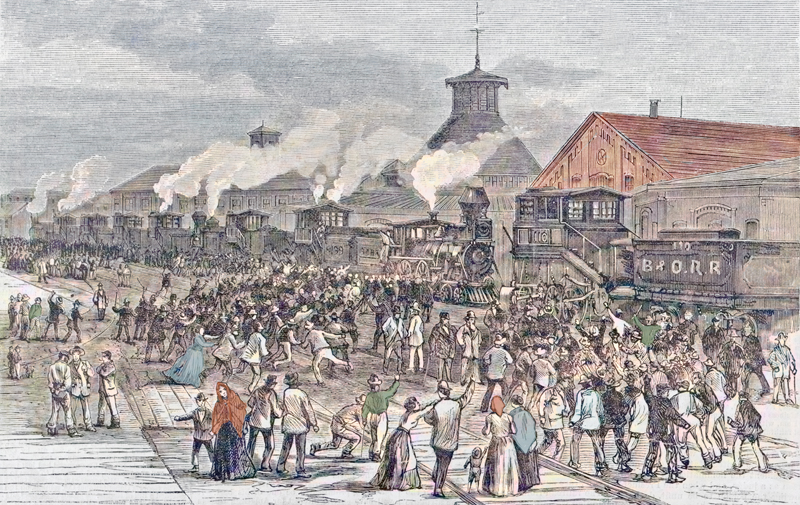
Great Railroad Strike in Martinsburg, West Virginia, by Harpers Weekly, 1877.
The Great Railroad Strike of 1877 was a series of violent labor strikes that occurred across the United States. It was the country’s first major rail strike and witnessed the first general strike in the nation’s history. The strikes and the violence they spawned briefly paralyzed the country’s commerce, prompting governors in ten states to mobilize 60,000 militia members to reopen rail traffic.
By that time, the total miles of railroad track in the United States had increased significantly, from just 23 miles in 1830 to 35,000 miles by the end of the Civil War.
In 1872, the Credit Mobilier scandal broke, negatively impacting the railroad securities market. Several railroads went bankrupt, and soon after, trouble spread to the banks.

Financial Panic in New York City, 1873.
In September 1873, Jay Cooke’s bank, Jay Cooke & Company, was unable to sell bonds for the Northern Pacific Railway, leading to a collapse of its credit and ultimately forcing the bank to declare bankruptcy. This triggered the Financial Panic of 1873, which marked the beginning of the Long Depression. As a result, numerous banks, railroads, and insurance companies either went bankrupt or faced severe financial struggles. Many businesses also failed, leading to widespread layoffs among factory workers. The events of 1872-1873 had a lasting impact on the economy.
Railroad work was already known to be poorly paid and dangerous, and during this time, railroad companies exploited workers’ economic difficulties to undermine the growing trade unions. Over the course of three years, starting in 1874, the Baltimore & Ohio Railroad cut wages significantly, leaving workers with salaries less than half of what they had earned before the Panic. Other northern railroads also followed suit, reducing wages and salaries.
In May, the Pennsylvania Railroad, the nation’s largest railroad company, cut wages by 10%. It followed this with another 10% cut in June, prompting other railroads to implement similar reductions.
On July 13, the Baltimore & Ohio Railroad’s president announced that, since the depression was “seriously affecting the usual earnings of railway companies,” another 10% cut was needed to allow the company to continue paying the same dividends to its shareholders. It also slashed the workweek to just two or three days.
The cutbacks prompted strikes and violence with lasting consequences when the working class lashed out in response to the wage cuts that had brought many workers to the brink of starvation and protested against the excesses of the new industrial order, including long hours, economic instability, and brutal exploitation. Forty disgruntled locomotive firemen walked off the job. By the end of the day, workers blockaded freight trains near Baltimore, Maryland, and in West Virginia, allowing only passenger traffic to get through.
“The strike is not a revolution of fanatics willing to fight for an idea. It is a revolt of working men against low prices of labor, which have not been accomplished with corresponding low prices of food, clothing, and house rent.”
— An anonymous Baltimore merchant
That month, the Pennsylvania Railroad announced that it would double the length of all eastbound trains from Pittsburgh, Pennsylvania, without increasing crew size. Railroad employees responded by seizing control of the rail yard switches, blocking train movement.

Great Strike of 1877 in Martinsburg, West Virginia.
On July 16, 1877, workers at the Baltimore & Ohio Railroad station in Martinsburg, West Virginia, who had organized into labor unions, resisted by uncoupling the locomotives in the station, confining them to the roundhouse, and declaring that no trains would leave Martinsburg unless the cuts were rescinded.
The July 17 Baltimore Sun began reporting on the previous day’s activities on the Baltimore & Ohio Railroad. Another newspaper reported that employees were attempting to derail a freight train. The Sun also reported that employees in Martinsburg, West Virginia, walked off the job, and no freight trains were allowed to pass.
In the meantime, West Virginia Governor Henry M. Mathews dispatched the militia when police were unable to break up the supportive crowd that had gathered in Martinsburg, West Virginia. When the militia then proved incapable of freeing the 600 or so trains stranded, Mathews requested and received assistance from federal troops.
After police and state militia were called in, the strike turned violent.
President Rutherford B. Hayes issued a series of proclamations on July 18 for West Virginia. Afterward, trains began leaving Martinsburg on July 20.

Great Railroad Strike in Baltimore, Maryland, 1877.
In Maryland, protestors threw stones at militia troops, who responded by firing into the crowd and killing eleven people. Protesters then torched buildings and trains, and distributed manifestos that stated “Be it understood, if the Baltimore and Ohio Railroad Company does not meet the demands of its employees at an early date, the officials will hazard their lives and endanger their property, for we shall run their trains, and locomotives into the river; we shall blow up their bridges; we shall tear up their railroads; we shall consume their shops with fire and ravage their hotels with desperation.”
Strike activities then moved further into Maryland and, subsequently, to Pennsylvania and New York as word spread among employees down the line.
On July 19, the strikes grew to include Pittsburgh and the Pennsylvania Railroad. That day, flagman Gus Harris unilaterally refused to work on a “double-header” (a train hauled by two engines, thus requiring fewer workers), and the rest of the crew joined him. The resulting strike quickly grew and was joined by men from the nearby iron mills and factories.
Elsewhere, on July 20, militiamen were sent to Cumberland, Maryland, where strikers had halted trains. At least ten people in a crowd were killed by militiamen who were en route to Camden Depot, prompting the assignment of federal troops to Baltimore, Maryland.
Back in Pittsburgh, when local police and National Guard units were reluctant to act against their fellow townsmen, Pennsylvania Governor John F. Hartranft called in guardsmen from Philadelphia. On July 21, after local forces had made only a token effort to clear the tracks of the growing mob, the troops from Philadelphia made a bayonet charge. A riot erupted, with guns being fired on both sides, and as many as 20 deaths resulted. As anger swelled among the workers, the guardsmen withdrew into a roundhouse while the crowd set fire to the Pennsylvania Railroad’s engines, cars, and buildings. Gunfire was exchanged

Burning of the Union Station at Pittsburgh, Pennsylvania, in 1877.
President Rutherford B. Hayes issued proclamations on July 21 for Maryland and July 23 for Pennsylvania, aiming to assist governors in managing crowds and ensuring trains continued to operate. Cities like Baltimore and Pittsburgh experienced some of the worst disruptions and violence. In Pittsburgh, the official death toll was recorded at 26, though the actual number was likely higher. The unrest and violence were not confined to major cities; places like Reading, Pennsylvania, were also affected, where at least ten people were killed in an incident referred to as the Reading Railroad Massacre.
Although President Hayes intended to preserve order rather than to suppress the strike, he inadvertently set a strong precedent for using federal troops to intervene on behalf of businesses during mass strikes. Subsequent presidents would invoke this precedent over the following two decades.
The entire Pennsylvania National Guard was called up, but many units faced delays in arriving due to strikers’ actions in other towns across the state. In Harrisburg, factories and stores were shut down; in Lebanon, a National Guard company mutinied; and in Reading, a mob destroyed tracks, derailed train cars, and set fires. However, by July 29, a fresh contingent of the National Guard, supported by federal troops, restored calm in Pittsburgh and reopened railroad operations.

Troops open fire on rioters in Chicago, Illinois, in July 1877.
Meanwhile, the strike had begun spreading to Chicago, Illinois, St. Louis, and Kansas City, Missouri, and as far west as San Francisco, California.
The strikes resembled a spontaneous uprising rather than a well-organized resistance capable of confronting the concerted efforts of the government and corporations. There was essentially no leadership to unite the workers after the initial excitement faded, resulting in a loss of strike momentum. Many strikers and their supporters were jailed, and companies intensified their efforts to undermine the unions. Wage cuts, which had originally sparked the strike, were not reversed, though companies eventually raised wages. Strikers received no immediate concessions, and the government took no significant action to support the workers. Consequently, little changed for the strikers, and the strike was largely forgotten. However, the cost of suppressing the strike, combined with the resulting revenue loss, had a notable impact on railroads, governments, and corporations.
By September 1877, the collective efforts of state governments and federal troops had effectively quelled the strike, and train operations resumed.
The strikes dissipated, first and foremost, because the federal army did not break. Unlike the militias, those professional soldiers stayed together and followed orders. The strikes also collapsed because, despite the fears of the industrialists and the government, they were not organized uprisings but rather spontaneous outbursts. Once the anger of the strikers and crowds had subsided, so too did the revolt. There had been no leaders with greater political vision to take command of the strikers.
More than 100,000 workers participated in the Great Railroad Strike of 1877. At the peak of the strike, over half of the freight across the country was halted. By the time the protests ended, approximately 1,000 people had been jailed, and around 100 had lost their lives. Ultimately, the strike achieved very little. While some national politicians discussed labor reforms, no substantial changes were made. Industrialists continued to cut wages and dismantle unions. Within a few years, the Great Railroad Strike of 1877 faded from memory.
In the end, the strikes, protests, and civil unrest did not yield tangible benefits for workers. Most returned to their jobs without receiving a pay increase, and many of the strike leaders were fired and blacklisted for their involvement.

The Great Railroad strike in Albany, New York.
The Great Railroad Strike of 1877 had long-term ramifications. Afterward, workers became better organized and enlightened. However, government officials at both the state and federal levels took steps to curb unions’ power. Many states also strengthen their police forces and the National Guard.
Workers’ rights came much later. It was nearly 50 years later that the first federal law guaranteeing collective bargaining rights for a group of workers was enacted. Under the 1926 Railway Labor Act, unions would negotiate agreements with railroads to determine employment terms, including pay, benefits, hours, and leave.
This legislation sought to prevent future labor strikes, given the railroads’ importance to the American economy. The resolution process would include mediation by an independent federal agency and presidential action to facilitate agreement. Strikes would only be permitted for major disputes and only after the union exhausts the negotiation and mediation procedures outlined in the law.
©Kathy Alexander/Legends of America, updated December 2025.
Also See:
Industrial America and the Progressive Era Timeline, 1876-1929
Industrial Revolution in America
Railroad Lines in American History
Sources:
Digital History
Encyclopedia Britannica
Eno Center for Transportation
Digital History
Library of Congress