

Hugh Glass.
Hugh Glass was an American frontiersman, fur trapper, trader, hunter, and explorer. He is best known for his story of survival and forgiveness after being left for dead by companions when a grizzly bear mauled him.
Believed to be born in Pennsylvania in 1783, little is known of Hugh Glass’ early life. However, there is some evidence suggesting that he had been a seafaring man, captured and forced into piracy in the Gulf of Mexico by the notorious pirate Jean Lafitte in 1816. After two years, Glass allegedly escaped by swimming to shore near present-day Galveston, Texas. He was later rumored to have been captured by the Pawnee tribe, with whom he lived for several years.
He traveled to St. Louis, Missouri, in 1821, accompanying several Pawnee delegates invited to meet with U.S. authorities.
In 1822, many men responded to an advertisement in the Missouri Gazette and Public Advertiser placed by General William Henry Ashley, which called for a corps of 100 men to “ascend the river Missouri” as part of a fur-trading venture for the Rocky Mountain Fur Company. Many of them, who later earned reputations as famous mountain men, joined the enterprise, including James Beckwourth, David Jackson, William Sublette, Jim Bridger, John S. Fitzgerald, James Clyman, and Jedediah Smith. These men and others would later be known as “Ashley’s Hundred”.
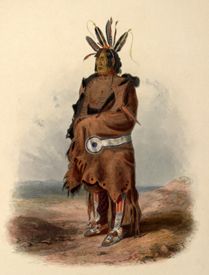
Arikara Warrior by Karl Bodmer.
In the spring of 1823, Hugh Glass joined Ashley’s company when he ascended the Missouri River into present-day Montana, the Dakotas, and the Platte River area of Nebraska with William Ashley, Major Andrew Henry, and more than a dozen men. While in the Grand River Valley, they encountered hostile members of the Mandan Tribe who attacked them and killed two of their group.
In June 1823, they met up with many of the men who had joined in 1822 and were attacked by Arikara warriors. Glass was apparently shot in the leg, and the survivors retreated downstream and sent for help.
On about August 23, 1823, Hugh Glass encountered a protective mother grizzly bear with two cubs in present-day northwestern South Dakota. When the big bear charged, Glass was severely mauled by it. When party members heard Glass’ screams, they killed the bear.
Glass suffered extensive wounds, including a broken leg, a punctured throat, and deep cuts on his back, exposing several ribs. His fellow frontiersmen felt sure he would die from his wounds by the morning, but he didn’t, so they carried him for two days on a litter made from tree boughs. Deep in hostile Indian territory, the group felt an urgency to keep moving. Andrew Henry then recruited two volunteers—John Fitzgerald and young James Bridger to stay with Glass until he died and give him a proper burial. Afterward, the party moved on, and the volunteers began digging his grave.

A bear attacked Hugh Glass.
Later, claiming that they were interrupted by an attack from Arikara, the pair grabbed the rifle, knife, and other equipment belonging to Glass and took flight. Fitzgerald and Bridger later caught up with the party and incorrectly reported to Ashley that Glass had died.
Despite eye movements and breathing being his only signs of life, Glass lived after the group departed. Despite his injuries, he regained consciousness but found himself abandoned with his festering wounds without weapons or equipment. He then set the bone of his broken leg and wrapped himself in the bear hide his companions had placed over him as a shroud.
More than 200 miles from Fort Kiowa on the Missouri River, the fiercely independent, solitary mountain man used Thunder Butte as a navigational landmark. He crawled overland south toward the Cheyenne River. To prevent gangrene, Glass allowed maggots to eat the dead, infected flesh in his wounds.
When he reached the river, he fashioned a crude raft and floated downstream, surviving on wild berries, roots, insects, snakes, and scavenged animal meat. After a six-week journey, he finally arrived at Fort Kiowa by mid-October.
After recovering from his wounds and obtaining a rifle and ammunition, Glass set out again to find John Fitzgerald and Jim Bridger. He eventually travelled to Fort Henry on the Yellowstone River but found it deserted. A note indicated that Andrew Henry and company had relocated to a new camp at the mouth of the Bighorn River. Arriving there, Glass found Jim Bridger and apparently forgave him for his youth and then re-enlisted with Ashley’s company.
Glass later learned that Fitzgerald had joined the army and was stationed at Fort Atkinson in present-day Nebraska. Glass reportedly spared Fitzgerald’s life because he would be killed by the army captain for killing a soldier of the United States Army. However, the captain asked Fitzgerald to return the stolen rifle to Glass, and before departing, Glass warned Fitzgerald never to leave the army, or he would still kill him. According to an account by Glass’s friend George C. Yount, not published until 1923, Glass also obtained $300 as compensation.
Afterward, Glass became an explorer of the Upper Missouri River watershed in present-day Montana, the Dakotas, and the Platte River area of Nebraska. He was later employed as a hunter for the U.S. Army garrison at Fort Union, near Williston, North Dakota.
Glass left the Upper Missouri region and traveled over the Santa Fe Trail to Santa Fe and Taos, New Mexico. Attaching himself to a trapping party, he had yet another battle with Indians, this time surviving an arrow wound to the back. He continued trapping to the north of New Mexico. He attended the 1828 rendezvous at Bear Lake in present-day Utah.
Hugh Glass then stayed with the Upper Missouri Outfit, working part-time as a hunter to supply meat to the new fort, and spending his spare time trapping in the area.
In early 1833, Glass was killed along with two of his fellow trappers, Edward Rose and Hilain Menard, on the Yellowstone River in an attack by the Arikara Indians.

Hugh Glass Monument.
A monument to Glass was placed near the site of his mauling on the southern shore of the present-day Shadehill Reservoir in Perkins County, South Dakota, at the forks of the Grand River.
Kathy Alexander/Legends of America, updated November 2025.
Also See:
Trading Posts of the Mountain Men
Trappers, Traders & Pathfinders
Sources:
History.com
National Park Service
South Dakota Hall of Fame
Wikipedia