

South Dakota Forts.
Fort Kiowa, also known as Fort Lookout and Fort Brazeau/Brasseaux, was a 19th-century fur-trading post located on the west bank of the Missouri River between modern Chamberlain, South Dakota, and the Big Bend of the Missouri River.
Built in 1822 by the Columbia Fur Company to serve the expanding fur trade in the American West, the square, 140-by-140-foot palisade featured a blockhouse and a watchtower in the two opposite corners, along with a storehouse. Tall cottonwood pickets enclosed the fort. The fort served as an essential rest stop and trading post for trappers and explorers, including Jim Bridger and Hugh Glass. In the early 1840s, as the American fur trade moved further west, Fort Kiowa was abandoned. The Missouri River eventually flooded it, and today the building’s site is submerged beneath the man-made reservoir of Lake Francis Case.
Following the Louisiana Purchase in 1803, the size of the United States nearly doubled, and the fur trade quickly sought to profit from the unexplored new territory. Forts sprung up along rivers and overland trails as parts of a burgeoning factory system. The factory system was a nationally funded and operated trade network in which Native Americans met at certain forts to exchange furs for finished goods. The American government had hoped that nationalizing the fur trade would prevent the debauchery caused by the trading of alcohol with the natives.
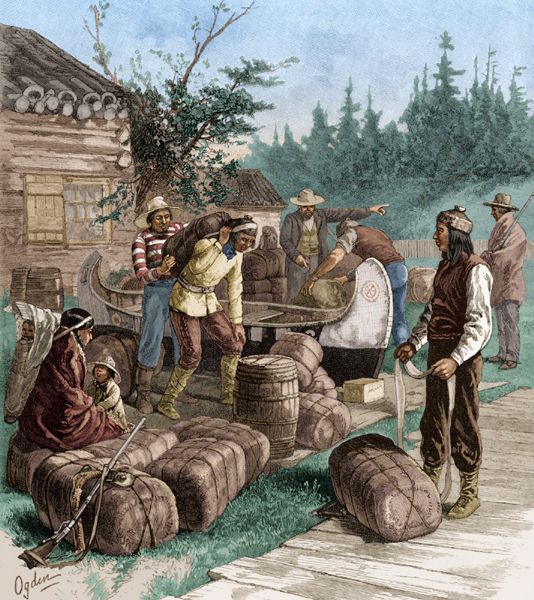
Trading Post.
The factory system eventually failed for several reasons. First, the men working the factories were ex-military men and not experienced fur traders. These men often mishandled the furs, leading to significant changes in profits. Second, the government failed to stop all private traders who bribed natives with alcohol. Eager to obtain liquor, the natives would break treaties with the government to obtain it. Lastly, the factories were not permitted to give gifts to natives or assimilate into native culture, as many private fur traders could.
Mixed-race marriages were a major unifying force among private fur traders and Indians, strengthening their relationships.
With the demise of the factory system, private companies emerged and made significant profits. Included in these were Manuel Lisa of the Missouri Fur Company and John Jacob Astor of the American Fur Company. These men were among the wealthiest in America at the time. These private companies established forts that acted as rest stops for trappers.
Fort Kiowa was constructed in 1822 by Joseph Brazeau Jr. of the Berthold, Chouteau, and Pratte French Company. Brazeau fortified the 20,000-square-foot complex with a blockhouse and watchtower to guard against Crow and Sioux attacks.

A bear attacked Hugh Glass.
In 1823, Fort Kiowa soon became the jumping-off point for the 1823 trading expedition known as “Ashley’s Hundred”, which included traders Hugh Glass, John Fitzgerald, and Jim Bridger. Several months after the journey began, Glass was brutally attacked by a grizzly bear. Glass was able to kill the bear, but suffered many severe, life-threatening wounds in the process. Two of Glass’ companions were instructed to remain with Glass until he died, and then bury him before reuniting with the rest of the party. However, a group of Arikara natives allegedly chased the pair off, and Glass was left alone to die.
However, Glass was somehow able to bind his wounds and crawl more than 200 miles back to Fort Kiowa.
Bridger returned to the hunting party and reported to his commander that Glass had perished. However, Glass survived and was able to set his own wounds and crawl more than 200 miles back to Fort Kiowa. This feat and others, in which pioneers such as Adam Helmer demonstrated perseverance despite harsh challenges in the wild, have maintained a special place in the folklore of the American West.
The fort was abandoned in 1825.
In 1827, Bernard Pratte purchased Fort Kiowa from Brazeau and made significant improvements. Pratte added several four-room log houses, a storehouse, and a smith shop. Furthermore, Pratte encircled the fort with a wooden picket fence, roughly 20 to 30 feet high, to deter Native attacks. Thus fortified, Fort Kiowa became a significant trading post for Native peoples in the region.
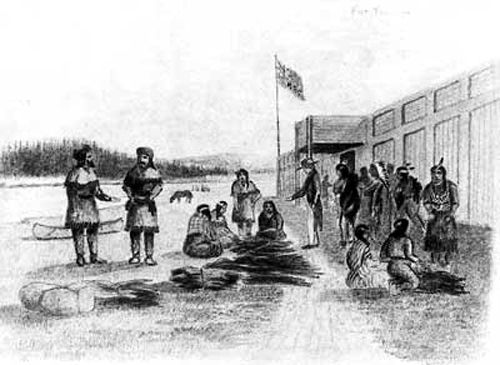
Trading with the American Fur Company.
Later in the same year, John Jacob Astor purchased Fort Kiowa from Pratte for his rapidly expanding American Fur Company. Astor, who was the first multi-millionaire in America, bought Fort Kiowa to establish his presence in the upper Missouri and to further his monopoly on the American fur trade. Astor found the upper Missouri River area to be highly prosperous. However, in the late 1830s, Astor’s American Fur Company was forced to abandon Fort Kiowa, as the once-lucrative fur-trading business had become unprofitable due to several factors. First, there was a scarcity of beavers caused by rapid overhunting by intruding trappers. Second, there was a lack of public demand in America and Europe for pelts, as a new style, silk hats, was gaining prominence. Lastly, the intrusion of American trappers on what the natives perceived as their land angered native tribes, who began to revolt against the trappers. As supply and demand both declined, fur trading in America faced extinction.
Before 1833, the fort was rebuilt, possibly on a separate but adjacent site, by the American Fur Company. This second post also functioned as the Sioux Indian Agency during its time.
In 1840, Joseph LaBarge, a former steamboat captain, bought Fort Kiowa as a wintering post and Indian Agency. LaBarge housed many Indian agents whose job was to monitor and control trade between Native tribes and Euro-Americans. These agents lost popularity among the latter, who tended to view them as exploiters of the Native peoples, corrupt leaders who acted in their own interests. Popular opinion was relatively accurate, as many Indian Agents were replaced during the 1840s after corruption was discovered. Under LaBarge’s ownership, Fort Kiowa was an unsuccessful venture, and as a result, he abandoned it within the year. LaBarge is the last known inhabitant of Fort Kiowa.
The fort was located about 12 miles above Chamberlain, South Dakota.
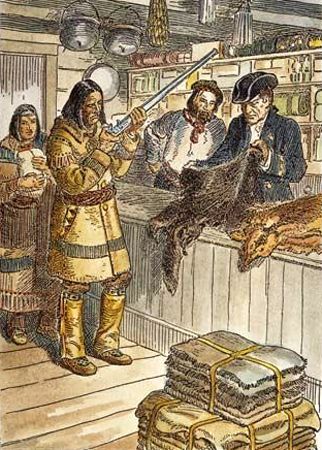
Trading with Native Americans.
©Kathy Alexander/Legends of America, November 2025.
Also See:
Forts & Presidios Across America
Soldiers & Officers in American History
Sources: