
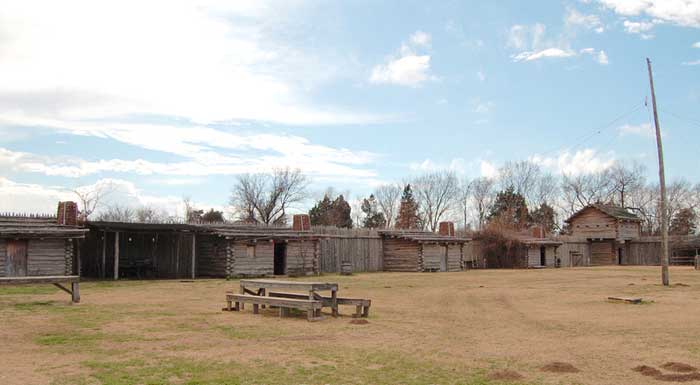
Fort Parker, Texas, by Kathy Alexander.
Fort Parker, Texas, was a private fort built by Elder John Parker and his three sons, Benjamin, Silas, and James W. Parker, and other members of the Pilgrim Predestinarian Baptist Church. This group, from Crawford County, Illinois, settled near the headwaters of the Navasota River in Limestone County in 1833.
Daniel Parker, a theologian, gained permission to come to Texas. Traveling by ox-drawn wagons, Daniel Parker led the first group, leaving Illinois in July 1833. Daniel’s party first settled in Grimes County, then later moved to Anderson County near present-day Elkhart, where they established the Pilgrim Church.
Elder John Parker and the rest of the group arrived in December of 1833, settling near the headwaters of the Navasota River at a natural crossroads. Peace treaties were made with the surrounding Native American chiefs.
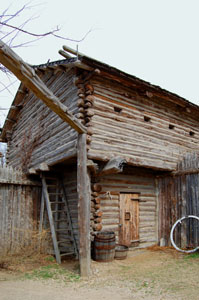
Fort Parker, TX – Blockhouse by Kathy Alexander.
Their first task was building a fort for protection against the Indians. Fort Parker was completed in March 1834. The stockade’s 12-foot-high walls were constructed of split cedar logs, with sharp points. Within the walls, blockhouses were placed at the two corners for lookouts, and six cabins were attached to the interior walls, along with a livestock corral. The fort had two entrances, a large double gate facing south, and a small gate for easy access to the spring. Most of the residents of the fort were part of the extended family of John and Sarah Parker.
The Parkers and other families moved inside the compound and began farming outside the walls. Since there had been no Indian troubles, they felt so secure that they left the fort’s gates open so workers could come and go with ease.
On May 19, 1836, while the men worked in the fields and the children played inside the fort, more than 100 Indians — Comanche, Kiowa, Caddo, and Wichita — appeared at the gates with a white flag of peace. Greeted by Benjamin Parker, who left the fort to talk to the warriors, the Indians told him that they wanted a safe place to camp and some beef. As Parker returned with beef, the riders surrounded and killed him with their lances.
Before the gates could be closed, the raiders rushed inside the fort and killed Elder John Parker and his son Silas.
As the men in the fields rushed to the fort, the Indians escaped with Silas Parker’s nine-year-old daughter, Cynthia Ann, his six-year-old son, John, Mrs. Rachel Plummer and her son James, and Mrs. Elizabeth Kellogg.
The next morning, 21 survivors, led by James Parker, started for Fort Houston near present-day Palestine. It took six days to travel the 60 miles. Behind them, five settlers lay dead, and others were wounded, some of whom died later.
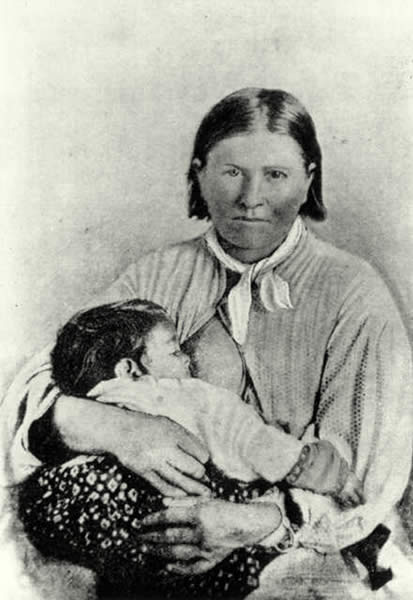
Cynthia Parker, 1861, with infant daughter.
Later, the two captured women and one of the children were ransomed and returned to the Parker family. But eleven-year-old Cynthia Ann Parker and her six-year-old brother John, the children of Silas and Lucy Parker, were kept by the Comanche and raised as Indians.
John Richard Parker remained with the Comanche for six years before his release was negotiated. However, he was unable to readapt to Western society and chose to return to the Comanche Nation. Later, John became a Comanche warrior, married a Mexican captive, and settled on a ranch in Mexico.
The most famous captive, Cynthia Ann Parker, was adopted by a Comanche family and renamed Naduah. Resisting ransom several times, she married Comanche Chief Peta Nocona while she was in her teens. They had three children, the most famous of which was Quanah Parker.
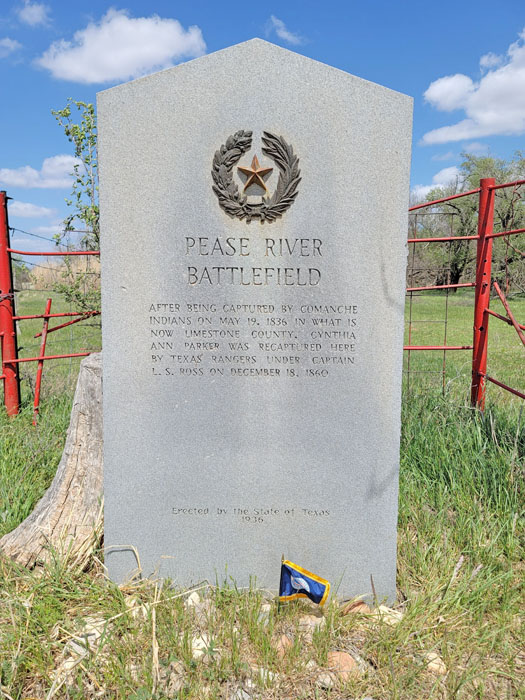
Pease River Battlefield Marker in Foard County, Texas.
In the winter of 1860, a group of Texas Rangers led by Captain Sul Ross attacked an Indian camp along the Pease River in the Texas Panhandle. Cynthia Ann Parker and her daughter, Prairie Flower, were caught trying to escape. Noticing her blue eyes, Ross knew Cynthia Ann was not an Indian and sent for her uncle, Isaac Parker, who identified her.
The former hostage was returned to her family in East Texas, but could not adjust to the white man’s ways. She died in 1864 at the age of 37, six months after the death of Prairie Flower. Both were buried in Fosterville Cemetery near Poynor.
In the meantime, Cynthia Ann’s son, Quanah Parker, became a prominent Comanche leader and a war leader during the Red River War of 1874-1875. Quanah died in Oklahoma in 1911.
During the Great Depression, with local economies struggling, Limestone County businessmen sought a Civilian Conservation Corps camp to build a recreational park near the historic site of Parker’s fort. The city of Mexia and three local landowners donated about 1,500 acres of land for the park.
The young African American men of Civilian Conservation Corps Camp 3807 reported to Camp Mexia in July of 1935. Company 3807 was one of the first segregated camps of young African-American men. Most of the 200 young men were from the Limestone County area, many of them the sons of sharecroppers struggling to survive in farming communities like Mart, Coolidge, Teague, and Springfield. Of the $30 a recruit earned each month, $25 was sent home to support his family. Camp Mexia had its own sawmill and limestone quarry, using local rock and timber to build the park. One of the camp’s first projects was building a replica of the Parker stockade and cabins for the Texas Centennial celebration in 1936.
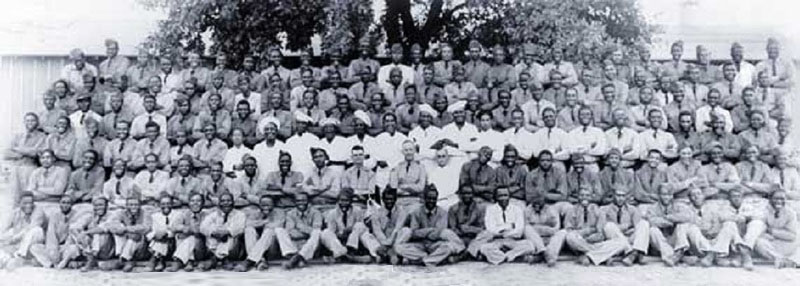
Civilian Conservation Corps Company 3807, at Fort Parker, Texas, 1935.
Then Camp Mexia work crews tackled one of the most ambitious CCC projects in Texas, building a 423-foot limestone, concrete, and earth dam across the Navasota River to create 750-acre Fort Parker Lake in 1939. The Civilian Conservation Corps also built the roads, picnic areas, the park concession building, the bathhouse, drinking fountains, and a clubhouse on the 1,400-acre site.
Most of the work was done by hand, digging with pickaxes and shovels, hauling rocks and cement in deep-wheeled wheelbarrows.
Company 3807 was the only all-black unit in the district to receive a superior rating, earning it twice by October 1940. Construction of Fort Parker State Park lasted until 1942.
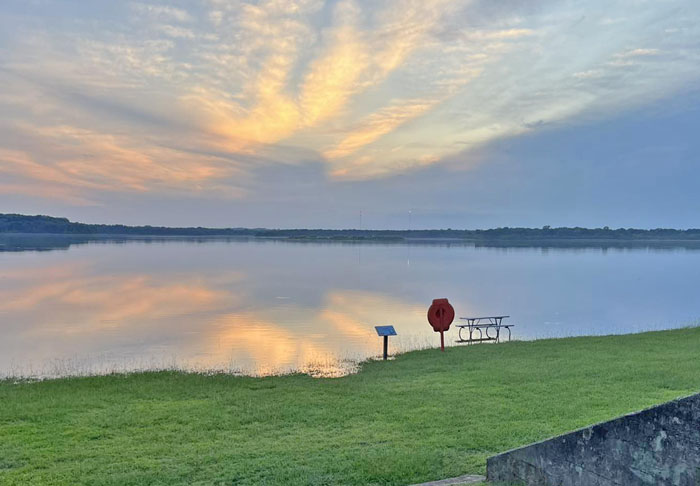
Fort Parker Lake, Texas.
The Texas Parks and Wildlife Department initially operated the rebuilt fort as part of Fort Parker State Recreation Area (now Fort Parker State Park). When Fort Parker State Park held its grand opening on May 1, 1941, about 700 visitors attended.
In 1957, the bodies of Cynthia Ann and Prairie Flower were exhumed and reburied at Fort Sill, Oklahoma.
The fort was rebuilt in 1967 by prisoners from Huntsville, Texas.
In 1992, the City of Groesbeck assumed control and operation of the state historic site with the formation of the Fort Parker Historical Society.
Today, living history events take place at the site. Visitors can also enjoy fishing, mountain biking, hiking, canoeing, kayaking, bird-watching, swimming, and many other outdoor activities. Historic Springfield Cemetery, located within the park, is a reminder of a once clamoring city. In 1860, Springfield’s population of 4,537 was over twice that of Dallas, Texas (2,000), and rivaling that of Houston (4,845).
Weekly interpretive programs about the native wildlife and unique cultural history are offered during peak season. Amenities include camping facilities, including a Boy Scout Wilderness Area, picnicking, family events, and large-group events. Playgrounds, group barracks, and dining hall, open pavilion, and a recreation hall provide modern comforts for any size group. The park’s Annual Trout Clinic is a favorite for young fishing enthusiasts. Nearby is Fort Parker Cemetery, which contains the graves of the Fort Parker victims.
Fort Parker State Park is located eight miles southwest of Mexia on State Highway 14.
Fort Parker, Texas Cemetery by Kathy Alexander.
©Kathy Alexander/Legends of America, December 2025.
Also See:
Sources:
Old Fort Parker
Texas Escapes
Fort Parker State Park Interpretive Guide
Texas Parks & Wildlife
Texas State Historical Association
Wikipedia