
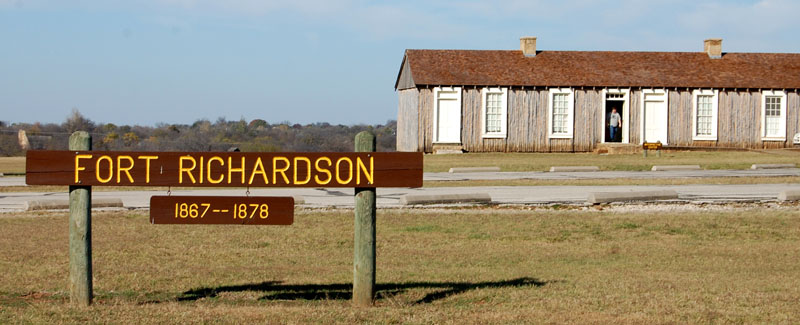
Fort Richardson, Texas Officer Quarters, by Kathy Alexander.
Fort Richardson was a United States Army installation in present-day Jacksboro, Texas. It was named in honor of Union General Israel B. Richardson, who died in the Battle of Antietam, Maryland, during the Civil War.
Fort Richardson, the northernmost of the chain of Texas forts, replaced Fort Belknap, which was abandoned after the Civil War due to a lack of water. Like Belknap, Fort Richardson was a protective fortification for the North Texas frontier during Indian conflicts.
Soldiers arrived in Jacksboro in 1866 to establish a fort at Buffalo Springs in Clay County, 20 miles north of Jacksboro. However, due to a lack of timber, inadequate water resources, and Indian raids, they soon abandoned the site and returned to Jacksboro.
Fort Richardson on Lost Creek, Texas by Kathy Alexander.
In 1867, the Army established Fort Richardson at the new location on the east bank of Lost Creek. Before it was fully completed, 55 stone, picket, and cottonwood-lumber buildings were constructed at an estimated cost to the government of $800,000. The fort was occupied on November 26. Originally a five-company post, it was later expanded to accommodate ten or more companies. The unstockaded reservation occupied some 300 acres, one-half mile south of Jacksboro, in Jack County.
The post hospital began construction in 1867 but was not completed until 1870. It was one of the most modern buildings between Fort Worth and El Paso. Even so, more men died from diseases than from battle wounds.
The northern-most point on a line of forts along the Texas frontier, its objective was to protect against marauding bands of Comanche and Kiowa Indians on the North Texas frontier. Located 70 miles from the Indian Territory (Oklahoma) and 120 miles from Fort Sill, Oklahoma, Fort Richardson was the northernmost army outpost in Texas and the anchor of a defensive line of fortifications that included Forts Griffin and Concho.
Life was hard for a soldier at Fort Richardson. Routine duties included long, arduous patrols along the frontier from Clay and Jack Counties west to Palo Duro Canyon near present-day Amarillo, Texas. They also made long, difficult patrols along the frontier, sometimes going as far as modern-day New Mexico and Colorado. They also guarded the military road connecting them with forts to the southwest, pursued criminals and deserters, escorted wagon trains, oversaw elections, protected cattle herds, helped local law officers keep the peace in Jacksboro, and, most importantly, patrolled for Indians. During the prime raiding months of April through September, scouting parties were constantly in the field.

Battle of the Little Wichita River, Texas.
Although most of these excursions were fruitless, occasionally the soldiers had bloody encounters with bands of hostile Indians. In July 1870, Captain Curwin B. McClellan and 56 officers and men of the Sixth Cavalry were ambushed near the Little Wichita River by a large war party of Kiowa and Comanche led by the Kiowa chief Kicking Bird. After a desperate fight, McClellan and his men were able to hold off the Indians and retreat to safety. Thirteen men of the Sixth won the Medal of Honor for gallantry in action in the Battle of the Little Wichita River.
In May 1871, while touring the system, General William T. Sherman stayed at Fort Richardson as part of a fact-finding tour of the Texas frontier. While there, he received word of the Warren Wagon Train Raid by a large party of Indians on the Salt Creek Prairie, 20 miles from the fort. Having just passed over the route, he was impressed by the seriousness of the situation in North Texas. He ordered Colonel Ranald S. Mackenzie out of Fort Richardson onto the trail of the hostiles. At the Fort Sill Reservation, the leaders, Satanta, Satank, and Big Tree, were arrested and sent to Jacksboro, a settlement only a half mile north of Fort Richardson, for a non-military trial. According to the official report, Satank was shot and killed as he tried to escape while en route to Jacksboro.
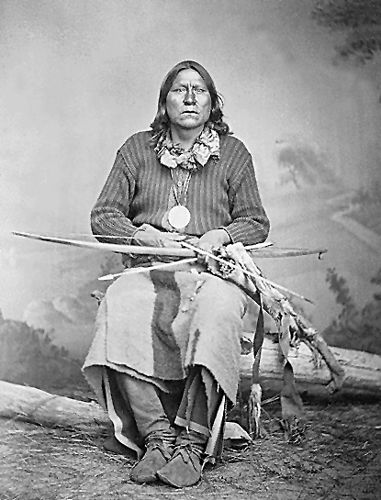
Chief Satanta of the Kiowa tribe.
In July 1871, after sensational hearings that received nationwide publicity, the chiefs were found guilty of murder and sentenced to hang, which was later commuted to life imprisonment. They were the first Native Americans to be tried and convicted in a Texas civil court system. It also marked the beginning of the end of President Ulysses S. Grant’s Peace Policy programs.
In late 1871, Colonel Ranald S. Mackenzie fought a running battle with the Quahadi Comanche, led by their famous war chief, Quanah Parker.
The most strategically critical post in Texas, it had the largest garrison (666 officers and men) in 1872, making it the largest U.S. Army installation in the United States. Units that occupied the fort included the 6th Cavalry Regiment, the 4th Cavalry Regiment, and the U.S. 11th Infantry Regiment, along with parts of the 10th Cavalry Regiment and the 24th Infantry Regiment, both Buffalo Soldier regiments.
In the summer of 1872, Colonel Ranald S. Mackenzie explored the unmapped Llano Estacado, and late that year, on the North Fork of the Red River, he located and attacked the encampment of the Comanche Chief Mow-way, killing 50 warriors and capturing 130 women and children.

Mackenzie’s Raiders at Palo Duro by Michael Gray.
In 1874, General Sherman authorized the commander of the 4th Cavalry, Colonel Ranald S. Mackenzie, to begin offensive operations against the Comanche and Kiowa not on the reservation in the Texas Panhandle. One scouting party fought in the Battle of Palo Duro Canyon in September 1874, a U.S. victory that ended the Red River War with Quanah Parker’s Comanche and Red Warbonnet’s Kiowa. The cavalry captured so much of the tribes’ provisions that they were forced to move back to reservations north of the Red River in Oklahoma before winter. This battle was primarily responsible for ending Comanche and Kiowa raids along the northern frontier between Oklahoma and Texas.
With the North Texas frontier secure, the army saw no need to maintain Fort Richardson and abandoned the post on May 23, 1878. Afterward, it was used as an Indian school for a short time. The 55 buildings, many made of stone and cottonwood lumber, including a morgue, bakery, magazine, commissary, and commanding officer’s quarters, were soon sold, scavenged, and fell into disrepair.
In 1936, the Texas Centennial Commission purchased the surviving fort buildings and the surrounding 41 acres. At that time, the fort was partially reconstructed.
During World War II, the Texas National Guard established a facility at Fort Richardson for Battery F, 2nd Battalion, 131st Field Artillery Regiment, 36th Division on November 25, 1940. The unit departed from San Francisco, California, towards Pearl Harbor, Hawaii, but was at sea during the infamous attack. The Lost Battalion defended Java until being captured in March 1942, and performed forced labor for over three years. Most of the 63 deaths occurred while building the Burma-Siam Railway.
The Texas National Guard remained at Fort Richardson until 1954.
Thanks to a group of Jacksboro residents, the fort was declared a state historic site and National Historic Landmark in 1963 for its role in securing the state’s northern frontier in the post-Civil War era. It then came under the management of the Texas Parks and Wildlife Department.
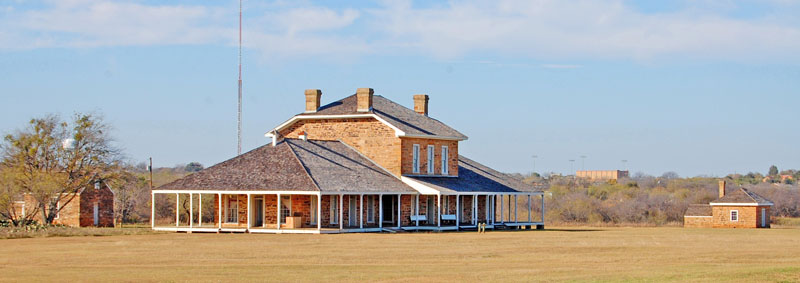
Fort Richardson, Texas Hospital by Kathy Alexander.
The site became a National Historic Landmark in 1964.
Texas Parks & Wildlife acquired the fort in 1968, and extensive renovations began. At that time, the post hospital was in bad repair. Though structurally sound, it had undergone considerable alterations since the army had abandoned the fort some 90 years earlier. Other alterations had been made by the National Guard and the Jack County Historical Society in their efforts to preserve the structure while using it as the county museum.
These alterations included the addition of partitions, the covering of original plank floors, and various modernization modifications. The Parks and Wildlife Division has replaced the fort-period porch, restored exterior and interior wood trim, and repointed the original rubble stonework. The handsome structure features 18-inch-thick sandstone walls and a wood-frame veranda that completely encircles the first floor. The hospital contains a kitchen, dining rooms, washrooms, a dispensary, a surgeon’s office, and two large wards for patients. Although designed to patch up soldiers wounded in battle, records show that hospital staff treated more illnesses and saw more deaths caused by bad water, spoiled food, alcoholism, and venereal diseases than battle wounds. Today, visitors can enjoy a tour of the hospital and grounds, including the morgue, complete with a wooden coffin. At present, the hospital is used as a museum, with interpretive booths that relate the history of the fort and this part of the state.
Officers’ Quarters, built in 1867, were restored in 1972. The U-shaped, one-and-a-half-story frame building, with a porch extending across the north elevation facing the parade ground, rests on a sandstone foundation.
Prior to the erection of officers’ quarters on Fort Richardson, officers and enlisted men lived in tents and hastily constructed temporary structures on the north side of the creek. The original first five officers’ quarters were frame structures. By 1872, five other structures had been constructed. Built of lumber cut from cottonwoods growing in nearby river bottoms. Only one of the five original officers’ quarters remains, as the structures had deteriorated by 1875.
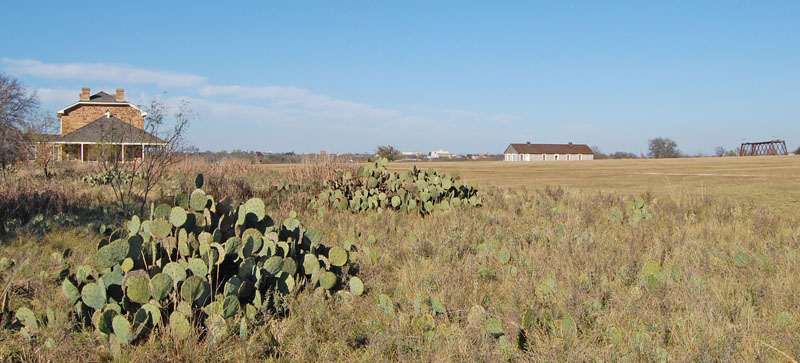
View of Fort Richardson, Texas by Kathy Alexander.
The remaining building outlasted the fort’s barracks and stables, which were built of small vertical pickets. The City of Jacksboro preserved the remaining building. The interior walls on the ground floor are plastered, while the attic rooms have canvas walls and ceilings. Each of the six first-floor rooms has a fireplace, except the stair hall. There are no fireplaces on the second floor.
In 1973, the site reopened as Fort Richardson State Historic Park.
Today, the 42-acre site is part of the larger Fort Richardson State Park, Historic Site, and Lost Creek Reservoir State Trailway. Visitors can tour seven restored original buildings, including the post hospital, officers’ quarters, a powder magazine, morgue, commissary, guardhouse, and bakery. Two replica buildings of the enlisted men’s barracks and the officers’ barracks house the Interpretive Center. Guided tours and various special events are offered, including military reenactments. The Fort grounds provide opportunities for a variety of activities, including tent camping, hiking, and wildlife observation. It is open seven days a week.
Fort Richardson is located at 228 State Park Road 61 in Jacksboro, Texas, northwest of Fort Worth.
More information: Fort Richardson State Park
©Kathy Alexander/Legends of America, updated November 2025.

Fort Richardson, Texas landscape.
Also See:
Forts & Presidios Across America
Sources:
Fort Richardson State Park
National Register of Historic Places
Texas Parks & Wildlife
Texas State Historical Association
Wikipedia