

President James Garfield.

James Garfield’s childhood home.
James Abram Garfield was the 20th president of the United States, serving from March 4, 1881, until his death six months later — two months after an assassin shot him. As a lawyer and Civil War general, he served nine terms in the United States House of Representatives. He was the only sitting member of the House elected to the presidency. Before his candidacy for the White House, he had been elected to the U.S. Senate by the Ohio General Assembly — a position he declined when he became president-elect.
James Abram Garfield, the youngest of five children, was born in a log cabin on November 19, 1831, to Abram and Eliza Ballou Garfield in Moreland Hills, Ohio. His father, Abram Garfield, was born in Worcester, New York, and came to Ohio to court his childhood sweetheart, Mehitabel Ballou. However, when he arrived, she was already married. He then married her sister, Eliza.
In early 1833, Abram and Eliza Garfield joined the Church of Christ, a decision that influenced their youngest son’s life. Abram died later that year, and James was raised in poverty by his strong-willed mother, who molded his character. Despite their poverty, she scraped together enough money to send her bookish son to school and college.

James Garfield as a young man.
Garfield’s early years were spent alternating between manual labor in the warm season and school in the winter. Poor and fatherless, Garfield was mocked by his peers, became sensitive to slights, and sought escape through voracious reading.
Eliza remarried in 1842 to a man named Warren Belden.
In 1847, James left home at age 16 and was rejected for work on the only ship in port in Cleveland. Instead, he found work on the Ohio Canal for a while on a canal boat, managing the mules that pulled it. After six weeks, illness forced Garfield to return home, and during his recuperation, his mother and a local school official secured his promise to forego canal work for a year of school.
In 1848, he began at Geauga Seminary in nearby Chester Township, Geauga County, Ohio. There, he learned academic subjects he had not previously had time for. He excelled as a student and was especially interested in languages and elocution. He worked as a carpenter’s assistant and teacher to support himself at Geauga. During this time, Garfield attended church mostly to please his mother, but he underwent a religious awakening in his late teens. He was “born again” on March 4, 1850, when he was baptized in the icy waters of the Chagrin River. He left the seminary that year.
“I lament that I was born to poverty, and in this chaos of childhood, 17 years passed before I caught any inspiration… a precious 17 years when a boy with a father and some wealth might have become fixed in manly ways.”
— Garfield later said of his childhood
In 1850, his mother, Eliza, left her second husband, Warren Belden, and filed for divorce.

Lucretia Rudolph Garfield.
After leaving school, Garfield worked for a year at various jobs, including teaching. He soon determined to work his way through college and sought a school that could prepare him for the entrance examinations. From 1851 to 1854, he attended the Western Reserve Eclectic Institute (later named Hiram College) in Hiram, Ohio, where he was both a student and a tutor. Securing a janitorial position, he obtained a teaching position while still a student. Lucretia Rudolph, who had also attended Geauga Seminary, also enrolled at the Institute. Garfield began to date her while teaching her Greek.
By 1854, Garfield was a full-time teacher at the institute. He then enrolled at Williams College in Williamstown, Massachusetts. As a third-year student, he received credit for two years of study at the Institute after passing a cursory examination. Garfield graduated Phi Beta Kappa from Williams College in August 1856, earning the title of salutatorian. He espoused the cause of the Republican Party, then just organized, and became a noted “stump speaker” in that year’s campaign. He campaigned for Republican John C. Fremont in 1856. He gave his first vote to that party’s candidates and remained loyal to it for the rest of his life.
Upon his return to Ohio, he became a teacher at the Hiram Institute and, in 1857, was made its principal. During this time, he began to consider a career in politics.
In 1858, he married Lucretia Rudolph, and they would eventually have seven children, five of whom survived infancy. Soon after the wedding, he registered to read law at the office of attorney Albert Gallatin Riddle in Cleveland, Ohio. Garfield was elected a Republican member of the Ohio State Senate in 1859, serving until 1861. That year, he was admitted to the bar and began practicing law.
Garfield opposed Confederate secession and advocated coercing the seceding states back into the Union.
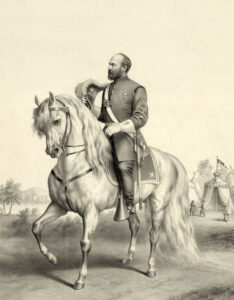
General James Abraham Garfield, by Kurz & Allison, 1882.
When the Civil War broke out, he was commissioned a brigadier general and reported to General Buell in Cincinnati, Ohio, late in 1861. He was sent, with three regiments, to drive the rebels out of Eastern Kentucky. In early April, he participated in the Battle of Shiloh, Tennessee, and in May in the Siege of Corinth, Mississippi. He joined the Army of the Cumberland under William Rosecrans and became his chief of staff. Garfield urged the general into Georgia and took a conspicuous part in the Battle of Chickamauga. Afterward, he was promoted to major general.
While in this service, General Garfield was elected to Congress in 1862 to represent Ohio’s 19th district. President Abraham Lincoln then persuaded him to resign his commission, as it was easier to find major generals than to obtain effective Republicans for Congress.
Garfield won re-election nine times and became the House’s leading Republican over 18 years. Throughout his congressional service, he firmly supported the gold standard and gained a reputation as a skilled orator. He initially agreed with Radical Republican views on Reconstruction but later favored a Moderate Republican-aligned approach to civil rights enforcement for freedmen.
He was one of the prominent republican members of the electoral commission appointed by Congress in 1877.

Republican National Convention in Chicago, Illinois, in June 1880.
He attended the Republican National Convention in Chicago, Illinois, in June 1880, where he was a firm advocate of John Sherman’s presidential nomination. To his utter astonishment, Garfield received the nomination for president on the 36th ballot when a decided majority in the Electoral College elected him as the “dark horse” nominee. However, he had not sought the White House. He then conducted a low-key campaign in the presidential election and defeated the Democratic nominee, General Winfield Scott Hancock, by a margin of only 10,000 popular votes. It was the closest election in terms of the popular vote in American history.
Victory may have been sweet, but troubles were ahead for the new president. The Republican Party was divided as the preceding years had been rent by the rivalry of Maine Senator James G. Blaine and New York Senator Roscoe Conkling. Conkling had often been at odds with President Hayes as well. As President, Garfield strengthened Federal authority over the New York Customs House, a stronghold of Senator Roscoe Conkling.

Roscoe Conklin, Senator.
The ever-suspicious Conkling began pressuring President Garfield to fill government positions with New Yorkers, which seemed to the president like Conkling’s constant attempt to pressure him. After months of such treatment, Garfield decided to challenge Conkling directly and appointed William Robertson, a Conkling adversary, as the new Port of New York Collector. To Conkling, Garfield’s move was an attack. Conkling contested the nomination, trying to persuade the Senate to block it, and appealed to the Republican caucus to compel its withdrawal.
Conkling maneuvered to have the Senate confirm Garfield’s uncontested nominations and adjourn without acting on Robertson. Garfield countered by withdrawing all nominations except Robertson’s; the Senators would have to confirm him or sacrifice all the appointments of Conkling’s friends.
Conkling and his fellow Senator from New York resigned in a final desperate move, confident that their legislature would vindicate their stand and re-elect them. Instead, the legislature elected two other men; the Senate confirmed Robertson. Garfield’s victory was complete.

Charles Guiteau, political cartoon by Puck Magazine.
Public opinion seemed to favor the president, but Charles Guiteau, a lawyer-theologian-writer-bill collector-commune member, and drifter saw the situation differently. In his view, Garfield’s public challenge to Conkling was damaging the Republican Party, and Garfield had to be “removed.” Guiteau’s view was motivated by more than Washington politics, however. Having given a speech at a rally in New York, the emotionally disturbed man believed he had played an essential role in Garfield’s victory. He deserved a government job as a reward for his services, such as a position at the American Consulate in Paris, France. However, Charles Guiteau had no training for such work.
While President Garfield was in the White House, Guiteau repeatedly attempted to arrange an interview with the President, but he never succeeded. Guiteau nursed his resentment through the spring as he followed the political fight between the President and Conkling. Soon, he began to dream, and in his dreams, he claimed God told him to “remove” James Garfield.
Guiteau began stalking the President on the streets of Washington, D.C. On the morning of July 2, 1881, Garfield looked forward to heading out to New Jersey for a much-needed vacation. Having read in the newspapers that President Garfield would be at the Baltimore and Potomac Railway Station that morning, Charles Guiteau waited for his latest chance to shoot the President. Suddenly, the quietness was broken by a loud, sharp clap.

President Garfield was Shot in 1881, by Frank Leslie’s Illustrated Newspaper.
Guiteau had fired twice as the President walked through the Ladies Waiting Room of the station, accompanied by Secretary of State James G. Blaine. Two shots struck Garfield, one glancing off his arm and the other piercing his back, shattering a rib and embedding itself in his abdomen. Garfield yelled out, “My God! What is this?” and collapsed. He was then taken up to a private office on a mattress, where several doctors examined him. He was taken back to the White House under the care of noted physician and surgeon Dr. Willard Bliss, and his wife was sent for.
The president was given morphine for the pain and asked Dr. Bliss to tell him his chances, which the doctor put at one in a hundred. “Well, Doctor, we’ll take that chance.” Over the next few days, Garfield made some improvements. Though he could sit up and write, he never stood again. Garfield’s condition remained perilous, especially as the measures Dr. Bliss took proved ineffective at best and, at worst, contributed to the President’s declining condition.
Alexander Graham Bell tried to locate the bullet with a primitive metal detector but was unsuccessful, though the device had been effective when tested on others. Because Dr. Bliss insisted the bullet rested somewhere it did not, the detector could not locate it. Bell shortly returned after adjusting his device, which emitted an unusual tone in the area where Bliss believed the bullet was lodged. Bliss confirmed that the bullet was where he said it was.
On July 23, Garfield took a turn for the worse when his temperature spiked to 104°. Concerned about an abscess at the wound site, a drainage tube was inserted, which initially helped. The bedridden Garfield held a brief cabinet meeting on July 29. When doctors probed the abscess, hoping to find the bullet, they likely worsened the infections. Garfield performed only one official act in August, signing an extradition paper. By the end of the month, he was much worse than he had been, and his weight had decreased from 210 pounds to 130 pounds.
As he slowly died, his popularity across the country soared. Former president Rutherford Hayes wrote, “Garfield will now have a hold on the hearts of the people like that of Washington and Lincoln.”

James Garfield’s house in Long Branch, New Jersey.
Anxious to escape the heat in Washington, Garfield was moved to Long Branch, New Jersey, on September 5, traveling in a specially cushioned railway car.
On September 19, Garfield, suffering from pneumonia and hypertension, marveled that he could not pick up a glass despite feeling well and went to sleep without discomfort. He awoke that evening around 10:15 p.m., complaining of great pain in his chest. Clutching his heart, he fell into unconsciousness. Despite efforts to revive him, Garfield never awoke and was pronounced dead at about 10:30 p.m. As the nation mourned, church bells tolled across the country. Chester A. Arthur took the presidential oath of office the next day.
At his death, the monarchs of England, Belgium, and Spain ordered their respective courts to wear mourning for a week; the day of his funeral was solemnly observed, with tokens of grief, in every city, village, and hamlet in the nation.
Charles J. Guiteau was indicted on October 14, 1881, for the murder of the president. During his trial, Guiteau declared that he was not responsible for Garfield’s death, admitting to the shooting but not the killing. After a chaotic trial in which Guiteau often interrupted and argued, and his counsel used the insanity defense, the jury found him guilty on January 5, 1882, and he was sentenced to death by hanging. He was executed on June 30, 1882.

President Garfield’s Funeral Train, 1881.
The following year, in honor of Garfield, President Chester Arthur enacted one of the most significant reforms of the time, the Pendleton Civil Service Reform Act, which abolished the spoils system. He placed nearly 90,000 federal positions under a merit system administered by a new, independent Civil Service Commission.
James Garfield was in office for only 200 days, but in that short time, he established his strength in Congress and united his party. Garfield’s accomplishments as president included a resurgence of presidential authority over senatorial courtesy in executive appointments, a purge of corruption in the Post Office, and the appointment of a Supreme Court justice. He advocated for agricultural technology, an educated electorate, and African American civil rights.
©Kathy Alexander/Legends of America, updated November 2025.
Also See:
Presidents of the United States

Garfield Memorial in Cleveland, Ohio, by Detroit Photographic Company, 1900.
Presidential Trivia & Fun Facts
Sources:
National Park Service – James Garfield
National Park Service – 2
Whitehouse.gov
Wikipedia