
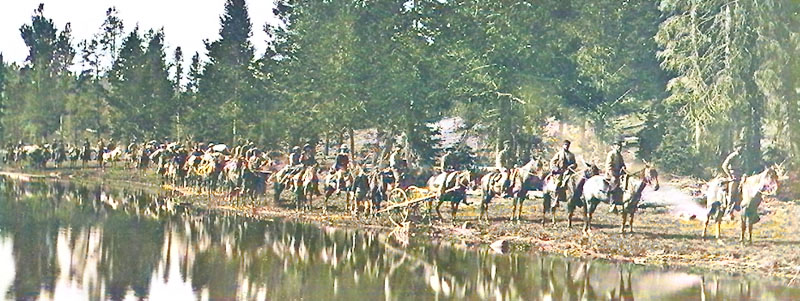
Yellowstone Expedition.
By Hiram Martin Chittenden, 1934.
The Yellowstone Expedition of 1825, like that of Lewis and Clark, a score of years before, was conducted in an eminently sensible and practical way because it fully accomplished its purpose. The restlessness of the Missouri River tribes ever since the War of 1812, and their frequent acts of hostility to the whites, culminating in the Blackfeet and Arikara outrages of 1823, caused the government to adopt more effective measures for their reduction and pacification. In 1824, Congress passed an act authorizing treaties with the Missouri River tribes, and the President appointed General Henry Atkinson of the Army and Major Benjamin O’Fallon, Indian agent, as commissioners to visit and conclude the treaties.

General Henry Atkinson.
The appointments were made too late in the year 1824 to permit the accomplishment of the work during that season, but measures were taken to carry it promptly into effect with the opening of spring. The commissioners left St. Louis, Missouri, on about March 20, 1825, and arrived at Council Bluffs, Iowa, on April 19. The last invoice for their goods arrived on May 13, and preparations for the expedition’s departure were completed the following day. The transports consisted of eight keelboats, which had, in addition to the usual appliances of sails, cordelles, poles, etc., a set of paddle wheels operated by hand power. The boats were named after the fur-bearing animals most commonly met in the Missouri River trade — Beaver, Buffalo, Elk, Mink, Muskrat, Otter, Raccoon, and White Bear.
The commission set out from Council Bluffs with an escort of 476 men, of whom 40 were mounted, and went by land, always within reach of the boats. Among the expedition officers, besides General Henry Atkinson, were Colonel Henry Leavenworth, Majors Stephen W. Kearny, Langham, and Ketchum; Captains Armstrong, Riley, Mason, Gaunt, Pentland, Kennedy, and Culbertson; and Lieutenants Harris, Swearinger, Wragg, Greyson, Waters, Holmes, and Doctor Gale.
The expedition proceeded without serious accident, although with much disarrangement of the machinery, and arrived at the Ponca village on June 8. Captain Armstrong, accompanied by the mounted troops and Edward Rose, the interpreter, arrived 13 days prior. The force landed and went into camp just below the mouth of Paint Creek, and arrangements were made to hold a council and form a treaty with the Indians on the following day. Here, a military display was given, which, with the considerable force of troops present, made an excellent impression upon the Indians. The ceremony was recorded in the journal:
“The troops were paraded in brigade in uniform at nine this morning, and were reviewed by General Atkinson in the rear of the Ponca village. They appeared extremely well and were excited and had great curiosity about the Indians, the whole tribe, men, women, and children, leaving the village to witness the scene.”
Immediately after the review, a council was held with the Indians, and nearly the whole tribe was present. The desired treaty was unanimously approved, and the business was concluded with present-making, all in the most satisfactory manner.
The necessary repairs to the boat’s delayed departure were not completed until 1:00 p.m. on the 6th, when the expedition resumed its course and camped that night a little above the Niobrara River in Nebraska. Here, the Indians followed and entertained the expedition with native dances. The party then made its way to Fort Lookout, South Dakota, without notable incident, at this time under the charge of Mr. Wilson, a trader with the American Fur Company.

Arikara Village.
Some runners were dispatched to bring in the Lakota, Nakota, and Yanktonai. At the same time, Rose, the interpreter, was sent to tell the Cheyenne to meet the commission at the Arikara villages. After a delay, the Indians arrived, and on June 20, military ceremonies were held again. General Atkinson and staff on horseback reviewed the brigade. “The display was wonderful, the troops being in fine order,” and the impression on the Indians was excellent. The council was then organized, and the credentials of the chiefs examined. At this time, a girl from their tribe who had been a prisoner among the Otoe was delivered to the Yankton, and the expedition had taken up the river. That night, the Indians were treated to a display of rockets, which greatly impressed them.
The next day, the treaty was concluded with these tribes, and presents were distributed among them, including one gun for each chief. If the military made a good impression upon the Indians, the Indians made no less favorable an impression upon the whites. “These tribes deport themselves with gravity and dignity,” says the journal, “while they displayed a quality of taste in their dress which did great credit to their untutored view of things.”
The expedition resumed its journey on June 22 and reached the Great Bend of the Missouri River the following day. Here, a portion of the passengers, as generally happens when navigating the river, crossed the narrow neck of land while the boats passed around. They left the flotilla on the 24th and were taken up on the boats on the 26th. At Elk Island, the party had its first real excitement in buffalo hunting. Majors O’Fallon and Ketchum were walking along the shore when they saw three buffalo on the island. One of them remained to watch the animals while the other went to notify the party. It being about noon, the flotilla halted for dinner. At the same time, a small party under Major Ketchum crossed to the island to get the buffalo. “The party landed and went in pursuit, but their design was partly frustrated by the imprudence of Lieutenant Wragg, who crossed over to the island shortly after, and ran forward and fired upon the buffalo.” This frightened the animals, and they immediately leaped into the water. One swam toward the boats, was shot, but sank into the river, and did not rise. The remaining two came back to the island, where one was killed, and the other escaped in a wounded condition. The troops were in want of fresh meat, and Lieutenant Wragg’s performance on this occasion did not redound much to his credit in their eyes.

Missouri River in Montana.
On June 30, the expedition arrived at the mouth of the Teton River about two and a half miles above, where the American Fur Company had a trading establishment at this date. Here, the party waited until the Sioux, Cheyenne, and Ogallala could be brought in. On the first day of arrival, a party under Lieutenant Waters secured six buffalo. The journal says that “Rose, an interpreter, one of the party, we understand, covered himself with bushes and crawled into the gang of eleven bulls, and shot down the six on the same ground before the others ran off.” The six buffalo weighed, dressed, 3,300 pounds.
While waiting for the arrival of all the Indians, the commissioners were treated to a feast by the Ogallalah, of which the following account is given in the journal:
“It consisted of the flesh of 13 dogs boiled in plain water in seven kettles, much done. Our drink was water from the Missouri brought up in the paunches of buffalo, which gave it a disagreeable taste… We were occupied about an hour and a half at the feast, when we and the officers returned to camp and sat down and partook of wine and fruit at a table provided by the camp.”
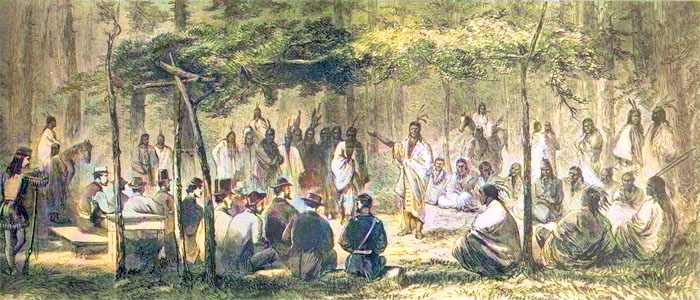
Treaty-making.
The Indians, having been finally gathered together, the usual review took place on July 5, with the added feature of a mounted artillery drill, by which “the Indians were struck with great awe.” On July 6, the council and treaties took place, and presents were given and received. “This evening,” the journal says, “Lieutenant Holmes threw six shells from the howitzer in the presence of the Indians. They exploded handsomely and made a deep impression upon the savages.”
The expedition set out at about 9:00 a.m. on July 7. “The exhibition was beautiful. The wind being fair, the boats put off in regular succession, under sail and the wheels, and ran up a stretch of miles in view of more than 3,000 Indians who lined the shore.” This day, the cavalry horses were mostly sent back to Council Bluffs, with only enough horses being retained to pack in the same and flank the river. The party arrived at Hidden Creek on July 6, and here, on the following day, after the usual military ceremonies, a treaty was made with a band of the Sioux called the Fire Hearts, numbering about 150 souls. From one of the young men, Major O’Fallon took a British medal.
The journal notes the following occurrence at this place:

Major Benjamin O’ Fallon.
“Major O’ Fallon and General Atkinson obtained two Indian horses and rode three-quarters of a mile back to the hills in rear of our position to look at the impression of footsteps on a rock. We found the impression of three tracks of the foot of a common-sized man. The first, near the upper edge of the rock, is made by the right foot and is about an inch deep, leaving a full impression of the whole track, with the five toes about an inch deep. The next track is of the left foot, and about 334 feet from the first, impression full and deep as the first. The next footprint of the right foot is not visible, but at about six feet from the second track, the left foot again makes an impression, large and plain as the others. This is near the lower edge of the rock, which of itself is about 1 1 feet long by 9, lying at an angle of about 30 degrees of elevation.”
The expedition arrived at the Arikara village on July 15, where treaties were made with these Indians and with the Hunkpapa Sioux, after the usual ceremonies. When the journey resumed, no significant incidents occurred from this point to the Mandan villages, where the expedition arrived on July 26. Here, it was expected to make treaties with the Mandan, Minnetaree, and Crow. The latter tribe was some distance off and seemed reluctant to come in, for although repeatedly sent for, they did not arrive until August 3. In the meantime, treaties were made with the other tribes, and a large amount of buffalo hunting was indulged in. After the arrival of the Crow, the usual military ceremonies were gone through with, and a treaty was made with that nation.
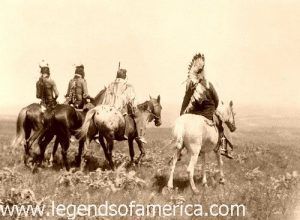
Absaroka (Crow) Warriors.
At this time, an occurrence ensued that has passed into nearly all the narrative literature of that period. It is thus related in the journal: “Two Iroquois prisoners were demanded of the Crow. From this or some other cause unknown to me, the Crow became very hostile in their conduct, and from their attempting to take the presents before they were told to do so, Major O’Fallon struck three or four of the chiefs over the head with his pistol. About this time, Geiss-jal Atkinson, who had been absent from the council to get his dinner, on returning to the council, saw the commotion and ordered the troops under arms. This probably saved bloodshed.”
The expedition left the Mandan villages on August 6 and reached the mouth of the Yellowstone River on August 17 without incident. Game everywhere abounded, and there was plenty of hunting.
After passing the mouth of the Yellowstone River, the expedition “came to Ashley’s old fort, a mile above the mouth of that river, on the bank of the Missouri River. This position was the most beautiful spot we have seen on the river, being a tongue of land between the two rivers, a perfectly level plain, elevated above high water, and extending back two miles to a gentle ascent that rises, at the distance of two miles, 100 feet. Three sides of the fort, or picket work, remain intact. The west side has been burned down. One house is standing, and three appear to have been burnt, as also the gate of the work.”
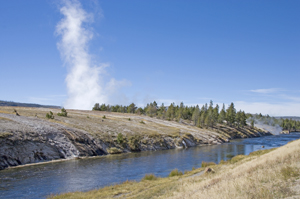
Yellowstone National Park, Montana. Yellowstone National Park, by Carol Highsmith.
While still at this place, the party was agreeably surprised by the arrival of a band of hunters descending the Yellowstone River in boats with a cargo of furs. It was no other than General William H. Ashley, who had just arrived from the Salt Lake Valley with a party of 24 men and with 100 packs of beaver. General Atkinson offered him transportation for his party and property if he would await the return of the troops from an excursion farther up the river. This he readily assented to, as it gave him protection the rest of the way to the settlements.
From such information as General Ashley could give, it was thought that the Blackfeet must be above the Falls of the Missouri, and that, therefore, there was no prospect of seeing them. But it was thought that they might run across the Assiniboine. Accordingly, a part of the force set out on the 20th, accompanied by General Ashley, and ascended the river about 120 miles. Finding no indication of the presence of Indians, they turned about on the 24th, and four arrived at the mouth of the Yellowstone on the 26th. The next day, the whole party commenced the descent of the Missouri, “at 40 minutes past five a.m.,” having “embarked the horses on board the Buffalo, Elk, Otter, and Beaver,” with Ashley’s beaver “on board the Mink, Muskrat, and Raccoon.”
No incident worthy of mention occurred on the way down, except the wrecking of the Muskrat on a snag three miles above the mouth of the James River. The boat was repaired, and General Ashley’s fur was saved. The expedition arrived at Council Bluffs on September 19. Here, councils were held, and treaties were signed with the Otoe on September 26, with the Pawnee on September 30, and with the Omaha on October 6. General Ashley left for St. Louis on September 22. On October 7 at 4:00 p.m., General Atkinson, Major O’Fallon, and three officers, with eight effective men and the invalids, set out in the transport Antelope for St. Louis, Missouri, where they arrived at 5 p.m. on October 20, just seven months after their departure.

Tower Fall in Yellowstone by Thomas Moran.
On November 7, the commissioners forwarded the treaties that they had concluded to Washington, D.C., along with a comprehensive report on the expedition. They were able to give the gratifying statement that they had found all the tribes they had hoped to except two; that they had everywhere formed satisfactory treaties; that they had left a strong impression among the Indians of the friendship, and at the same time of the power, of the United States; and that on the whole expedition “not a boat or man was lost, nor did any accident occur of any sort of consequence.” The report provides a succinct account of the tribes’ conditions at that time and offers recommendations. The commissioners found no evidence that the British interfered in the least with any of the tribes whom they saw.
On November 23, General Atkinson transmitted a copy of the above report from the headquarters of the Western Department at Louisville, Kentucky, to General Jacob Jennings Brown, commanding the army of the United States, with some additional comments of importance. He discussed the propriety of establishing a military post farther up the river than Council Bluffs and concluded it was not a necessary measure. If one were to be established, however, he thought that it ought to be at the mouth of the Yellowstone River, with a dependent post near the Great Falls. But he believed that better results would follow from an occasional display of military force, such as what had just taken place, than from the permanent presence of troops among the Indians. His advice was followed.
General Atkinson referred to the valuable geographical and other information pertaining to routes, the location of South Pass, Wyoming, the extent of British trade on the Columbia River, and other matters that he had derived from General Ashley and J.S. Smith. He stated that General Ashley had prepared a topographical sketch of the country he had visited, which would be forwarded as soon as it was received. It is hoped that this sketch was made and that it will yet come to light.
On the whole, the expedition was a distinct success. It had undertaken to accomplish a definite thing and had accomplished it promptly and thoroughly. It was a conspicuous exception among the various enterprises with which we are here called upon to deal.

Native Americans at Yellowstone.
By Hiram Martin Chittenden, 1934. Compiled and edited by Kathy Alexander/Legends of America, updated March 2025.
Also See:
Discovery and Exploration of America
Expeditions & Exploration of America
Westward Expansion and Manifest Destiny
Source – American Fur Trade Of The Far West by Hiram Martin Chittenden; Chapter Four, 1934.