
Jump to: Links to Full Articles
Jump to: Outlaw Summaries (name begins with) A B C D E F G H I J K L M N O P Q R S T U V W X Y Z
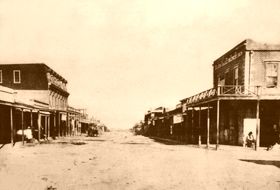
Allen Street, Tombstone, Arizona, 1882.
Bill Halderman – An outlaw, he was hanged with his brother Tom in Tombstone, Arizona, on November 16, 1900, for killing a man.
Tom Halderman – An outlaw, he was hanged with his brother Bill in Tombstone, Arizona, on November 16, 1900, for killing a man.
“Haltbreek Jack” – An outlaw, he was lynched near Yellowstone by the Montana Stranglers in 1884 for rustling cattle.
Bill Hall – An Arizona outlaw, he was the first prisoner of Yuma Prison in 1875.
Caleb Hall, aka: The Prowler, John Collins, Sam Collins (18??-1935) – A former John Kinney Gang member, he fought in New Mexico’s Lincoln County War.
Silas Hampton (1868-1887) – Near the town of Tishomingo, Oklahoma, an 18-year-old Cherokee Indian, Silas Hampton, robbed and killed a farmer by the name of Abner N. Lloyd on December 9, 1886. Having made off with only $7.50, the foolish young man purchased a bright red handkerchief and a few other small items he proudly displayed to his friends. He was soon arrested, and as he was led away, he pleaded with the marshals, “Don’t take me to Fort Smith; kill me right now!” His pleading was to no avail. He was soon shipped off to Fort Smith, where he was found guilty by Judge Isaac Parker. He was hanged on October 7, 1887.
Orlando Camillo Hanks, aka: Charley Jones, Deaf Charley (1863-1902) – An outlaw and the last and toughest of Butch Cassidy’s Wild Bunch. He robbed trains in Montana and New Mexico in the 1880s. He was killed in 1902 by Sheriff Pink Taylor after killing a lawman.
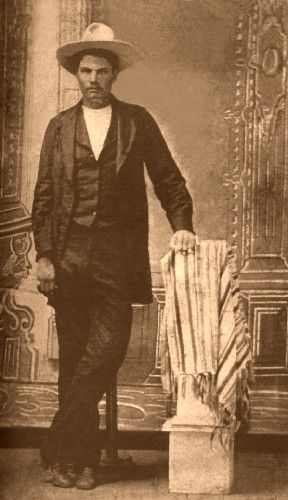
John Wesley Hardin.
John Wesley (Wes) Hardin (1853-1895) – Known as Texas’ most deadly gunman, Hardin killed over thirty people. After spending 18 years in prison, he was shot and killed on August 19, 1895, by John Henry Selman.
Joseph “Joe” Hardin – The brother of John Wesley Hardin, he was also an outlaw and was lynched in June 1874.
Mart Hardin – An outlaw charged with conspiracy in the murder of Bud Frazer, who was killed by Jim Miller in 1893.
John Jefferson Harlin, aka: Off Wheeler – An outlaw, Harlin was one of the many bad men who were run out of Las Vegas, New Mexico.
Adolf Harmon – An outlaw, he was shot and killed by Gabriel Gonzolez ten years after Harmon killed Deputy Sheriff Esteban Trujillo on January 22, 1897.
Augustin Harmon – A gunman, Harmon was sentenced to twenty-five years in prison for killing Ricardo Lovato of Springer, New Mexico.
Harpe Brothers – Murderous outlaws who operated in Tennessee, Kentucky, and Illinois in the late 1700s; they are said to have been America’s first serial killers.
Chas Harper – An outlaw and member of the Plummer gang, was hanged at Florence, Idaho, in 1891.
Charles A. “Jack” Harris – A saloon keeper and highwayman, Jack Harris paraded as a good citizen but secretly robbed stagecoaches in Nevada.
Edward Hart – A former John Kinney Gang member, he fought in New Mexico’s Lincoln County War. Afterward, he joined Selman’s Scouts, a vicious gang that terrorized the county. He was shot and killed by John Selman in Lincoln County in September 1878 for allegedly attempting to assume the role of gang leader.
Splay Foot Hartnett – An outlaw, he was lynched by the Montana Stranglers in 1884.
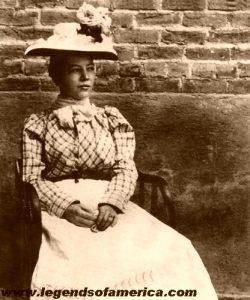
Pearl Hart, Lady Outlaw.
Pearl Hart, aka Pearl Bywater, Pearl Taylor, Mrs. L.P. Keele (1871-19??) – Hart was one of the only female stagecoach robbers in the American West.
L. B. Hasbrouck (18??-1874) – A horse thief operating in Kansas, Hasbrouck was captured with several other horse thieves near Caldwell, Kansas. Hauled to jail to await trial, a lynch mob stormed the Caldwell jail on July 29, 1874, and lynched Hasbrouck, along with two other horse thieves by the names of William “Billy” L. Brooks and Charlie Smith.
Sam Hasley – An outlaw, he killed several men and joined the war against the Texas reconstructionists in Bell County.
Henry Hawkins – Led a band of outlaws named the “Mesa Hawks,” robbing trains in the New Mexico Territory in 1897.
C.B. Hawley (18??-1882) – An outlaw, Hawley confessed to stagecoach robbery in 1882 near Globe, Arizona, and was lynched.
Bob Hayes, aka Sam Hassell, John West (1874-1896) – An outlaw, he began his criminal career as a horse thief before becoming a member of Black Jack Christian’s High Fives Gang. He was killed in a gunfight with lawmen in New Mexico.
Harry Head, aka Harry the Kid (18??-1881) – A cattle rustler and stage robber in southern Arizona, Head was known to hang out with the Clanton Gang. He was killed while trying to rob a store.
John Heath (or Heith) (1851-1884) – After receiving only life in prison for a brutal robbery and murder, Heath was lynched in Tombstone, Arizona.
Marion Hedgepeth (1856-1910) – Known as the “Handsome Bandit,” the “Debonair Bandit,” and the “Montana Bandit,” Hedgepeth was a dapper-dressing outlaw train robber, hired gun, and killer who operated throughout the American West.
William Hedges, aka: Pawnee Bill – An outlaw, he was listed in a Las Vegas, New Mexico poster warning all “Thieves, Thugs, Fakirs and Bunko-Steerers” to leave town before 10 p.m. or be invited to “a Grand Neck Tie Party.”
Art Hefferman – An outlaw who shot a man at Virginia City, Montana, in March 1871 and was lynched by vigilantes.
Bill Heffridge – Outlaw member of the Sam Bass Gang in 1877; he was killed in Kansas during a gun battle.
Augustus “Gus” Heffron – An outlaw and friend of the outlaw Dave Crockett, he was captured in the gun battle with lawmen at Cimarron, New Mexico in October 1876, where Crockett was killed. He escaped and was not heard from again.

Levi Boone Helm.
Boone Helm (1823-1864) – An outlaw member of Henry Plummer’s gang called the Innocents. Helm was hanged in Virginia City, Montana, by vigilantes.
Davenport Helm (18??-1855) – Outlaw cousin to Boone Helm, he was killed in Sonoma County, California.
Jack Helm – A lawman, gunfighter, and outlaw, he fought for the Suttons in the Sutton-Taylor Feud in Texas. His posse killed Hays Taylor on August 23, 1869. In retaliation, he was later killed by John Hardin and Jim Taylor in July 1873.
Bill Henderson (18??-1876) – Leader of a rustling gang near Fort Griffin, Texas, a posse was sent in heavy pursuit after they stole more than two dozen horses from a local ranch. The gang soon fled to Dodge City, Kansas, but Sheriff Charlie Bassett arrested Henderson and others. They were soon returned to Albany, Texas, Shackelford County seat, and were lynched.
Wall Henderson – An outlaw, he was shot and killed on November 14, 1871, by John W. Stinson in Elizabethtown, New Mexico
Mariano Hernandez – An outlaw, he was lynched in 1850 after killing a man in San Jose, California.
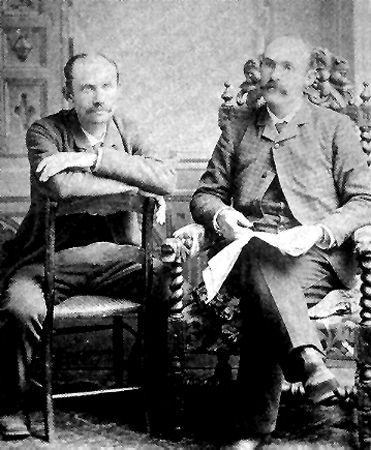
Sam Pipes, on the left, and Albert Henderson, on the right, shortly after they were released from prison
Albert Herndon – Albert Herndon was an outlaw member of the Sam Bass Gang who participated in the train robbery in Mesquite Springs, Texas. He was sent to Sing Sing prison in New York and afterward disappeared in history.
Nestor Herrera – An outlaw member of Vicente Silva’s White Caps Gang in Las Vegas, New Mexico.
Bob Herring – A Texas outlaw and member of Joe Baker’s gang, he stole horses from 1885 to 1894 and was imprisoned for 35 years following a gunfight at Dallas in 1899.
Joe Hetherington – An Englishman outlaw, he was lynched by vigilantes in San Francisco, California, on July 29, 1856.
Milt Hicks – An outlaw in Arizona and New Mexico.
George Hilderman, aka The Great American Pie-Eater, was an outlaw who belonged to Henry Plummer’s gang of Innocents.
Frank Hill – An outlaw and rustler who was killed by a posse in New Mexico in March 1880.
Owen D. Hill (18??-1888) – A black outlaw in Indian Territory, he murdered his wife and mother-in-law. Convicted of murder, he was sentenced to die. He was hanged in Fort Smith, Arkansas, on April 27, 1888.
Tom Hill, aka: Tom Chelson (18??-1878) – An outlaw and gunfighter, he went by the name of Tom Chelson when he was rustling cattle in Texas. He soon went to New Mexico and became Jesse Evans’ right-hand man. In October 1877, Hill and Evans and several other outlaws raided the Tunstall and Brewer ranches in Lincoln County, New Mexico. Aggressively pursued by the local authorities, they were soon captured and placed in the Lincoln County Jail. However, they escaped when more than 30 cohorts busted them out of jail. Hill was said to have been one of the instigators in the killing of John Tunstall in February 1878, which ignited the Lincoln County War. However, Hill would not live long enough to fight in much of the “war,” as he was killed on March 13, 1878, while robbing a sheep camp.
Clarence Browler Hite (1862-1883) – Born in Logan County, Kentucky, to George B. Hite and Nancy James Hite, Clarence was the first cousin of Frank and Jesse James. Hite joined the James Gang, where he is credited with participating in the Blue Cut, Missouri, train robbery and commandeering the train engine at the Winston, Missouri, robbery in 1881. On February 11, 1882, he was arrested in Kentucky for the Winston robbery and returned to Missouri. He pled guilty on July 15 rather than go to trial and was sentenced to 25 years in prison. Shortly after he was released, he died of tuberculosis.
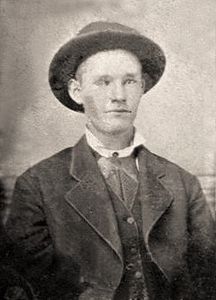
Robert Woodson Hite, member of the James Gang.
Robert Woodson Hite (1848-1881) – The first cousin of Frank and Jesse James, Wood rode for “Bloody Bill” Anderson during the Civil War. Later, he joined the James Gang and was killed by Robert Ford, another gang member.
Joseph Hlavaty – An accomplice to Pretty Boy Floyd and Fred Hildebrand.
Thomas J. Hodges, aka Tom Bell, The Outlaw Doc (1825-1856) – Thomas J. Hodges, who was also known as Tom Bell and the “Outlaw Doc,” was a physician, stagecoach robber, and leader of an outlaw gang in California.
Foster “The Kid” Holbrook – An outlaw member of the Christian Gang, was captured in 1895, a short time after the killing of Deputy Sheriff W.C. Turner.
Lewis Holder (18??-1894) – An Oklahoma outlaw, Holder was convicted of robbing and killing George Bickford and was hanged at Fort Smith, Arkansas, on July 25, 1894.
H.H. Holmes – Herman Webster Mudgett (1861-1896), better known as Dr. Henry Howard Holmes or, more commonly, H.H. Holmes, was a prolific serial killer who operated in the late 19th century.
Russ Holloway – An outlaw, he killed a man in 1879 in Earth County, Texas, and fled. He returned in 1927 and surrendered himself, but was released as no indictment was standing.
Reimund Holzhay, aka Black Bart – A German immigrant and outlaw, was captured in 1889 while robbing a train single-handedly. He received a life sentence.
Joe Horner – See Frank M. Canton
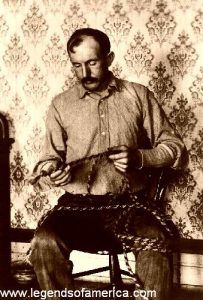
Tom Horn.
Thomas Horn, aka: James Hicks (1860-1903) – A gunfighter and lawman, he turned outlaw when he began to offer his “services” for hire and was hanged on November 20, 1903.
Eddie House – New Mexico outlaw charged with the murder of a Lincoln County sheepherder, but was acquitted in 1881.
Thomas Jefferson House, aka Tom Henry – An outlaw and horse thief, he killed Joe Carson, constable of Las Vegas, New Mexico, on January 22, 1880 (or 1884). He was lynched on February 7.
Walter Hovey, aka Fatly Ryan – An outlaw member of the Black Jack Ketchum Gang.
Charles Howard – Outlaw member of the Robert McKemie Gang, he was captured in 1878 along with McKemie.
James “Tex” Howard, aka Tex Willis, Jack Howard – An outlaw, he was the scout for a Bisbee, Arizona, robbery in 1883, during which several people were killed. Howard was arrested and hanged in 1884.
Joe Howard – An alleged outlaw and horse thief, he was lynched in 1873 at Franklin, Missouri.
“Big Dan” Howland – An outlaw, Howland murdered J.W. Lacy, a relative of Ike Stockton, in May 1881 at the insistence of the vigilantes in Farmington, New Mexico.
Joe Hubert, aka: Joe Roberts – An outlaw, rustled cattle in 1877 near Hillsboro, New Mexico, and was convicted of mail robbery.
Jim Hughes – An Arizona and New Mexico outlaw, he died on November 2, 1899.
Wilson “Texas Jack” Hughes – Outlaw member of the Ike Stockton Gang.
Della Humby – A black outlaw in Indian Territory, he was wanted for murdering his wife and killing Sergeant James Guy of the Chickasaw Mounted Police. Arrested, he was tried at Fort Smith, Arkansas. In the first trial, he was found guilty, but on appeal, he was acquitted.
O.V. Humphreys – After killing a man named John Allen, he then wounded his wife and committed suicide in Apache, Oklahoma.
“Humpy Jack” – An alleged outlaw, he was shot and killed in his cabin in 1884 by the vigilante Montana Stranglers.
Richard “Zwing” Hunt (1858-1882) – An outlaw, he robbed the Tombstone Mining and Milling Co. with Billy “the Kid” Grounds and killed M.C. Peel. U.S. Deputy Marshal William Breakenridge killed Grounds and wounded Hunt. Hunt escaped later, only to be killed by Apache Indians a short time later.
Bill “Tex” Hunter – An outlaw, Hunter was a member of Ike Stockton’s Gang.
Bill Hunter (18??-1864) – An outlaw and member of Henry Plummer’s gang of Innocents in the 1860s. He was the last of the gang to be lynched by the Montana Vigilantes.
By Kathy Alexander/Legends of America, updated April 2026.
Jump to: Links to Full Articles
Jump to: Outlaw Summaries (name begins with) A B C D E F G H I J K L M N O P Q R S T U V W X Y Z
Also See:
Outlaw & Scoundrel Photo Galleries
Story of the Outlaw – Study of the Western Desperado
See Sources.