
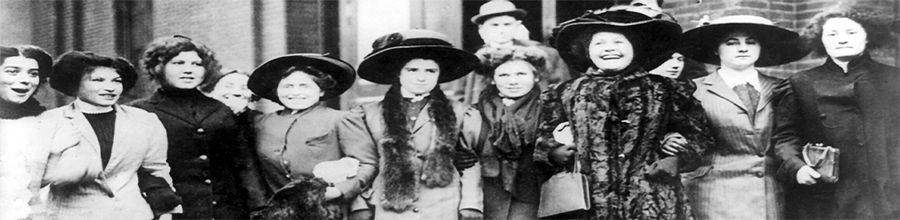
A Group of Women in New York City, 1909.
Also see: Women in American History
Jump to (last name begins with): A B C D E F G H I J K L M N O P Q R S T U V W X Y Z
A
Annie Heloise Abel (1873-1947) – Historian and professor renowned for her studies of Native Americans and was one of the first thirty women in the United States to earn a Ph.D. in history.
Jane Addams (1860-1935) – A pacifist, suffragist, an advocate of social reform, and, in 1931, the first American woman to win the Nobel Peace Prize. She turned her prize winnings over to the Woman’s International League for Peace and Freedom, of which she was president.
Hannah Adams (1755-1831) - Historian and the first professional woman writer in the United States, published A Summary History of New England in 1799.
Louisa May Alcott (1832-1888) – A servant, seamstress, teacher, and Civil War Nurse, Alcott became famous as an author.
Susan “Doc Susie” Anderson (1870-1960) – A female pioneer physician in Colorado.
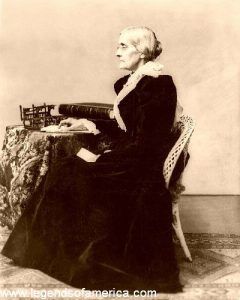
Susan B. Anthony.
Susan Brownell Anthony (1820-1906) - Susan Brownell Anthony was the American Anti Slavery Society leader and later devoted her life to the women’s suffrage movement.
B
Anne Hennis Trotter Bailey (1742-1825) – Better known as “Mad Ann,” she was a colorful figure, scout, spy, and Indian fighter during the colonial Indian Wars and the American Revolution.
Dona Gertrudis “La Tules” Barcelo (1800-1852) – A saloon owner and master gambler in the Territory of New Mexico during the Mexican-American War. She amassed a small fortune by capitalizing on the flow of American and Mexican traders involved with the Santa Fe Trail.
Ida B. Wells Barnett (1862-1931) – A black journalist and militant civil rights leader, she co-founded the NAACP and was the first president of the Negro Fellowship League.
Clara Barton (1824-1912) Called the “Angel of the Battlefield” for her first aid heroism during the Civil War, she was instrumental in founding the American Red Cross.
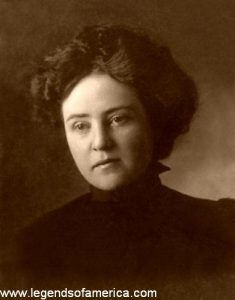
Ann Bassett.
Anne Bassett (1878-1956) – The daughter of ranch owners at Brown’s Hole, near the Wyoming, Colorado, and Utah border, Bassett became a “member” of Butch Cassidy’s Wild Bunch.
Martha McFarlane McGee Bell (1735-1829) – She became a heroine in the American Revolution after encountering General Cornwallis and the British Army and collecting valuable information for the American cause.
Sarah Bernhardt (1844-1923) – A French actress, Bernhardt made her way to the United States and was so popular that she was soon dubbed “The Divine Sarah.”
Mary McLeod Bethune (1875-1955) The daughter of former slaves, Mary became a writer, educator, champion of humanitarian causes, and an advocate for Blacks’ civil rights and education.
Mary Bickerdyke (1817-1901) – An energetic heroine whose sole aim during the Civil War was to care for wounded Union soldiers more efficiently.
Elizabeth Blackwell (1821-1910) – The first American woman to receive a medical doctor degree in 1849, she opened the New York Infirmary for Women and Children and co-founded the Women’s Medical College in 1868.
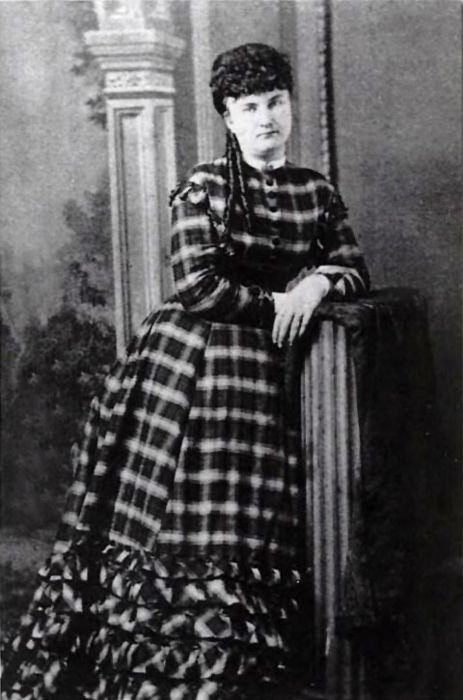
Mattie Blaylock.
Celia Ann “Mattie” Blaylock (1850-1888) – Involved with Wyatt Earp after the death of his first wife, Blaylock is often termed as Wyatt’s “common law” wife.
Amelia Bloomer (1818-1894) Social reformer, suffragist, and publisher of the temperance paper The Lily, she was ridiculed by 19th-century men for the liberated “pants” outfits she popularized.
Lizzie Borden (1860-1927) – The only suspect in the ax murders of Andrew and Abby Borden in 1892 was arrested, tried, and acquitted in Fall River, Massachusetts. No one else was ever investigated for the crime, and the case remains “officially” unsolved.
Margaret Heffernan Borland (1824-1873) – A Texas Rancher, Borland owned more than 10,000 cattle in 1873. She was said to be the only woman known to have led a cattle drive during the days of the Old West.
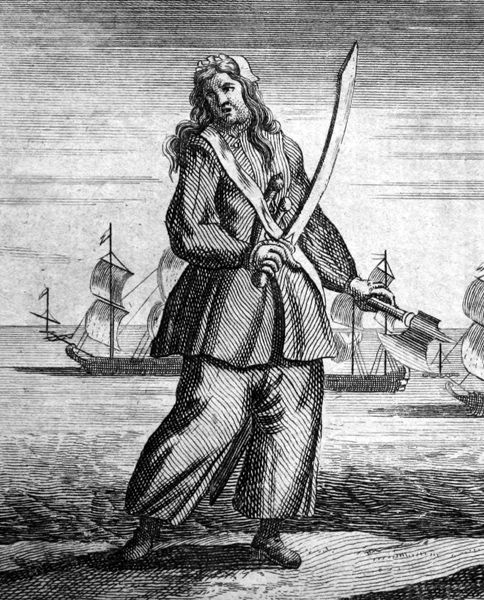
Anne Bonny, Lady Pirate.
Anne Bonny – Lady Pirate (1700?-1782?) – A female pirate, Bonny fell in love with a handsome young sailor and ran away to the West Indies with him. She sailed on Captain “Calico Jack” Rackham’s ship, gaining fame as a bloodthirsty pirate.
Eilley Orrum Bowers (1827–1903) – Known as the “Queen of the Comstock” and the “Washoe Seeress,” Bowers is remembered as one of the most influential women in the development of Utah.
Sarah A. Bowman, aka Great Western (1813-1866) – Sarah A. Bowman, who earned the moniker “Great Western,” was a Madame, cook, businesswoman, nurse, wife, and mother who made her way around the American West, primarily following soldier camps.
Mary Elizabeth Bowser (1839?-??) – Born as a slave in Richmond, Virginia, she was later freed and became a member of Jefferson Davis’ staff during the Civil War. There, she acted as a prominent Union spy.
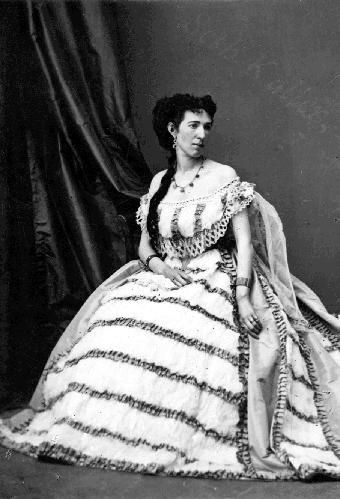
Isabella Marie Boyd
Marie Isabella Boyd (1844-1900) – Best known as Belle Boyd or Cleopatra of the Secession, she was a Confederate spy in the American Civil War. She operated from her father’s hotel in Virginia and provided valuable information to Confederate General Stonewall Jackson in 1862.
Sarah Breedlove (1867-1919) – See Madam C.J. Walker
Antoinette Louisa Brown (1825-1921) Social reformer, abolitionist, and suffragist, she was the nation’s first ordained female minister, one of the first American women to attend college, and an author of books on evolution and social theory.
Margaret “Molly” Tobin Brown (1867-1932) – Better known as “The Unsinkable Molly Brown,” Molly survived the sinking of the Titanic. But before this disaster, she was involved in women’s rights, helping establish the Colorado chapter of the National American Women’s Suffrage Association.
Julie Bulette – (18??-1867) – A popular Virginia City, Nevada prostitute in the 1860s. She was found murdered in her home on January 20, 1867.
Laura Bullion, aka Della Rose, Rose of the Wild Bunch (1876?-1961) – Bullion was a “member” of outlaw Butch Cassidy’s Wild Bunch.
S.M. Burche – Appointed as a U.S. Deputy Marshal by C.H. Thompson of Guthrie, Oklahoma, Burche was one of the few women appointed as a deputy during the 19th century.
Jump to (last name begins with): A B C D E F G H I J K L M N O P Q R S T U V W X Y Z
Also see: Women in American History