
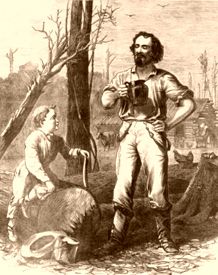
The Pioneer by Harper’s Weekly.
There were literally hundreds of colorful characters on the Frontier that weren’t outlaws, lawmen, trailblazers, gunfighters, or other easily categorized figures but were still extremely interesting people who deserved to be mentioned.
You will find eccentrics, businessmen, poker players, ministers, entertainers, doctors, photographers, historians, writers, and more here.
Though many people may not have become icons of the American West, as they are often portrayed in everything from history books to “dime novels,” each had an interesting tale to tell.
From colorful names like Poker Alice to Potato Creek Johnny, Rawhide Jimmy, Levi Strauss, and others, watch as this Old West List of Colorful Characters grows.
Other Frontier Characters:
A
Sam Aaron (1866-1940) – Aaron was an Arizona pioneer who later wrote memoirs of pioneer life and the characters he met along the way. The son of a frontiersman, Aaron was the first Jewish boy born in Salt Lake City, Utah, and at a young age, he moved with his family to various places, including Galveston, Texas; New York; Philadelphia, Pennsylvania; and finally back west in 1877, landing in Butte, Montana.
Thomas Adams went west as a civil engineer with the Isaac I. Stevens railroad survey expedition in 1853. They later became expedition leader, Lieutenant John Mullan’s assistant, and topographer and artist for the survey. He then became the temporary Indian Agent for the Flatheads in Montana’s Bitterroot Valley and served on the Flathead Treaty Council of 1855.
B
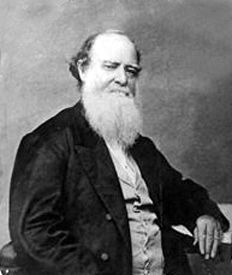
Albert Gallatin “A.G.” Boone.
Albert Gallatin “A.G.” Boone – Trapper, Trader, Pro-slavery advocate, and Indian Agent.
Samuel Brannan (1819-1889) – One of the major capitalists of the California Gold Rush, Brannan was a Mormon newspaper publisher, store owner, and politician who became California’s first millionaire.
Wayne Brazel (1876-1915?) – A stockman in New Mexico, Brazel allegedly killed Pat Garrett in 1908.
C
Samuel Clemens (Mark Twain) (1835-1910) – The best-known author during the days of the Old West.
D
James Joshua Dolan (1848-1898) – One of the primary instigators of New Mexico’s Lincoln County War, James Dolan attempted to control the economy of Lincoln County in the 1870s. He led the Murphy-Dolan faction and was suspected of riding with the posse that killed John Tunstall. He was charged with the murder of H.J. Chapman on February 18, 1879, but nothing came of it.
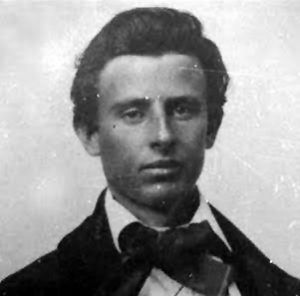
George Donner.
George Donner (1786?-1847) – One of the leaders of the infamous Donner Party, his group would become trapped in the early winter snows of the Sierra Nevada. Many died, and some of the emigrants resorted to cannibalism. George died at his camp in the Alder Creek Valley in Nevada County, California, in March 1847.
F
Camillus Sydney “Buck” Fly (18??-1901) – Best known for his photography of Geronimo’s surrender in 1886, Fly lived and worked in Tombstone during the Gunfight at the O.K. Corral. He also served as the sheriff of Cochise County, Arizona, for two years.
Albert Jennings Fountain – Soldier, lawyer, and politician, the mystery surrounding Albert Jennings Fountain’s disappearance in southern New Mexico’s deserts has puzzled lawmen and historians for over a century.
Robert Fulton (1765-1815) was an American engineer and inventor widely credited with developing a commercially successful steamboat, the Claremont.
G
Joseph F. Glidden (1813-1906) – The inventor of barbed wire, widely used in the West.
H
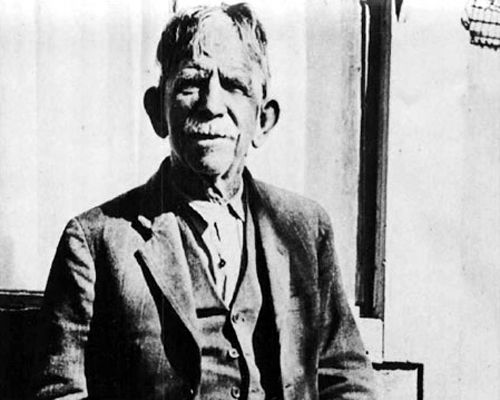
Frank “Shorty” Harris.
Frank “Shorty” Harris (1856-1934) – One of the best-known and colorful prospectors of Death Valley, Frank Harris discovered the ore of the Bullfrog District in Nevada and at Harrisburg, California, which was named for him.
J. Edgar Hoover (1895-1972) – John Edgar Hoover, the first and longest Director of the Federal Bureau of Investigation, was a very powerful man who was not only lauded for building the FBI into a large and efficient crime-fighting agency, but he was also an extremely controversial figure due to his secret abuses of power, and rumors of homosexuality and cross-dressing.
J
William Henry Jackson (1843-1942) – A painter, photographer, and explorer, Jackson is known as the first person to photograph the wonders of Yellowstone and other places in the American West and document the Civil War in several sketches. He also became a partner in the Detroit Publishing Company, which utilized thousands of his images in the first color postcards and prints published in America.
K
Simon Kenton (1755-1836) – A legendary frontiersman and soldier, Kenton saved Daniel Boone’s life, acted as a scout, and participated in Indian Wars and the War of 1812.
L
Jack Langrishe (18??-1895) – A native of New York, Jack (John) S. Langrishe, an actor, impresario, and production manager, operated theatres throughout the West, including Deadwood, South Dakota, Denver, Colorado, and another in Helena, Montana.
M
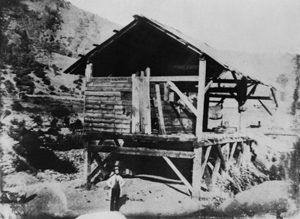
James Marshall at Sutter’s Sawmill, Coloma, California, 1851.
James Wilson Marshall (1810-1885) – Discovered gold in California in 1848 at John Sutter’s Mill in the area around which quickly became Coloma, California. His discovery started the California Gold Rush.
Lucien Bonaparte Maxwell (1818-1875) – Maxwell was a rancher and entrepreneur who once owned more than 1,700,000 acres, called the Maxwell Land Grant. His headquarters were located at Cimarron, New Mexico, along the Santa Fe Trail. He was one of the largest private landowners in United States history.
Peter Maxwell (1848-1898) – In Peter Maxwell’s home in Fort Sumner, New Mexico, Pat Garrett killed Billy the Kid.
Alexander McSween (1843?-1878) – A lawyer in Lincoln County, New Mexico, McSween and his partner, John Tunstall, opened a rival store in Lincoln, which ignited the Lincoln County War.
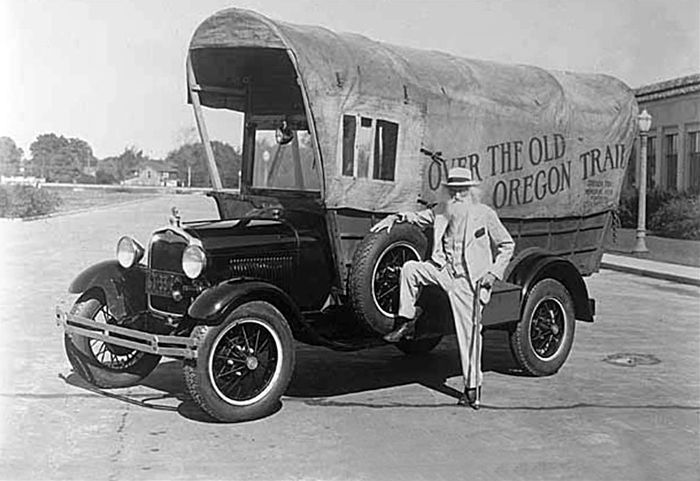
Ezra Meeker and a converted Model A Ford, which he planned to use for his 1928 trip before his death.
Ezra Meeker (1830-1928) – Meeker was a pioneer who traveled the Oregon Trail by ox-drawn wagon as a young man in 1852. Fifty years later, he would make the trip repeatedly, retracing his youth trip and working to memorialize the Trail.
Samuel Finley Breese Morse (1791-1872) – Creator of a single-wire telegraph system, co-inventor of the Morse Code, and painter of portraits and historic scenes.
Lawrence Murphy (1831 or 1834-1878) – An Irishman who immigrated to the United States, Murphy was a Civil War Veteran, cattleman, and businessman whose greed ultimately sparked New Mexico’s Lincoln County War.
P
John Perrett, aka Potato Creek Johnny – One of Deadwood’s most colorful characters, John Perrett, more often referred to as “Potato Creek Johnny,” is credited with finding one of the world’s largest gold nuggets. Though he never made his fortune, he became a local attraction in his own right until he died at 77 in February 1943.
R
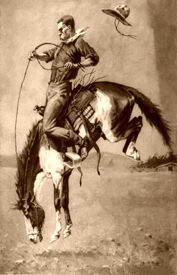
Bucking Bronco by Frederic Remington.
Ringling Brothers – Founded in Baraboo, Wisconsin, the Ringling Brothers Circus was established by five of the seven Ringling Brothers in 1882.
Frederic Sackrider Remington (1861-1909) – An American painter, illustrator, sculptor, and writer who specialized in depictions of the Old American West, specifically concentrating on the last quarter of the 19th century and images of cowboys, American Indians, and the U. S. Cavalry.
William Penn Adair “Will” Rogers (1879-1935) was a Cherokee-American cowboy, comedian, humorist, social commentator, vaudeville performer, presidential candidate, and actor.
Charles Marion Russell (1864-1926) – One of the great artists of the American West, Russell created more than 2,000 paintings of cowboys, Indians, and landscapes set in the Western United States and bronze sculptures.
S

Charles M. Schwab
Charles M. Schwab (1862-1939) – Making his fortune in the steel industry, Schwab invested heavily in Death Valley mining ventures. After living a lavish lifestyle for years, and the stock market crash of 1929, he died in poverty.
Erwin E. Smith (1886-1947) – Often referred to as “one of the greatest photographers of cowboy life,” Smith created engaging and action-filled images of ranch life that have come to symbolize the universal western cowboy type.
Joseph Smith (1805-1844) – Smith founded the Church of Jesus Christ of Latter-day Saints, better known as the Mormons. He was one of America’s most charismatic and influential religious figures.
Levi Strauss (1829-1902) – The inventor of Levi Blue Jeans, Strauss first sold them to California gold miners.
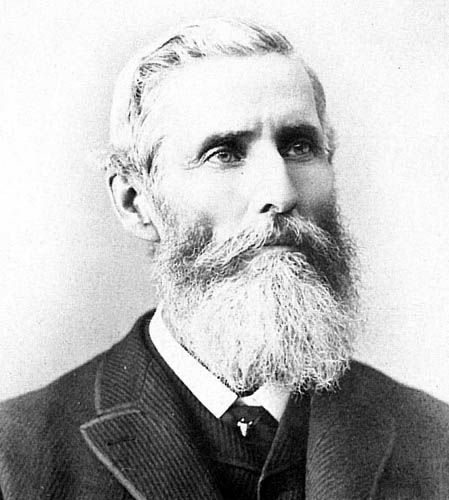
Granville Stuart (1834-1918)
Granville Stuart (1834-1918) – Frontiersman, miner, Montana Land Baron, leader of the vigilante group called Stuart’s Stranglers, author, and more; Granville Stuart is recognized as a Montana pioneer and hero. See Article HERE.
John Sutter (1803-1880) – The property owner of the place where gold was first discovered in California, his land was taken over by prospectors. He experienced an economic setback and went bankrupt.
T
Alice Ivers Tubbs, aka Poker Alice (1851-1930) – Perhaps the best-known female poker player in all of the Wild Old West, Alice Ivers Tubbs moved from mining camp to mining camp, building her reputation as a superb gambler. After rambling through the West for years, she finally settled down in the Black Hills of South Dakota, where she died in Rapid City in 1930.
John Henry Tunstall (1853-1878) – An English cattleman in Lincoln County, New Mexico, Tunstall and Alexander McSween opened a rival store in Lincoln, vying for the business that had been controlled by the Murphy & Dolan Mercantile and Banking. Tunstall’s rivals murdered him in February 1878, igniting the Lincoln County War.
Frederick J. Turner (1861-1932) – Turner was a historian of the American West.
Mark Twain – See Samuel Clemens
W
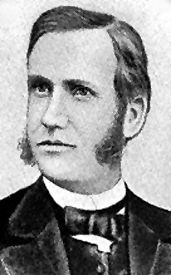
Dr. Marcus Whitman.
Dr. Marcus Whitman (1802-1847) – Among the first American settlers in the West, Dr. Whitman and his wife, Narcissa, played an important role in opening the Oregon Trail and establishing the Whitman Mission in 1836. They were killed in what is known as the Whitman Massacre.
Narcissa Prentiss Whitman (1808-1847) – A missionary in the Oregon Country of what would become the state of Washington, she, along with Eliza Hart Spalding, was the first European-American woman to cross the Rocky Mountains in 1836. Along with her husband, Dr. Marcus Whitman, they established the Whitman Mission near modern-day Walla Walla, Washington.
Brigham Young (1801-1877) – Leader of the Mormon movement to Utah, president of the church from 1847 to 1877, and the first governor of Utah. Young’s legacy is mixed, with praise for his many accomplishments and historical influence, as well as controversy over a number of 19th-century events, including the Mountain Meadows Massacre.
Kathy Alexander/Legends of America, updated February 2026.
Also See: