
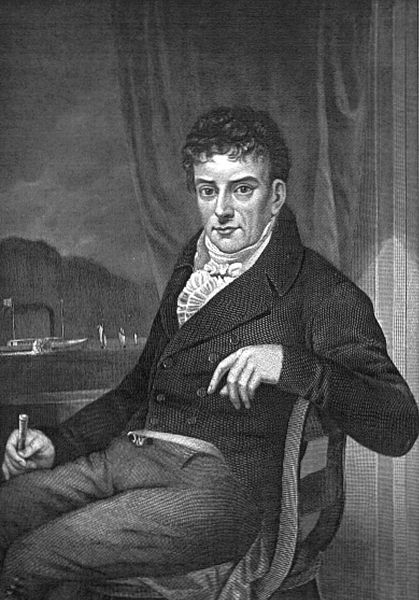
Robert Fulton.
By Inez Nellie Canfield McFee in 1913.
In Revolutionary times, and for many years after, the people’s easiest way to get about and carry their goods from one point to another was by boat. There were few roads, and they were sometimes almost impassable because of ruts and mud. Breakdowns and upsets were common. Passengers often had to help the stagecoach driver pull the wheels out of the mud before a journey could be completed. Water accidents were few, and the going was easier and swifter. Dutch sloops and schooners were used considerably on the larger streams in the East, and all kinds of small sailboats and canoes were also in use.
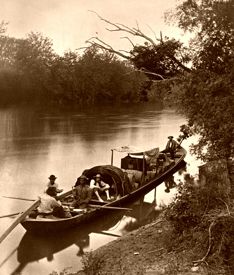
Keelboat, by Jedediah Hotchkiss, 1872.
On the western rivers, the flatboat was the most familiar form of craft. It was merely a box, some 50 or more feet in length and about 16 feet wide, and was propelled by long poles. As it was used chiefly to carry produce, it was usually torn to pieces at the end of the journey after its cargo of flour, pork, lumber, molasses, etc., had been sold. Hundreds of these boats went down the Ohio and Mississippi Rivers every year.
The favorite passenger craft was the keelboat. It plied up and down the rivers more or less regularly, being pushed upstream with long poles. Where the current was too strong for this, the boatmen went ashore and hauled the craft along by ropes. Small wonder, then, that one of the day’s problems was to invent a boat that could move with swiftness and ease and that should not depend on the ever-varying wind for its speed.
James Watt, a Scotchman, had improved the steam engine so much that people began to hope steam might be used to work for man. Naturally, many inventors turned their thoughts toward it. Why couldn’t some machinery be devised for applying the power of the steam engine to the movement of boats?
One ingenious Englishman attempted to propel a boat by using a device shaped somewhat like a duck’s foot to push the engine through the water. But it was not a success. In 1730, another Englishman, Dr. John Allen, tried to run a boat by taking in water through an opening in the bow and then driving it out at the stern with enough force to push the boat forward. This, too, failed. In 1786, American John Fitch built a steamboat and launched it on the Delaware River. He moved his boat using a row of engine-worked paddles arranged along its sides. For more than three months, it plied up and down the river, but it moved so slowly that few passengers cared to ride.

Fitch’s Steamboat.
Fitch grew ragged and poor and at last gave up the trips. Three years later, another American, James Rumsey, built a steamboat, but like Fitch’s boat, it never became practical. One inventor after another experimented with the steamboat and failed. People began to think that such a boat could not be built. But two Americans in Paris were not yet ready to give up. These were Chancellor Livingston, the American Minister to France, and Robert Fulton, a young inventor. Both were interested in steam navigation, and they formed a partnership to promote it. Livingston would provide the money and advice, and Fulton would do the work.
Robert Fulton was born in Chester County, Pennsylvania, on November 14, 1765. His father was an Irish tailor. Like many other boys, Young Robert did not care to learn his father’s trade. He was not especially interested in books either. He was a born inventor and also had considerable talent as an artist. At 17, he worked as a miniature painter in Philadelphia, and he succeeded so well that within four years he bought a small farm for his mother. After seeing her comfortably settled, he sailed for Europe to study art under the direction of Benjamin West.
But his inventive genius continually interfered with his studies. Now and then, he abandoned art to invent a mechanical device. One was a submarine torpedo, which he tried in vain to persuade Napoleon to buy. After entering into a partnership with Livingston, he went to England to see a steamboat that William Symington, a Scotchman, had invented. This steamboat had a side wheel and was based on an idea Fulton had already had in mind. It could make five miles per hour.
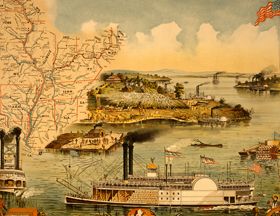
Mississippi River Steamboat.
Young Fulton was confident that he could improve on Symington’s model and went back to France full of enthusiasm. The firm immediately built a boat, which they launched on the Seine; however, it broke into pieces when the engines were placed on board. Fulton proved his determination by building another boat immediately. He was not a man to be disheartened by one failure. The second venture was more successful. He made a trial trip in sight of a large crowd of Parisians. The great Napoleon was deeply interested in the boat. “It is capable of changing the face of the world!” he exclaimed. Still, the two Americans decided to return to their own country, where the need for steamboats was much greater.
One of the first things to be done was to get the best engine that could be built. Fulton immediately sent for James Watt to build an engine, which was to be fashioned according to his plans. While it was being made, he set about building a steamboat in New York. He named his model the Clermont. It was the first side-wheel steamboat built in America. It did not appeal to the general public, who laughed and called it “Fulton’s Folly.” However, they assembled in large numbers when it was finally ready, on a day in August 1807, to watch it make a trial trip. It was an anxious moment for Fulton, as everyone was sure he would fail; indeed, when the signal was given, the boat moved for a short distance, then it stopped and became immovable. But Fulton hurried below and soon discovered the cause of the trouble. This being easily remedied, the boat went on.
The Clermont made the distance from New York City to Albany, New York (150 miles) in 32 hours and returned successfully. Still, many pronounced it a failure and declared it could not be repeated. But it did, and not once, but many times. Then people finally appreciated the invention’s usefulness. In 1808, a line of steamboats regularly operated on the Hudson River, and others were put into operation in various parts of the country.
Initially, the steamboat created terror and consternation along the entire route. For in those days, newspapers were scarce, and news traveled slowly. Few knew of its existence until the horrid monster “marched by on the tides, lighting its path by the fires it expelled.” This was especially true in the sparsely settled country along the Ohio and the Mississippi Rivers, where many amusing stories were told of the fear it inspired. Some vessels ran ashore to escape the terrible creature. Passengers and crews on ships that could not get out of the way hid in the hold to escape the dreadful doom that threatened them.
Robert Fulton died in New York in 1815. He lived long enough to see the beginning of the prophecy Napoleon had made concerning his invention. Hundreds of steamboats were already in use in our country alone, and their number would reach the thousands by the early 20th Century. Not just like Fulton’s model, to be sure, but built along the same general plan he, in turn, had copied from Symington’s invention. But neither man could have imagined the great ocean steamers and battleships that grew out of their seemingly insignificant little boats in his wildest dreams.
In 1909, New York celebrated the centennial of the little Clermont’s first trip, which marked the real beginning of steam navigation, and the tricentennial of Henry Hudson’s discovery of the Hudson River.
By I.N. McFee, 1913. Compiled and edited by Kathy Alexander/Legends of America, updated October 2026. About the Author: Inez Nellie Canfield McFee wrote this article in 1913 and included it in her book American Heroes From History. McFee also authored several other books on American History, poetry, birds, and more. The article, as it appears here, is not verbatim; it has been edited and includes additional information.
Also See: