

Samuel Clemens, forever known as Mark Twain, poses for a portrait in 1907.
Few figures in American literature loom as large as Mark Twain, the pen name of Samuel Langhorne Clemens. With a wit as sharp as a steamboat’s whistle and a pen that captured the soul of a nation, Twain chronicled the American experience with humor, satire, and unflinching honesty. From his humble beginnings in Missouri to his final days as a celebrated author and cultural critic, Twain’s life was as colorful and complex as the characters he created.
Humble Beginnings in Missouri

Mark Twain at 15 by G.H. Jones,1850.
Samuel Langhorne Clemens was born on November 30, 1835, in the tiny village of Florida, Missouri, as Halley’s Comet passed by Earth. He was the sixth of seven children born to John Marshall Clemens, a lawyer and judge, and Jane Lampton Clemens, a storyteller and resilient woman. When Sam was four, the family moved to Hannibal, a bustling port town on the Mississippi River. This riverside setting would later become the fictional St. Petersburg in The Adventures of Tom Sawyer and Adventures of Huckleberry Finn.
Twain’s early life was marked by both adventure and hardship. His father died when Sam was just 11 years old, plunging the family into financial difficulty. Forced to leave school, he became a printer’s apprentice and later worked for his brother Orion Clemens, who ran a local newspaper. It was here that Twain began to hone his writing skills, typesetting articles and contributing humorous sketches.
As a young man, Twain was drawn to the Mississippi River’s mystique and majesty. In 1857, he began training as a steamboat pilot, a prestigious and well-paying profession at the time. He earned his river pilot’s license in 1859 and spent several years navigating the winding channels. The river left an indelible mark on Twain’s imagination, becoming both a literal and symbolic current in his later works.

Hannibal, Missouri, and the Mississippi River. Photo by Kathy Alexander.
The outbreak of the Civil War in 1861 brought his river career to an abrupt end. With river traffic disrupted and the country in turmoil, Twain joined a short-lived Confederate militia before heading west to Nevada with Orion, who had been appointed Secretary of the Nevada Territory.
From Prospector to Penman

Virginia City’s Main Street today is lined with historic buildings, Kathy Alexander.
Twain’s time in the American West was filled with misadventures. He tried his hand at silver mining but found little success. Turning once again to journalism, he began writing for the Territorial Enterprise in Virginia City, Nevada. It was during this period that he adopted the pen name “Mark Twain,” a term used by riverboat pilots to indicate a depth of two fathoms—safe water for navigation.
His big break came in 1865 with the publication of “The Celebrated Jumping Frog of Calaveras County” in the New York Saturday Press. The story’s blend of frontier humor and deadpan delivery captivated readers and launched Twain into national prominence. He soon found himself in demand as a lecturer, traveling across the country and later the world, regaling audiences with his sharp wit and colorful anecdotes.
Twain’s early success as a humorist evolved into a deeper, more reflective literary voice. His first significant book, The Innocents Abroad (1869), chronicled his travels through Europe and the Holy Land with biting satire and cultural commentary. It was a commercial hit and established Twain as a serious author.

Mark Twain at 31 by Abdullah Freres, 1867.
In 1870, Twain married Olivia Langdon, the daughter of a wealthy New York coal magnate. The couple settled in Hartford, Connecticut, and had four children: Langdon, Susy, Clara, and Jean. Their home became a hub of literary and intellectual activity, and Twain entered his most productive period.
During the 1870s and 1880s, Twain published a string of enduring works, including:
The Adventures of Tom Sawyer (1876): A nostalgic and mischievous look at boyhood along the Mississippi.
The Prince and the Pauper (1881): A historical novel exploring themes of identity and social class.
Life on the Mississippi (1883): A memoir blending personal narrative with historical reflection.
Adventures of Huckleberry Finn (1884): Widely regarded as his masterpiece, this novel tackled race, freedom, and morality with unflinching honesty and remains a cornerstone of American literature.
Financial Ruin and Personal Tragedy

Mark & Olivia Twain with their three Daughters.
Despite his literary success, Twain’s financial life was fraught with missteps. He invested heavily in the Paige typesetting machine, a complex invention that ultimately failed. By the early 1890s, Twain was bankrupt. To repay his debts, he embarked on an arduous world lecture tour, traveling to places as far-flung as Australia, India, and South Africa. His observations from these travels were later compiled in Following the Equator (1897).
Tragedy also struck Twain’s personal life. His beloved daughter Susy died of meningitis in 1896, a loss that devastated him. His wife, Olivia, had a steady decline in her health, and she passed away in 1904. Two more of his children, Langdon and Jean, also died young. These losses cast a long shadow over Twain’s later years, deepening the cynicism and melancholy that had always simmered beneath his humor.
In his twilight years, Twain remained a prominent public figure, known as much for his white suits and wild hair as for his razor-sharp commentary. He received honorary degrees from Yale, Oxford, and the University of Missouri, and was celebrated as a national treasure.
Twain moved to Redding, Connecticut, where he built a home he called Stormfield. There, he continued writing, reflecting, and entertaining guests. Though his later works, such as The Mysterious Stranger and Letters from the Earth, were darker and more philosophical, they revealed a mind still grappling with the contradictions of human nature and society.
Fittingly, Twain’s life ended as it had begun—with Halley’s Comet in the sky. He had once predicted, “I came in with Halley’s Comet in 1835. It is coming again next year, and I expect to go out with it.” He died on April 21, 1910, just one day after the comet’s closest approach to Earth.
He was buried in Woodlawn Cemetery in Elmira, New York, beside his wife and children.
The Mark Twain home in Hannibal, Missouri. Photo by Kathy Alexander.
Legacy
Mark Twain’s influence on American literature is immeasurable. His works continue to be read, studied, and debated for their humor, humanity, and social critique. He captured the voice of a nation in transition…from frontier to industrial power, from innocence to complexity.
Twain’s legacy also lives on in the countless writers he inspired, from Ernest Hemingway to Toni Morrison. As Hemingway famously said, “All modern American literature comes from one book by Mark Twain called Huckleberry Finn.”
Visitors to the Mark Twain House & Museum in Hartford, Connecticut, are transported into the richly appointed Victorian home where Samuel Clemens—better known as Mark Twain—penned some of his most iconic works, including The Adventures of Tom Sawyer and Adventures of Huckleberry Finn. This 25-room Gothic Revival mansion, designed with help from Louis Comfort Tiffany, offers guided tours that reveal Twain’s family life, creative process, and personal quirks. The adjacent museum center features interactive exhibits, rare artifacts, and a documentary by Ken Burns, while seasonal events and specialty tours, like the Graveyard Shift Ghost Tour, add layers of intrigue to the experience.
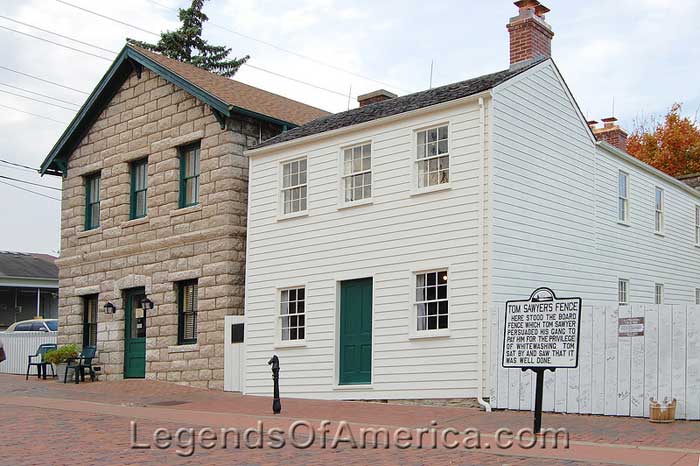
In Hannibal, Missouri, the Mark Twain Boyhood Home & Museum invites guests to walk in young Sam Clemens’ footsteps through a complex of historic buildings and engaging exhibits. Visitors can explore his childhood home, the Becky Thatcher House, and his father’s law office. The museum gallery showcases original Norman Rockwell illustrations and Twain memorabilia, while interactive displays let guests whitewash Tom Sawyer’s fence or raft down the Mississippi with Huck and Jim. Together, these two museums offer a vivid, coast-to-coast journey through the life, imagination, and enduring legacy of America’s most beloved humorist.

Mark Twain was awarded a “Doctor of Literature” (D.Litt) degree by Oxford University in 1907.
But perhaps Twain’s greatest gift was his ability to hold a mirror to America—reflecting both its promise and its flaws, with honesty, empathy, and laughter. In doing so, he became not just a chronicler of his time but a timeless voice for generations to come.
More information:
Mark Twain House & Museum, Hartford, CT
Mark Twain Boyhood Home & Museum, Hannibal, MO
©Dave Alexander, Legends of America, November 2025.
Also See:
Historical Accounts of American History
The Mississippi River and the Expansion of America
Sources:
Mark Twain House & Museum
Library of Congress
PBS: American Experience – Mark Twain
Mark Twain Boyhood Home & Museum