
By William A. Pinkerton in 1893.
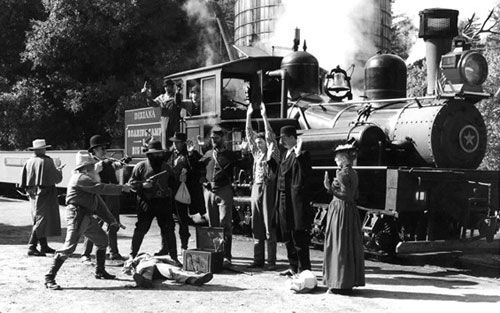
Train Robbery,
The recent epidemic of train robbing in different sections of the country has naturally caused considerable discussion about the best means of checking this peculiar class of crime. Train robbing has been practiced pretty steadily in the South and West during the last 20 years, but during the last few months, outrages of this character have increased at an alarming rate. Most of these occurred South and West of the Missouri River. More than any other state, Texas has suffered from this newest and just now most threatening form of crime.
My experience with train robbers began with the earliest operations of these daring criminals. No train robberies of any importance occurred before the war. The first incident our agency dealt with was perpetrated by the Reno brothers of Seymour, Indiana.
Four of these brothers became noted as train robbers. They began their robberies immediately after the war and became terrors to the community in which they lived. The necessary evidence to convict them was impossible to obtain. To a certain extent, they controlled some of the local judges through terrorizing them, and the local authorities, either through sympathy or fear, were afraid to do their duty.
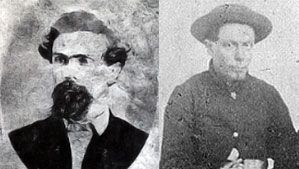
Frank Reno (left) and John Reno (right).
The gang’s downfall began in 1867 with the arrest of John Reno, who, with others, had robbed the county treasurer’s safe in Savannah, Missouri. He was tracked back to Seymour, and, as there was no chance of his being extradited, a party of masked men went into Seymour and bodily carried him on board a train that was about to start for Missouri, where he was convicted and sentenced to 25 years of imprisonment. Later on, Frank, William, and Sim Reno committed several train robberies throughout Indiana, extending their operations as far west as Iowa. In the Winter of 1868, they “held up” a train near Marshfield station, Indiana, forced their way into the Adams Express car, threw the messenger from the car while the train was under headway, and robbed the Express Company of $80,000. Authorities arrested Sim and William Reno in Indianapolis. Frank Reno and Charles Anderson, another of this gang, were also arrested at Windsor, Canada. After bitterly contesting their extradition in all the courts of Canada, they were finally brought to Indiana and confined in the jail at New Albany. The people in the vicinity of Seymour became aroused because war had actively commenced against the Reno brothers, and, as these men had terrorized them for years, they were willing to take a hand in exterminating them.
One stormy night, a band of masked men surrounded the jail at New Albany; the sheriff and jailer were overpowered, and the three Renos and Anderson were taken from their cells and hanged in the corridors of the jail. Their execution was rapidly followed by that of the other members of the gang, their sympathizers, and abettors, who lived in the vicinity of Seymour, no less than nine being hanged by the vigilance committee. For years after that, and up to the present time, Seymour, Indiana, has been noted as a model, flourishing city. I do not recall a single case of train robbing in southern Indiana since the execution of the Renos. Before that, a train was usually robbed there about every 60 days.
Farrington Brothers.
Levi and Hillary Farrington, William Barton, and William Taylor committed the next train robbery of any importance. These people came from western Tennessee. After making a desperate resistance, we arrested Levi Farrington at Farmington, Illinois. We arrested Hillary Farrington and William Barton near Venetta, Indiana Territory. A posse surrounded the house where they were hiding; the door was broken down, and the house was fired when they were compelled to come out with their “hands up.” Our men arrested William Taylor at Red Foot Lake in western Tennessee. While conveying Hillary Farrington and William Barton from the Indiana Territory to Union City, Barton made a complete confession as to the other gang members and what had been done with the proceeds of the robberies.
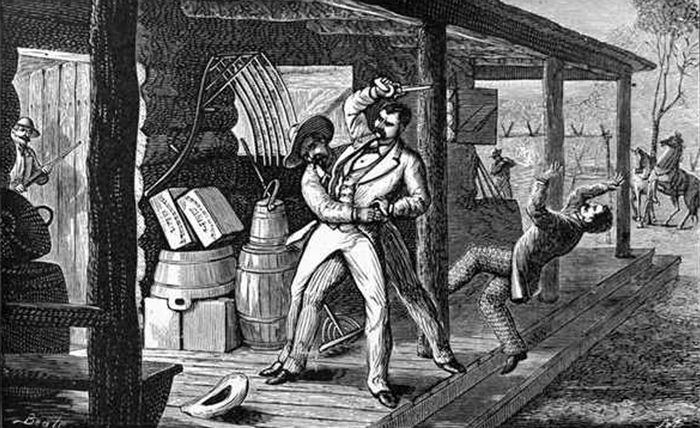
While traveling from Cairo, Illinois, to Columbus, Kentucky, I was about to enter the barroom of the steamer when Hillary suddenly seized a large pistol that was sticking from my overcoat pocket and tried to conduct a murderous assault on me.
During the struggle which ensued for the possession of the pistol, Hillary Farrington fell over the low railing of the boat, nearly dragging me with him, and was drowned. Levi Farrington was the most desperate of the gang. When he was brought to Union City, Tennessee, the citizens held a jollification meeting, as he had shot and killed a marshal and his deputy in eastern Missouri and a deputy sheriff in Tennessee. About two o’clock in the morning, fifty masked men came to the house where he and the other prisoners were under guard, as the town jail was not strong enough to hold them. They overpowered the guards, dragged out a man who had attempted to rescue Farrington, and hanged him. Levi Farrington was shot in his room, his body fairly riddled with bullets. William Taylor and William Barton pleaded guilty and were sentenced to long prison terms in Tennessee.
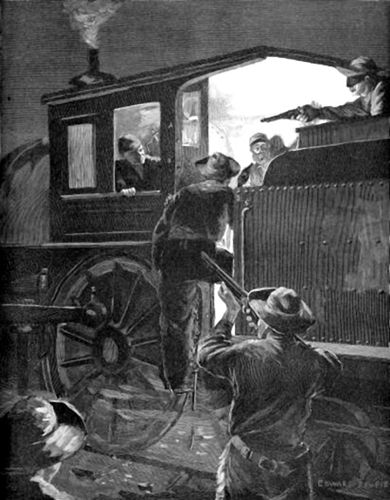
Train Robbery.
Capturing and sentencing the members of this gang helped break up train robberies in western Tennessee. No train robbery has occurred in that vicinity since 1871, the date of these men’s execution. The Farringtons were among the most desperate of this class of men I have ever known and were as successful as any of the desperadoes engaged in “holding up” and robbing trains.
The next train robbers of any importance were the James and Younger brothers of western and southwestern Missouri. The robbery that brought them into prominence occurred at a small station on the Iron Mountain Railway, known as “Gad’s Lull,” where they “held up” the train and got a large amount of money from the Adams Express Company’s safe. This was in 1873. A short time previous to this, they had robbed the safe of the Hot Springs stagecoach, holding up the coach with its twelve passengers and taking all the express money. One of our best men, Joseph Whicher, was sent to the neighborhood of the James boys’ home to find work as a farmhand. He dressed as a farmer, his hands hardened and his skin darkened to complete the disguise.
At about dark, he approached the James home, knocked, and applied for work. Mrs. Samuels, the James brothers’ mother, opened the door, invited him in, and gave him a chair.
While he sat, the door was suddenly thrown open, and Jesse and Frank James, along with some of their followers, entered and accused him of being a detective. This he denied. The Jameses, however, said they were at war with all police officials and took him from the house, gagged and bound him, tied him to a horse, and took him across the old Blue Mill Ferry, telling the ferryman that he (Whicher) was a horse thief, whom they were going to deliver up to the authorities.
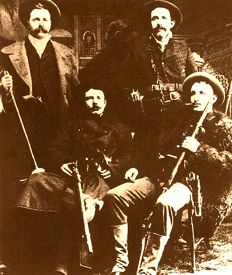
The James-Younger Gang – Left to right: Cole Younger,
Jesse Woodson James, Bob Younger, and Frank James.
They took him to within about five miles of Independence, Missouri, and murdered him by shooting him in the back. Captain Lull, who searched for the Younger brothers in St. Clair County, Missouri, shot and killed John Younger and wounded his brother, Jim Younger, but was himself shot by the latter and died from his wounds. Jim Younger is currently at the Minnesota Penitentiary. But, it is said, he never recovered from the wounds received at Captain Lull’s hand. It now became a war of extermination on the part of the express companies and our officers against the remnant of this gang. The three Younger Brothers, consisting of Coleman, Jim, and Robert, were arrested and convicted for the murder of bank cashier Haywood at Northfield, Minnesota, and were sentenced to life imprisonment. Shortly after this, Jesse James was shot and killed by Robert Ford, the youngest member of his gang.
Robert and Charles Ford were arrested and pleaded guilty to the killing of Jesse James and were sentenced to be hanged, but were immediately pardoned by Governor Crittenden, and they were paid the reward of 5,000, which had been offered for the arrest of Jesse James, dead or alive. This was according to an arrangement the Ford brothers had made with the Governor. After this, Frank James surrendered and, as far as I am advised, has been living an honest life since.
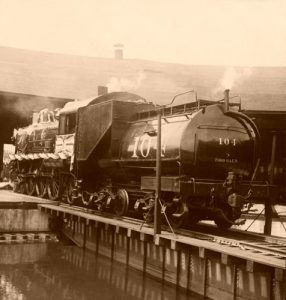
Union Pacific engine.
Sam Bass, the Collins brothers, and others led the next gang to appear. They “held up” and robbed the Pacific Express on the Union Pacific Railroad and got about $60,000 in gold. Two gang members stopped the train, forced the crew to get off, and searched the safes, taking everything in sight: money, watches, and jewelry. Their career, however, was brief. Joel Collins was shot and killed; one confederate named Berry was shot and killed near Moscow, Missouri, and all the money was recovered. Sam Bass escaped and went to Denton County, Texas, where he had many friends. It was situated there much the same way as the James brothers in Missouri; nobody was willing to give any information about him.
In Texas, he organized another gang of train robbers. These men perpetrated several train robberies in Texas, but the United States government, in conjunction with the detectives, took hold of the matter and arranged a plan to lure the gang to Round Rock, Texas, to rob a bank.
Armed men carefully covered the bank, secreted wherever they could be placed without attracting attention. When the gang appeared near the bank, the fight was opened prematurely by a local officer, who attempted to arrest one of them for carrying firearms, not knowing of the plans made. The fight thus commenced; the concealed officers ran into the street and opened fire on the gang with their Winchesters, killing most of them and taking the others prisoners. One thing to note about train robbers: they generally go in families; that is, there are usually two or three members of one family in the same gang.
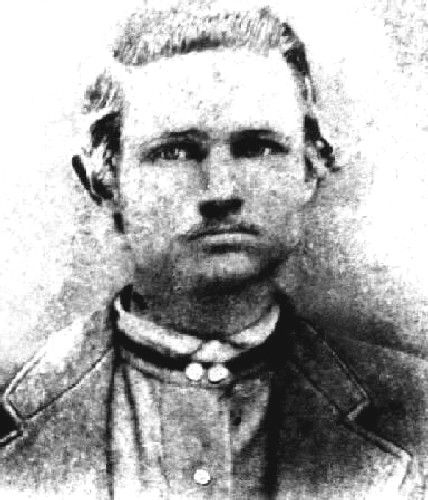
Rube Burrow.
Brothers Jim and Rube Burrow of Alabama perpetrated the next series of train robberies. These men, in company with several others, “held up” several trains but never succeeded in getting much money. Our men afterward arrested all three men, who were tried and convicted in Texas. Local officers in Savannah, California, surprised Rube and Jim Burrow; Jim was arrested, but Rube was not taken so easily. He shot down two men in Savannah, one of whom died afterward, but he succeeded in getting away. Jim turned himself in to our men, who took him to Arkansas for his part in robbing the Southern Express Company. He was sentenced to Arkansas State Prison, where he died. Rube Burrow, in company with two others, “held up” a train at Duck Hill, Mississippi, on the Illinois Central Railroad. He and his companions escaped to the mountains of Alabama. He held up another train in Florida to which was attached a Southern Express car. The Southern Express and its detectives followed him persistently and finally had local officers arrest him.
Then came the daring express robbery on the St. Louis & San Francisco Railroad, perpetrated a few miles outside St. Louis, Missouri, by Fred Wittrock of Leavenworth, Kansas. Wittrock had planned the robbery for some time and had taken several people into his confidence, but they weakened when they saw the risk they had to take. He then went alone to commit the robbery. Wittrock presented an order to the messenger purporting to be from the route agent of the Adams Express Company for that division, asking the messenger to “break him in.” When out a little way on the road, he plugged the bell cord, threw the messenger on the floor, bound and gagged him, and then rifled the safe of its contents and succeeded in getting away with about 50,000.
Under the name of Jim Cummings, he subsequently wrote several letters to the St. Louis papers stating that the robber would never be discovered. However, Mr. Robert A. Pinkerton and two of our detectives arrested him in Chicago, and the rest of the gang was captured. Wittrock was extradited to Missouri and sentenced to seven years’ imprisonment in the penitentiary. He gave up all the money he had not spent. Authorities located everyone connected with the robbery almost immediately after it was committed, except Wittrock, who was caught about forty days later. When arrested, he was heavily armed and would have made a desperate resistance had he not been taken by surprise.
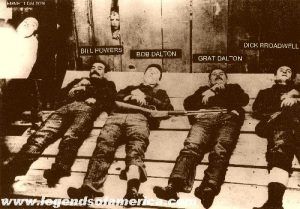
Daltons Dead.
Around this time, the Dalton brothers appeared in Kansas and the Indian Territory (Oklahoma). These five men “held up” numerous trains throughout the country. Their base of operations extended from Missouri to the Pacific Coast. Several of them were taken into custody but afterward succeeded in escaping from jail. The whole gang was shot down except for one brother in Kansas, who is supposed to be the leader of a new gang operating under the old name “The Daltons.”
The next robbery of note was the Adams Express robbery on the St. Louis & San Francisco Railroad, near Pacific, Missouri, by Albert Denton Slye, Marion Hedgepeth, Dink Wilson, and a man named Tom Francis. They obtained about 15,000 by this robbery.
Our agency worked with the St. Louis, San Francisco, and Los Angeles police forces. Robert A. Pinkerton, Detective Whittiker, and an officer in Los Angeles arrested Slye in Los Angeles, California.
Police found on his person the watch taken from the express messenger and a ring known to have been in the express safe. Slye pleaded guilty and was sentenced to twenty years. Later on, I received information that Hedgepeth was receiving mail under an alias in San Francisco, California. I shared this information with the San Francisco police, who arrested Hedgepeth a few days later as he was calling for his mail at the post office. Shortly after this, Jim Francis and a man named Myers, members of this gang, attempted to “hold up” a train near Fort Scott, Kansas, but were overpowered and killed. Hedgepeth fought his case bitterly in the courts but was finally convicted and sentenced to twenty-five years in the Missouri State Prison. Dink Wilson, the other member of this gang, escaped, went into the mountains near Utah, and hid for a long time. Last July, while a detective at Syracuse, New York, was trying to arrest two men who were suspected of being connected with several burglaries that had occurred in the neighborhood of Syracuse, the men turned and fired at short range, killing him almost instantly. One of the murderers was taken, but the other escaped. The picture of the man arrested was sent throughout the country and was finally identified as that of Dink Wilson. We subsequently located the second man in Buffalo, where the local officers arrested him. These two men are bound to be convicted and will, in all probability, be electrocuted. This will dispose of this whole gang of train robbers.
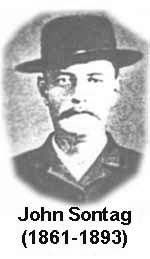
John Sontag.
The two Sontag brothers and Chris Evans were the next train robbers to rise to prominence. They operated as far East as Racine, Wisconsin. They “held up” a train on the Chicago, Milwaukee & St. Paul Railroad, robbing the American Express Company of a large amount of money. After this robbery, they decamped to Minneapolis, Minnesota. Our agency, acting for the American Express Company, put them on the trail but did not have sufficient evidence to arrest them. We, however, followed them to California, where they “held up “a train on the Southern Pacific, robbing the Wells-Fargo Company’s safe. One of the Sontag brothers was arrested, but Evans and the other Sontag succeeded in escaping after shooting all the officers. They were, however, recently captured, and in the encounter, Sontag was killed, and Chris Evans is now awaiting trial, badly wounded.
In the recent train robbery on the Mineral Range Railway, the robbers succeeded in getting about $70,000, the property of the American Express Company. Two brothers named Hoagan and three others committed this robbery. With the aid of the local officers, our agency speedily captured these men and recovered all the money. The last robbery of the United States Express Company on the Lake Shore & Michigan Southern Railway has not yet been worked up. Still, I feel confident that the officers involved will eventually get the right people. One thing is sure: the men engaged in the last express robbery will not be allowed to escape.
One reason for the recent epidemic of train robberies may be found in the general business depression. It is, however, also primarily due, in my opinion, to the reading of yellow-covered novels. Country lads get their minds inflamed with this class of literature. Professional thieves or designing men find many willing to go into their schemes among this class. Most of these robbers are recruited from among the grown boys or young men of small country towns. They start as amateurs under an experienced leader. They become infatuated with the work and never give it up until arrested or killed. I recollect a case where three boys aged respectively 17, 21, and 16 “held up” a train near Emmett, Arkansas, in 1882 and took from the Pacific Express about $9,000 and from the passengers about $1,500. The train conductor ran one of them down and brought him back; the other two escaped but were eventually arrested in the Indian Territory. They were convicted and sentenced to 70 years each in state prison. One of them was a mere lad who had seen a railway train for the first time and wanted to “hold it up.”
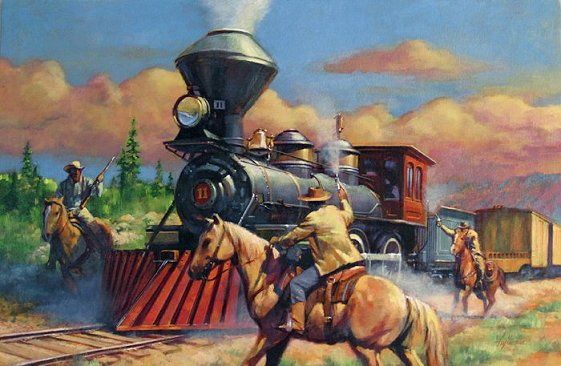
Train Robbery.
Train robbery is not a profitable pursuit by any means. In nearly every case, capture and punishment are almost certain, and death is frequently the penalty. The chances of escape are not one in a hundred, and the stealing, as a rule, is very small despite the widespread belief that train robbers succeed in getting large sums of money without being caught. Three years ago, dynamite was never used in train robberies. However, they have been used in several more recent cases, and their use makes train robberies even more dangerous. Robbers can now blow open an express car in a few seconds, whereas before it took several minutes to pick the lock or force the combination. Speaking on this point, the General Manager of the St. Louis & San Francisco Railroad said recently:
“I frequently receive suggestions to have steel express cars built and send guards with trains. But why should we do that when anyone may buy a quarter’s worth of dynamite and blow to pieces the strongest metal ever put together? Every line carries great treasure, and dynamite will open the best of safes. In many states, anyone may buy that dangerous explosive, and no one asks questions. Law should first restrict its sale, as it does the sale of poison. Men who hold up passenger trains are armed, and if it is necessary to carry out their designs, they will kill. Aside from the liability of a messenger, an engineer, or a curiously inclined passenger to be shot, there is a greater danger that another train may come along and wreck the passenger train, standing alone on the track, in some dark cut or lonely piece of woods. Train robberies are increasing each year, and I shall bend my energies to procure legislation making train robbery a capital offense.”
No one will deny that this particular form of crime is increasing. It is imperative that it be checked promptly and firmly. Indeed, unless some measures are taken to prevent the increase of train robberies, I would not be surprised to see an express train held up within ten miles of New York or Philadelphia at a not-very-remote date. The question is very serious. A meeting of the general managers of the different railroads, centered in a Western city, was recently held to adopt some means of defense against these desperadoes.
The bill recently introduced in the House of Representatives by Congressman Caidwell, of Ohio, which proposes to place the crime of train robbery under the jurisdiction of the United States, has great merit and should be passed without delay. If it becomes a crime against the United States to “hold up” and rob a train, it is almost certain that this class of work will soon come to an end. The robbers frequently have friends or relatives among the local authorities in the county where they reside; and, more particularly, is this so in the South and Southwest? A Western officer once told me, when I asked his assistance to arrest a part of a train-robbing gang, that he would deputize me and aid me secretly, but owing to the relatives and sympathizers of these men residing in the county, he dared not lend a hand openly; that J did not reside in the county and did not have to live there after this arrest was made, but he did. He deputized me and one of our men, whom I had brought with me. That night, he rode with us into the Missouri River “bottoms” and pointed out the home of the men we wanted, helped to surround the house, and was ready to kill either of the men if necessary, provided it was not known that he helped to do so. This man was a good officer and willing to do his duty, but he couldn’t fight these men alone. Had it been known that he was against them, he would have been assassinated. This is a good argument for why the United States government should take charge of these cases, since the robbers are unlikely to be able to control United States officials, who control the local authorities. The latter will frequently drop pursuit at the state or county lines, claiming no authority to go further. A state or county line would not be a barrier for a United States officer. I hope, therefore, that Congress will see the necessity of taking action on the bill before them now.
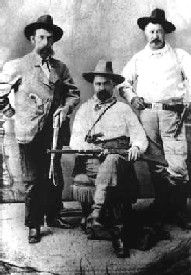
Pinkerton Agents aggressively pursued the members of the Wild Bunch.
If it were not for the prompt and energetic action of the express companies in persistently following up train-robbing gangs and never giving up the search until all the gang is landed in prison or killed, train robberies would be more frequent. A man who will rob an express company is a fugitive forever afterward until arrested or punished, as express companies are relentless in pursuing those who rob them. Still, it is not right that these companies should be obliged to take these steps and go to the great expense they are frequently having to arrest or exterminate these highwaymen. They are as much entitled to protection under the law as is a private individual, but, being corporations, they do not get this protection. Still, they must spend large amounts of money to protect themselves.
Express companies which carry large sums of money are seriously considering the advisability of placing the money rates so high that the banks will be forced to use the United States mails for the transport of their money, so that the robbers, to get the money, must “hold up” the United States mails as well as the express companies, thus making such a robbery a government offense. The express companies are now running their heavy money trains with guards armed with the latest improved style of revolvers and Winchesters. These guards are men known for their determination and nerve, and will most likely give a warm reception to the next gang that attempts to rob a train anywhere in the country. The express companies are also placing burglar-proof safes in their cars. These safes are strongly constructed, so it will take the robbers hours to get into them, and if they are blown up, the money will be destroyed, so that it will not do the robbers any good. The safes are locked in New York and cannot be opened by anyone until they arrive in Chicago or another destination, and the messenger does not know the combination.
Written by William A. Pinkerton, 1893, compiled and edited by Kathy Alexander/Legends of America, updated October 2026.
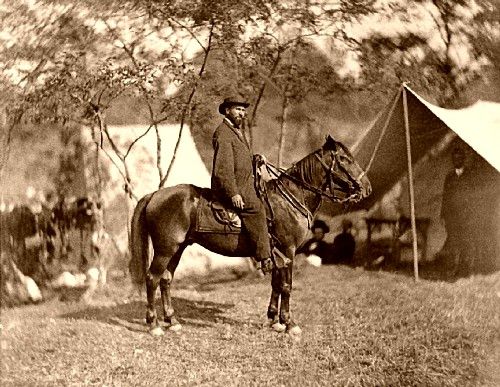
Allan Pinkerton, William’s father, 1862.
Also See:
The Pinkertons – Operating For 150 Years
Historical Accounts of American History
Highwaymen of the Railroad, written by William A. Pinkerton of the Pinkerton Detective Agency, appeared in The North American Review in November 1893. William’s father, Allan Pinkerton, a Scottish immigrant, founded the Pinkerton Agency in 1850. He quickly became one of the most important figures in crime detection and law enforcement in the latter half of the 19th Century. William and his brother Robert worked at the agency and eventually took it over after their father died in 1884. Though no longer family-run, Pinkerton’s Inc. is still in business today. The text that appears here has been edited for punctuation and updated for the modern reader.