
Real Characters: (All cast photos courtesy HBO)
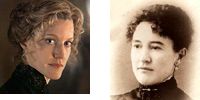
Martha Bullock – Played by Anna Gunn in the series, Martha was Seth’s childhood sweetheart. The two married in Salt Lake City, Utah, in 1874, and she went back with him to Helena, Montana. However, when Seth moved his business to Deadwood with Sol Star, Martha and their infant child, Madge, went to stay with her parents in Minnesota. After Seth got the business going in Deadwood and helped tame the lawless mining camp, Martha and her daughter came to Deadwood. The couple had two more children, and Martha became a pillar of the Deadwood community.
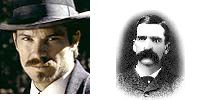
Seth Bullock – Hailing from Canada, Bullock started out in Helena, Montana, as a young man. There, he met Sol Star, and the two began a hardware business before chasing the gold strike to Deadwood. Bullock spent most of his life as a lawman in various capacities and was a successful entrepreneur, rancher, and politician. He and his wife, Martha, who became a pillar of the Deadwood community, had three children. Bullock built the Bullock Hotel, which continues to stand in Deadwood today.

Johnny Burns – While little is known about this real character, he did work for Al Swearengen at the Gem Theatre. His job at the Gem was as a Box Herder, a term used to describe the person in charge of the “girls” and keeping them in line. Unfortunately, Burns was said to have been brutal on the “ladies,” beating them often.
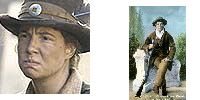
Calamity Jane – Calamity Jane was renowned for her excellent marksmanship, preference for men’s clothing, and bawdy behavior. Jane was said to have been an Army scout, a bullwhacker, a nurse, a cook, a prostitute, a prospector, a gambler, a heavy drinker, and one of the most foul-mouthed people in the West. In June of 1876, she partnered with Wild Bill Hickok as an outrider for Colorado Charlie Utter’s wagon train, galloping into Deadwood with a shipment of prostitutes fresh from Cheyenne. Calamity Jane claimed to have been Hickok’s lover for the remainder of her days. But the record shows that Wild Bill had just recently married, and his letters home from Deadwood indicate that he was happily wedded. Calamity Jane requested to be buried next to Wild Bill Hickok when she died, and there she rests.

Dan Doherty (spelled Dority in the series) – Doherty acted as Al Swearengen’s general manager at the Gem Theatre when it first opened in 1877 and was also rough with the women. Two years later finds Doherty partnering up with a man named Johnny Cooley and opening their own saloon. Somewhere along the line, Doherty married while in Deadwood. He stayed in the camp until the late 1880s when he moved on to Nevada.
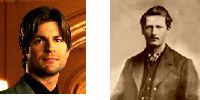
Wyatt Earp – A lawman and gunfighter from Missouri, Wyatt served as a Lamar, Missouri, constable before moving to Ellsworth, Kansas, in 1873, where he was appointed marshal. A year later, he was in Wichita before moving on to Dodge City in 1876. Following the gold rush with all the rest of the fortune seekers, Morgan and Wyatt Earp came to Deadwood in September 1876 and stayed until the following Spring. Some say there was a confrontation between Wyatt Earp and Seth Bullock; however, the local newspapers of the time, which reported even the most trivial events, fail to support this account. By 1880, Wyatt was in Tombstone, Arizona, when his brother Virgil appointed him deputy city marshal. He is best known for participating in the Gunfight at the O.K. Corral along with Doc Holliday, Virgil Earp, and Morgan Earp. When Earp wasn’t working as a lawman, he also worked as a teamster, buffalo hunter, gambler, and saloon keeper. Gale Harold plays Wyatt Earp on the HBO Series.

E.B. Farnum – Before coming to Deadwood, E.B. Farnum, his wife, and three children lived in Wisconsin. One of the first non-mining residents in Deadwood, E.B. Farnum, opened a retail store in 1876. Seeing the camp’s growth potential, he also secured claims to several other Main Street lots. Soon joining up with other area businessmen, the group financed and built the Deadwood-to-Centennial Toll Road to ensure the camp could get its needed supplies. The successful Farnum went on to invest in several Deadwood mining ventures. On August 18, 1876, he was elected mayor of Deadwood, and he worked first to obtain official recognition of the settlement from the Dakota Territorial government. Soon, salaries and maintenance costs were paid with new fees levied on Deadwood’s businesses. Farnum was also active as the head of the school board, which established Deadwood’s first school. He also acted as the Justice of the Peace and judge for the community. The following year, when duties were split up, he failed in his bid for Justice of the Peace, and about a year later, he and his family left Deadwood for Chicago, Illinois.
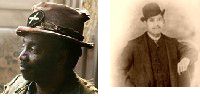
Samuel Fields – More often referred to as the “Ni**er General,” Fields was a “real” character in Deadwood’s history. Described with words like irrepressible, duplicatory, and candescent, Samuel Fields first appeared in Deadwood during its booming mining camp days with the many other hundreds of men hoping to find their fortunes. The flamboyant man, who went about saying that he had been a general in the Union Army during the Civil War, was referred to by many names, including General Fields, General Darkey, and Sly-coon, as well as “Ni**er General.” Seemingly unperturbed by the racial slurs, Fields’ antics in the camp made headlines in Deadwood’s various newspapers almost immediately upon his arrival. By 1889, he was known to have been working in Omaha, Nebraska, but a year later, he was again back in South Dakota working as a bellhop in Rapid City, after which he is lost in history. Franklyn Ajaye plays the character in the series.
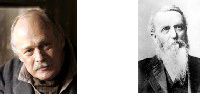
George Hearst – In June 1877, George Hearst, who had earlier sent agents to offer a bond to owners of the Homestakeclaim, bought the four-and-one-half-acre claim for $70,000. George Hearst was a mining tycoon who had already made millions in Utah, Nevada, California, and Montana. The man was almost illiterate and loved poker, bourbon, and tobacco. In later life, his sole ambition was to be a politician, which eventually led to the Hearst publishing empire.

Wild Bill Hickok – Born in Troy Grove, Illinois, on May 27, 1837, Hickok was an excellent marksman even in his youth. Always enamored of the frontier west, Hickok joined the pioneers when he was just 17 years old. Soon, he worked as a freighter on the Oregon and Santa Fe Trails, where he perpetuated his reputation with his gunfighting skills. He also served as a marshal in several Old West settlements and as an Army scout. During his travels, he became a proficient gambler. Touring with Buffalo Bill Cody in his Wild West Show, Hickok was well known when he arrived in Deadwood in 1876. However, his stay in the rough and tumble camp would be a short one, as he was murdered by Jack McCall while playing poker in a Deadwood saloon on August 2, 1876.
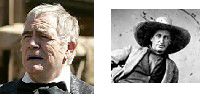
Jack (John) Langrishe-Langrishe, the gay stage promoter and friend of Al Swearengen who tries to bring culture to the mean streets of Deadwood, was a real character during Deadwood’s booming mining days. Though not gay and unlikely to have been a friend of Swearengen’s, Langrish was an actual theatre owner and promoter who preferred working in the Old West to Broadway in New York. Married to a wife named Jenette, the pair opened several theatres during their careers, including one in Denver, Colorado, another in Helena, Montana, and the one in Deadwood. Before erecting a permanent building for his theatre, Langrishe temporarily operated out of the Bella Union.

Lucretia “Aunt Lou” Marchbanks – Except for “Aunt Sally” Campbell, who came with the Custer Expedition in 1874, most believe that Lucretia Marchbanks was the first black woman in the Black Hills of South Dakota. Born a slave in Tennessee, Lucretia began traveling west after being freed, working in the gold camps of Colorado before being lured by reports of gold in the Black Hills. Arriving in Deadwood on June 1, 1876, she soon found work as the Kitchen Manager in the Grand Central Hotel. In no time, the hotel, which wasn’t so grand, was better known for the great food served in its restaurant, and Lucretia became better known as “Aunt Lou.” Aunt Lou went on to own a boarding house before retiring to ranch life in Wyoming. Although she may have met George Hearst while working at the DeSmet Mine, she never worked directly for him.
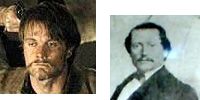
Jack McCall – Unfortunately, this cowardly and drunken figure was real. Born around 1851 in Jefferson County, Kentucky, he was raised there with his three sisters. McCall drifted west as a young adult, joining a group of buffalo hunters. By the time he arrived in Deadwood in 1876, he was going by the name of Bill Sutherland. McCall felt insulted when Wild Bill gave him money to buy himself something to eat after losing at a poker game, and shot him from behind the next day. In the first trial, found illegal later, McCall claimed that Hickok had shot his brother in Abilene, Kansas, and was found innocent. McCall hung about Deadwood for several days until a man called California Joe strongly suggested the air might be bad for McCall’s health. McCall got the message and, believing he’d escaped punishment for his crime, headed to Wyoming, bragging to anyone who would listen that he had killed the famous Wild Bill Hickok. Less than a month later, the trial held in Deadwood was found to lack legal authority, as Deadwood was located in Indian Territory. McCall was arrested in Laramie, Wyoming, on August 29, 1876, charged with murder, and taken to Yankton, South Dakota, to stand trial. On March 1, 1877, Jack McCall was put to death by hanging. As to McCall’s earlier claim of having shot Hickok out of revenge for his brother, it was discovered that Jack McCall never had a brother.

Albert W. Merrick – Born about 1839 in New York, Merrick worked in Denver, Colorado, before he and another man, W.A. Laughlin, established the Pioneer newspaper in Deadwood. The first edition was published on June 8, 1876. However, Merrick didn’t own the paper for long, as he sold it to R.O. Adams in 1879. Historically known as the first newspaper west of the Missouri River, the newspaper is still in publication today. However, it is located in Spearfish, South Dakota. Merrick was married to Ray and had three children. Unfortunately for the Merrick’s, they lost their 8-year-old son, Walter, on October 8, 1880, when he died of inflammation of the bowels. They also lost an infant daughter in 1884. Daughter,

Tom Nuttall – Played by actor Leon Rippy, Tom is based on an actual Deadwood figure named William “Billy” Nuttall. Billy was one of the proprietors of Nuttall & Mann’s Saloon No. 10 when Jack McCall shot Wild Bill Hickok on August 2, 1876. However, history next finds him involved in a partnership with Tom Miller, the owner of the Bella Union Theatre, in the summer of 1877. Securing several talents to the Bella Union, Nuttall managed the property when it was purchased by Mr. McDaniels in 1878 and leased to Billy Nuttall soon after that. The following year, Nuttall is in Leadville, Colorado, along with a score of other Black Hillers who had followed the mining rush. There, he opened another “Bella Union” in the summer of 1879, utilizing many of the actors he had previously hired in Deadwood. While in Leadville, his wife left him in 1880, and by 1882, he was in a New Mexico jail for a gambling violation.
Reverend Henry Weston Smith – Born in Ellington, Connecticut, on January 10, 1827, Smith first married in 1847, but his wife and infant son died a year later. In 1850, he became a Methodist preacher. In 1859, he remarried Lydia Ann Joslin, and the couple had four children. Smith served in the Civil War and became a doctor. In 1876, he followed the gold rush to Deadwood, becoming the first preacher of any denomination in the Black Hills. Smith never had a church in Deadwood but used the dirty streets of the mining camp as his sermon mount. To make ends meet, the preacher did a little prospecting and worked at odd jobs. On August 20, 1876, Smith, along with Sheriff Isaac Brown, Charles Mason, and Charles Holland, were killed on the road between Crook City and Deadwood. The men were thought to have been killed by Indians. The Reverend Smith was 49 years old. His body now lies at Mount Moriah Cemetery, among the other notable characters of Deadwood.

Sol Star – Born into a Jewish family in Bavaria, Germany, on December 20, 1840, Star migrated and was sent to live with his uncle in Ohio when he was about ten years old. As he grew into a young man, he moved to Helena, Montana, where he soon began a hardware business with Seth Bullock. The pair followed the Deadwood gold rush in August 1876. Star and Bullock expanded their business interests by purchasing a ranch, where they raised livestock and partnered in the Deadwood Flouring Mill in 1880. Star was one of the first town councilmen elected in 1876, served as postmaster in 1878, and was elected mayor in 1884, a position he held for 14 years. Sol Star never married. John Hawkes plays the character on the HBO Deadwood Series.

Con Stapleton – Though the series shows Stapleton as a dim-witted card dealer at the Number 10 Saloon, who gained his short-lived marshal’s position by begging Al Swearengen to appoint him, Stapleton actually was elected marshal by the miners on September 16, 1876. The first marshal elected by the Miner’s Court was Isaac Brown, an event that occurred after Jack McCall’s trial on August 5, 1876. But for Marshal Isaac Brown, being a lawman would be a short-lived career. When he, along with the Reverend Smith and two other men named Charles Mason and Charles Holland, were traveling between Crook City and Deadwood, they were ambushed and killed on August 20, 1876. Leaving an open position, the miner’s court soon met again, electing Stapleton as the new marshal. Seth Bullock was never the City of Deadwood’s marshal but was actually the Lawrence County Sheriff, a position he didn’t hold until March 1877. After becoming the Deadwood Marshal, one of Stapleton’s favorite pastimes was organizing wrestling matches, most often at the Gem Theatre. Sometimes he acted as a referee and at others as a participant. Con Stapleton died in Denver, Colorado, on September 10, 1879. Peter Jason plays Stapleton’s character on the HBO Series.

In real life, Al Swearengen – Al Swearengen was every bit as ugly as the character played in the Deadwood series. What they don’t tell you is that the man lured dozens of women to the camp by falsely promising good jobs at local hotels and to make them stage performers at his popular Gem Theatre. Once they arrived, the women were virtually forced into white slavery or thrown into the street. The man was married three times and was brutal to his wives and the women who worked for him. The Gem Theatre caught fire twice in 1879, the second time burning it to the ground. On both occasions, Swearengen rebuilt. Twenty years later, it was demolished again by a third inferno. By this time, Swearengen called it quits and left Deadwood for good. The drunk and penniless Swearengen was killed not long after while trying to hitch a ride on a Colorado train like a common tramp.

Trixie – This is more than a little “iffy.” Reportedly, there were several “Trixies” who came and went during the Gem Theatre’s twenty-two years of operation. Potentially based on any one of the many women, one woman with the name spelled “Tricksie” shot a man at the Gem Theatre after he had beaten her. Though she shot him in the head, he didn’t immediately die. The doctor was quickly called in, who put a probe through the man’s skull, amazed that he survived the gunshot at all. However, this nameless man did die about thirty minutes later.

Charlie Utter – Though Charlie Utter was very real, his real-life persona was much different than that portrayed on the HBO series by Dayton Callie. The show depicts Utter as an unkempt man who is often uncomfortable around others. He took a lot of pride in his appearance in real life, often dressing in hand-tailored suits and keeping his long blonde hair and mustache meticulously groomed. Even more unusual for the times, he insisted on taking a daily bath. Utter was born near Niagara Falls, New York, in 1838 and spent his childhood in Illinois. When he grew up, he moved west, and in the 1860s, he earned a living as a trapper and a prospector in Colorado. Over the years, Charlie was a hunter, trapper, gold prospector, mine owner, express rider, and transportation businessman. Long before arriving in Deadwood, he had become a true friend to Wild Bill Hickok. Out of the most genuine respect for his friend, he claimed Bill’s body when he was killed, arranged a proper funeral, and placed a marker at his gravesite.