
by Jennifer M. Murray
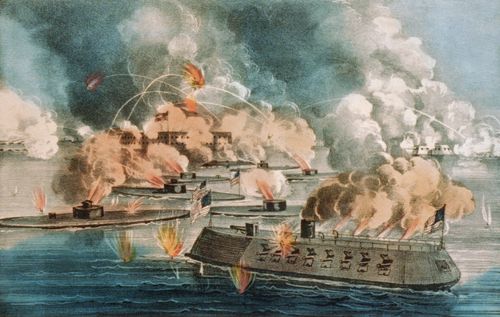
The great fight at Fort Sumter, South Carolina, April 7, 1863, by Currier & Ives.
By the winter of 1860–1861, the United States was on the brink of Civil War. For decades, differing views on slavery had created a growing divide in the nation, making it impossible to reach any lasting political compromise. The Kansas-Nebraska Act of 1854, which allowed residents of a territory to vote on whether to enter the Union as a slave state or a free-state, only intensified the conflict. This led to violent confrontations in Kansas, which threatened to spread to neighboring states and territories.
In October 1859, just a year before the presidential election, John Brown, supported by northern abolitionists, seized the federal arsenal at Harpers Ferry, then located in the slave-holding state of Virginia, in an attempt to spark a slave uprising. Although federal troops quickly suppressed the revolt, tensions were high on both sides as the nation headed to the polls in November 1860.
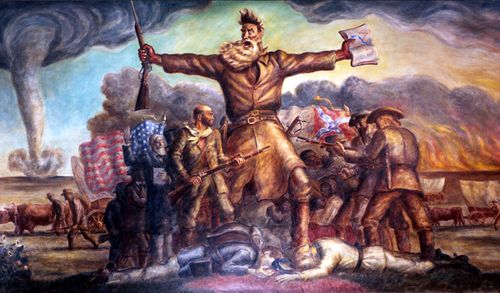
John Brown Painting.
By a narrow margin in the electoral vote, Abraham Lincoln, a Republican from Illinois, was elected as the 16th president of the United States on November 6, 1860. In the following weeks, the country began to fall apart. The situation deteriorated further under the lame-duck administration of President James Buchanan, which struggled to manage the crisis.
On December 20, 1860, delegates at a meeting in Charleston, South Carolina, voted to secede from the Union to protect slavery. Following their lead, other states also decided to secede. Mississippi seceded on January 9, 1861; Florida on January 10; Alabama on January 11; Georgia on January 19; Louisiana on January 26; and Texas on February 1.
The Army’s effectiveness declined significantly as many key officers resigned to join the Confederacy. At the end of 1860, there were 1,080 active-duty officers, but 286 of them left to support the South. This loss included many experienced commanders, which further weakened the Regular Army. Meanwhile, the Confederacy organized its forces and seized hundreds of cannons and 159,000 small arms from southern arsenals and forts, quickly surpassing the Union in numbers.
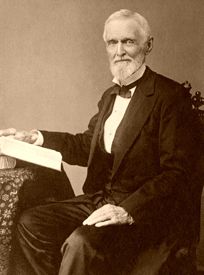
Jefferson Davis by C.E. Emery, about 1888.
On February 9, 1861, delegates from the seceded states met in Montgomery, Alabama, to lay the foundation of the newly formed Confederate States of America. The convention chose Jefferson F. Davis, a U.S. senator from Mississippi, as president, and Alexander H. Stephens of Georgia as vice president. A Kentucky native, Davis graduated from the U.S. Military Academy in 1828, fought in the Mexican-American War, and later served as secretary of war. In his inaugural address on February 18, Davis said that “henceforth, our energies must be directed to the conduct of our own affairs, and the perpetuity of the Confederacy which we have formed.”
During the winter and spring of 1861, both the Union and the Confederacy were actively recruiting and mobilizing for war. As both sides relied on their state militias as the core of their armies, they were able to field large numbers of troops quickly. On March 6, the Confederacy established the Army of the Confederate States of America. Multiple calls for one-year volunteers from the Confederate government quickly increased the number of men ready to bear arms to 182,000.
Abraham Lincoln took the oath of office on March 4, 1861, in the shadow of the unfinished Capitol building. In his own inaugural address, he declared that he had no intention of abolishing slavery in states where the institution existed. Proclaiming he would not initiate a war, Lincoln informed Southerners:
In your hands, my dissatisfied fellow countrymen, and not in mine, is the momentous issue of Civil War. The government will not assail you. You can have no conflict without being yourselves the aggressors.
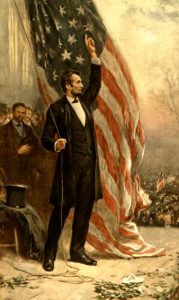
Abraham Lincoln, by Jean Louis Gerome, 1908.
President Lincoln maintained that the Union was perpetual and promised to enforce the laws while also “holding, occupying, and possessing” Federal property within the seceded states. However, despite Lincoln’s pledge, the states that had left the Union seized numerous U.S. arsenals, forts, and mints. Only a few facilities—such as Fort Sumter in Charleston, South Carolina; Fort Zachary Taylor in the Florida Keys; and Fort Pickens in Pensacola, Florida—remained under Federal control.
On March 9, Lincoln convened his first cabinet meeting to discuss whether the forts should be abandoned. While the Florida forts were not in immediate danger, South Carolina state troops had surrounded Fort Sumter. Secretary of State William H. Seward argued that reinforcing Sumter was not worth the risk of igniting a war and encouraging other slave states to secede. Postmaster General Montgomery Blair was the only member of the cabinet in favor of reinforcing Fort Sumter. He contended that evacuating the fort would weaken Lincoln’s presidency and provide the newly formed Confederacy with a significant symbolic victory.
To buy time for pro-Union supporters in the South, President Lincoln chose to maintain existing garrisons rather than abandon them or send reinforcements. His decision stemmed from both a desire to avoid violence and the fact that the U.S. Army was unprepared for war. Of the 16,000 soldiers in the Regular Army, less than 1,000 were in the eastern United States, while the rest were spread across the American West.
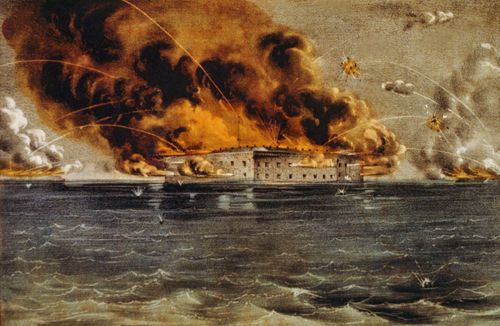
Bombarding Fort Sumter, April 1861 by Currier & Ives
However, the Civil War began on April 12, 1861, when Confederate forces fired upon the Union-held Fort Sumter in Charleston Harbor, South Carolina.
Federal mobilization began on April 15, when President Lincoln called on the Union states to provide 75,000 militiamen for a three-month term. On May 3, he issued a proclamation to enlist 64,748 three-year volunteers for the Army and 18,000 for the Navy. This brought the total force, including an increase in the Federal Army, to 181,461, of whom 75,000 were serving for only three months.
The rise of volunteer armies compelled both Lincoln and Davis to appoint generals who might not have otherwise been qualified for the positions. Lincoln strategically used military appointments to gain broader support for the war from various factions. To secure backing from Democrats, he appointed Benjamin F. Butler and Daniel Sickles. To gain the support of German Americans, he commissioned Franz Sigel and Carl Schurz. However, Lincoln was careful not to overindulge in political appointments. The majority of the first 40 volunteer units that were formed were led by regulars on active duty, graduates of the U.S. Military Academy, or individuals who held volunteer commissions during the Mexican-American War.
To lead the Confederate troops, Davis appointed 89 generals, about half of whom were professionals. Employing somewhat different criteria, Davis chose generals based on personal relationships rather than attempting to strengthen ties with a particular faction. However, Davis never conferred higher responsibilities than brigade command on unproven volunteer officers.
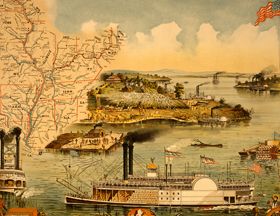
Mississippi River steamboat.
In 1861, the geographic situation appeared to favor the South. Borrowing from the antebellum U.S. Army system, Davis divided the Confederacy into eight departments. He dispersed his military forces around the Confederacy’s perimeter in the hope that the sheer size of the new nation would work in its favor by making it difficult for Federal commanders to coordinate multiple thrusts into Southern territory. The Southerners planned to counter Federal offensives by transferring troops from unthreatened areas to reinforce any department under attack. The Confederates retained control of only 20% of the estimated 1,000 Mississippi River steamboats. A successful defense of Confederate borders would demonstrate that the new nation could protect its sovereignty, increasing its chances of international recognition.
Demographics and industry, on the other hand, favored the North. The 1860 census revealed that 5,582,222 whites and 3,521,110 slaves made up the population of the eleven states that would eventually secede. The remainder of the Union, including Delaware, Kentucky, Missouri, and Maryland, numbered 21,907,405 whites and 432,586 slaves. As a result, the Union could call on four million military-age white males, while the corresponding figure for the Confederacy was one-fourth of that number. The Union also had ten times the industrial capacity, including almost all of the shipbuilding yards and foundries. transportation capabilities were similarly skewed.
On land, the North had 22,085 miles of railroads, nearly three times as many as the 8,541 miles available to the Confederacy. These advantages were important to the North because riverboats and railroads were about to become key components of logistics and maneuver. One train car carried the equivalent of 20 wagonloads of military supplies, while a large riverboat could transport enough materiel to sustain 40,000 men and 18,000 horses for two days.
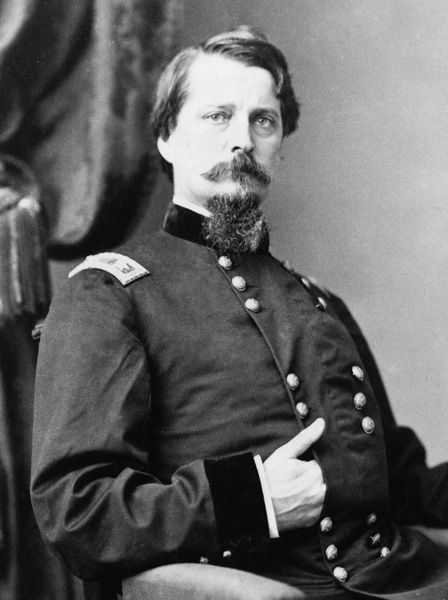
General Winfield S. Hancock.
The responsibility for arranging the North’s advantages into a coherent plan fell to Lieutenant General Winfield S. Scott, general in chief of the U.S. Army. Commissioned in 1808, the 74-year-old Virginian commanded troops in battle during the War of 1812, Second Seminole War, and Black Hawk War, before rising to the position of commanding general. During the Mexican-American War, Scott led the southernmost of two American armies to victory at Cerro Gordo, Contreras, Churubusco, and Molino del Ray before capturing Mexico City. On the eve of Lincoln’s inaugural address in March 1861, Scott sent the president a memorandum outlining four potential courses of action. Only one option suggested military force. The remaining options were to impose an economic blockade on the South, accept a diplomatic compromise, or allow the South to secede. Scott’s memorandum reflected a widely held Federal assumption that Southerners had been led into secession by a phalanx of radicals and that a hard war strategy directed against civilians would be counterproductive.
Accordingly, Scott’s military option aimed to minimize bloodshed and violence. Arguing against a full-scale invasion of the South, Scott proposed a two-pronged offensive, starting with a blockade of the Southern coastline and along the Mississippi River. With the seaboard and internal waterways in Union hands, Scott called for “a powerful movement” of 60,000 Federal soldiers down the Mississippi River— one column on riverboats and another by land—to divide and conquer the South. After some deliberation, Lincoln accepted portions of Scott’s proposal and, on April 19, ordered the blockade of the Confederate coastline. Outrage emerged in Northern quarters at what the press called Scott’s Anaconda Plan, with its too-slow squeeze of the enemy states. Some journalists and politicians called for an immediate attack on Richmond, Virginia, and a quick, decisive end to secession and war. The critics thought that one sharp battle in Virginia ought to be enough to snuff out the illusions of Southern nationhood.
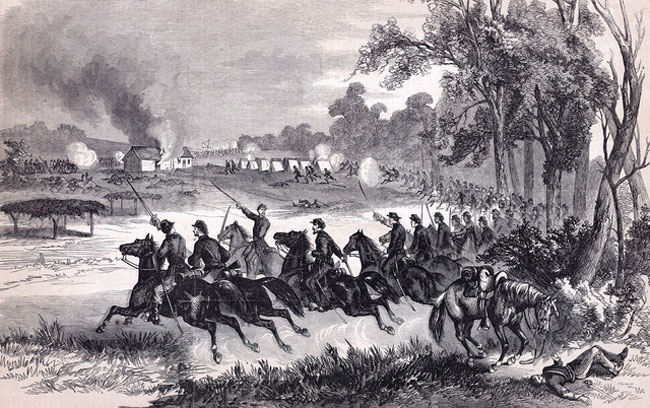
Cavalry in the Civil War.
Written by Jennifer M. Murray, Center of Military History, United States Army, 2012.
Compiled and edited by Kathy Alexander/Legends of America, March 2026.
Also See: