
By Wilbur Fisk Gordy, 1917
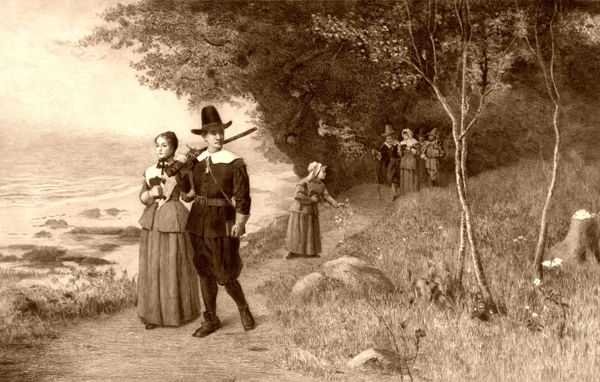
Pilgrims holding Bibles.
In the early days of American settlement, many immigrants came to the New World to worship as they saw fit without punishment. Some people loved the Church of England but wished to simplify their worship. They were called Puritans.
Some of them disliked the forms of worship so much that they wished to separate from the Church of England and form a church of their own. These people later came to be called Pilgrims because they traveled extensively in pursuit of their religion. Before they left England, these people met for Sunday service in the home of William Brewster, one of their chief men. He lived in the small village of Scrooby.
For a year, they tried to worship on their own. But the law did not permit secret meetings. So when they were found out, they were punished, and some were imprisoned. This was difficult, and after a while, they decided to leave England and seek homes in Holland, where they knew they could worship God as they pleased.
But as the king wanted his own way, he was unwilling to let them go, so it was not easy for them to carry out their plan. Yet in 1608, a year after the settlement of Jamestown, Virginia, they managed to escape and sailed to Amsterdam, later moving to Leyden. They were well treated in Holland and found work as weavers, tailors, carpenters, and in other roles. However, they felt like strangers in a strange land and were unhappy. It was more difficult for them to make a living there than in England, where most were farmers. Even after they had been in Holland for many years, they still loved England and did not get over longing for the English ways of doing things. It made them sad to see their children growing up as Dutch children and speaking Dutch instead of English. Finally, they said, We will go to America, where we can worship God and raise our children in our own way.
But the English king was unwilling to let them settle in America, and they were poor, making it difficult to raise money for the voyage. At last, the king promised he would not trouble them in America if they did nothing to displease him there. So the money needed for the voyage was borrowed, and after some time, the company was prepared to leave Holland. They sailed in a small vessel called the Speedwell. But not all of them could leave; some were too old and weak, and the parting was sad. The pastor, who stayed in Holland, knelt on the shore and asked God to bless those of his flock who were heading to the far-off land.

Mayflower.
At Plymouth, England, the Speedwell was joined by a larger vessel, the Mayflower. Twice the Pilgrims set out, and they had to return because the Speedwell leaked. Finally, they had to leave her behind and crowd as many as possible into the Mayflower. On September 6, 1620, they made the final start. There were about 100 people on board, among them 28 children. It was a terrible journey. Day after day, heavy storms and high winds tossed the boat about as if it were a cork. The sails were torn, and at times it seemed as if the vessel would be lost in the raging waves. Despite the storms, however, the ship sailed safely to the end of its voyage, and on Saturday, November 21, 1620, she anchored in what is now called the Harbor of Provincetown.
They had taken 64 days to cross the Atlantic Ocean, whereas our modern steamships today make the crossing in less than a week. Before anyone landed, the Pilgrims gathered in the cabin of the Mayflower and agreed to stand together and obey such laws as they might pass later. They elected John Carver as their governor and Captain Myles Standish as their military leader. Captain Standish was not a Pilgrim, but he liked these brave men and enjoyed the adventure. He was a small man but active and daring. He was also a brave soldier and was a significant help to the Pilgrims in meeting the dangers of their new life. Without delay, a few men, with Myles Standish as the leader, headed ashore to look for a place to settle. At night, they returned without having found one.

Myles Standish.
As the next day was Sunday, all stayed on board the ship and listened to a sermon preached by their minister, Elder Brewster. On Monday morning, the company landed. The water was too shallow to float the boat, so the men had to wade ashore carrying the women. The weather was so bitterly cold that their wet clothing soon stiffened with ice. But fires were lit at once. While the women were busy washing clothes, the men stood on guard with muskets ready in case wild beasts or Indians attacked them.
The Pilgrims had brought with them a shallop, or small boat, which they expected to use in exploring the coast. While it was being built, Captain Standish and his men went out on land to search for a suitable place to settle. They went as soldiers and put on all their armor. They wore steel helmets, iron breastplates, and quilted chainmail.
Some of them, including Captain Standish, had swords hanging at their sides. All carried big, heavy muskets that had to be rested on some support before firing. The Pilgrims had not gone more than a mile when they noticed Indians running away. Then they came across a patch of land cleared for corn and a hut. Inside was a large iron kettle that had been used for cooking. Looking about, they came upon some mounds in which were bows and arrows. In one were baskets of corn stored away. The Pilgrims took some of the corn for seed, but they were very careful to pay the Indians for it later.

Mayflower Pilgrims.
While on this trip, William Bradford had a strange accident. As he was picking his way through the underbrush, he was suddenly jerked upward and held dangling by one leg in mid-air. His foot had been caught in a deer trap, and he was quickly set free. After a two-day search, the exploring party returned to the Mayflower without finding a suitable place for a settlement. Ten days after that, another party ventured out, this time in the shallop, but they also failed. It was now two weeks since the Mayflower had landed. The Pilgrims were tired and were longing for a home.
Additionally, winter was already upon them, and they needed to get settled. On December 16, ten men set out again in the shallop. The day was bitterly cold. The ocean spray, blown by the wind, froze to ice on the men’s clothes.” The ocean spray, blown by the wind, froze to ice upon the men’s clothing. Yet they bravely went forward. When it grew dark, they headed ashore for the night. To protect themselves against the Indians and to keep from freezing, they built a barricade of logs, sticks, and boughs, five or six feet high, and kept a huge fire burning inside. With their cloaks wrapped around them and their feet turned toward the fire, all but the watchful sentinel lay down to sleep. The great forest trees were their only shelter that cold winter night. On the second morning, before daybreak, all were astir, some preparing breakfast and others putting supplies into the boat. Suddenly, a strange cry made everyone stop to listen. It was the war whoop of the Indians. Then a shower of arrows fell upon the small Pilgrim band. For a time, the fighting carried on briskly. But when Captain Standish wounded the leader of the Indians, they quickly fled, and the Pilgrims took to their shallop. This was but the beginning of a day full of danger. A furious storm of snow and rain caught them late in the afternoon. They were in great peril and struggled to stay afloat. Just before dark, a big wave almost swallowed them up. Soon their rudder was swept away, and then an angry gust of wind struck the mast and snapped it into three pieces.
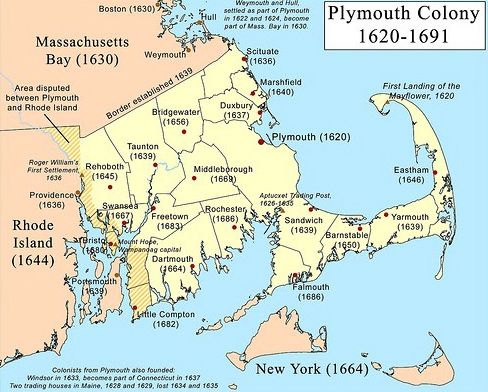
Plymouth Colony Map.
Finally, they landed safely on an island where they found shelter. Here, they kindled a fire to warm themselves and dry their wet clothing. Sunday, as usual, had been set aside as a day of rest. But on Monday, December 21, they went to the mainland and, at last, chose a place to settle. They were not long in getting back to tell the company, and the same day the Mayflower entered the harbor, the Pilgrims made a landing. One month had passed since they cast anchor near Cape Cod. They named the place Plymouth.
A good harbor, pure drinking water from a running stream, and a hill nearby to build a fort, they must have, and all these they found at Plymouth. There were also several acres of cleared land that the Indians had used some years earlier. As soon as the settlers arrived, they”>settlers had landed, everybody set to work. We can almost see the busy men and boys, some eagerly chopping down trees, others sawing trunks into logs of proper length, and still others dragging the logs to the places where they were to be used. All this had to be done by hand because the Pilgrims brought no horses or other animals except a dog or two.
While the men and boys were getting into the work with a big appetite, the women and girls were busy kindling fires, washing clothes, cooking, and doing the many things needed for the family’s comfort. How good it would be to have a home once more. The first building they built was a 20-foot square log house. This was to serve as the common storehouse and shelter until they could build separate houses.

Pilgrims’ House.
The logs were laid upon one another to form the walls of the buildings. Then the cracks were filled with straw and mud, and the roof was covered with reeds. The windows were made of oiled paper. When they later built their houses, they placed them in two rows for safety, one on each side of the street that led from the harbor up the hill. At the top stood the fort, where they could defend themselves if the Indians attacked them. During that first winter, their food was plain, and there was not enough of it. Bread made of wheat, rye, or barley was about all they had. Only once in a while, when someone killed a deer or a wild fowl, did they have any meat to eat; for, like the planters of Jamestown, the Pilgrims had no chickens or cows. All they had to drink was cold water.
Besides having too little food, the Pilgrims suffered much from the cold. Until their dwellings were finished, some had slept on board the Mayflower. With many other hardships, including scant food and a lack of warm clothing, the people suffered greatly. At one time, only Elder Brewster, Captain Standish, and five others were well enough to take care of the sick. Standish was very gentle and kind in sickness and made an excellent nurse. He also cheerfully helped with the cooking, washing, and other household duties.
At times, there was a death every day, and at the end of the first winter, one-half of the settlers had gone. Yet despite all this suffering, no one would leave Plymouth when the Mayflower sailed back to England in the spring. They felt they must complete the work they had set out to do, and that it was not right to give up.

Samoset meets the pilgrims.
Although they constantly dreaded attacks from the Indians, it was nearly three months before an Abenaki Indian showed himself at the settlement. Then, one day in March, a dusky stranger was seen coming down the village’s street. His first words were: Welcome, Englishmen. This was Sam-o-set. Where do you suppose he learned those English words? A week later, he returned with a friend named Squanto.
Squanto had formerly lived at Plymouth with other Indians, who had been swept away by a plague. That was why the Pilgrims found the cleared land deserted. Squanto was glad to get back to his old home. He liked the Pilgrims so well that he was willing to live with them and taught them many things. He showed them how to hunt, catch fish, plant corn, and feed the soil so it would grow. About a week after Samoset made his first visit to Plymouth, he came again, bringing the chief, Mas-sa-soit with him. Captain Standish, with his company of soldiers, went out to meet the Indian chief and escort him to Governor Carver. This was an important meeting. The Pilgrims spread a green mat upon the cabin floor and covered it with cushions for the chief and the governor to sit upon.
Plymouth in the Early Days

Massasoit.
Amid the beating of drums and the blowing of trumpets, Massasoit was brought into the room where he met the Pilgrim governor. The two men agreed to be friends and keep the peace between the white and red men. This peace lasted for more than fifty years. With summer came easier times. There was much less sickness and much more food. In the autumn, they had good crops of corn and barley to store away and plenty of wild ducks, geese, turkeys, and deer, which they brought down with their guns.
Late in the autumn, Massasoit, with 90 Indians, came to pay a visit to Plymouth. They brought some deer with them, and the Pilgrims supplied the rest of the food. A three-day feast followed, and that was the beginning of our New England Thanksgiving. This feast made the Indians and white men even better friends than they had ever been. But not all the Indians were as friendly as Massasoit and his tribe. One day, a Nar-ra-gan sett brave ran through the village of Plymouth and threw into the governor’s house a bundle of arrows tied up in a snake’s skin. What does this mean? The Pilgrims asked Squanto. It means, said he, that the Indians wish to make war upon you.
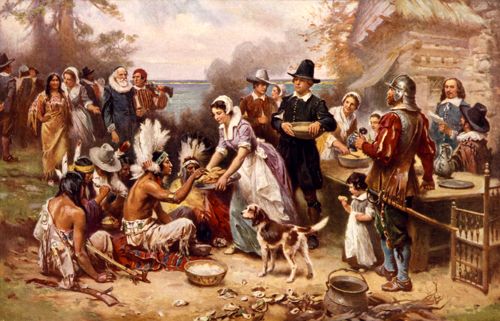
The first Thanksgiving with the Pilgrims. 1921 painting by Jean Leon Gerome Ferris.
But the Pilgrims made a very good answer. They at once stuffed the skin with powder and bullets and sent it back to the chief. When it came back to him in this way, he was afraid to touch it. He was not even willing to let it stay in his wigwam. So it was sent from place to place until it returned to Plymouth. However, the Pilgrims thought it wise to get ready for Indian attacks. They built a palisade of posts around Plymouth, 10 to 12 feet high. These were set deep in the ground, with their tops pointed up. They also built a large, square blockhouse on Burial Hill, or a thick-walled building with holes for firing their guns.
The lower part was used as a meeting house, where all kinds of meetings were held. On Sunday, it was a place of worship. But when they met on weekdays, they wished to discuss some plan for the public good, such as building a road or bridge. These weekday meetings were very much like our town meetings today. But the Pilgrims had other worries besides the Indians. They had borrowed a great deal of money when they came to the New World, and men and women alike had to work hard to pay it back. Yet by trading with the Indians, mainly for furs, by sending furs, fish, and timber to England, and by earning and saving in every way, they had freed themselves from debt at the end of six years. Such people were bound to succeed. They built a palisade of posts around Plymouth. far more, and that was the desire and the will to do what was right. But life in the colony was hard, and their numbers grew slowly. After four years, there were only 180 people and 32 houses.
The Puritans Come to New England
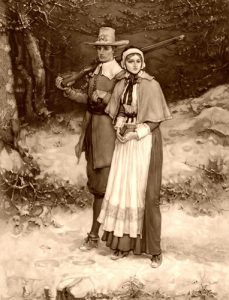
Puritans. By George Henry Boughton, 1884.
From time to time, news of the free life of the Pilgrims reached England, where the King, Charles I, was making it harder than ever for the Puritans. He believed that whatever he did as king was right and that all should obey him without question. The Puritans became so unhappy that many left their old homes and sailed for New England to build new ones in a free country.
They were not simple folk like the Pilgrims. Many were rich men, some belonged to families of high rank, and some had great learning.
A small company arrived in 1628 and settled in Salem, Massachusetts. But in 1630, the great body of Puritans began to come over in throngs. Over 900 people, led by John Winthrop, a rich lawyer and country gentleman, settled first at Charlestown before spreading to Boston and other nearby cities.
The first part of this company left England in eleven vessels, bringing horses, cattle, and many other things useful in settling a new country. After nearly nine weeks, they reached New England around mid-June. The sailing time had been carefully planned so they could reach their new homes early enough to prepare for winter. But despite their foresight, things did not turn out as they had hoped. Winter did not find them ready, and they had many hardships. The coarse food did not agree with them. Cornbread, bad drinking water, and poor shelter made many ill. Before December, 200 had died, yet nobody thought of returning. I am not sorry that I have come, said the leader, John Winthrop, a man of strong and beautiful character. When the future looked darkest, a fast day was appointed to ask for God’s help. But a supply ship came from England on the very day before it. Thus, the fast day became a day of thanksgiving.
The worst was over. Soon spring brought milder weather, the early wild fruits, and soon afterward, the new crops. Before another winter, they had learned how to make themselves more comfortable.
Roger Williams and Rhode Island

Roger Williams, founder of Rhode Island.
The Puritans valued their religion above all else. For its sake, they had given up their homes in England and most of what was pleasant in their lives. They didn’t want to lose their freedom to worship since it cost them so much. They thought that, above all else, they must not let any other religions grow up. So they made very strict laws. They said, “Everyone must go to the Puritan church.” No one may vote or participate in making the laws except for church members. Some of the Puritans did not like this. Among them was Roger Williams, a young man of gentle, noble, yet strong character. He was a minister, first at Salem, then at Plymouth, then again at Salem.
While at Plymouth, he took a deep interest in the Indians. Although he was so poor that he had to earn his living by farming and fishing, he gave much of his time to the red men. He studied their language and learned to know them well. He was kind to them in many ways, and they returned his love with kindness and goodwill.
When he returned to Salem, he got into trouble with the Puritans, for he said many things they did not like. You do not own the land you live on, he boldly declared. You got your claim to it from the King of England. But as he never owned the land, he had no right to give it to you.
You have no right, he went on, to tax people to support a church to which they do not belong. Nor have you the right to make people go to church. His bold talk startled the Puritans. Of course, they did not like it. Such ideas might make them no end of trouble if Roger Williams kept on preaching them. So they made him leave the colony. Bidding goodbye to his wife and children, he set out alone with only a compass for a guide. To keep from freezing, he carried an axe to chop wood, flint, and steel to kindle fires. His only shelter at night was a hollow tree or perhaps a covering of brush. After many days, he reached Mount Hope, and there the Indians sheltered him. He spent most of the winter in the wigwam of his good friend, Massasoit. In the spring, he started out in a frail canoe to a place where the Indians said there was good spring water. He found it and, with five or six friends who had joined him, made a settlement, which he called Providence. Such was the beginning of the Rhode Island Colony. At first, every man was welcome, and he could worship as he thought best or not at all if he chose.
Thomas Hooker and the Hartford Colony

Thomas Hooker’s Company reaches the Connecticut River.
Thomas Hooker’s Company reaches the Connecticut River. During the same year (1636) in which Roger Williams began the settlement of Rhode Island, Thomas Hooker”>Thomas Hooker led a company of settlers to the Connecticut Valley. Like Roger Williams, he believed that the Puritans were wrong in keeping all men except church members from voting and from taking part in making the laws. So, because of this belief and for other reasons, he and the members of his congregation at Watertown left Massachusetts to make new homes for themselves on the banks of the Connecticut River.
About 100 men, women, and children set out in June, driving 160 cattle before them. The children must have been very tired sometimes, but they must have had their frolics too. We may imagine them gathering wildflowers, listening to the birds, and eating their meals as if at a picnic under the leafy branches of spreading trees. The men carried packs on their backs and guns in their hands. There were no roads, nor even trails of Indians or wild beasts to follow through this wild region. A compass was their only guide on their journey of more than 100 miles through the woods. At last, they reached the place where Hartford now stands. They were much pleased with its beauty. The rolling hills, the broad river, the rich green meadows with Indian wigwams dotted here and there, and a few log cabins of early settlers made a welcome sight for the tired travelers.

Connecticut State House, New Haven, Connecticut, 1831.
The New Haven Colony
Two years later, another group of Puritans settled 30 miles west of the Connecticut River on Long Island Sound. In the spring of 1638, under the leafy branches of a great oak tree, John Davenport, their minister and leader, preached his first sermon.
As in Massachusetts, so here, none but church members were allowed to vote. There were no written laws, but all agreed to live by the Word of God. Such was the beginning of the New Haven Colony.
By Wilbur Fisk Gordy, 1917. From the book Stories of American History; Charles Scribner’s Sons, 1917.
Compiled and edited by Kathy Alexander/Legends of America, March 2026.
Also See: