
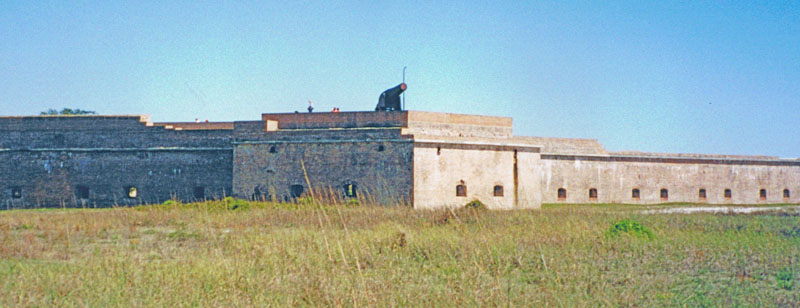
Bastion of Fort Pickens, Florida, courtesy of National Park Service.
Fort Pickens, Florida, is a historic pentagon-shaped U.S. military fort on Santa Rosa Island near Pensacola. It was named for American Revolutionary War hero Andrew Pickens, who fought with distinction in South Carolina.
Fort Pickens was the largest in a group of fortifications designed to defend Pensacola Harbor, supplementing Fort Barrancas, Fort McRee, and the Navy Yard. Located at the western tip of Santa Rosa Island, just offshore from the mainland, Fort Pickens guarded the island and the entrance to the harbor.
After the War of 1812, the United States decided to fortify its major ports. In 1816, the United States began constructing Third System forts along its coastline to protect essential waterways and seaports. Five years later, the federal government began fortifying areas along Florida’s 3,500-mile seaboard, including Pensacola Bay.
European powers had long considered Pensacola Bay one of the most important on the northern Gulf Coast. With depths ranging between 20 and 65 feet and about 13 miles, the bay afforded excellent anchorage and protection for ships. Pensacola Bay became U.S. territory after the Adams-Onís Treaty of 1819, in which Spain ceded East and West Florida to the United States.

Santa Rosa Beach, courtesy of Wikipedia.
In 1825, President James Monroe signed a law establishing a new navy yard and depot on the bay. Forts were needed to protect the natural bay and the navy yard. Fort Pickens was meant to enhance the old earthworks and simple, obsolete designs of the First and Second Systems of Fortifications.
The U.S. Army Corps of Engineers initially planned Fort Pickens under Lieutenant Colonel Joseph G. Totten, with later modifications by Brigadier General Simon Bernard, who recommended fortifications at key locations on Santa Rosa Island and Perdido Key.
In May 1828, the federal government acquired about 998 acres on Santa Rosa Island for the fort, and by August, Captain William H. Chase was overseeing its construction. Fort Pickens was completed in October 1834, becoming the largest brick structure on the Gulf of Mexico. It incorporated advanced coastal defense design and weaponry, symbolizing the United States’ growing power.
The fort was designed to unleash a “ring of fire” from its five walls, capable of housing up to 200 cannons in casemates or on barbette tiers. During peacetime, it could accommodate 60 soldiers, increasing to 500 in wartime and up to 1,000 during a siege.
To appear imposing, Fort Pickens featured five walls, allowing cannons to fire in all directions. The south and channel-facing walls could support a total of 112 cannons, with additional placements on the north and east walls. Attacking forces would have to cross a dry ditch around the fort, which had walls rising about 40 feet above it.
The fort featured three permanent rooms, known as powder magazines, designed to store black powder. These large brick rooms were lined with wood to absorb moisture and secured with heavy doors to prevent theft or tampering. Fort Pickens had ample space to accommodate up to 272,600 pounds of black powder. On the east side, the fort included a counterscarp that created a defensive moat to protect against a land invasion from the west. Additionally, the westernmost bastions were equipped with mine chambers that could be detonated in a last-ditch effort to defend the fort against invaders.

Lieutenant Adam Slemmer.
When the Civil War began, Fort Pickens had not been occupied since shortly after the Mexican-American War. Despite its dilapidated condition, Lieutenant Adam J. Slemmer, in charge of United States forces at Fort Barrancas, decided Fort Pickens was the most defensible post in the area. He abandoned Fort Barrancas when, around midnight of January 8, 1861, his guards repelled a group of local civilians who intended to occupy the fort. Some historians claim these were the first shots fired in the Civil War.
On January 10, 1861, the day Florida declared its secession from the Union, Lieutenant Slemmer destroyed over 20,000 pounds of gunpowder at Fort McRee. He then spiked the guns at Fort Barrancas and moved his small force of 51 soldiers and 30 sailors to Fort Pickens. On January 15, 1861, and January 18, 1861, Slemmer refused surrender demands from Colonel William Henry Chase of the Florida militia. Chase had designed and constructed the fort as a U.S. Army Corps of Engineers captain. Slemmer defended the fort against the threat of attack until he was reinforced and relieved on April 11, 1861, by Colonel Harvey Brown and the USS Brooklyn. The fort was further reinforced by Colonel William Wilson and elements of the 6th New York Infantry Regiment by late June 1861.
The Confederates attacked the fort on October 9, 1861, in the Battle of Santa Rosa Island, with about 1,000 men. The attack came from the east after forces landed four miles away. The attack was repelled by artillery and gunfire, and the Confederates retreated with 90 casualties.
After tensions in Pensacola grew and the Confederates secured posts at Fort McRee and Fort Barrancas, the Federal forces decided to shell the Confederate forts. On November 22, two Union warships, the Niagara and the Richmond, sailed into the bay, and the bombardment began. The attack lasted two days, and the results were in the Union’s favor. Fort McRee was nearly destroyed, and the town of Warrington and the Navy Yard were destroyed.
A second bombardment, meant to finish off the Confederates, was initiated on New Year’s Day 1862. Fort McRee was almost destroyed, and any buildings near Fort Barrancas were burned.
Running low on supplies and with dwindling morale, the Confederates began to doubt their chances of success in the Battle of Pensacola. Eventually, the Battle of Mobile Bay drew the last of the southern forces westward to Alabama to defend against Admiral Farragut’s invasion forces. On May 10, 1862, the last Confederates at Pensacola surrendered to Fort Pickens.
Despite repeated Confederate threats, Fort Pickens was one of only four Southern forts to remain in Union hands throughout the war, the others being Fort Taylor at Key West, Florida, Fort Jefferson at Garden Key, Florida, in the Dry Tortugas, and Fort Monroe in Virginia.
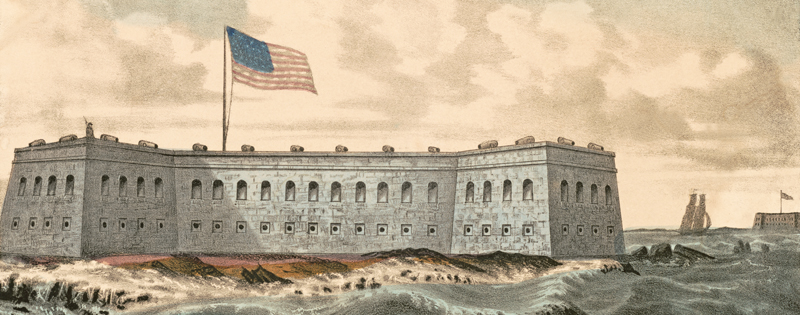
Fort Pickens in Pensacola Harbor, Florida, by Currier & Ives, in about 1865.
During the Indian wars in the West, captives were transported to the East Coast to be held as prisoners. From October 1886 to May 1887, Apache War Chief Geronimo was imprisoned in Fort Pickens, along with several of his warriors. Their families were held at Fort Marion in St. Augustine, Florida.
In the late 1890s and early 20th century, the Army built new gun batteries at Fort Pickens as part of the Endicott Board program, led by Secretary of War William C. Endicott. Unlike traditional fortifications with concentrated guns in thick masonry walls, these Endicott batteries were spread out and concealed behind concrete parapets to blend with the terrain, taking advantage of the improved accuracy and range of modern weaponry.
On June 20, 1899, a fire in Bastion D ignited the magazine containing 8,000 pounds of powder, causing an explosion that killed one soldier and obliterated the bastion. Debris was found over 1.5 miles away at Fort Barrancas.
Battery Pensacola was constructed within Fort Pickens, while additional concrete batteries were built as separate facilities nearby and are now part of the Gulf Islands National Seashore. During World War I, obsolete weapons were repurposed, including the removal of the 6-inch M1905 guns from Battery Cooper in 1917, although one gun was relocated there from West Point in 1976.
Little consideration was given to preserving the old fort during the construction of Endicott Batteries. The parapet on the south wall of the fort was demolished, along with the officers’ quarters beneath. The barbette on the southeast wall and the casemate arches of the southernmost bastion were also removed. These changes allowed the firing arc of Battery Pensacola’s 12-inch Guns to clear without raising the battery.
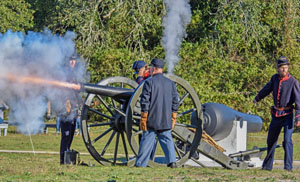
Fort Pickens, Florida renactment, courtesy of the National Park Service.
As with many other forts, Panama mounts were planned for in the interwar era, beginning in 1937.
Four 155mm GPF guns were placed around Battery Cooper, two forward and one to each side, in 1942. The guns used concrete rings for positioning and aiming, which remain today. The guns, however, have been removed for a long time. The 155 battery used Battery Cooper’s magazines, communications, and other support facilities.
Battery Langdon was constructed in 1923, with 12-inch guns meant to complement those already in place at Battery Pensacola. The guns were originally exposed to fire, but the ammunition and command center were stored inside a reinforced embankment between the guns.
During World War II, Fort Pickens was of interest to the U.S. Navy, and it was decided that the fort’s defenses needed strengthening. A specific threat was German U-boats already operating in the Gulf of Mexico.
One addition to Fort Pickens’s defenses was Battery 234, intended to operate alongside Battery 233 across the bay on Perdido Key. Many of these batteries were built nationwide, all with the same design, to replace the role of light artillery formerly held by the three-inch M1903 guns. Both batteries were designed to equip two 6-inch M1905 guns in cast-steel casemates. The command center is buried underneath an artificial hill to protect it from air attacks. The guns were never fitted during the war, but were donated by the Smithsonian in 1976 and are present today.
Fort Pickens remained in use until 1947. Fort Pickens is included within the Gulf Islands National Seashore and is administered by the National Park Service.
Fort Pickens, Florida, structures by the National Park Service.
©Kathy Alexander/Legends of America, updated February 2026.
Also See:
Gulf Islands National Seashore
Sources: