LEGENDS OF AMERICA

A Travel Site for the Nostalgic & Historic Minded


  Search


Legends Home

Site Map

What's New!!


Recommend this site


American History

Ghost Towns

Ghostly Legends

Historic People

Native Americans

The Old West

Photo Galleries

Roadside Attractions

Rocky Mtn Store

Route 66

Travel Destinations

Treasure Tales

Legends Blog

Free E-Newsletter


Facebook Fanpage


Twittering


Legends of America's Exclusive Custom Products


Contact Us


Please report broken links, missing pictures, or other problems online by clicking HERE or send us an email.  Thanks!


Native American IconNATIVE AMERICAN LEGENDS

Military Campaigns of the Indian Wars


Vintage Native American Photographs


<< Previous  1 2 3 4 5 Next >>


Campaigns:


Old Northwest War - 1790-1795

Tippecanoe - 1811

Creeks - 1813-1814, 1836

Seminoles - 1817-1818, 1835, 1842, 1855, 1858

Black Hawk - 1832

Comanches - 1867-1875

Modocs - 1872-1873

Apaches - 1873, 1885-1886

Little Big Horn - 1876-1877

Nez Perces - 1877

Bannocks - 1878

Cheyennes 1878-1879

Utes - 1879-1880

Pine Ridge - 1890-1891


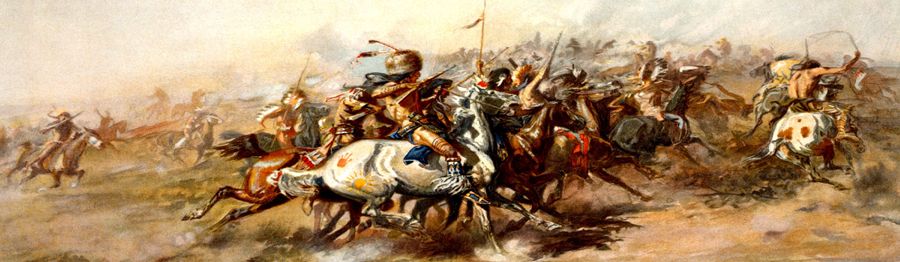
Sioux and Blackfoot Warriors

Sioux and Blackfoot Warriors, painting by Charles

M. Russell 1902.

This image available for photographic prints

 and downloads HERE!


Old Northwest War (January, 1790 - August, 1795) - Called the Miami Campaign by the U.S. Military, this war erupted In the late 1780's as settlers wished to push into the "Old Northwest," now present-day Ohio and Indiana. However, hostile Indians, chiefly the Miami and Indiana tribes, resisted this expansion. Three separate expeditions of military forces were soon sent in to remove this obstacle to expansion.

In the fall of 1790 a force of 320 regular army troops, along with 1,000 Kentucky and Pennsylvania militiamen led by Brigadier General Josiah Harmar, moved north from Fort Washington (Cincinnati), but were badly defeated in two separate engagements on October 18th and 22nd in the vicinity of present-day Fort Wayne, Indiana.

Congress then commissioned Governor Arthur St. Clair of the Northwest Territory as a Major General. St. Clair then collected a force of about 2,000 troops who advanced north from Fort Washington in September, 1791, building a road and forts as it progressed. However, on November 3-4, the troops were surrounded by the Indiana tribe, who killed 637 of St. Clair's men and wounded another 263. The defeated troops returned to Fort Washington.

Congress reacted to these disasters by doubling the authorized strength of the Regular Army in 1792 and appointed Anthony Wayne to succeed St. Clair. Major General Wayne joined his troops near Pittsburgh, Pennsylvania in June, 1792. Moving his men to Fort Washington in the Spring of 1793, Wayne reorganized the soldiers and began extensive training programs. After trying unsuccessfully to negotiate peace with the Indians, the troops moved north once again in October, building additional fortifications along the way. In the spring of 1794, they built Fort Recovery at the site of St. Clair's defeat. In June, the fort was attacked by the Indians, but the newly reorganized and trained soldiers forced them to retreat. The following month, Wayne moved forward with a force of some 3,000 men, pursued the Indians confronting them on August 15 near Fort Miami (a British outpost.) After a stand-off of several days, the conflict ended after a two-hour battle on August 20, 1794 that the Indians defeated. Wayne's troops then destroyed the Indian villages. The following year, in the Treaty of Greenville, the Indians of the region ceded their lands in southern and eastern Ohio and the way was opened for rapid settlement of the Northwest Territory.


Tippecanoe (September 21 - November 18, 1811) - The spread of settlements in the "Old Northwest" created additional tension with other tribes. In 1804, Shawnee Chief Tecumseh, along with his his medicine man brother, the Prophet, gained British backing and began serious efforts to form a new Indian confederacy in the Northwest. Governor William Henry Harrison of the Indiana Territory rejected Tecumseh's demand that settlers be kept out of the region. In the summer of 1811 Harrison, with the approval of the War Department, undertook to break up the confederacy before it could organize a major attack against the settlements.


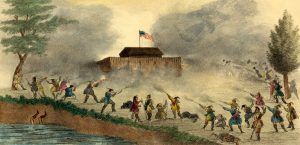
Battle of Tippecanoe

Battle of Tippecanoe, chromolithograph by

Kurz & Allison, 1889.
This image available for photographic prints

and downloads HERE!


In September, 1811 Harrison led a well-trained force of nearly 1,000 troops up the Wabash River. After building Fort Harrison at Terre Haute, Harrison marched with 800 men toward the main Indian village on Tippecanoe Creek. On November 6, 1811, Harrison encamped near the village and tried to negotiate a peace settlement with the Prophet, as Chief Tecumseh was absent. However, at dawn the next morning, the Shawnee attacked Harrison's forces. Though the battled ended in an indecisive victory, with both sides having about the same amount of casualties, the U.S. forces were able to destroy the Indian village and cause them to flee.


Though this battle temporarily reduced the Indian threat in the region, the battle did not solve the area "Indian problems" in the Old Northwest. Instead, the Indians were to make common cause with the British in the War of 1812.


Creeks (July 27-August 9, 1814 and February, 1836 - July, 1837) - Since the early 19th century, the Creek Indians of present-day Georgia and Alabama were deeply troubled by the continuing encroachment of white settlers onto their lands. Though tribal leaders initially counseled neutrality and peace, this would change when Shawnee Chief Tecumseh visited the southern tribes, urging a confederation to end the encroachment on their lands and to maintain their way of life. He won many ardent supporters among the younger warriors, who joined with the northern Indians and the British.

The first of the Creek campaigns constituted an initial phase of the War of 1812, as a series of raids were launched against white settlements. Later, the war reached crisis proportions when the Upper Creeks, along with British soldiers, sacked Fort Mims, Alabama in August, 1813, massacring more than 500 men, women, and children. These same Indians, grown to a force of about 900 warriors, were decisively beaten at Horseshoe Bend, Alabama in late March, 1814 by Andrew Jackson and his force of about 2,000 troops, plus several hundred friendly Indians. Eventually, the vast majority of Creek Indians were sent Indian Territory in 1832. Most of the rest of Creek who remained the Southeast were also moved to Indian Territory in 1836-37, after participating in the Second Seminole War.


Continued Next Page


ALSO SEE:


Battles, Campaigns and Massacres of the Indian Wars

Frontier Skirmishes between the Pioneers & the Indians\

Indian War List and Timeline

Three Indian Campaigns

Indian Fighters

Indian Wars of the Frontier West

War of 1812

War of 1812, by William Charles.

<< Previous  1 2 3 4 5 Next >>

From the Rocky Mountain General Store

Native American Vintage Photographs Native American Photo Prints  - Vintage photographs of famous chiefs, heroes, and Indian life in the 19th century.


                                                              Copyright © 2003-2009, www.Legends of America.com