
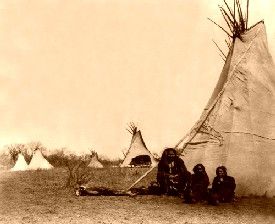
Comanche Camp, 1873.
The Comanche War Campaign from 1868 to 1875 was instituted by Major General Philip Sheridan, commander of the Department of the Missouri, in the winter of 1868, to locate the elusive Indian bands in the region.
Notable incidents in the campaigns from then until 1875 against the Indians in the border regions of Kansas, Colorado, New Mexico, and Texas Roman Nose’s band in September 1868 by Major George A. Forsyth’s detachment; the defeat of Black Kettle on the Washita River in Oklahoma on George Custer and the 7th Cavalry; the crushing of the Cheyenne under Tall Bull at Summit Spring, Colorado on May 13, 1869; the assault on the Kiowa-Comanche camp in Palo Duro Canyon on September 27, 1875, by Colonel Ranald S. Mackenzie; and the attack and rout of Greybeard’s big Cheyenne encampment in the Texas Panhandle on November 8, 1875, by 1st Lieutenant Frank Baldwin’s detachment.
Following the Red River War, a campaign that lasted from August to November in 1874, the Comanche surrendered and moved to their new lands on the reservation. However, even after that loss, it was not until June 1875 that the last of the Comanche, those under the command of Quanah Parker, finally surrendered at Fort Sill, Oklahoma. Though the U.S. troops themselves were directly responsible for just a few hundred deaths, their tactics in the Comanche campaign were the most devastating to the tribe. The tactics they used eventually led to the tribe’s economic, rather than military, downfall. The Comanche tribe, which numbered nearly 5,000 in 1870, finally surrendered and moved to the reservation, leaving barely 1,500 by 1875.
©Kathy Alexander/Legends of America, updated December 2025.
Also See:
Battles and Massacres of the Indian Wars
Indian Wars of the Frontier West by Emerson Hough
Sources: