
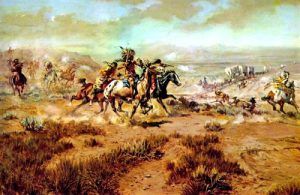
Attack on the Wagon Train, by Charles Russell, hangs at the Gilcrease Museum; photo courtesy of the Gilcrease Museum.
Blue Water/Ash Hollow Battle (1855)
Little Blue River Raid (August 7-9, 1864)
Eubank Homestead (August 7, 1864)
Plum Creek Massacre (August 8, 1864)
Little Blue/Oak Grove Station (August 9-10, 1864)
Kiowa Ranch Station (August 10, 1864)
Battle of Mud Springs (February 4-6, 1865)
Battle of Rush Creek (February 8-9, 1865)
Battle at Warbonnet Creek (1876)
Fort Robinson Massacre (1879)
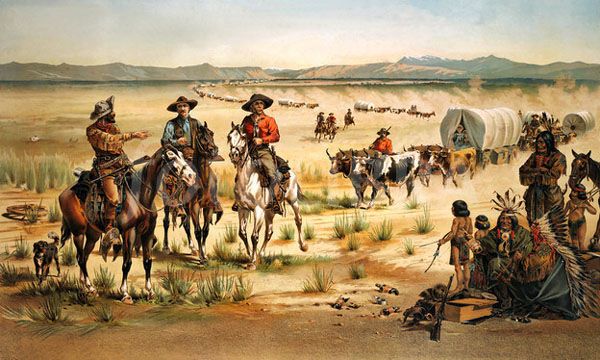
A wagon train and Indians.
Beginning in the early 18th Century and ending with the conclusion of the Plains Indian wars of the 19th Century, Nebraska would see several bloody clashes between whites and Indians. Some of the first whites to visit what would later become Nebraska were fur traders and explorers in the early 1820s. A decade later, more would come, including mountain men, traders, missionaries, and military expeditions. As the Oregon, California, and Mormon Trails developed, emigrants began crossing Nebraska in significant numbers, especially after gold was discovered in California in 1849.
Even before it was legal, several white settlers began to make their homes in Nebraska, which was officially reserved for Indians. Naturally, this sparked resentment among the many Plains tribes who called Nebraska home. Soon, demands were made that the federal government organize Nebraska as a territory to legalize the settlements already there, and in 1854, the U.S. Congress passed the Kansas-Nebraska Act. This act created the Territory of Nebraska, which included Nebraska and parts of Colorado, Wyoming, Montana, and South Dakota. New towns were soon established, including Nebraska City, Plattsmouth, and Omaha. When Nebraska became a territory, an estimated 10,000 Indians lived there, most in permanent villages along the Missouri and Platte Rivers and their tributaries. However, several roving bands of Sioux lived in western Nebraska, and the Pawnee, who had ceded most of their lands to the government, were accustomed to using the frontier as hunting grounds.

Nebraska Homestead.
Though settlement was slow at first, the pioneers continued to push in, leading to increasing conflicts with the Indians. One of the first significant clashes was the Battle of Ash Hollow, fought in western Nebraska in 1855. More skirmishes followed, and troops were sent in 1859 to subdue the Indians. The Homestead Act of 1862 brought more settlers. During the Civil War, many regular troops were withdrawn from Plains military posts to fight in the East. The Sioux, Cheyenne, and Arapaho, seizing this opportunity, attempted to drive white settlers from their land. Beginning on August 7, 1864, the Indians made concerted attacks on stage stations and ranches along the Oregon Trail, hitting nearly every settlement for 400 miles from Julesburg, Colorado, to Big Sandy, Nebraska. Travel ceased for two months. Troops and local militia companies attacked and drove back the Indians in the Battle of the Little Blue River on August 17, 1864. Major raids ceased, but skirmishes continued through the fall.
Throughout the next several decades, several skirmishes would take place between the Indians and the settlers as the Native tribes recognized that encroaching white men were killing their buffalo and transforming their homeland into sprawling settlements. The last Indian troubles on the Nebraska border ended with the Wounded Knee Massacre at the Pine Ridge Reservation in South Dakota on December 29, 1890.
©Kathy Alexander/Legends of America, updated October 2026.
Also See:
Indian Wars, Battles & Massacres
Indian Wars of the Frontier West by Emerson Hough
Native Americans – First Owners of America
Winning The West: The Army In The Indian Wars
See Sources.