
Jump to: Links to Full Articles
Jump to: Outlaw Summaries (name begins with) A B C D E F G H I J K L M N O P Q R S T U V W X Y Z
P
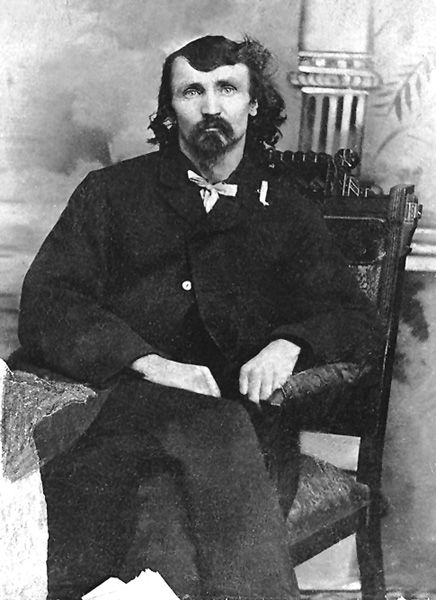
Alfred Packer.
Alfred G. Packer – Prospector and guide in the Rocky Mountains during the 1870s, Alfred Packer confessed to cannibalism during the Winter of 1874.
Pablo Padilla – A horse thief and cattle rustler around Valencia County, New Mexico, he was lynched in January 1872.
George W. Padgett – Though Padgett claimed self-defense in killing a man in Oklahoma, he was found guilty of murder and hanged at Fort Smith, Arkansas, on September 9, 1881.
Billy Page – A road agent in Montana, who was thought to have been a member of Henry Plummer’s gang of Innocents. Montana Vigilantes hanged him.
Manfred Paine – An outlaw and son of a suspected killer, he shot and killed his father in Washington, as well as the lawman who arrested him.
Geronimo Para – A bandit leader and murderer, Para was hanged on January 6, 1900, in El Paso County, Texas.
William Parchmeal – A murderer operating in Indian Territory, Parchmeal was hanged at Fort Smith, Arkansas, on June 26, 1885.
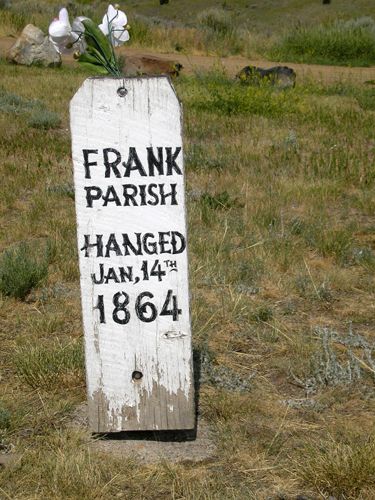
Frank Parish Grave.
Frank Parish (or Parrish) (18??-1864) – An alleged road agent and horse thief in Montana, he was thought to have been a member of Henry Plummer’s gang of Innocents. Montana Vigilantes hanged him in January 1864.
George Leroy Parker – See Butch Cassidy
Allen H. Parmer (1848-1927) – Born and raised in Missouri, Parmer rode with William Quantrill during the Civil War and was paroled with Frank James in Kentucky at the war’s end. Afterward, he joined the James-Younger Gang and was allegedly present during their first robbery of the Clay County Savings Association in Liberty, Missouri, on February 13, 1 66. He then attended Bryant and Stratton’s Business College in St. Louis, Missouri, in 1867 68. A warrant was issued for his arrest for participating in the robbery of the Hughes and Wasson Bank in Richmond, Missouri, in May 1867; however, when he produced an alibi that he was working in St. Louis at the time, all charges were dropped. On November 24, 1870, he married Susan Lavinia James, sister of Frank and Jesse James, and the couple had six children. He moved his family to Archer City, Texas, at some point, where he worked as a manager for the Stone Land and Cattle Company. His brother-in-law, Jesse James, often utilized his home as a hideout during this time. His wife, Susan, died in 1889, and he remarried Sarah Katherine Ogden on December 27, 1 92. Parmer died on October 25, 1927, in Texas.
John Parris (or Parish) – An Indian outlaw and bootlegger, he was one of two men accused of killing U.S. Deputy Marshal Dan Maples. U.S. Deputy Marshal John Curtis arrested him.
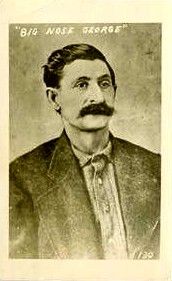
George Parrot, aka George Francis Warden, George Manuse, George Curry.
George Parrot, aka George Francis Warden, George Manuse, George Curry, Big Nose George (18??-1881) – Running with a gang in Wyoming, they robbed pay wagons and stages. Parrot was arrested, convicted, and sentenced to be hanged. However, he was lynched before the execution could be carried out.
Emanuel Patterson – Killed U.S. Deputy Marshal Willard Ayers on August 11, 1880. For the next six years, he was a fugitive until Heck Thomas tracked him down and arrested him. He was sentenced to life in prison, where he died.
C. C. “Champ” Patterson – Wanted for murder and bank robbery in Oklahoma, he killed a Shawnee Police Officer. He was later shot in a bank robbery in Boley, Oklahoma.
William S. Pearl – A gunman, he killed a soldier in Fort Stanton, New Mexico, and was lynched on January 23, 1883, by other soldiers.
Alexander Doniphan “Donnie” Pence (1847-1896) – Rode with William Quantrill during the Civil War and allegedly participated in the Liberty, Missouri Bank Robbery in 1 66. He later became a respected sheriff in Nelson County, Kentucky, and died of typhoid fever in 1896.
Thomas Edward “Bud” Pence (1842-1880) – Rode with William Quantrill during the Civil War and allegedly participated in the Liberty, Missouri Bank Robbery in 1 66. He died in 1880.
Louis Perkins – An outlaw, he was captured with Charlie Allison in Albuquerque, New Mexico, in June 1881.
Gabriel Petal – An outlaw and member of Vicente Silva’s White Caps Gang in Las Vegas, New Mexico.
Samuel Peters – After being accused of theft by James Hanson in Indian Territory, Samuel Peters visited Hanson’s home and stabbed his wife, Charity, to death. He was convicted of murder and was hanged at Fort Smith, Arkansas, on September 8, 1876.
Lyon Phillipowski – A lawman and gunfighter involved in a shootout with a store clerk in Lincoln County, New Mexico, on October 21, 1874.
Tom Pickett (1858-1934) – An outlaw and lawman, Pickett rustled cattle with Billy the Kid and was captured with the more famous outlaw on December 23, 1880. He later served as a U.S. Deputy Marshal and died in Arizona on May 14, 1934.
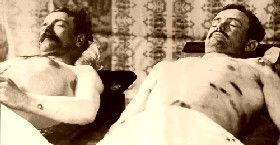
Charlie Pierce and George “Bitter Creek” Newcomb were killed on May 1, 1895.
Charles “Charley” Pierce (18??-1895) – After unsuccessfully racing horses in Pawnee, Oklahoma, Pierce became a member of the Dalton Gang during the 18 0s. After most of the gang’s members were killed during the Coffeyville, Kansas, raid on October 5, 1892, Pierce joined Bill Doolin’s Oklahombres. He participated in several Hold-up, but his final battle occurred on May 2, 1 95. After the Doolin Gang split up, Pierce and George “Bitter Creek” Newcomb rode to the Dunn Ranch on the Cimarron River to visit Newcomb’s lover, the famous “Rose of Cimarron.” They also planned to collect some $900 owed to Newcomb by Rose’s brothers. However, as they approached the house, the pair of outlaws was ambushed, shot out of their saddles by Rose’s brothers, who wanted to collect the large bounty on their heads. Both bodies were then taken to Guthrie, but Newcomb was still alive. When he sat up and begged for water, he received another bullet for his efforts.
George Pierce (18??-1896) – George and his brother, John, robbed and murdered their traveling companion, William Vandever, as they rode through the Cherokee Nation in November 1894. Found with Vandever’s horses, mules, and wagon, they were arrested. Tried and convicted at Fort Smith, Arkansas, both were hanged on April 30, 1896.
John Pierce (18??-1896) – John and his brother, George, robbed and murdered their traveling companion, William Vandever, as they rode through the Cherokee Nation in November 1894. Found with Vandever’s horses, mules, and wagon, they were arrested. Tried and convicted at Fort Smith, Arkansas, both were hanged on April 30, 1896.
Red Pipkin – An outlaw, he rode with Bronco Bill Walters.
Charles Pitts – On September 7, 1876, the James-Younger Gang attempted to rob the First National Bank of Northfield, Minnesota. Among the outlaws were the James Brothers, the three Younger Brothers, and two more Quantrill veterans, including Clell Miller and Bill Chadwell. The attempted robbery was to be the demise of the infamous James-Younger Gang and the death of Charley Pitts. When ordered to open the safe, bank cashier Heyman refused and ducked down. Angered, Jesse put a pistol to his head and shot. The shot was heard beyond the bank, and when the bank alarm began to go off, the Northfield citizens opened fire upon the gang. Charley Pitts and Bill Chadwell were killed. Cole, Jim, and Bob Younger were severely wounded but escaped. However, they were captured just one week later, East of Mankato. The Younger Brothers were sentenced to life terms in prison. Frank and Jesse escaped back to Missouri unharmed.
Joe Pizanthia – A road agent in Montana, who was thought to have been a member of Henry Plummer’s gang of Innocents. He was shot and hanged by Montana Vigilantes.
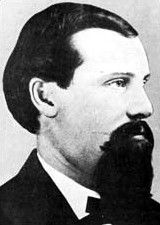
Henry Plummer.
Henry Plummer (1837-1864) – A Montana lawman, he was supposedly the outlaw leader of a gang called the Innocents and was lynched by vigilantes in 1 64. However, historians now believe the vigilantes committed many of the crimes, and Plummer was not guilty.
John Pointer (18??-1874) – A Seminole Indian, Pointer murdered a white man in the Chickasaw Nation. He was convicted of murder and hanged at Fort Smith, Arkansas, on April 3, 1874.
Johnny Pointer (1873?-1894) – While traveling from Texas to Arkansas in December 1891, Pointer killed his traveling companions, William Bolding and Ed Vandever, by bludgeoning them with an ax. When he tried to dispose of the victims’ wagon and team, he was arrested by U.S. Deputy Marshals. He was hanged at Fort Smith, Arkansas, on September 24, 1894.
Librado Polanco – An outlaw and member of Vicente Silva’s White Caps Gang in Las Vegas, New Mexico. He received a life sentence for robbery.
Frank Porter – A New Mexico outlaw, he was killed eighty miles West of Albuquerque in April 1888 by a posse.
John Postoak – Shot and killed John Ingley in the Creek Nation of Indian Territory in 1877. On December 20, 1878, he was hanged at Fort Smith, Arkansas.
Andrew Jackson Potter – An outlaw turned Methodist preacher, he scouted and fought hostile Indians in New Mexico and Texas from 1 47. He died in October 1895.
“Powder Bill” – A New Mexico outlaw and gunfighter, he was hired to kill A.J. Fountain, but did not follow through.
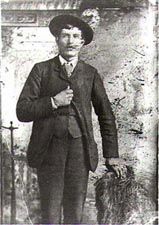
Bill Power
William “Bill” Power, aka William St. Power, Tom Evans (18??-1892) – Not much is known about Bill Power other than he drifted into Indian Territory with a trail herd from the Pe os. His name was actually William St. Power, and in addition to using the name “Bill Power,” he also used the alias of Tom Evans. While working at the Bar X Bar Ranch, he became acquainted with Emmett Dalton and other cowboys who would soon become part of the infamous Dalton Gang. In the two years the Dalton Gang operated, the outlaws were involved in several train and bank robberies before they schemed to commit a double bank robbery in Coffeyville, Kansas, on October 5, 1 92. Spotted by locals, a shootout followed the attempted robbery, which claimed the lives of Power, along with Grat and Bob Dalton and Dick Broadwell, as well as four Coffeyville residents. Emmett Dalton, though seriously wounded, was the only one to survive and wound up serving 14 years in prison. Power was buried with the Dalton brothers at the Coffeyville, Kansas, Cemetery.
Elmer Price – An outlaw who was sent to prison, he refused two pardons on February 6, 1909, and again on April 27, 1912.
Nicholas Provencio was a member of the Jesse Evans Gang in New Mexico’s Lincoln County. Afterward, he disappeared.
Aaron Purdy – An Oklahoma outlaw, accused of whiskey running, robbing trains, and planning to kill a federal officer, he was pursued by Heck Thomas and a posse and was severely wounded.
Tom Purdy – Oklahoma outlaw and brother of Aaron; he was accused of whiskey running and robbing trains
Ed Putman, aka Ed Sibley – Wanted for killing two men over a sheep deal in Texas; he was killed in a Shootout with Texas Rangers on December 1, 1906, at Del Rio.
Q
King of the Cowboys – An outlaw in Texas and Oklahoma, he robbed a bank at Cisco, Texas, in 1887. Sheriff Bud Sanders and a posse killed him.
Queho (1880-19??) – Though labeled Nevada’s “Public Enemy No.1” around the turn of the century, many historians believe he was used as a scapegoat.
Vic Queen – An outlaw who rode with Martin McRose in New Mexico.
Tom “Tex” Quinlan – An outlaw who escaped from the Las Vegas, New Mexico jail with J.J. Webb and Dave Rudabaugh on December 3, 1881.
©Kathy Alexander/Legends of America, updated October 2026.
Jump to: Links to Full Articles
Jump to: Outlaw Summaries (name begins with) A B C D E F G H I J K L M N O P Q R S T U V W X Y Z
Also See:
Adventures in the American West
See Sources.