
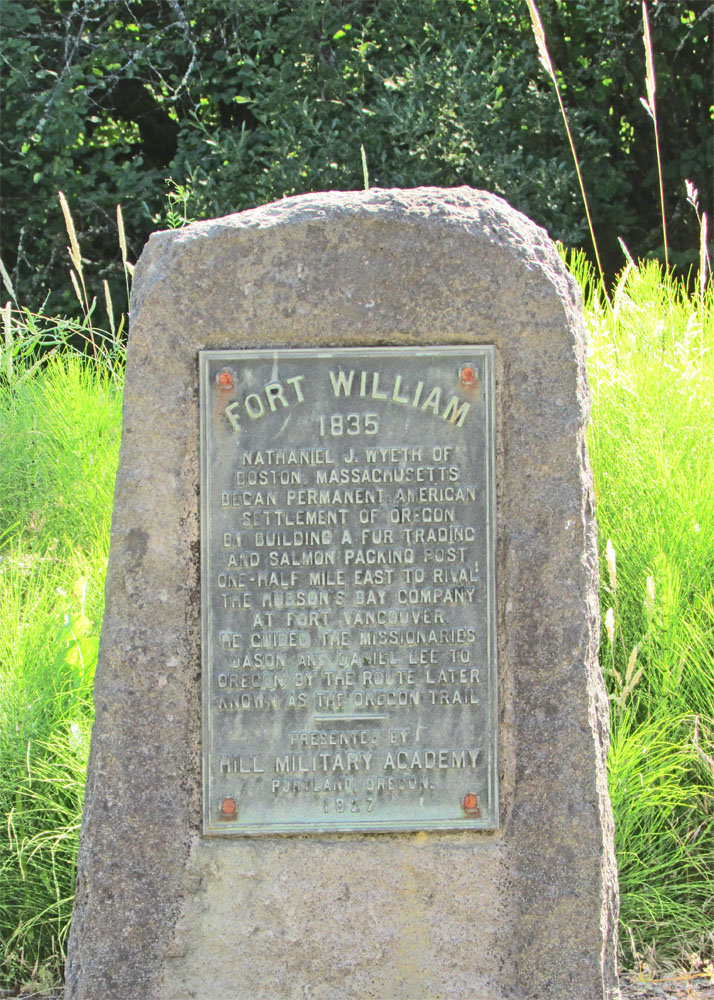
Fort William, Oregon Historic Marker, courtesy of Wikipedia.
Fort William, Oregon, was a fur-trading outpost built on the Columbia River on Wappatoo Island near the future Portland, Oregon. It was established by American businessman Nathaniel Jarvis Wyeth, a Boston, Massachusetts merchant, backed by American investors.
In 1834, Wyeth traveled to the Northwest with the intention of creating his own trade business to rival that of the British Hudson’s Bay Company. He and his company built the fort as part of the Pacific Trading Company, a joint-stock company formed by Wyeth to exploit the fur trade in the Oregon Country. He also held Fort Hall in southeastern Idaho to take advantage of trade in the Rocky Mountains. He intended to establish a fishery at Fort William and export salmon to the East and Hawaii.
When Wyeth established the outpost, the island was uninhabited because diseases had swept through the lower Columbia River, wiping out nearly 90% of the native inhabitants.
The post was initially built on the North end of the island. However, flooding caused it to move toward the center the following year. Fort William was West of and on the opposite side of the river from the Hudson’s Bay Company’s Fort Vancouver, which was established on the North side of the Columbia River in 1822.
To circumvent competition from Wyeth, Fort Vancouver’s Chief Factor Dr. John McLoughlin reached an agreement with him in the fall of 1834: Wyeth’s business would focus on exporting salt salmon, not furs, which were Fort Vancouver’s primary trade item.
Wyeth also began farming on the island. McLoughlin likely allowed Wyeth to continue to establish his rival business on the island in part because he felt reasonably sure that Wyeth would fail. However, just days after this agreement was made, McLoughlin received orders from his superiors that Wyeth’s business should be forced under and the Hudson’s Bay Company would not support any cooperation with him.
As McLoughlin had predicted, Wyeth’s venture was doomed. He had arrived too late for the 1834 salmon season. He reported to his associates in Boston, Massachusetts:
“This business looks very bad at this time. We have failed in everything for the first year. I shall do all I can one year more, which will, I think, show whether anything is to be done here or not, and I will not be long in closing the concern when I find that there is nothing to be made.”
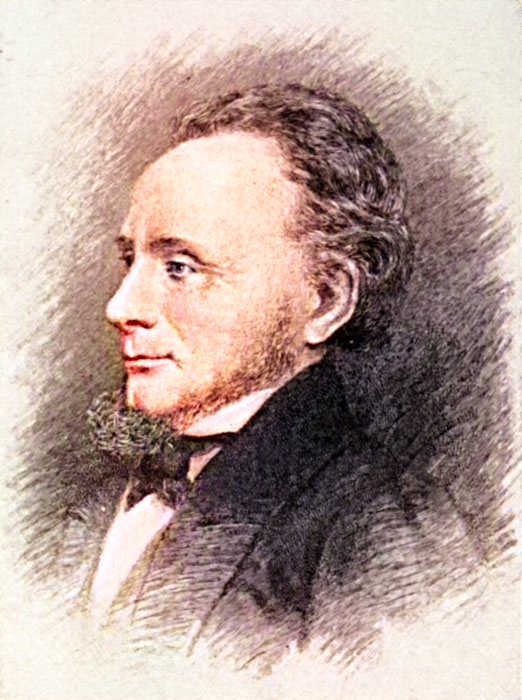
Nathaniel Jarvis Wyeth.
Wyeth and his men explored various commercial ventures from their outpost in the Pacific Northwest. They cut lumber and exported it to the Hawaiian Islands, constructed boats and canoes, and built a 60-foot-long fish processing facility.
They also tried to trap animals in the Deschutes River watershed in central Oregon but were unsuccessful. The young company struggled to compete against the Hudson’s Bay Company and the American Fur Company, under John Jacob Astor, in the Rocky Mountains.
The post had difficulties; its first supply ship sent to the Northwest Coast wrecked, and the second ship was late. The first ship was being used to export salmon.
In 1835, Wyeth’s salmon harvests continued to be dismal, and he and many of his men were afflicted by malaria.
He reported:
“I did not expect to recover, and am still a wreck. Our sick list has been this summer usually about one third the whole number and the rest much frightened.”
That year, the post’s gunsmith, Thomas J. Hubbard, attacked and killed the fort’s tailor in an argument over a young Native girl. The fort served as the backdrop to the first public trial by Europeans in Oregon. Wyeth’s friend and naturalist John Kirk Townsend, who was appointed magistrate, oversaw the case. The jury acquitted Hubbard when they ruled the death was justifiable homicide. This verdict was likely the result of evidence about the tailor’s alcohol induced rages.
In May 1836, as his business continued to struggle, Wyeth attempted to negotiate with McLoughlin once more. He proposed purchasing supplies from the fort and hiring men and horses from the Hudson’s Bay Company. In exchange, the Hudson’s Bay Company would guarantee to buy furs from him. This plan appealed to McLoughlin, who was looking for a way to reshape the Northwest fur trade so that both Americans and British could coexist in the region, while also giving British interests an advantage. McLoughlin presented this idea to his superiors, but once again, they insisted that Wyeth needed to be eliminated from the competition.
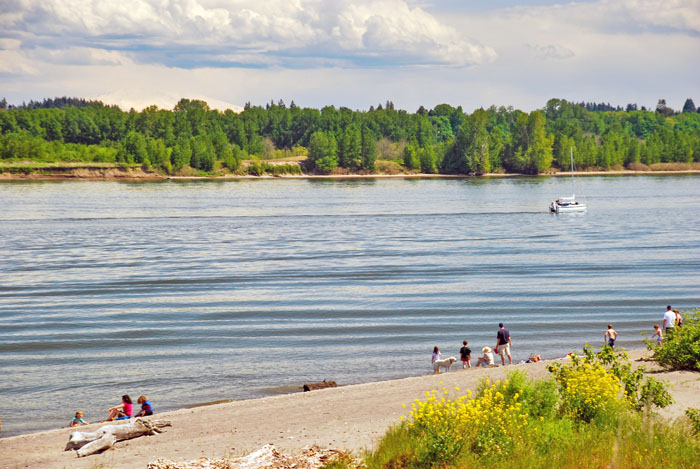
Sauvie Island, Oregon, courtesy of Wikivoyage.
In the fall of 1839, McLoughlin ordered the construction of five dairies to help produce butter for shipment to Alaska. Three of these dairies were built on Sauvie Island, with the principal dairy built near the former site of Fort William. By 1841, 150 cows had been brought to the island, and their milk was turned into butter and cheese for export.
Wappatoo Island, now Sauvie Island, lies just North of the main confluence of the Willamette and Columbia Rivers. The North end of the island is at the confluence with the Multnomah Channel.
Nothing remains of the fort today.
©Kathy Alexander/Legends of America, August 2026.
Also See:
Forts Across the United States
Sources:
National Park Service
Sauvie Island Community Association
Wikipedia