|
Legends Home
Site
Map
What's New!!

American History
Ghost Towns
Ghostly Legends
Historic People
Native Americans
The Old West
Photo
Galleries
Roadside
Attractions
Rocky Mtn Store
Route 66
Travel
Destinations
Treasure Tales
Legends Blog
Free E-Newsletter

P.O. Box 19423
Lenexa,
KS 66285
913-708-5119
Please report
broken links, missing pictures, or other problems online by clicking
HERE or send us an
email. Thanks!
| |
|
|
|
MONTANA LEGENDS
Montana Forts of the Old West |
|

|
|
<< Previous 1
2 3
Next >>
|
|
Fort Assinniboine
Fort Belknap
Fort Benton
Fort Browning
Fort
Campbell
Fort Claggett (Camp Cooke)
Fort Connah
Fort Custer
Fort Ellis
Fort Keogh
Fort Logan
Fort Maginnis
Fort McKinzie
Fort Missoula
Fort Owen
Fort Parker
Fort Peck
Fort Piegan
Fort Shaw
Fort C.F. Smith
|

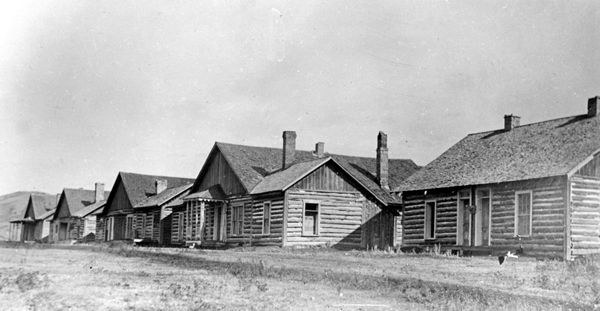
Fort Assinniboine, photo courtesy
Fort Assinniboine Preservation Asscoiation
|
|
Fort Assinniboine (1878-1911) - Following the
Black Hills War, the fort, named after the the
Assiniboine
Indians, was established to ward of any
further attacks from the
Sioux and
Nez Percé .
At the time of its construction, Fort
Assinniboine was the most elaborate post in the United States, featuring
over 100 buildings and designed to house ten companies of infantry and
cavalry. The troops were charged with monitoring the activities of the
region's many
Indian groups, patrolling
Montana's border with Canada,
stopping bootleggers and gunrunners and protecting the state's settlers.
In its heyday, nearly 750 officers, enlisted men, and civilians called Assinniboine home.
However, with the
Indian threat subdued,
the fort began to decline. In 1916, a portion of the fort was ceded to the Rocky Boy
Indian Reservation (home of the
Chippewa Cree tribe.) Later, more land was
ceded to Hill County to create Beaver Creek Park, the largest county
park in the United States. Unfortunately, most of the buildings at the
Fort were razed.
Today, several buildings survive on
an agricultural extension station associated with
Montana
State University. Those structures that are left are located
six miles southwest of Havre,
Montana on Highway 87.
Fort Belknap (1871-1886)
- Beginning as a a trading post, then a station on the Great Northern Railroad, the post was named in honor of Robert L. Belknap. The fort's purpose
was to serve as the
Indian Agency for the Fort Belknap
Indian Reservation in the eastern
half of Blaine County, which housed the Gros Ventre and
Assiniboine
Indians . It also
served as a subagency for the River Crow
Indians. Today,
it is the Fort Belknap
Indian Reservation
located in Harlem,
Montana.
Fort Benton (1846-1881) - Initially a
non-military fort, the site was
established as a trading post by Alexander Culbertson of the
American Fur
Company .
In the beginning it contained only a few log buildings, however;
Culbertson replaced them using bricks made of Missouri River clay in the
fall of 1848. When it was complete, the fort included Culbertson's home,
trader's quarters, a warehouse, blacksmith, trade store, kitchen and barn,
surrounded by a 20 foot bastion.
|
|
|
|

Old Fort Benton,
Montana |
In the 1860's as the many gold
rushes brought prospectors, traders and homesteaders flooding
to the area, the fort did a brisk business. Convoys of freight
wagons carried supplies to trade in Canada. However, by 1865,
the fur trade had declined and the
American Fur
Company
sold the property to the U.S. Military. By the time the troops
finally occupied the site in 1869, it had already begun to
deteriorate. Six years later, in 1875, the military abandoned
the fort. A decade later, the fort had fallen into ruins.
|
|
By 1900 only the crumbling northeast
bastion remained of fort. However, in 1908, the Daughters of
the American Revolution rescued this last remaining structure,
which continues to stand today. Over the years, a number of
the other old buildings have been reconstructed including
the Trade Store, the
Warehouse, the Blacksmith and Carpenter's Shop, and the main
"Sally Port" Gate.
More Information:
Historic Old Fort Benton
P.O. Box 262
Fort Benton,
Montana 59442
Fort Browning (1868-1873) -
Located at the junction of Peoples Creek and Milk River, 2
miles southwest of Dodson. Named for O.H. Browning, Secretary
of the Interior, the fort served as the
Indian Agency for the
Assiniboine and Upper
Sioux. It was abandoned in 1873 when the
Assiniboine
were moved to
Fort Belknap and the
Sioux to Fort Peck.
Fort Campbell (1847-1860) -
Established by the St. Louis Fur Company, it was the first
adobe fort in the area. Located just one mile from its rival, Fort Benton, it was established in direct competition with the
American Fur
Company. The fort was it was operated by
Alexander Harvey, the most infamous of
Indian traders on the
Upper Missouri River, known to have been fearless, bold,
vindictive and quarrelsome. Harvey died on July 20, 1854
while traveling on a trip down river to Fort William in a
mackinaw boat and was buried at the fort. The Fort was sold to
Chouteau and Company in 1860 and then later was occupied as a
Jesuit monastery. The site is located in Fort Benton,
Montana's
Historic District.
Fort Cass (1832-1835)
– Also known as Tullochs Fort, the subpost of
| |