
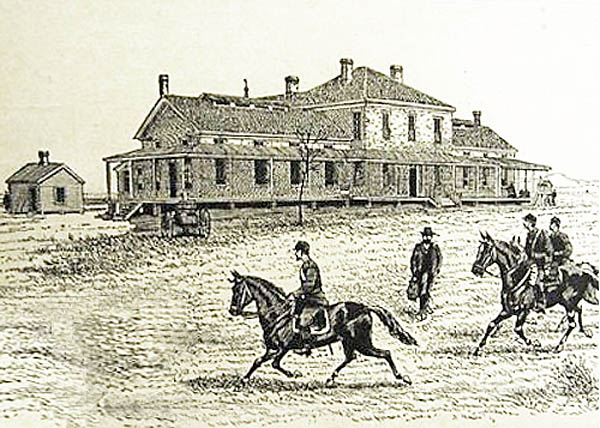
Fort Assinniboine, Montana, 1887.
Following the Black Hills War, Fort Assinniboine, Montana, named after the Assiniboine Indians, was established in 1878 to ward off any further attacks from the Sioux and Nez Perce. It was the second fort in Montana to bear this name.
At the time of its construction, Fort Assinniboine was the most elaborate post in the United States, featuring over 100 buildings and designed to house ten companies of infantry and cavalry. The troops were charged with monitoring the activities of the region’s many Indian groups, patrolling Montana’s border with Canada, stopping bootleggers and gunrunners, and protecting the state’s settlers. In its heyday, nearly 750 officers, enlisted men, and civilians called Assiniboine home.
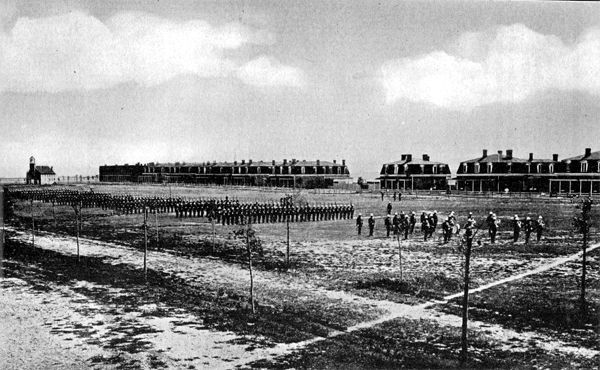
Buffalo Soldiers at Fort Assinniboine, Montana.
However, when the Indian threat was subdued, the fort began to decline. It closed in 1911, and Montana turned the site into an agricultural experiment station run by Montana State University.
In 1916, a portion of the fort was ceded to the Rocky Boy Indian Reservation (home of the Chippewa Cree tribe). Later, more land was ceded to Hill County to create Beaver Creek Park, the largest county park in the United States. Unfortunately, most of the fort’s buildings were razed.
Today, several buildings survive on the agricultural extension station associated with Montana State University.
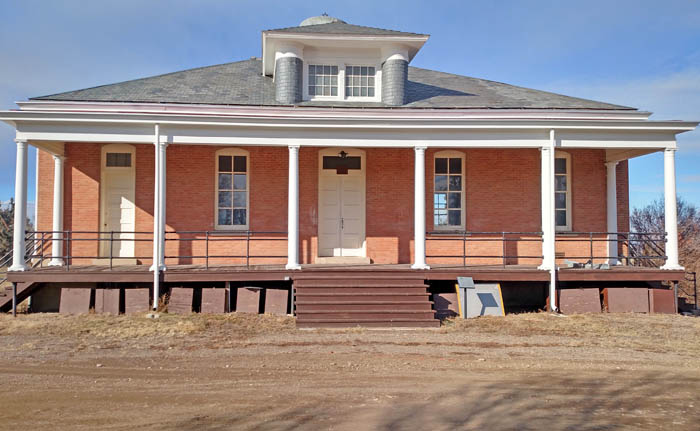
Guardhouse at Fort Assinniboine, Montana, courtesy of Fort Assinniboine Preservation Association.
The Fort Assinniboine Preservation Association preserves the last remaining brick, stone, and wood buildings at Fort Assinniboine and restores some that have been destroyed. The remaining structures are located six miles Southwest of Havre, Montana, on Highway 87.
More Information:
Fort Assinniboine Preservation Association
PO Box 863
Havre, MT 59501
406-265-4383
©Kathy Alexander/Legends of America, updated October 2026.
Also See:
See Sources.